
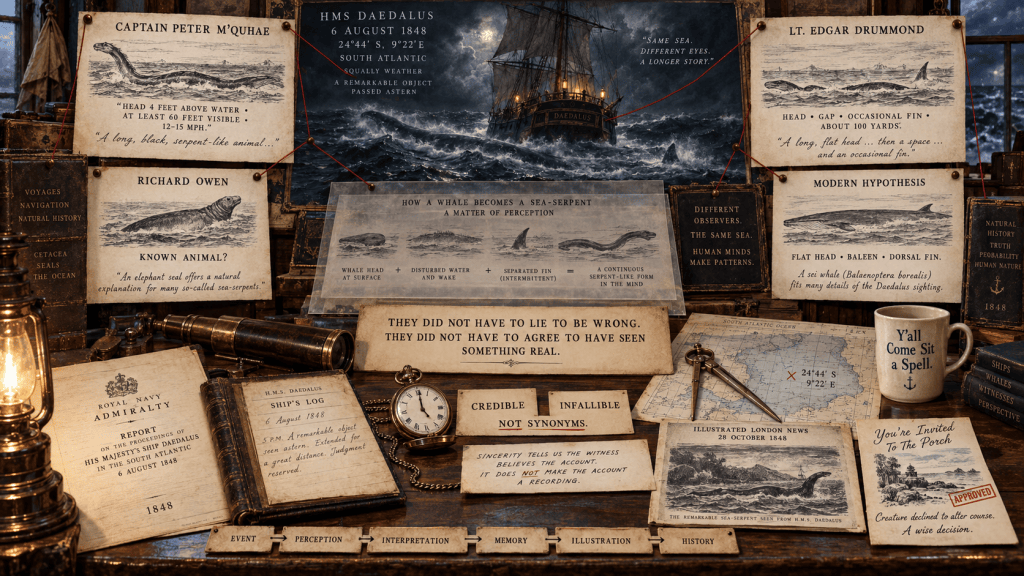
A Cross-Examination of Memory
On August 6, 1848, something passed HMS Daedalus in the South Atlantic.
That much seems difficult to dispute.
It was seen by several members of the ship’s company, including experienced Royal Navy officers. It remained visible long enough to be observed with the naked eye and through telescopes. It moved quickly, maintained a steady course, and looked unlike anything the witnesses recognized.
Captain Peter M’Quhae called it an enormous serpent.
First Lieutenant Edgar Drummond described something that gave him the impression of a large snake or eel.
Richard Owen, one of Victorian Britain’s most prominent scientists, thought they had seen an elephant seal.
A modern evolutionary biologist has proposed a surface-feeding sei whale.
Nobody accused the creature itself of offering testimony.
This was probably wise.
Something Off the Bow
At approximately five o’clock in the afternoon, Midshipman Sartoris noticed an unusual object approaching the ship and called the attention of the officers on the quarterdeck.
The Daedalus was traveling between the Cape of Good Hope and Saint Helena. The ship was roughly three hundred miles from the coast of present-day Namibia. The weather was dark and cloudy, the wind was fresh, and a long swell moved through the sea.
Captain M’Quhae later reported that the approaching object revealed itself to be an enormous serpent.
Its head and shoulders remained about four feet above the water. Its color was dark brown, with yellowish white around the throat. Behind the head, its body appeared to measure approximately fifteen or sixteen inches across.
Something resembling a horse’s mane, or perhaps a clump of seaweed, moved along its back.
The captain estimated that at least sixty feet of the creature remained visible along the surface. He saw no fins and no obvious vertical or horizontal movement propelling it through the water.
It traveled at approximately twelve to fifteen miles per hour.
More remarkably, it never altered course.
The ship did not frighten it. The commotion aboard did not interest it. It continued southwest as if it had an appointment and the Royal Navy was not invited.
M’Quhae insisted that it passed so close to the ship that, had the creature been a man he knew, he could have recognized his features with the naked eye.
That is an extraordinarily specific declaration.
It is also where this case begins to become more interesting than the creature.
What Lieutenant Drummond Saw
Lieutenant Edgar Drummond recorded the encounter in his diary.
His version overlaps with the captain’s account, but it is not identical.
Drummond described a long, pointed head flattened across the top. The upper jaw projected forward. He saw what he believed was a rear fin approximately twenty feet behind the head, visible only occasionally. M’Quhae reportedly saw another fin or tail farther back.
Drummond estimated that the animal passed about one hundred yards from the ship.
He wrote that the head sometimes disappeared briefly beneath the waves. M’Quhae said it remained constantly above the surface.
Drummond saw the creature clearly with the naked eye for approximately five minutes and continued watching it through a telescope for perhaps fifteen more. He described the weather as dark and squally, with a moving sea.
He did not describe sixty continuous feet of body lying above the water.
Instead, he saw a head, open water, and an occasional fin.
Yet his conclusion was similar to the captain’s. The creature gave him the impression of a large snake or eel.
These differences are often treated as weaknesses in the case.
I think they may be the most valuable part of it.
Five Witnesses Do Not Make Five Cameras
When several people witness the same event, we often expect their accounts to match.
If they disagree, we become suspicious.
If they agree too closely, we should probably become suspicious for an entirely different reason.
Human beings do not record events like cameras. Perception is selective from the moment an event begins. We notice different things based on where we are standing, what we expect, what we already know, and what appears important to us.
The officers of the Daedalus occupied different positions aboard a moving ship.
The ocean was moving.
The animal was moving.
The light was poor.
Waves repeatedly concealed and revealed portions of the creature.
One observer concentrated on the head. Another noticed the water behind it. Someone saw a fin. Someone else interpreted that shape as part of a continuous body.
Then one person said serpent.
That word mattered.
Once the object had been named, ambiguous information could begin arranging itself around the name. A line of disturbed water might become a body. A dorsal fin might become a mane. A flat marine head might become the raised head of a snake.
Nobody had to lie.
Their minds only had to do what minds do.
They built the most coherent animal they could from incomplete information.
Memory Is Not Playback
We often speak of memory as though an experience is recorded, stored, and later retrieved intact.
That is not how memory works.
Remembering is reconstructive.
Each retrieval rebuilds the event from stored fragments. The original perception matters, but so do later conversations, new information, emotional reactions, and the expectations operating at the moment of recall.
The witnesses almost certainly discussed the creature after it disappeared.
They compared what they had seen. They heard the captain’s interpretation. They may have examined sketches and attempted to reconcile their observations.
Every conversation offered new information.
That does not mean they deliberately adopted one another’s stories. Post-event details can become woven into memory without the witness realizing that the source of the detail has changed.
“I saw a fin” may gradually become “We saw a mane.”
“I saw a disturbance behind the head” may become “The body extended sixty feet.”
“I watched something strange cross the stern” may become “We encountered the sea serpent.”
The resulting memory can feel entirely authentic.
Sincerity tells us that a witness believes the account.
It does not tell us that the account perfectly reproduces the event.
The Official Version
M’Quhae’s report was written more than two months after the encounter.
That does not make it unreliable, but it means the report was not an untouched record of the captain’s first perception. Between the sighting and the report came discussion, reflection, comparison, and likely repeated retrieval.
The famous illustrations appeared later still.
M’Quhae worked with a professional artist to create images for the Illustrated London News. Those engravings gave the public a magnificent sea serpent with a raised head, a long body, and a dark mane trailing behind it.
The illustrations were not photographs.
They were interpretations based principally on the captain’s account.
Once published, however, they became the creature.
They gave thousands of readers a coherent image to attach to the story. They may also have given the witnesses a coherent image to attach to their own memories.
The illustration did what the original encounter could not.
It held still.
It removed the waves, the distance, the poor light, and the competing angles. It resolved every uncertain shape into a single animal.
The reconstruction became clearer than the event.
Clarity is persuasive.
It is not always true.
Enter Richard Owen
Richard Owen was one of the most formidable scientific figures in nineteenth-century Britain. He was a skilled anatomist and the man who coined the term Dinosauria.
He was not impressed by the serpent.
Owen suggested that the officers had seen an elephant seal swimming at the surface. The apparent body, he argued, may have been the wake trailing behind the animal.
Captain M’Quhae rejected this explanation forcefully.
His reaction is understandable.
He was an experienced naval officer who had spent years at sea. Owen was effectively telling the public that M’Quhae and his officers had mistaken an ordinary marine mammal and its wake for an enormous serpent.
The disagreement was no longer only about zoology.
It was about competence.
It was about credibility.
It was about whether a Royal Navy captain could trust his own trained eyes.
Once the sighting became a public challenge to M’Quhae’s professional identity, uncertainty became dangerous. Conceding that the distance might have been greater, the visible body shorter, or the animal less distinctly serpentine could feel like admitting that the entire report was foolish.
Owen had an identity invested in the debate too.
He represented institutional science. His demand for physical evidence was entirely reasonable. No specimen had been recovered. No vertebrae, skin, or body had reached a museum.
But Owen had not examined the creature either.
His elephant seal was also a reconstruction.
One man had eyewitness testimony without physical evidence.
The other had scientific authority without the animal.
Both were reasoning from incomplete information.
Both believed their experience qualified them to interpret what happened.
Credible Does Not Mean Infallible
The officers of the Daedalus were considered particularly persuasive witnesses because they were trained naval professionals.
They understood distance, speed, weather, navigation, and the movement of ships at sea. They were expected to observe carefully and report accurately.
They also risked ridicule and professional embarrassment by submitting the account.
All of that supports their credibility.
None of it makes their perception infallible.
This is one of the most difficult truths about testimony. People want credibility to function as a verdict.
If a witness is credible, the account must be accurate.
If the account is inaccurate, the witness must be dishonest or incompetent.
Neither conclusion follows.
A person can be observant, experienced, sober, honest, and sincerely mistaken.
Expertise can improve perception when the observed event belongs to the witness’s area of experience. It can also increase confidence when an unfamiliar event only resembles something familiar.
The officers knew the sea.
They knew ships.
They knew many marine animals.
What passed them may have combined familiar features in a configuration they had never encountered.
Their expertise made the report valuable.
It did not make it objective.
The Whale That Looked Like a Serpent
A more recent explanation proposes that the Daedalus encountered a sei whale feeding at the surface.
Sei whales are long, slender rorquals that can exceed forty feet. During surface feeding, the animal’s flattened upper head may rise at an unusual angle while the open mouth and baleen remain partly visible.
Seen from a distance in dark, squally weather, the exposed head could appear reptilian.
The pale baleen beneath the upper jaw might explain the yellowish white throat.
A distant dorsal fin appearing intermittently could match Drummond’s observation.
The animal’s submerged body and the water disturbed around it could create the impression of a much longer shape at the surface.
The sei-whale theory does not explain every detail perfectly. It requires some features to have been misperceived, particularly M’Quhae’s continuous sixty-foot body and his insistence that the head was unmistakably that of a snake.
But every proposed explanation requires choices about the testimony.
An elephant seal explains some details and strains others.
A whale explains more of Drummond’s account but less of the captain’s certainty.
A giant unknown serpent accepts M’Quhae’s interpretation but lacks physical evidence and must account for the strange method of propulsion.
The evidence does not permit us to replay the event.
It only permits us to compare reconstructions.
The Grove Take
Something real passed HMS Daedalus.
The witnesses did not need to agree perfectly for that to be true.
They also did not need to lie in order to be wrong.
That is what makes this case extraordinary.
The disagreement between M’Quhae and Drummond does not erase the creature. It reveals the process by which an unfamiliar animal became a sea serpent.
First came the event.
Then perception.
Then interpretation.
Then conversation.
Then memory.
Then the official report.
Then the illustration.
Then public argument.
Then history.
At every stage, the creature became a little more stable while the original moment moved farther away.
Perhaps it was a sei whale feeding in an unfamiliar posture.
Perhaps it was another known animal distorted by weather, distance, and expectation.
Perhaps the officers encountered something science has never identified.
I do not know.
Neither did they.
The most honest sentence in the entire record may be Drummond’s observation that nobody aboard had ever seen anything similar.
He did not have to know what it was to know that it was extraordinary.
Porch Policy
The invitation is approved.
Not because the creature was definitely a sea serpent.
Not because the officers described it perfectly.
Not because modern science has solved the case.
The invitation is approved because something crossed the stern of the Daedalus, passed within sight of several astonished sailors, and continued southwest without altering its course for anyone.
It did not attack.
It did not approach the ship.
It did not perform for the witnesses.
It simply kept moving with what M’Quhae described as “some determined purpose.”
We have placed a chair near the water and left the porch light on.
The creature does not turn toward us.
Perhaps it is a serpent.
Perhaps it is a whale.
Perhaps it understands that coming ashore would mean separate interviews, written statements, evidentiary diagrams, and a vigorous discussion about the reliability of eyewitness identification.
It keeps swimming southwest.
A wise decision.


Leave a Reply