
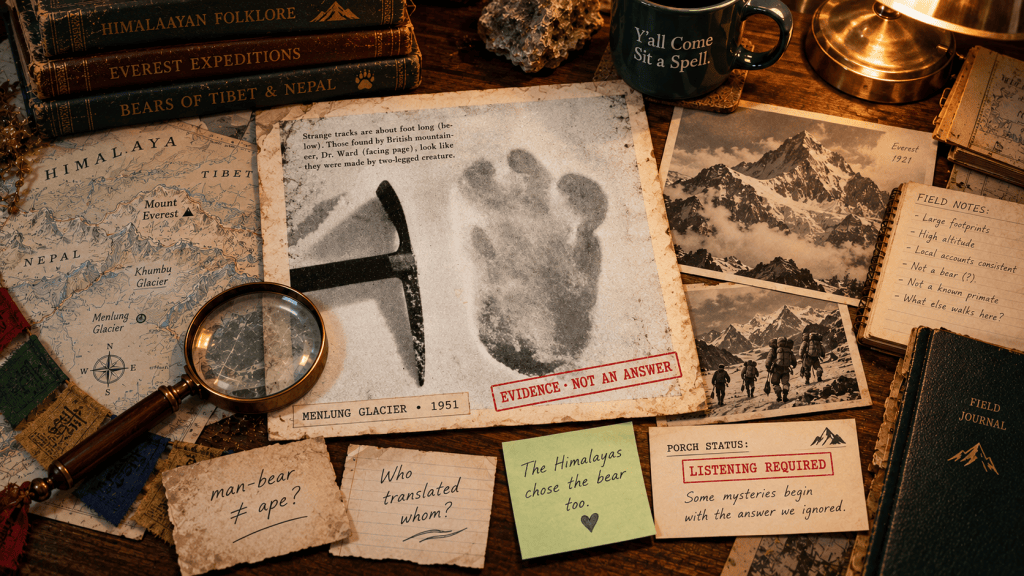
In 1921, a British expedition exploring Mount Everest found large footprints in the snow.
The men had theories. Perhaps the tracks belonged to a wolf. Perhaps the snow had melted and distorted them. Their Sherpa guides offered an explanation rooted in generations of knowledge about the mountains.
They described something closer to a man-bear, a wild being of the snow.
Then a journalist mistranslated the name, added a little flair, and introduced the Western world to the Abominable Snowman.
Because apparently arriving in someone else’s mountains, misunderstanding what they tell you, and then renaming it is a time-honored tradition.
The Yeti was not new to the people of the Himalayas. Stories of wild mountain beings had existed for generations across Nepal, Tibet, Bhutan, and surrounding regions. The descriptions varied, as folklore tends to do. Some were enormous. Some were smaller. Some were dangerous. Others were spiritual beings or guardians of wild places.
They did not fit neatly into one Western monster-shaped box.
We put them there anyway.
Once the Abominable Snowman had a catchy name, outsiders began searching for him. Expeditions marched into the Himalayas carrying cameras, plaster for footprint casts, and the extraordinary confidence of men who believed that if they had not documented something, it had not yet been properly discovered.
In 1951, British mountaineer Eric Shipton photographed a trail of large footprints on the Menlung Glacier. One image, taken beside an ice axe for scale, became the photograph everyone knew. The print appeared enormous, strangely human, and perfectly suited for newspaper pages.
The hunt intensified.
There were more footprints, more sightings, and more expeditions. Hairs were collected. Bones were examined. Monasteries were asked to surrender sacred relics for testing. At Khumjung Monastery in Nepal, a supposed Yeti scalp became an international curiosity rather than simply being allowed to remain what it had long been to the people who kept it.
Western explorers wanted proof.
Not understanding. Proof.
Decades later, science finally arrived with DNA testing. Researchers examined nine specimens said to have come from Yetis, including hair, bone, skin, and other remains collected across the Himalayas and Tibetan Plateau.
Eight came from local bears.
The ninth came from a dog.
Apparently, the Himalayas chose the bear too.
The headlines practically wrote themselves. The mystery was solved. The Yeti had been debunked. Everyone could go home.
It was only bears.
Only bears.
In the Himalayas.
The Himalayan brown bear belongs to an ancient and isolated lineage. These animals are rare, elusive, powerful, and capable of standing upright. They live in some of the most remote and unforgiving terrain on Earth. A brief encounter through blowing snow, fading light, or sheer terror could easily become something larger in the retelling.
That does not mean the people of the Himalayas were foolish.
It may mean they knew exactly what they were talking about.
Perhaps the creature described as a man-bear was, in fact, connected to bears. Perhaps generations of observation, warning, spiritual belief, and storytelling preserved the presence of a rare animal in a form that made sense within the cultures that shared its mountains.
Then Western explorers arrived, mistranslated the description, transformed it into a giant ape, and spent a century searching for the creature they had invented.
When the evidence led back to bears, they congratulated themselves for proving everyone else wrong.
That may be the most remarkable part of the Yeti story.
We listened just long enough to borrow the legend, but not long enough to understand it.
We wanted an undiscovered monster because an undiscovered monster would belong to the person who found it. A mountain guardian already known to generations of local people offered no such prize.
Science has given us a convincing explanation for many Yeti relics and sightings. It has not found an unknown Himalayan ape. It has found bears.
But that does not make the old stories meaningless.
It makes them worth hearing again without the noise we added.
Perhaps the Yeti was never disproved. Perhaps we simply asked the wrong question.
We asked whether an Abominable Snowman existed.
We should have asked what the people who lived beneath those mountains had been trying to tell us all along.
The Yeti may have been a bear.
We were simply too busy looking for a monster to listen.
The Grove Take
I think people in the Himalayas encountered something real.
That does not require an undiscovered ape to be wandering above the snow line.
The genetic evidence points overwhelmingly toward local bears. The language used in older traditions often pointed toward bears too. Somewhere between those two facts, Western explorers managed to invent an Abominable Snowman, spend a century searching for him, and declare the mystery solved when science led them back to the answer they had originally been given.
Only bears.
In the Himalayas.
Apparently, the Himalayas chose the bear too.
That does not make every footprint genuine or every story literally true. Snow melts. Tracks widen. Memory changes. Relics acquire histories more dramatic than their DNA.
But dismissing the Yeti as “just a bear” misses the most interesting part.
The Himalayan brown bear is rare, ancient, powerful, and capable of standing upright. It survives in terrain where humans require specialized equipment and extremely expensive jackets simply to remain alive. A creature does not have to be unknown to be extraordinary.
Perhaps the Yeti is not one animal.
Perhaps it is the place where real bears, dangerous mountains, spiritual belief, inherited warnings, and human imagination meet.
That is not a failed monster story.
It is a reminder that folklore may preserve observation in a language outsiders do not immediately understand.
The Yeti may have been a bear.
We were simply too busy looking for a monster to listen.
Porch Policy
The invitation is approved.
We are not addressing it to the Abominable Snowman. That name arrived through misunderstanding, theatrical translation, and the confidence of men who believed everything required their terminology.
The invitation is extended to the being the mountain people described before outsiders improved the story.
A wide chair has been placed at the far end of the porch. The steps have been reinforced. A heavy blanket has been provided, although the guest will almost certainly consider South Carolina weather an act of violence.
There will be no plaster footprint casts.
There will be no hair collection.
There will be no DNA swabs, expedition sponsors, or journalists waiting behind the hydrangeas.
If a bear arrives, the bear gets the chair.
If something else arrives, we will listen before naming it.
PORCH STATUS:
SEAT APPROVED
IDENTIFICATION OPTIONAL
RESPECT REQUIRED


Leave a Reply