
What’s one thing that would instantly improve your city?
Population reduction, Thanos style.
There. I said it.
I hate to sound like the old lady sitting on her porch, shaking her fist at traffic, but there are too damn many people around here.
Before anyone becomes alarmed, I am not actually advocating for the Infinity Gauntlet. I don’t dislike people individually. Some of my favorite people are people.
Collectively, however, you become traffic.
You become another SUV trying to turn across three lanes during rush hour. You become a line wrapped around the Harris Teeter parking lot. You become 400 new townhomes feeding onto a two-lane road that was already begging for mercy ten years ago.
And every one of those townhomes will be advertised as part of a peaceful, wooded community with a name like The Preserve at Whispering Oaks.
The oaks, of course, were bulldozed to build it.
That is the part I cannot laugh away.
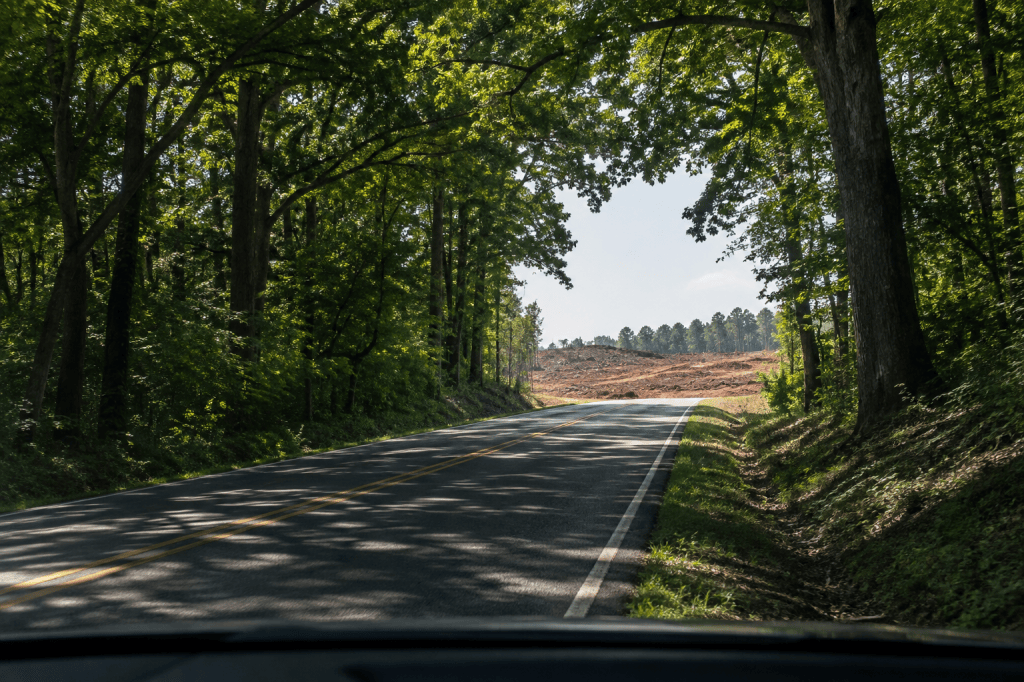
I have driven down roads that were once gorgeously shaded sanctuaries and barely recognized them. Roads where trees met overhead and the temperature seemed to drop as soon as you entered. Roads that offered a few quiet minutes between wherever you had been and whatever waited for you at home.
Then one day, the trees were gone.
Not trimmed. Not thinned.
Gone.
I have pulled over and cried.
That probably sounds ridiculous to some people. They were only trees. The land had been sold. The owner had every legal right to clear it. People need places to live. Communities grow. Progress requires change.
Those are all tidy, reasonable words.
But none of them describe what it feels like to see a living place stripped down to raw dirt.
“Development” is such a pretty word for something so violent.
We say the land was cleared, not destroyed. We say it was improved, as though the forest were deficient. We call it undeveloped, as though nothing was happening there before we arrived with survey flags and bulldozers.
But the land was never empty.
Those trees were cleaning our air. Their roots were holding the soil and drinking the rain. Their branches sheltered birds, insects, and animals whose homes apparently mattered less than ours. They softened the heat, absorbed noise, and turned an ordinary road into a place that could settle something inside a person.
Science tells us that trees communicate. They send chemical warnings when they are threatened. They respond to injury. Through their roots and the fungal networks beneath the soil, they exchange resources and information.
Science has not established that trees feel pain in the way animals do. They have no brains, nerves, or pain receptors like ours.
Still, they recognize damage. They respond to danger. They warn one another.
I do not know what a forest experiences when the machines arrive.
I only know what I experience afterward.
Grief.
We are very good at measuring what development adds. Houses. Businesses. Tax revenue. Jobs. Convenience.
We are much less interested in measuring what it takes.
How do you put shade on a balance sheet? What is the market value of birdsong? Where does an environmental impact report record the human need to drive beneath a canopy of trees and feel, for three minutes, that the world is still gentle?
What do you offer of value in exchange for the trees that were cleaning my air?
What do you offer my soul in exchange for the place that soothed it?
Another grocery store? Another storage facility? Another subdivision named for the natural feature destroyed during its construction?
We keep treating growth as inherently good, as though becoming larger automatically means becoming better. We celebrate every new development without asking whether the thing being built is worth the thing being erased.
It is not that nobody else should be allowed to come here. I came from somewhere else too. Most of us did.
The problem is the belief that wanting to occupy a place gives us the right to consume all of it.
We could build with restraint. We could preserve mature trees and meaningful stretches of habitat. We could stop approving enormous developments before the roads, schools, and infrastructure can support the people already here. We could require developers to treat the land as something more than an obstacle between them and profit.
We could begin with the radical idea that a forest is already doing something valuable.
Instead, we scrape the earth clean, crowd it with roofs, plant three decorative saplings beside the entrance sign, and call the result The Woodlands.
Perhaps the old lady on the porch has a point.
Perhaps she remembers when the road was cooler, quieter, and alive. Perhaps she is not resistant to change simply because she understands that some changes cannot be undone.
Perhaps she is angry because everyone keeps calling it progress and expecting her to be grateful.
So yes, my first answer was population reduction, Thanos style.
It was funny because it was outrageous.
The truth beneath it is quieter and much harder to dismiss.
I do not want fewer people because I hate people.
I want us to stop behaving as though we are the only living things whose needs count.
 Y'all Come Sit a Spell
Leave a comment