
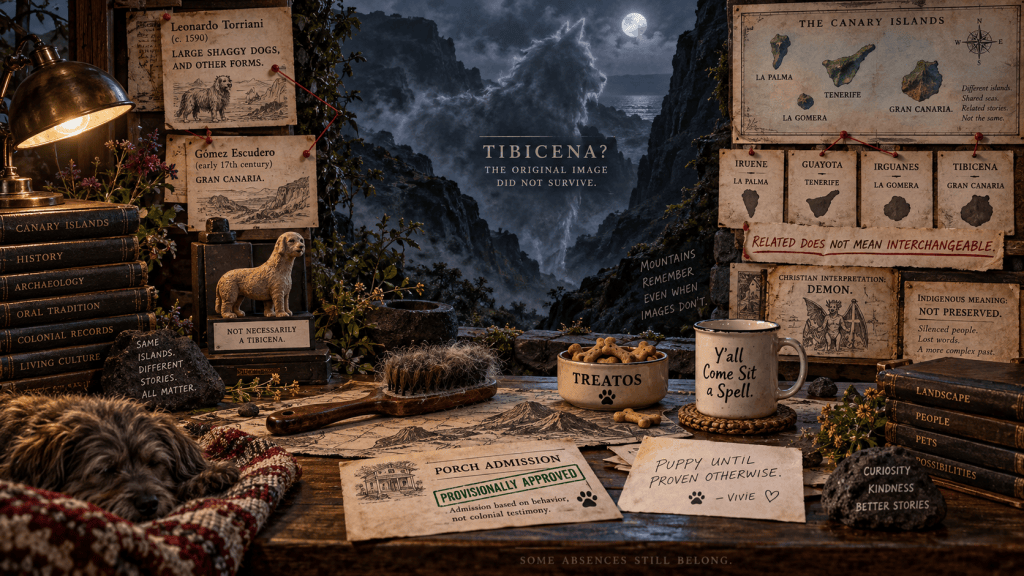
Who’s a Good Alleged Manifestation of Evil?
The Tibicena is described as an enormous, shaggy, supernatural dog from the Indigenous traditions of Gran Canaria.
European chroniclers called it a demon.
Vivie has requested that we postpone judgment until someone brushes it, offers it a treato, and asks for its side of the story.
Honestly, that may be the sounder research method.
Something Large and Shaggy This Way Comes
The surviving accounts describe Tibicenas as supernatural beings that appeared most often in the form of very large, shaggy dogs.
They could appear at night or during the day. Some accounts suggest they could assume other shapes, which means “giant dog” may not have been a permanent biological description. It may have been one form taken by something less easily defined.
They frightened people. They appeared along dangerous paths and in wild places. In one account, the beings seem to lure or frighten people toward steep drops.
This is not ideal puppy behavior.
It is, however, important to remember who wrote the surviving descriptions.
The Devil Arrived With the Chroniclers
The Indigenous people of the Canary Islands did not leave written accounts of the Tibicena. Most of what survives was recorded after the Spanish conquest by European Christian writers.
Those writers described Tibicenas as manifestations of the devil.
That tells us exactly how the chroniclers understood them.
It does not necessarily tell us how the Indigenous Canarians did.
This distinction matters because European Christians displayed a remarkable talent for encountering another culture’s spirits, deities, ancestors, guardians, rituals, sacred places, powerful women, medicinal practices, seasonal celebrations, and inconvenient opinions, then placing all of them into a box labeled DEMONIC.
It was an efficient filing system.
It was not an accurate one.
Around 1590, the engineer and chronicler Leonardo Torriani wrote that the being appeared to the Canarians as large, shaggy dogs and in other forms. He interpreted the figure as the devil and described it as frightening or deceiving people.
Another chronicler, Gómez Escudero, similarly recorded a belief in beings appearing as very large, shaggy dogs called Tibicenas.
Both accounts preserve something valuable.
Both accounts also pass that something through an aggressively Christian filter.
A Small Island Correction
The Tibicena belongs most specifically to Gran Canaria.
People often use “Guanche” as a general term for all the Indigenous inhabitants of the Canary Islands, but the name properly refers to the Indigenous people of Tenerife. Gran Canaria’s Indigenous population is more accurately called the Canarians, or ancient Canarians.
This becomes important because the islands had related but distinct cultures and traditions.
Gran Canaria had the Tibicena.
La Palma had a large shaggy supernatural being called Iruene.
La Gomera had beings called Irguanes, described in one colonial account as enormous, woolly figures capable of standing upright and terrifying adults and children.
Tenerife had its own spiritual landscape, including Guayota, the powerful being associated with Mount Teide.
Modern retellings often gather these traditions together, add caves, glowing red eyes, volcanic fire, the underworld, and a generous scoop of hellhound imagery, then introduce the result as the Tibicena.
It makes a magnificent monster.
It may not make good history.
Was It a Dog?
The Canary Islands have a long and complicated relationship with dogs.
Ancient writers connected the islands themselves with large dogs, although the origin of the name Canary remains debated. Dogs lived alongside the Indigenous islanders and could serve practical, social, and symbolic roles.
They could also become dangerous.
A large feral dog threatening livestock would not be a trivial problem in a community whose survival depended heavily on goats and sheep. An animal moving through a ravine at night could become both an immediate danger and the physical language used to describe a spiritual one.
Perhaps the Tibicena began with real dogs.
Perhaps it represented the danger of traveling alone through steep terrain.
Perhaps it was a guardian, an ancestral presence, a hostile spirit, or something that did not fit neatly into any of those categories.
Perhaps its meaning changed from one community to another.
We do not know.
That is not a failure of the story.
It is evidence of what conquest destroys.
When a culture’s people are killed, displaced, converted, enslaved, or forced to abandon their language, their stories may survive only in fragments recorded by the people dismantling them.
The creature remains.
Its explanation does not.
About Those Figurines
Small clay figures found at archaeological sites on Gran Canaria are sometimes presented online as images of Tibicenas.
Some are animal-like. Others are human or difficult to classify. A few possess exactly the sort of wonderfully strange appearance that encourages modern viewers to assign them supernatural identities.
But archaeology does not permit us to point at an unusual figurine and confidently announce, “Demon dog.”
We do not know that the figures represent Tibicenas. We do not know whether they were offerings, sacred objects, toys, symbols of identity, representations of people or animals, or objects with purposes we have not recovered.
Calling every mysterious object a Tibicena creates a satisfying answer.
It may also repeat the original mistake by forcing Indigenous material into a story we have already decided to tell.
Sometimes responsible scholarship must say, “This object mattered, but we do not know what it meant.”
Vivie dislikes this answer because she would like to name it, feed it, and build it a small bed.
Vivie must cope.
The Grove Take
I suspect the Tibicena was never simply a monster.
The surviving figure may contain pieces of animal encounters, dangerous landscapes, spiritual beliefs, practical warnings, and cultural meanings that colonial writers neither understood nor cared to preserve.
The chroniclers saw a large supernatural dog and reached immediately for the devil.
That conclusion feels less like evidence and more like habit.
If an Indigenous community recognized power in a place, Christianity called it haunted.
If they respected a spirit, Christianity called it worship.
If the spirit inspired fear, Christianity called it evil.
If it appeared as an enormous shaggy dog, Christianity apparently called animal control on behalf of Satan.
Vivie has now looked at the long historical record of European Christians mangling, tangling, mutilating, and misappropriating Indigenous stories.
She has considered the available evidence.
She is brushing the Tibicena.
The Tibicena, for its part, has not pushed anyone into a ravine. It appears to have had several centuries of compacted undercoat and some understandable trust issues.
Porch Policy
The Tibicena is approved for a provisional porch seat.
This ruling is contingent upon its behavior, not the accusations of men who arrived carrying crosses, swords, and a prewritten explanation for everything they did not understand.
The Tibicena will receive water, treatos, and a thorough brushing.
It may tell us what it guarded.
It may tell us why people feared it.
It may tell us whether it ever wanted worship, or whether it simply wanted travelers to stop wandering carelessly through dangerous ravines after dark.
If it turns out to be an actual malevolent spirit intent on driving us over a cliff, porch privileges will be reconsidered.
Until then, the Tibicena stays.
Vivie has finished brushing one side and would like someone to locate the detangling spray.
The colonial chroniclers may wait by the gate.
We are still checking their paperwork.


Leave a Reply