
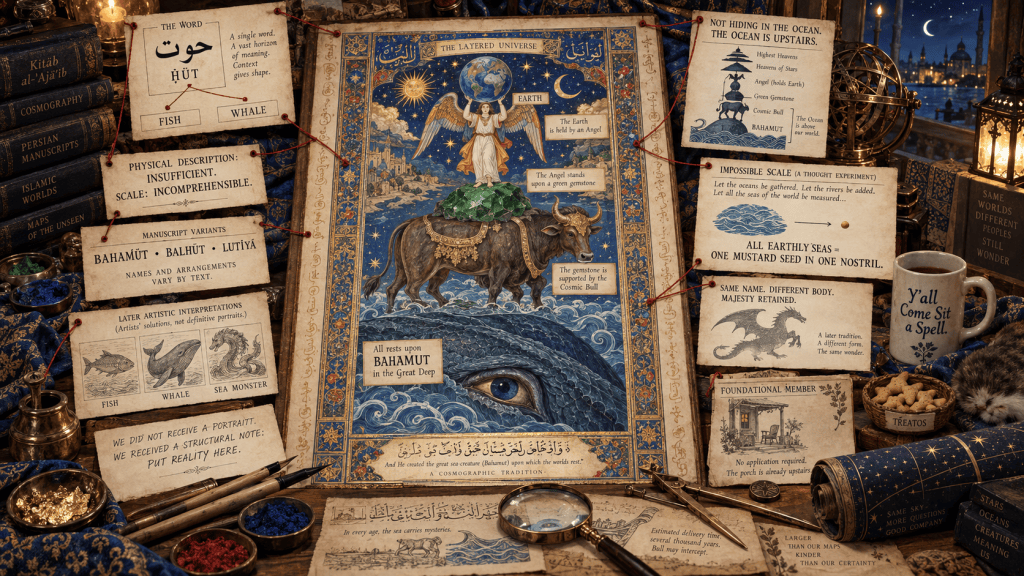
Day 18: Bahamut
The Fish Beneath Absolutely Everything
After examining eyewitness memory, legal credibility, scientific authority, and the reconstruction of perception aboard HMS Daedalus, we deserve something simpler.
Unfortunately, today’s creature supports the universe.
Bahamut is an immeasurably large fish from medieval Arabic and Islamic cosmographic traditions. He swims beneath the earth, the angel holding it, the gemstone supporting the angel, and the enormous bull carrying the gemstone.
Depending upon the version.
There are several versions.
The universe apparently had multiple contractors.
First, Bahamut Is Not a Dragon
We need to address this immediately.
If the name Bahamut brings to mind a majestic platinum dragon with enormous wings, divine power, and very strong opinions about justice, you have encountered the modern fantasy version.
That Bahamut is wonderful.
That Bahamut is also not the original Bahamut.
The older Bahamut is a fish.
Not a dragonfish.
Not a fish-shaped dragon.
Not a dragon who briefly became aquatic for narrative reasons.
A fish.
Modern fantasy borrowed the name, retained the cosmic scale and divine majesty, then replaced the animal entirely.
This may be the most successful rebranding campaign in mythological history.
What Is Holding Up the World?
In the cosmographic tradition most often associated with Bahamut, the earth does not simply float in space.
That would apparently be too easy.
The structure is described something like this:
The earth rests upon an angel.
The angel stands upon a great green rock, gemstone, or slab.
The rock rests upon the back of an enormous bull.
The bull stands upon an immeasurable fish.
The fish swims in a vast body of water.
Beneath the water lie still more layers, which may include air, darkness, fire, or an abyss beyond human comprehension.
At the bottom, some accounts add an enormous serpent capable of swallowing creation if it were not restrained by fear of God.
We are already on the back of a cosmic fish beneath a many-featured bull.
There was no need to add the serpent.
Someone added the serpent.
The Medieval Universe Had Flair
These stories belong to a broad tradition of medieval cosmography that combined religious reflection, geography, natural history, inherited stories, and accounts of wonders.
They were not modern scientific diagrams. They were attempts to describe an ordered creation extending far beyond ordinary human perception.
One important source is the thirteenth-century Persian scholar Zakariya al-Qazwini’s Wonders of Creation and the Oddities of Existence.
Al-Qazwini assembled knowledge and marvels from numerous earlier sources. His work described celestial phenomena, geography, plants, animals, jinn, angels, strange creatures, and the architecture of creation.
The resulting manuscript tradition was copied, translated, adapted, and illustrated for centuries.
A striking sixteenth-century manuscript illustration shows the earth held by an angel standing upon a green rock. Beneath the rock is a great bull. Beneath the bull is the fish.
The image is glorious.
The angel appears focused.
The bull appears committed.
The fish appears as though nobody consulted him before assigning the foundation contract.
I identify with the fish.
There Is Some Name Confusion
The creature’s name is not perfectly stable across the surviving tradition.
Bahamut appears alongside forms such as Balhut or Bahamūt, and scholars have connected the name to Behemoth, the enormous land creature described in the Book of Job and later Jewish and Christian traditions.
How a great terrestrial beast became a cosmic fish is not entirely clear.
Stories travel.
Languages reshape unfamiliar sounds. Translators make choices. Copyists alter words. Related traditions borrow from one another. A creature may change habitat, anatomy, and job description while retaining enough of its original grandeur to remain recognizable.
Bahamut is therefore not a single fixed character with an authorized biography.
He is a creature assembled across texts.
The fish is more stable than the spelling.
The Bull Has Problems Too
The enormous bull above Bahamut is now commonly called Kujata.
In popular modern descriptions, Kujata possesses four thousand eyes, ears, mouths, nostrils, and feet.
This raises logistical questions that the surviving stories do not answer.
Is everything evenly distributed?
Do all four thousand mouths require feeding?
Does the bull blink in sequence?
Who is responsible for hoof maintenance?
Jorge Luis Borges and Margarita Guerrero helped popularize these spectacular details for modern readers in The Book of Imaginary Beings, first published in Spanish in 1957.
Borges describes Kujata as so large that traveling from one eye to another would require five hundred years.
The bull stands upon Bahamut.
Bahamut is larger.
At some point, size stops being a measurement and becomes a theological argument.
How Large Is Bahamut?
Bahamut cannot be measured in miles.
Miles belong to the earth.
Bahamut is beneath the system that makes miles useful.
In one famous description, all the waters of the earth placed in one of Bahamut’s nostrils would resemble a mustard seed dropped into a desert.
That is not zoology.
That is scale used as surrender.
Some retellings describe the prophet Isa, or Jesus, being permitted to see Bahamut. The sight overwhelms him, and he loses consciousness.
When he awakens, God asks whether he saw the fish.
Isa has not seen the whole fish.
He has seen only part of its head.
This is an excellent reminder that human beings occasionally need to be told, “No, you still do not understand how large I mean.”
Bahamut is not merely bigger than us.
He is bigger than our ability to construct a meaningful comparison.
Is Bahamut a Cryptid?
Not really.
A cryptid is generally imagined as an animal whose existence has been reported but not scientifically established.
Bigfoot may be hiding in a forest.
Nessie may be moving beneath a lake.
The Daedalus creature passed a ship and declined to identify itself.
Bahamut is not hiding in an unexplored habitat.
Bahamut is beneath creation.
If he exists, we are not searching for him.
We are standing on several layers of cosmological furniture resting on his back.
Sending an expedition would be difficult.
“Turn left at the great green gemstone. If you reach the bull’s three-thousandth eye, you have gone too far.”
Bahamut belongs less to cryptozoology than to mythic cosmology. But our October project has never been limited to animals someone might capture, photograph, or inconvenience with a plaster footprint cast.
We are interested in the creatures humans place at the edge of explanation.
Bahamut is what happens when the edge becomes the foundation.
How the Fish Became a Dragon
The transformation of Bahamut into a dragon occurred through modern fantasy gaming.
The name entered tabletop role-playing culture and became attached to a powerful draconic deity. Later games, novels, and other media carried that version forward.
The platinum dragon became so culturally successful that many people now encounter him before learning about the cosmic fish.
On the surface, very little survived the transition.
The fins disappeared.
Wings arrived.
The bull and angel were released from the organizational chart.
The world-support responsibilities became less literal.
But something essential remained.
Bahamut was still immense.
He was still majestic.
He still belonged to the architecture of cosmic power.
The body changed.
The emotional function survived.
That is often how mythology moves into popular culture. A later storyteller does not preserve every feature. The storyteller preserves the part that feels important.
The ancient name carried weight.
Fantasy gave that weight wings.
The Grove Take
I love both Bahamuts.
The dragon is magnificent. He has presence. He looks appropriate on a game box, a cathedral mural, or the side of a van owned by someone with excellent priorities.
But the fish is stranger.
The fish does not conquer the world.
He carries it.
He is almost never the central figure in the structure, even though every other part depends upon him. The angel holds the earth. The bull supports the rock. The illustration directs our attention upward.
Bahamut remains beneath them.
Quiet.
Immeasurable.
Foundational.
Perhaps that is why the fish became a dragon. Modern stories prefer visible power. Dragons fly, roar, command, and fight. They announce their importance.
A fish beneath creation does none of that.
He simply bears the weight.
We often mistake spectacle for significance.
Bahamut does not need anyone to notice him.
Everything above him already proves that he matters.
Porch Policy
We cannot invite Bahamut onto the porch.
The porch is already on Bahamut.
So is the house.
So is the Grove.
So are the chairs, the coffee, the oatmeal rehabilitation pool, the Tibicena’s brush, the cryptid files, and the locked drawer containing the project we are definitely not calling The Vivie Files.
Bahamut is not a guest.
He is infrastructure.
His official status is:
FOUNDATIONAL MEMBER
No application required.
All porch activities occur upstairs.
We have lowered a basket of treatos through the various cosmological layers.
It may arrive in several thousand years.
The bull will probably eat it first.


Leave a Reply