
Witnesses, Watch Hours, and One Very Good Pamphlet
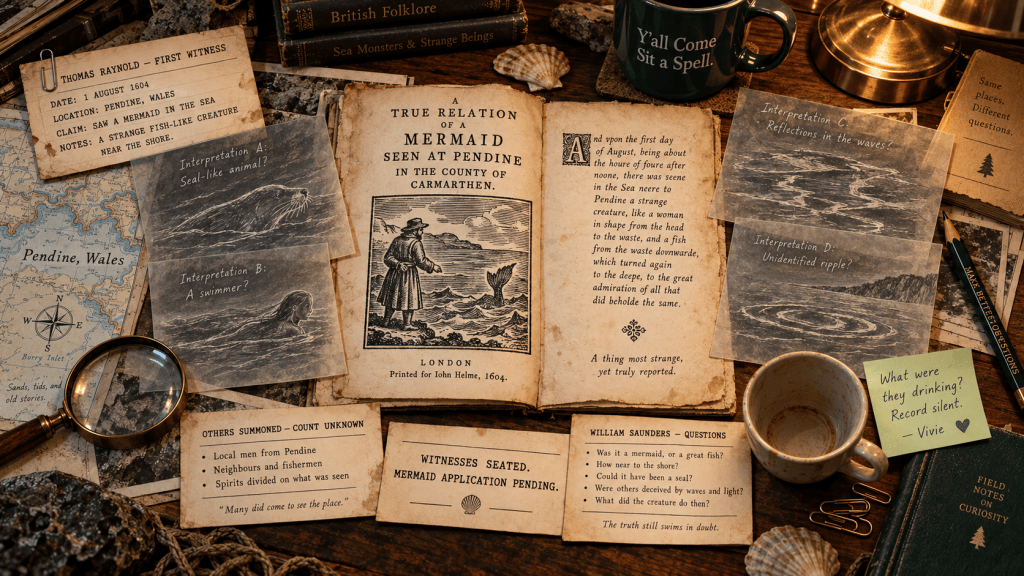
A mermaid allegedly appeared near Pendine, Wales, in 1603.
Before we give her a chair on the porch, I have questions. How many people saw her? How long did they look? And, because I know how people are, what had they been drinking?
The National Library of Wales describes the surviving account this way: Thomas Raynold, a local yeoman, saw the creature first and summoned others to watch. The group reportedly kept watch for three hours. William Saunders later questioned Raynold and some of the other witnesses.
Some is doing a lot of work there. We know the account names a first witness and says others joined him. We do not have a dependable total to put on the guest list. The library’s summary says nothing about what anyone ate or drank. I’m disappointed in the recordkeeping, too.
There is also the matter of what survives. The story reached readers through a pamphlet with the magnificent title A Most Strange and True Report of a Monsterous Fish, Who Appeared in the Forme of a Woman, from Her Waste Upwards. You can look at the surviving pamphlet record and text yourself. If that title sounds like someone trying very hard to sell you a story, remember that pamphlets were sold as inexpensive entertainment. A mermaid was excellent material.
That doesn’t mean Raynold lied. It means there are at least two events here: whatever people watched near Pendine, and the story someone chose to print about it.
I keep coming back to the three-hour watch. A fleeting glimpse can turn into almost anything after enough retelling. Three hours sounds more substantial. But what, exactly, stayed visible for three hours? Did everyone see the same details? Did Raynold describe a woman-shaped creature before the others arrived, giving them an idea of what to look for? Being present together makes them witnesses to the same occasion. It does not necessarily give us several independent identifications.
And what was in the water? An animal seen at an odd angle? A shape altered by distance and moving light? A person? Something else? I can propose possibilities all evening, but I cannot examine the thing they saw. There is no mermaid specimen waiting patiently in the archives for me to win an argument.
The National Library’s account gives us a reported sighting, a first witness, other people called to watch, and a later inquiry. The pamphlet gives us the story as it was presented to readers. Those are interesting pieces of evidence. They do not tell us what creature, if any, was there.
The Grove Take
I think Raynold saw something. I also think calling your neighbors over to stare at it is a wonderfully human response.
What I cannot do is turn an unidentified shape in the water into a mermaid just because a pamphlet put her name on the cover. Nor can I dismiss everyone on that shore with a joke about ale. We have no evidence of what they were drinking, and I refuse to invent a tavern bill four centuries late.
The Pendine story interests me most in the space between seeing and explaining. Raynold noticed something strange. Other people came to look. Saunders asked questions. Then a printer offered the public a woman-shaped monsterous fish. At each step, the story gained another set of human hands.
Porch Policy
Raynold and his fellow watchers may sit and tell us what they saw. Saunders gets a seat for asking questions. The pamphleteer may come up on the porch, but I’m keeping an eye on his sales pitch.
The mermaid’s application remains open. We have a historical account of an encounter, not proof of a new guest with fins.
Come sit with me anyway. Tell me what you think was in the water near Pendine, and tell me what question you would have asked those witnesses while they were still watching. If your question is “What’s in your cup?” I understand. Just remember that the surviving account doesn’t answer it.


Leave a Reply