
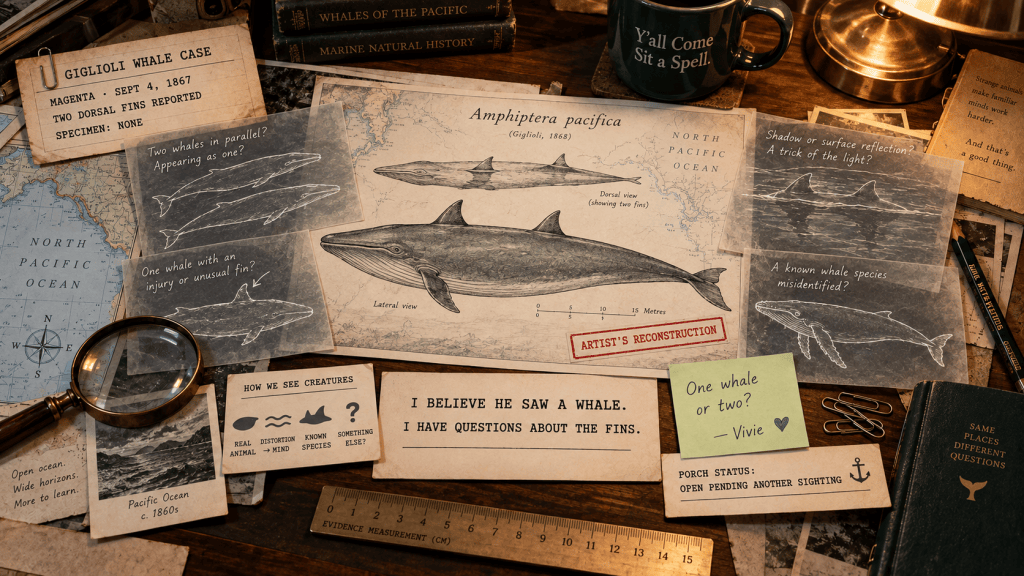
The Whale with Two Fins
On September 4, 1867, the Italian corvette Magenta was crossing the Pacific when naturalist Enrico Hillyer Giglioli heard a whale breathe beside the ship.
He looked down. A large gray-green back surfaced close enough for him to study, and rising from it were two dorsal fins.
Two.
A whale had come alongside. Giglioli could watch it from above. He estimated that it stayed near the ship for almost fifteen minutes, and he made a sketch. Later, he proposed a name for what he believed might be a new kind of whale: Amphiptera pacifica.
The animal never appeared for a second appointment.
No specimen followed. The name did not become a confirmed species. But Giglioli’s description survived, and so did a question that is much better than Was he lying?
What did he see?
A Naturalist at the Rail
Giglioli reported an animal roughly eighteen meters long, with two upright, triangular dorsal fins about two meters apart. He described its head, coloring, flippers, and the way it moved at the surface.
I can understand why he thought he was looking at something remarkable.
This was not an indistinct shape on a distant horizon. According to his account, the whale stayed beside the Magenta long enough for him to observe and sketch it. He believed the two fins were part of one body.
It is also worth remembering what his vantage point could and could not give him. Looking down from a ship let him see more of the animal’s back than an observer on shore might have seen. It did not let him see everything beneath the water.
That hidden part matters.
Two whales swimming close together can offer one apparent outline from above. An animal surfacing and submerging can change its shape from one moment to the next. A fold, injury, unusual fin, or complicated meeting of light and water might alter what an observer thinks he sees.
These are possibilities, not identifications. None of us was at that rail with Giglioli.
Fifteen Minutes Is a Long Time
A quick glance at a shadow could explain many strange sightings. This one asks us to work harder.
Giglioli said he watched for nearly a quarter of an hour. He had time to look again. He had time to sketch. A passing reflection alone feels like a thin answer for an observation he described in such detail.
But time is not the same thing as certainty.
If two animals stayed close together, another minute of watching might have helped him separate them. Or it might not. If an individual whale had an unusual physical feature, watching carefully would make the feature easier to see but would not tell him whether other whales shared it. If the animal was a species he did not know well, he could faithfully record its shape and still reach the wrong conclusion about its identity.
A careful witness can be accurate about many details while mistaken about what those details add up to.
That is a more interesting problem than deciding whether to call him a fool.
One Strange Whale Is Not a Species
Let’s suppose Giglioli saw exactly what he reported: one whale with two dorsal fins.
I would want to see her, too.
That sighting could represent an unusual individual. It could reflect an injury or a physical difference. It might raise a question about a known species. None of those possibilities automatically establishes an entire population of two-finned whales swimming around the Pacific.
And even if his proposed animal was unknown to science, a description and a sketch could not settle the matter on their own. Later observers would need a way to examine and compare animals, not merely repeat the tale.
They never got that opportunity.
A later analysis has suggested that aspects of Giglioli’s sketch resemble a pygmy right whale. That is an attempt to make sense of the evidence we have, not a confirmed solution. The whale beside the Magenta remains unidentified.
I can live with unidentified.
I have less patience for the way the word gets treated as a temporary inconvenience. People want it to mean a new species, just wait and see or an ordinary whale, move along. Sometimes it means exactly what it says. We have a report worth studying and too little evidence to close the case.
The Ocean Keeps Its Own Records
Whales are not small, and they do not live where we can easily follow them. They surface long enough to breathe, show us a portion of a body, and return to a world we cannot see from the deck.
I’ve watched a gray whale surface beside a fishing boat. I’ve watched wild orcas pass through an Alaska valley. Those moments were extraordinary, and I had no trouble believing the animals were real. Yet I could still only tell you what I witnessed. I could not tell you everything happening beneath the water.
Giglioli saw something in the Pacific that stopped him. He recorded it because he thought it mattered.
I think it mattered, too.
That does not mean I must believe in Amphiptera pacifica. It means I want to take his report seriously enough to ask what else might account for it.
The Grove Take
I believe Giglioli saw a whale.
I have questions about the two fins.
They might have belonged to two animals swimming close together. They might have been the unusual features of one animal. Light, shadow, water, and perspective might have played a part. A later researcher’s proposed identification might be right, or it might be one more thoughtful guess from someone who could not see the whale in person.
None of those answers is ours to claim.
Vivie has considered the evidence and declined to organize a campaign for the endangered two-finned whale. She, too, thinks Giglioli saw something real. She simply wants to know whether he saw one something before we start naming her friends and relatives.
For once, we have reached a calm agreement.
The mystery is not whether a naturalist aboard the Magenta had an encounter. The mystery is what the animal in that encounter actually was.
Porch Policy
Giglioli gets a seat. Bring the sketch. We want to hear everything he noticed.
The whale’s application is still open.
If she is an unusual individual of a known species, she is welcome. If two whales were swimming together and got mistaken for one, they are both welcome, though they will need separate chairs. If Amphiptera pacifica wants admission as a species, we need more than a single encounter from 1867.
Until then, there is room here for the story and for the questions.
Come sit a spell. Tell us what you think Giglioli saw.


Leave a Reply