
I thought I knew what a sea snail was. A little shell. A little foot. A creature going about its business while the rest of us fail to appreciate how strange the ocean already is.
Then somebody introduced me to the Sarmatian Sea Snail.
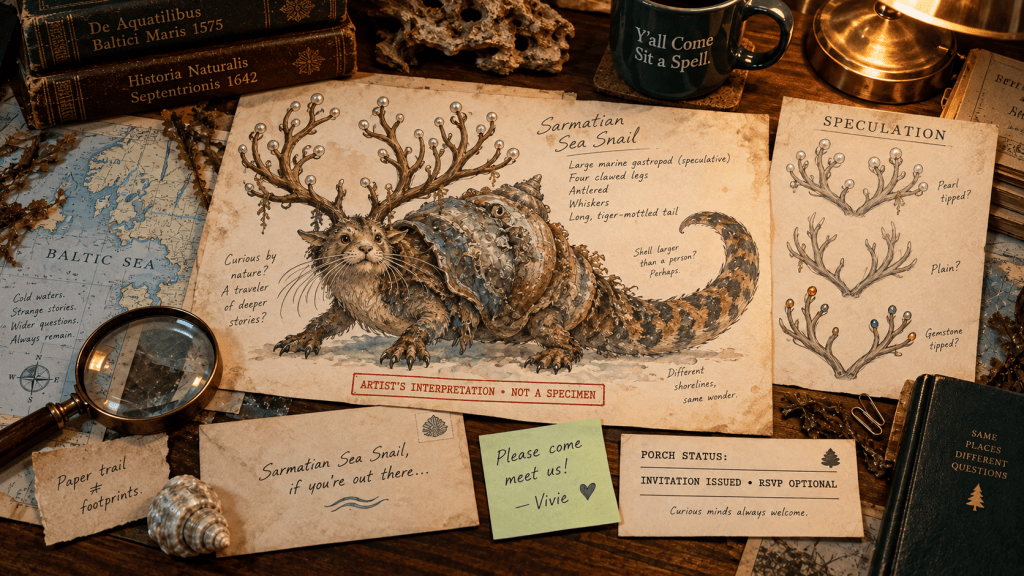
In 1575, André Thevet described a creature said to live in the waters near Denmark, in the sea we now call the Baltic. It was the size of a barrel. It had branching antlers like a stag, with rounded tips that shone like pearls. Its eyes glowed like candles. It had a whiskered, catlike nose, four clawed legs, and a long, mottled tail.
Thevet called it a snail.
I have questions.
First, where do the legs go when it retreats into its shell? Second, does it retreat into its shell? Third, are the pearl-like antler tips there from birth, or does one wake up one morning and discover that one has entered one’s bejeweled phase?
We do not know its life cycle. We do not even know whether it has a life cycle. But that is not going to stop me from wondering.
The description traveled through natural-history books. Ulisse Aldrovandi included the Sarmatian Sea Snail in a volume published in 1642, along with an illustration. That is the part of the story I find nearly as fascinating as the creature itself. A man describes an extraordinary animal. Other people copy the description, draw it, and put it among the creatures they are trying to understand. Before long, it has a paper trail.
A paper trail is not a set of footprints. No one has produced the barrel-sized snail for inspection. Its antlers have not been measured. The picture tells us what people imagined from the description; it does not tell us what swam past Denmark.
And some of the people passing the story along had doubts. The snail survived in their books anyway. A later study of its history calls it a “marvelous, monstrous, mythical” mollusk. That phrase is rather devastating to its case for zoological recognition.
It is also a magnificent reason to keep reading.
I want to know how an improbable creature became part of a serious attempt to describe nature. What did one writer believe? What did the next writer question? At what point did an illustration make the story feel more solid than the evidence beneath it?
There may have been a real animal somewhere behind the account, described badly, remembered imperfectly, or assembled from several things someone had heard about. There may have been no animal at all. The surviving description cannot settle that for us.
My hopes, meanwhile, are making themselves comfortable.
I would love to meet a large, whiskered sea creature with pearl-tipped branching antlers. I would love to see it emerge from the water and immediately complicate everything I thought I knew about snails. I would even accept ruby tips, emerald tips, or plain antlers if it was still growing into its formal look.
That last part is speculation. Vivie has been informed that any drawings of possible antler development must be labeled accordingly.
I know wanting an animal to exist does not make it exist. Still, wanting to meet it can send me back to the old books with a question worth asking. Sometimes the creature turns out to be real. Sometimes the story shows us how people looked at the world, what they feared, and what they hoped might be hiding just beyond their view.
Either way, I have learned something I did not know when I sat down.
The Grove Take
I am withholding judgment on the snail and refusing to withhold delight.
Thevet’s animal is not verified. Its four legs, glowing eyes, and pearl-bright antlers are details in an old account, not features we have observed in a living species. But I am glad somebody preserved the description. We can examine how it traveled without pretending that every stop along the way confirmed it.
And if a barrel-sized creature with branching antlers ever does appear at the edge of the Grove, I expect everyone to remain calm enough to let it introduce itself. I cannot promise that I will.
Porch Policy
The invitation has been issued: “Sarmatian Sea Snail, if you’re out there.”
The lagoon is available if our visitor chooses to come. So is a quiet place to rest, should it turn out to have feet after all. We will ask what it needs before making assumptions about salt water, snacks, antlers, or preferred forms of address.
Vivie may decorate the invitation with pearl-tipped antlers. They are illustrations, not evidence.
To the snail, or to whatever creature inspired the story: you are welcome to answer in your own time. We would be very excited to meet you. We will try not to make that your problem.


Leave a Reply