
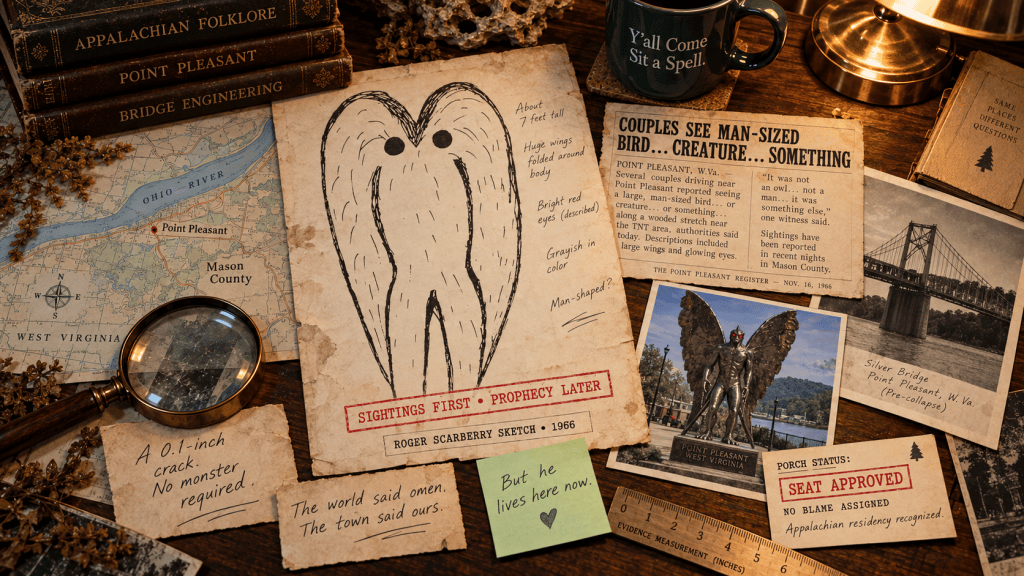
What Point Pleasant Did With the Monster
On November 15, 1966, two young couples were driving near an abandoned munitions facility outside Point Pleasant, West Virginia, when they saw something, they could not explain.
It was tall and gray, shaped vaguely like a man, with enormous wings and red eyes that caught the headlights. It rose into the air and followed their car as they fled.
The next morning, the Point Pleasant Register ran one of the finest newspaper headlines ever written:
Couples See Man-Sized Bird… Creature… Something
“Something” may be the most honest word in the entire Mothman story.
More sightings followed.
For thirteen months, people around Point Pleasant reported strange lights, unusual sounds, and encounters with a large winged creature, many of them near the abandoned TNT plant. Witnesses described something fast, powerful, and deeply unsettling.
Skeptics suggested a sandhill crane, a large heron, or an owl caught in the glare of headlights. Any of those explanations are possible. An owl appearing suddenly in the dark is impressive enough before fear, distance, and adrenaline have their turn with it.
But whatever those witnesses saw, Point Pleasant had itself a monster.
Then, on December 15, 1967, the Silver Bridge collapsed during evening rush hour.
Cars plunged into the Ohio River.
Forty-six people died.
The bridge did not fall because of Mothman.
Investigators eventually traced the collapse to a tiny crack in a single eyebar. Corrosion allowed the crack to grow until the component failed. Because the bridge’s design lacked sufficient redundancy, the failure of that one piece triggered the collapse of the entire structure.
A fraction of an inch in a piece of steel brought down a bridge.
The disaster ultimately changed bridge-inspection practices across the United States. That matters. The cause was identified. Engineering learned from it. Future lives were protected because investigators looked at the evidence and found what had failed.
But a hidden crack does not stare at you from the darkness.
It does not have wings.
It cannot become a warning.
Years later, writer John Keel connected the Mothman sightings to the Silver Bridge collapse in his 1975 book, The Mothman Prophecies. In the story that followed, the creature became an omen. Its appearance had been a warning of the catastrophe to come.
That version traveled.
Books repeated it. Movies dramatized it. The world came to know Mothman as the red-eyed figure who appeared before the bridge fell.
But the prophecy was assembled after the tragedy.
There was no useful warning naming the bridge, the date, or the danger before forty-six people died. Mothman did not tell engineers where to look. He did not expose the corroded steel. The catastrophe gave the earlier sightings a meaning they had not carried clearly enough to save anyone.
Perhaps that is why the story endured.
A monster gives dread a face.
Corrosion does not.
It is easier to imagine a winged creature watching from the riverbank than to accept that something enormous can fail because of something almost too small to see. It is easier to believe there was a warning than to live with the possibility that disaster can arrive quietly, hidden inside a structure people trust every day.
The world took Point Pleasant’s loss and made it a prophecy.
Point Pleasant did something else.
The town kept Mothman.
They gave him a museum. They built him a gleaming twelve-foot statue with red eyes, enormous wings, and an anatomy that has inspired more than a few memorable tourist photographs. Every year, thousands of people come to Point Pleasant for the Mothman Festival.
There are costumes, vendors, speakers, art, stories, and people delighted to stand beside a cryptid who once terrified drivers on a dark West Virginia road.
From the outside, that can look like a town profiting from tragedy.
From inside, it may be something much more human.
Point Pleasant did not create the connection between Mothman and the bridge collapse. The world did that. Writers, filmmakers, paranormal investigators, and generations of fascinated strangers carried the story far beyond West Virginia.
The town could not stop the world from telling it.
So Point Pleasant claimed the creature.
The Grove Take
I do not believe Mothman brought down the Silver Bridge.
A damaged eyebar did that.
The distinction matters because forty-six real people died, and their deaths should not become scenery behind a better monster story. Engineers found the physical failure. The investigation changed bridge inspection across the country. Understanding the actual cause helped prevent other families from experiencing the same loss.
Mothman did not provide that answer.
The world gave him the job afterward.
A winged creature with red eyes is easier to fear than a crack hidden inside steel. A monster gives dread a body. Corrosion does not.
So the sightings became warnings. The warnings became prophecy. The prophecy became books and movies. Point Pleasant’s tragedy traveled around the world attached to a creature that had never named the bridge, the date, or the danger.
Then the town did something remarkable.
It took Mothman back.
Point Pleasant gave him a statue, a museum, and a festival. The creature stopped belonging only to writers, filmmakers, and strangers fascinated by catastrophe. He became local art, local humor, local business, and a reason for people to gather.
That does not erase the bridge.
It does not diminish the dead.
It means the world did not get the final word about what Mothman would represent.
The world turned a town’s tragedy into a prophecy.
Point Pleasant turned the monster into community.
Porch Policy
The invitation is approved.
Mothman is Appalachian. Technically, he could probably reach the Grove without stopping for gas.
His chair has been placed near the edge of the porch where he can see the road. The lamp will remain low. Reflective red eyes are not a character flaw, and nobody will accuse him of predicting a catastrophe simply because he appears before something unfortunate happens.
That standard would make every relative who arrives before Thanksgiving an omen.
He is not responsible for bridge maintenance.
He is not required to deliver prophecies.
He may sit quietly, watch the tree line, and attend the festival planning committee if Point Pleasant has not already booked him for the season.
PORCH STATUS:
SEAT APPROVED
NO BLAME ASSIGNED
APPALACHIAN RESIDENCY RECOGNIZED


Leave a Reply