
You Don’t Know What You Don’t Know | November 2
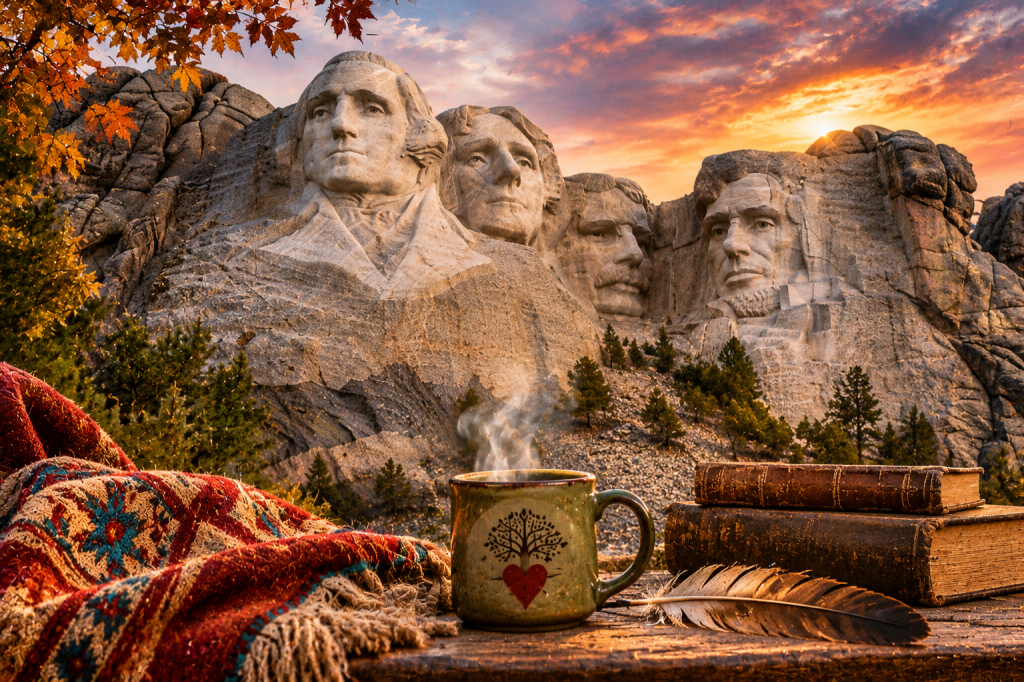
Come on into the Grove, friends. The coffee’s hot, there’s a comfortable chair waiting, and today we’re heading to the Black Hills of South Dakota.
You might want to top off your cup before we get started, because we’ve got quite a bit to talk about.
Yesterday, we began our November journey into the history we thought we knew with the Trail of Tears. We discovered that a familiar story could become considerably more complicated when we looked beyond the few paragraphs many of us remember from school.
Today, we’re visiting one of the most recognizable landmarks in the United States.
Mount Rushmore.
Four presidents. One enormous mountain. An extraordinary feat of engineering and sculpture.
And a history that began long before anyone thought about carving faces into granite.
The Story We Know
Even if you’ve never visited Mount Rushmore, you’ve almost certainly seen it.
George Washington, Thomas Jefferson, Theodore Roosevelt, and Abraham Lincoln gaze out from a mountainside in South Dakota, their enormous faces carved into stone.
Most of us learned that the monument honors four presidents who helped shape the United States.
We learned about the incredible effort required to carve those faces into a mountain. The workers suspended high above the ground, the dynamite, the drills, and the years of labor.
Perhaps we learned that sculptor Gutzon Borglum designed it, or that construction began in 1927 and ended in 1941.
And depending on where and when we went to school, that may be most of what we learned.
It’s an American landmark. A national memorial. An engineering marvel.
All true.
But why those four presidents?
Why that particular mountain?
Who lived in the region before the monument existed?
And how do we reconcile what the mountain was with what it has become?
Well, friends, that’s where things get interesting.
Before the Four Faces
Long before anyone called it Mount Rushmore, the Black Hills were home to Indigenous histories, traditions, and sacred places.
The region is known to the Lakota as Paha Sapa, the Black Hills. The Black Hills hold profound cultural and spiritual significance for the Lakota and other Indigenous peoples whose histories are connected to the region.
The mountain on which the presidential faces would eventually be carved was known to the Lakota as the Six Grandfathers, or Tȟuŋkášila Šákpe.
Think about that for a moment.
Before it was a national monument, before it was a tourist attraction, before it appeared on postcards and in schoolbooks, the mountain already had a name.
And meaning.
And history.
That history didn’t begin with the arrival of American settlers, and it didn’t disappear when someone gave the mountain a different name.
The name Mount Rushmore came from Charles E. Rushmore, a New York lawyer who visited the Black Hills in the nineteenth century.
The mountain’s new name eventually became official, and the older Indigenous name became far less familiar to the broader American public.
Which raises an interesting question.
When we rename a place, what happens to the history that was already there?
A Promise Made in 1868
To understand the controversy surrounding Mount Rushmore, we need to go back nearly sixty years before construction began.
In 1868, the United States entered into the Treaty of Fort Laramie with Lakota and allied leaders.
The treaty established the Great Sioux Reservation, including the Black Hills, and promised that the land would be reserved for the use and occupation of the Sioux Nation.
The agreement also established conditions for surrendering reservation land.
Any future cession required the signatures of at least three-fourths of the adult male Sioux population.
That detail is important.
Because treaties weren’t simply friendly conversations or informal promises.
They were agreements between governments.
And the United States Constitution recognizes treaties as part of the supreme law of the land.
The Lakota had negotiated an agreement intended to protect their territory.
The United States had agreed to its terms.
But then came gold.
Gold Changes Everything
In 1874, Lieutenant Colonel George Armstrong Custer led a military expedition into the Black Hills.
Reports of gold discoveries attracted prospectors, and miners began entering the region despite the treaty protections.
The federal government faced increasing pressure to open the Black Hills to mining and settlement.
Officials attempted to negotiate the acquisition of the land.
But the proposed agreement failed to obtain the consent required by the 1868 treaty.
Only about ten percent of adult Sioux men signed the agreement presented in 1876.
The treaty required three-fourths.
Those numbers aren’t remotely close.
Nevertheless, Congress passed legislation in 1877 that effectively took the Black Hills from the Sioux Nation.
Federal officials argued that changing conditions, conflict, and the government’s responsibilities toward Native peoples justified their actions. The broader public also saw opportunities for mining, settlement, and economic development.
But the Sioux Nation had not agreed to surrender the land under the terms established by the treaty.
That dispute would eventually reach the United States Supreme Court.
More than a century later.
We’ll come back to that.
Because first, we need to understand how four presidential faces ended up on the mountain.
An Idea to Bring Visitors to South Dakota
Here’s something that might surprise you.
Mount Rushmore didn’t begin solely as a grand national effort to commemorate American democracy.
It began, in significant part, as an idea to attract tourists.
In the 1920s, South Dakota historian Doane Robinson envisioned large sculptures in the Black Hills that would encourage people to visit the state.
His original concept involved figures associated with the American West.
He approached sculptor Gutzon Borglum, who had been involved in developing a Confederate memorial at Stone Mountain in Georgia.
Borglum had considerably larger ambitions.
Rather than carving regional Western figures, he envisioned a monumental tribute to the United States.
He selected four presidents whose lives, in his interpretation, represented major stages in the nation’s development.
George Washington represented the birth of the nation.
Thomas Jefferson represented its expansion.
Abraham Lincoln represented its preservation.
And Theodore Roosevelt represented its development.
The symbolism was deliberate.
Borglum wanted a monument that would tell a particular story about America.
And he wanted it large enough to endure for generations.
But here’s where our two histories begin to collide.
The mountain he selected was already culturally significant to the Lakota.
The land had already been the subject of a treaty dispute.
And the monument’s celebration of American expansion would be carved into a place deeply connected to the people whose lands that expansion had affected.
I don’t think we can fully understand Mount Rushmore without recognizing that contradiction.
The Men Behind the Faces
The four presidents weren’t chosen because they were flawless.
They were chosen because Borglum believed they represented defining developments in American history.
And they did play extraordinary roles in shaping the country.
Washington helped establish the presidency and the young republic.
Jefferson authored the Declaration of Independence and oversaw the Louisiana Purchase.
Lincoln led the nation through the Civil War and issued the Emancipation Proclamation.
Roosevelt pursued conservation, expanded the national park system, and helped establish the United States as a more prominent international power.
Those are significant accomplishments.
But their histories are more complicated than the symbolism carved into the mountain.
Washington and Jefferson enslaved people.
Jefferson’s vision of American expansion had enormous consequences for Indigenous nations.
Lincoln’s administration pursued policies toward Native peoples that deserve examination alongside his role in emancipation and preserving the Union.
Roosevelt’s views on race, expansion, and Indigenous peoples reflected attitudes and policies that remain subjects of historical criticism.
None of this means their achievements were imaginary.
It means they were human beings whose decisions had different consequences for different people.
And perhaps that’s one of the difficulties with monuments.
A monument generally tells us what someone wanted to celebrate.
It doesn’t necessarily tell us everything we ought to remember.
Carving a Mountain
Now, let’s give some attention to the people who actually created Mount Rushmore.
Because whatever we think about the monument’s location or symbolism, the work itself was extraordinary.
Construction began in 1927.
Over the next fourteen years, nearly 400 workers participated in carving the mountain.
They climbed steep stairways, operated heavy equipment, and worked suspended from the rock face.
Dynamite removed enormous quantities of granite. Drills and specialized techniques shaped the stone into the recognizable faces we see today.
The working conditions were difficult.
The hours were long, employment could be uncertain, and the work was physically demanding.
Yet remarkably, no workers died during the carving.
For some, the project was simply a job, especially during the economic hardships of the Great Depression.
For others, it became something much more meaningful.
Mount Rushmore worker Red Anderson later recalled that the workers increasingly felt they were creating something remarkable and became deeply committed to the project.
I think their perspective deserves a place in our understanding of the monument.
They weren’t negotiating nineteenth-century treaties.
They weren’t deciding federal Indian policy.
They were skilled workers doing dangerous, demanding work to create something they believed would last.
And they succeeded.
The monument remains an astonishing accomplishment of engineering and sculpture.
Recognizing that achievement doesn’t require us to ignore the history of the land.
Just as acknowledging the history of the land doesn’t erase the workers’ skill.
Both belong to the story.
The Supreme Court and the Black Hills
Now let’s return to that treaty.
The Sioux Nation continued challenging the loss of the Black Hills through the legal system.
The dispute lasted for generations.
In 1980, the United States Supreme Court decided United States v. Sioux Nation of Indians.
The Court upheld the finding that the federal government had taken the Black Hills without providing the compensation required under the Fifth Amendment.
The ruling recognized that the 1877 taking created an obligation to compensate the Sioux Nation, including interest dating back to the taking.
That’s significant.
More than a century after the land was taken, the nation’s highest court upheld a legal finding that the United States owed compensation.
But here’s where the story becomes even more complicated.
The Sioux Nation did not simply accept the money and consider the matter settled.
Tribal governments have declined to accept the award, maintaining that the Black Hills should be returned.
And that distinction brings us to something we don’t always consider when discussing historical restitution.
What if the dispute isn’t really about money?
When Land Is More Than Property
For many Lakota people, the Black Hills are not simply a piece of real estate.
They are connected to spirituality, identity, history, community, and relationships with the land.
How do you assign a dollar value to that?
And even if you could calculate the economic value of the land, would that resolve the loss of its cultural and spiritual significance?
The federal government’s legal response centered on monetary compensation.
But the demand for the return of the Black Hills has continued.
In November 2024, representatives of several Oceti Sakowin tribal governments and treaty councils gathered to discuss a proposed effort called the He Sapa Restoration Act.
The proposal sought the return of federally controlled lands in the Black Hills while leaving private property titles undisturbed.
Not everyone agreed about the best strategy.
Some supported pursuing legislation to restore land.
Others were concerned that a new law might weaken existing treaty claims or establish an undesirable precedent.
That disagreement is important.
Just as we saw with the Cherokee Nation yesterday, Indigenous communities are not politically uniform.
People can share a commitment to protecting their homeland while disagreeing about how best to achieve that goal.
Standing Rock Vice-Chairman Frank Jameson described the continuing struggle during the 2024 gathering:
“This fight has been ongoing for many decades before us and it will continue after us.”
That’s a powerful reminder that the Black Hills dispute isn’t simply something historians discuss.
It’s an ongoing issue for living communities.
And it’s not one that can necessarily be resolved by writing a check.
What Mount Rushmore Has Become
Now we come to the other side of the story.
Because Mount Rushmore has become something far larger than the original tourism proposal or even Borglum’s artistic vision.
It’s one of the most recognizable symbols of the United States.
Millions of visitors have traveled to the Black Hills to see it.
Families have made memories there.
Children have stood beneath those enormous faces and learned about the presidents.
Visitors have marveled at the engineering, the scale, and the determination required to create it.
For many Americans, Mount Rushmore represents national identity, democracy, perseverance, and the accomplishments of generations who helped build the country.
Those feelings are real.
And they aren’t automatically invalidated by the monument’s complicated history.
But neither does the affection people feel for Mount Rushmore erase the significance of the Black Hills to the Lakota.
Both histories occupy the same mountain.
For one visitor, those four faces might inspire pride.
For another, they might be a reminder of a treaty that was not honored.
And for someone else, the monument might inspire admiration for the artistry while raising difficult questions about its location.
People can experience the same place very differently.
That doesn’t mean the underlying historical facts are simply matters of opinion.
The treaty existed.
The land was taken.
The Supreme Court ruled.
The monument was built.
Those are parts of the historical record.
But what the monument means to people today is another layer of the story.
And that brings us to the question I’ve been thinking about most.
How Do We Reconcile What Was With What Has Become?
I think this may be one of the most difficult questions we’ll encounter throughout November.
Because we can’t go backward and undo history.
We can’t restore the mountain to precisely the way it looked before the carving.
We can’t reverse the experiences of the people who lost their land.
And we can’t erase the generations of meaning that have accumulated around Mount Rushmore since it was created.
So what do we do?
Do we celebrate the monument and ignore the history beneath it?
Do we reject everything the monument has come to represent because of the circumstances surrounding its creation?
Or can we find a way to acknowledge both?
I don’t think the answer has to be an either-or proposition.
We can admire the extraordinary skill required to carve Mount Rushmore while recognizing that the mountain was already significant to Indigenous peoples.
We can acknowledge the achievements of the four presidents without pretending their decisions were universally beneficial.
We can understand why Americans cherish the monument while listening seriously to Lakota people who regard the Black Hills as sacred homeland.
And we can recognize that the legal dispute over the land is not resolved simply because the monument has become famous.
But I also think reconciliation has to mean something more than agreeing to tell a fuller story.
Acknowledgment matters.
Education matters.
Respectful conversations matter.
Yet questions about treaty obligations, land return, stewardship, and sovereignty involve more than historical interpretation.
They concern decisions that governments and communities are still making.
And there may not be one solution that satisfies everyone.
Perhaps reconciliation begins with understanding that appreciating something and examining its history are not opposing activities.
Perhaps it requires us to distinguish between what a monument was intended to celebrate and what its creation meant to people whose stories were left out.
And perhaps it asks us to consider whether preserving a national symbol and respecting Indigenous sovereignty must always be treated as competing goals.
I don’t have a simple answer.
But I think it’s a question worth asking.
A Mountain With More Than One Story
There’s a temptation when discussing complicated history to divide everything into heroes and villains.
Good and bad.
Right and wrong.
And certainly, there are actions in history that deserve clear moral and legal examination.
But the people who lived that history rarely fit neatly into the categories we create afterward.
Mount Rushmore is a monument to American achievement.
It is also a monument built on land with an older history, including a treaty whose terms were not honored.
It is an extraordinary work of art.
It is also a place that carries painful meaning for some Indigenous communities.
It is a source of national pride for many Americans.
And it remains connected to an unresolved dispute over the Black Hills.
Those truths can exist together.
We don’t have to discard one to acknowledge another.
What we do need is the willingness to look beyond the familiar picture.
Because once we understand the history beneath those four faces, we’re no longer looking at quite the same mountain.
We’re seeing more of it.
Until Tomorrow
Well, friends, I think we’ve given ourselves quite a bit to consider over today’s coffee.
Mount Rushmore is still an extraordinary sight.
Those four faces are still an astonishing accomplishment.
And the Black Hills are still a place of profound cultural significance, with a history that began long before the monument and continues today.
Knowing more about that history doesn’t have to diminish our sense of wonder.
It can deepen our understanding of what we’re seeing.
And maybe that’s what this entire November journey is really about.
Not telling ourselves that everything we learned was wrong.
Not deciding that everything our country has accomplished must be celebrated without question.
But recognizing that the story is bigger than the version we were originally given.
The next time you see a photograph of Mount Rushmore, perhaps you’ll notice more than four presidents.
Perhaps you’ll think about the Lakota people and the Black Hills.
The treaty of 1868.
The gold rush.
The sculptor with an enormous vision.
The workers suspended above the granite.
The Supreme Court decision.
And the people still asking what justice and reconciliation might look like.
Four faces.
One mountain.
And far more history than meets the eye.
The coffee pot’s still on, and there’s always another chair waiting here in the Grove.
Y’all come sit a spell.
— Sunstone Grove
Sources & Further Reading
National Park Service
Treaties and legal history
- Smithsonian National Museum of the American Indian — Fort Laramie Treaty Case Study
- United States v. Sioux Nation of Indians (1980) — Supreme Court opinion
Contemporary Indigenous perspectives
Additional context


Leave a Reply