
Welcome, y’all. Come on up, grab something to sip on, and find yourself a comfortable spot on the porch. We’ve been having quite a conversation about Southern history, the stories we inherited, and what happens when we begin questioning the things we thought we knew.
Today, we’re bringing that conversation full circle.
In the first two parts of this series, we’ve explored the causes of the Civil War and the Confederate flag. Now we’re turning to something that has occupied our town squares, courthouse lawns, parks, and public spaces for generations.
The monuments.
And for me, this part of the story begins with a question I couldn’t answer.
There are questions that stay with you long after you’ve forgotten the person who asked them.
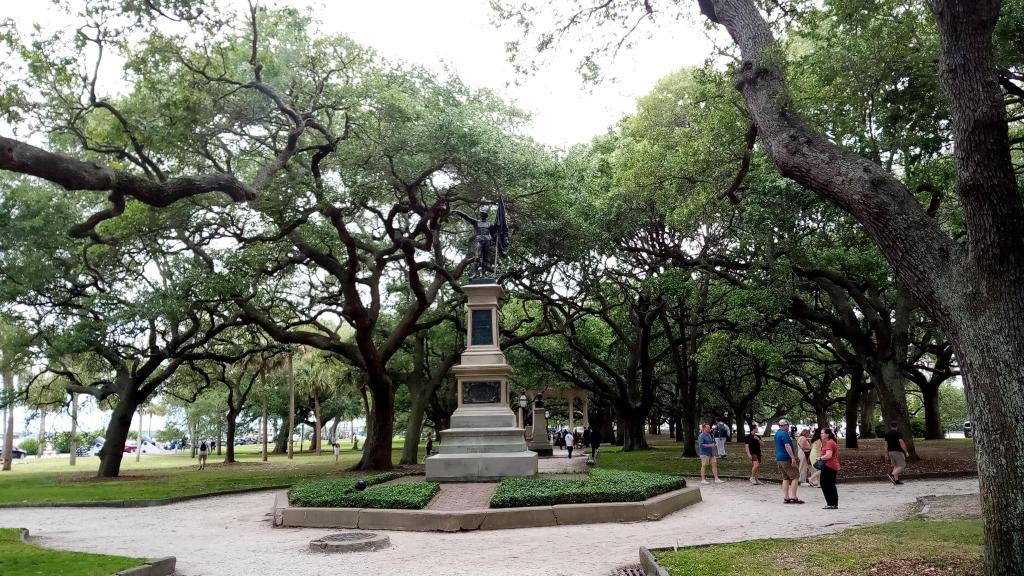
Years ago, I was walking through White Point Garden in Charleston, South Carolina, with a gentleman from Chicago. We were talking about the South, its history, and, eventually, Confederate monuments.
Now, I am a Southern girl. Always have been, always will be. I love the South. I love its people, its landscapes, its traditions, its food, and the particular way a conversation can begin on a front porch and wander through three generations before anybody remembers what started it.
I also grew up with a particular understanding of Southern history.
At the time of that Charleston conversation, I had already begun questioning some of what I’d been taught. The Confederate flag flying on the South Carolina State House grounds was one of those things. I was beginning to understand why something I had grown up regarding as a symbol of Southern heritage meant something very different to other people.
But the monuments?
Those were different, I insisted.
They honored the soldiers. The men who fought and died. Surely we could separate remembering those men from endorsing the cause for which they fought.
My Chicago gentleman asked how I could make that distinction for the monuments when I was beginning to question it for the flag.
And I couldn’t untangle the two as neatly as I wanted to.
Now, I suspect that Chicago boy was trying to get lucky and wisely decided not to spend his evening arguing with a passionate Southern girl.
But he had asked a good question.
I didn’t have a good answer.
And the question stayed with me.
The History I Carried With Me
I’ve written before about what I was taught concerning the causes of the Civil War and about my changing understanding of the Confederate flag.
I’m not going to retell those stories here.
Suffice it to say that I grew up hearing about states’ rights, Northern aggression, economics, tariffs, and Southern honor. Slavery was acknowledged, but it was presented as one issue among many rather than the central issue that the seceding states themselves described in their declarations and political arguments.
I was taught to distinguish the ordinary Confederate soldier from the politicians and institutions that led the South into war.
And I still believe there are distinctions worth making.
People go to war for complicated reasons. Some volunteer enthusiastically. Others are conscripted. Some believe deeply in their government’s cause. Others fight because their brothers, neighbors, and friends are fighting, or because they cannot imagine doing otherwise.
A mother mourning her son is not necessarily making a political statement about every decision that sent him to war.
But a monument erected in a public square is something more than a mother’s grief.
Somebody chose its location.
Somebody raised the money.
Somebody wrote the inscription.
And somebody decided what future generations should understand when they looked at it.
That was the part I hadn’t really considered.
Who Put Them There?
Confederate monuments did not all appear at the same time, for the same reasons, or under the direction of one organization.
Some were erected in cemeteries soon after the war. Families and communities were grieving, and the work of identifying, burying, and remembering the dead was painfully real.
Other monuments appeared decades later, often in prominent civic spaces: courthouse lawns, State House grounds, town squares, and public parks.
Organizations such as the Ladies’ Memorial Associations, the United Daughters of the Confederacy, veterans’ groups, and local monument committees played important roles in these efforts.
It is worth remembering that the United Daughters of the Confederacy was founded in 1894. Confederate memorial work had begun long before that.
The South Carolina Monument Association, for example, was responsible for the Confederate monument unveiled in Columbia in 1879.
These organizations did not simply purchase statues.
They organized campaigns, raised money, arranged dedication ceremonies, and helped shape the stories attached to the memorials.
And the locations mattered.
A memorial in a cemetery asks us to remember the dead.
A monument standing before the seat of government does something else as well. It gives a particular interpretation of history a place of public honor.
That doesn’t mean everyone who contributed to a monument had identical motives. Grief, pride, loyalty, nostalgia, and political conviction could exist together.
But it does mean we need to examine what the organizers actually said they were doing.
Fortunately, some of them left us their words.
What Did the Monument Builders Actually Say?
In May 1879, South Carolina unveiled its Confederate monument in Columbia.
The inscriptions were not limited to the names of the dead.
One inscription described soldiers as having glorified a fallen cause.
Another asked future generations to let the soldiers’ virtues speak in favor of the cause for which they died.
Think about that for a moment.
The inscription wasn’t merely asking that the men be remembered.
It was asking future generations to judge their cause favorably.
The South Carolina Monument Association’s published history makes the intention even clearer. It spoke of honoring those who had fought and fallen for the Confederate cause, and of keeping that memory alive for generations to come.
It also reflected the racial attitudes of the Reconstruction era, describing Black political participation in language that reveals how closely Confederate remembrance could be tied to opposition to the new political order.
Those words matter.
They tell us what at least some of the monument builders wanted their work to accomplish.
They were mourning the dead, certainly.
But they were also defending a historical interpretation.
And they wanted that interpretation to endure.
The same commemorative tradition continued into the twentieth century.
At the dedication of South Carolina’s monument at Chickamauga in 1901, speakers presented the memorial as a means of teaching future generations a worthy account of Confederate history.
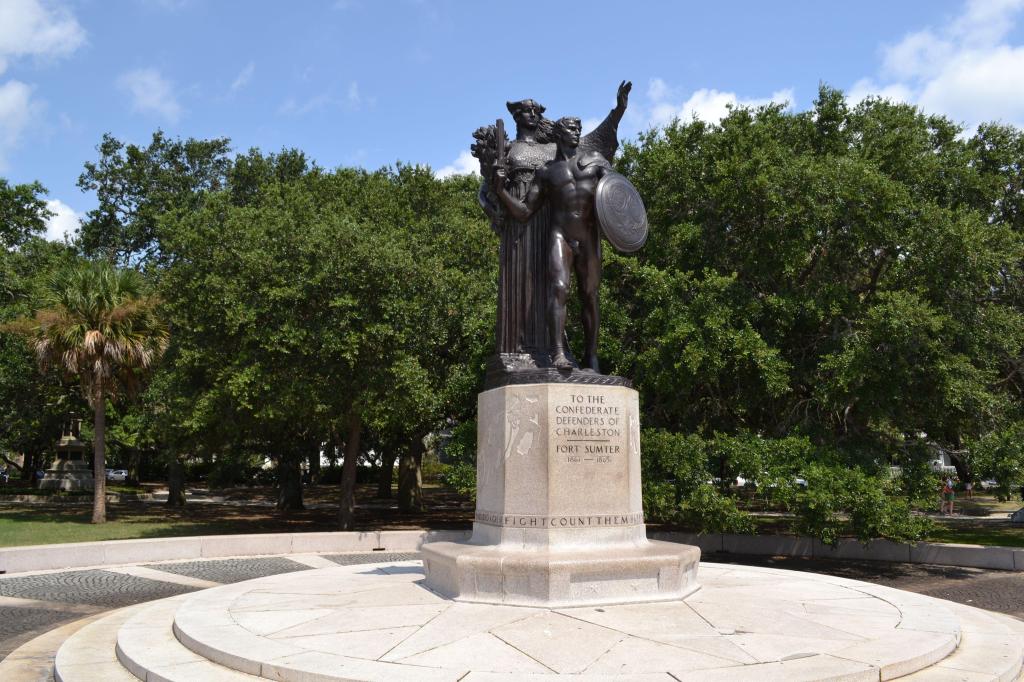
By 1932, when the Confederate Defenders monument was unveiled in Charleston’s White Point Garden, that tradition was well established.
The Charleston monument was sponsored by the local chapter of the United Daughters of the Confederacy and funded through the estate of Andrew Murray, a Charleston businessman and former Confederate soldier.
Its imagery presented the city’s Confederate defenders in heroic terms.
I haven’t established the complete wording of its dedication speeches, and I’m not going to invent what anyone said.
But the monument itself, its sponsors, and the larger history of Confederate commemoration give us plenty to examine.
Here is what troubles me about the distinction I once tried to make in Charleston:
If the people erecting a monument explicitly intended to honor both the soldiers and their cause, can I reasonably insist that the monument was only about the soldiers?
I can bring my own meaning to it.
But I cannot erase theirs.
The People Who Didn’t Get a Say
There is another question we have to ask.
Whose voices were missing when these decisions were made?
For much of the period when Confederate monuments were being erected, Black Southerners faced segregation, racial violence, and increasing exclusion from political power.
By the time many twentieth-century monuments were dedicated, disfranchisement had severely restricted Black participation in the governments responsible for public spaces.
A monument might be described as expressing a community’s values.
But which members of that community had been allowed to decide?
And what did the monument communicate to those who had been excluded?
We don’t have to guess whether Black Americans objected to public commemorations that romanticized slavery and the Old South.
They told us.
In 1923, supporters of Confederate commemoration promoted a proposed national monument to the stereotyped figure of the supposedly loyal enslaved “mammy.”
Black women protested.
Mary Church Terrell, a prominent educator and civil rights activist, wrote that Black women across the country were appalled by the proposal.
The monument was never erected.
This wasn’t an argument about whether enslaved women had existed or whether their lives deserved remembrance.
It was an argument about who had the authority to define those lives, and whether a sentimental image created by white commemorators could honestly represent the experience of enslavement.
The women being supposedly honored had not been asked.
Their descendants were speaking up.
And they were saying no.
There are more local examples, too.
Charleston’s John C. Calhoun monument stood in Marion Square for generations. Calhoun was not a Confederate soldier; he died before the Civil War. But he was an influential defender of slavery, and his monument became part of the city’s contested public landscape.
The monument was familiar to generations of Charlestonians.
Familiarity, however, does not mean everyone understood or experienced it the same way.
Some saw a historical statesman.
Others saw a public tribute to a man who had defended their ancestors’ enslavement.
Those perspectives did not carry equal political power when the monument was erected.
And that matters.
The History That Wasn’t There
Sometimes the most revealing thing about a public monument isn’t what it says.
It’s what the surrounding landscape leaves unsaid.
Consider Denmark Vesey.
Vesey was a free Black Charlestonian accused of organizing a planned uprising against slavery in 1822. He and others were executed.
His story is complicated, as history often is, and historians have examined both the alleged conspiracy and the evidence used against those accused.
But whatever conclusions we draw about the details, his place in Charleston’s history is undeniable.
Yet Henry Darby, a Black man who grew up in Charleston, did not learn about Vesey until he went away to college.
Imagine that.
Growing up in a city filled with historical markers, monuments, buildings, and stories, and discovering that an important part of its history had been largely absent from the version you knew.
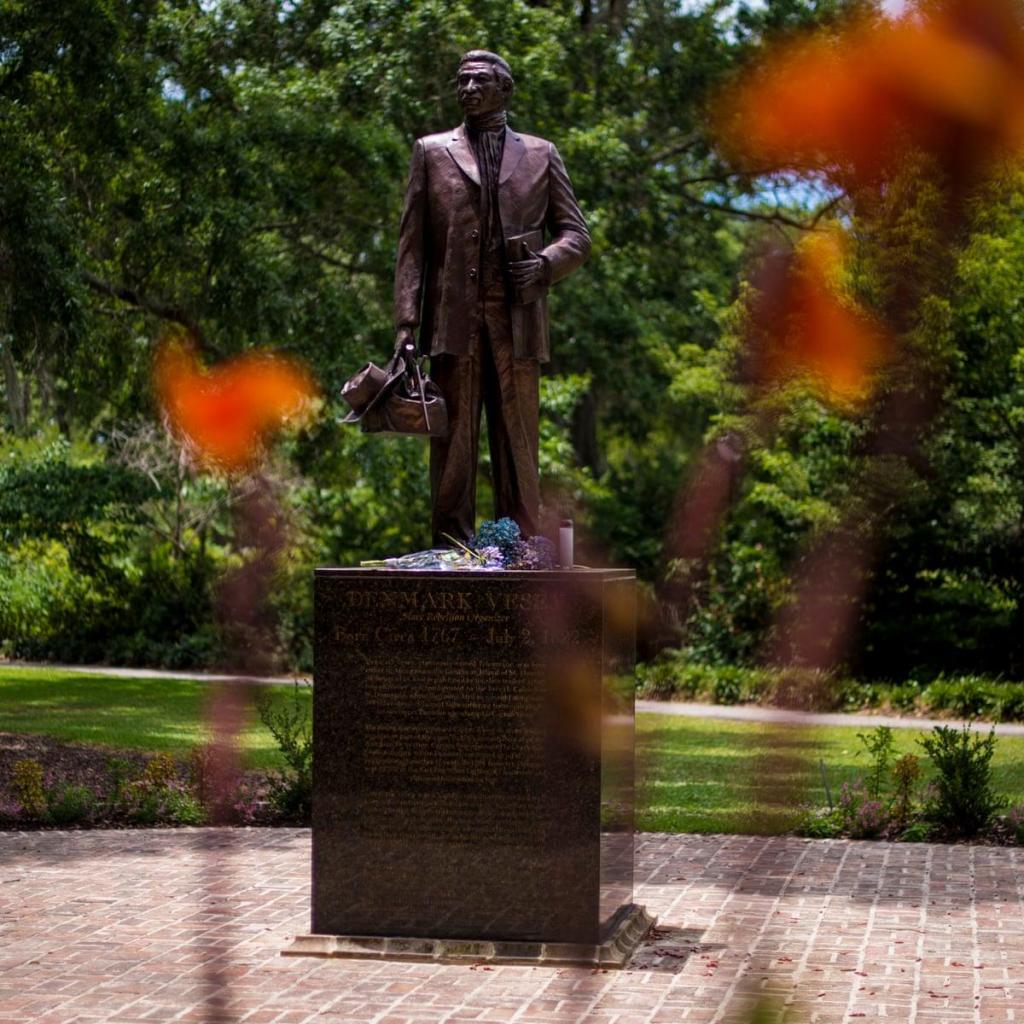
Darby later became a leading advocate for a public monument to Vesey.
The effort took years and encountered substantial opposition. In 2014, Charleston finally dedicated a Denmark Vesey monument in Hampton Park.
I keep thinking about the contrast.
I walked through Charleston believing I understood what the Confederate monuments represented.
Henry Darby grew up in Charleston without knowing about a man whose story the city had not chosen to commemorate in the same way.
Our experiences were not equivalent. They arose from very different positions within Southern history.
But they point toward the same uncomfortable truth.
What we see in public spaces helps shape what we believe is important. What we don’t see can shape us, too.
And sometimes we don’t realize what’s missing until somebody asks a question.
We Inherited More Than Monuments
Here’s where this subject became considerably bigger than I expected.
Because once you start asking who erected the statues and why, another question follows.
What about everything else?
The street signs?
The schools?
The parks?
The bridges?
The public buildings?
An entire stretch of highway?
The Southern Poverty Law Center’s Whose Heritage? inventory documented 741 roadways and 38 parks honoring Confederate figures or the Confederacy as of January 2022.
Those were historical inventory figures, not a count of physical street signs or a claim that every one remains unchanged today.
Still, consider the scale.
A monument is something you might stop and look at.
A road name can become so ordinary that you scarcely notice it.
You give directions using it. You see it on a map. You pass its sign on your way to the grocery store.
And eventually the name can feel as natural and permanent as the road itself.
But someone chose it.
The United Daughters of the Confederacy understood the power of that kind of commemoration.
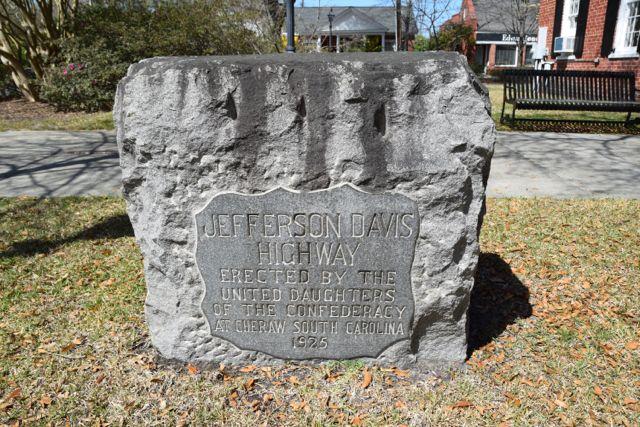
Beginning in the early twentieth century, the organization promoted the Jefferson Davis Highway, an ambitious effort to honor the former Confederate president through a network of roads.
South Carolina has its own history with that campaign, including a Jefferson Davis Highway marker placed at the State House in 1923.
This wasn’t simply about preserving a battlefield or marking the location of a historical event.
It was about putting a name into the everyday landscape.
And once a name becomes familiar, the reason for its selection can fade from public memory.
That raises questions I hadn’t considered during my Charleston walk.
How many people know why their street bears a particular name?
How many know when it was named?
How many know who proposed it?
And how many of those names were selected during periods when substantial portions of the community had little or no political voice?
We inherited more than monuments.
We inherited decisions about whose history deserved a place of honor.
What Does It Mean to Preserve History?
And that brings us to the difficult part.
What do we do with what we’ve learned?
For a while, I thought I had a fairly straightforward answer.
If a Confederate monument stands on public land, perhaps it belongs somewhere else: a cemetery, a museum, private property, or another location where it can be understood as remembrance rather than government endorsement.
But the more I considered that idea, the more questions appeared.
What about a memorial to unidentified soldiers?
What about a monument erected at a battlefield, where the history actually happened?
What about cemetery memorials, historic artwork, and monuments whose significance has changed over time?
What about the families who have maintained these places for generations?
And what about monuments to Union soldiers? Surely whatever principles we establish ought to be applied thoughtfully and consistently, rather than depending solely on which side someone fought for.
A battlefield marker and a courthouse monument are not necessarily doing the same job.
A grave marker and a statue honoring a political leader are not necessarily making the same statement.
Neither are a public school name and a museum exhibit.
That doesn’t mean the difficult questions disappear.
It means we have to ask them carefully.
I can understand the desire to preserve a historic object without agreeing that it should continue to occupy a place of civic honor.
I can understand the grief behind a memorial without accepting every historical claim made by its sponsors.
And I can understand why a community might want a monument removed without believing that removing it somehow erases the events it commemorates.
History is not contained inside a statue.
We preserve history through records, scholarship, archives, museums, historic sites, education, and the stories people pass down.
A monument is one way a generation chose to interpret that history.
It is not history itself.
And Then There’s the Law
In South Carolina, these questions are not merely theoretical.
The state enacted its Heritage Act in 2000, restricting changes to certain monuments and memorials.
In May 2026, South Carolina expanded those protections through Act 224.
The updated law broadens the categories of monuments and memorials protected against removal, relocation, or disturbance, and provides a legislative process for authorizing certain changes.
The law also raises questions about the balance between statewide preservation requirements and decisions made by local communities.
That balance matters.
One possible response to a disputed monument is to leave it standing while adding historical context.
Explain who erected it.
Explain when.
Explain what the dedication speeches said.
Explain what was happening in the community at the time.
Let people encounter the monument with more information than its original sponsors chose to provide.
But even decisions about how and where that context can be presented can become questions of law and public authority.
Supporters of monument-protection laws argue that historical memorials deserve protection from changing political attitudes and that significant alterations should receive statewide scrutiny.
Critics argue that such restrictions can limit local communities’ ability to reconsider whom they honor and how they present their own history.
Those are competing concerns about preservation, public authority, and historical interpretation.
And they bring us right back to the question of who gets to decide.
The people who erected these monuments made choices.
The governments that permitted them made choices.
The generations that left them standing made choices.
And the laws governing what can happen to them today are choices, too.
We cannot pretend that doing nothing is somehow outside the conversation.
Leaving something as it is can also be a decision.
Honoring the People Without Honoring the Cause
Honoring those who fought does not require us to honor the causes for which they fought.
And we need to acknowledge that we may never know precisely why some of those men went to war.
We know what the Confederate government stood for. Its defense of slavery is a matter of historical record. But we cannot automatically assign every individual soldier the same personal motivations.
Where letters, diaries, and other records exist, we should examine them. Where they don’t, we should be honest about what we cannot know.
We should also consider the wishes of families, benefactors, and organizations responsible for memorials, particularly when those wishes are documented. Their intentions deserve to be understood, even when we ultimately disagree with them.
That doesn’t mean every monument must remain exactly where it stands. A memorial on private property, a grave marker in a cemetery, and a monument occupying a place of public honor raise different questions.
But it does mean that these decisions deserve more than a blanket rule.
We can remember the dead without celebrating injustice. We can preserve history without endorsing every interpretation of it. And we can acknowledge the complexity of individual lives without losing sight of a fundamental truth:
Slavery was wrong. The Confederacy’s defense of it was wrong. And remembering the people who fought in that war does not require us to pretend otherwise.
Back to Charleston
I wonder what I would say today if I found myself walking through White Point Garden with that same gentleman from Chicago.
I’d still defend the importance of remembering the dead. I’d still distinguish individual lives from the political decisions that sent people to war.
And I’d still be every bit as Southern as I was that day.
That has never been in question.
But I’d ask different questions.
Who put this monument here? What did they intend it to represent? Who participated in that decision, and who was excluded?
And what history was happening all around it that the monument doesn’t tell us?
I might still disagree with my Chicago gentleman about some things.
Knowing me, I probably would.
But I wouldn’t be quite so certain of my answers anymore.
Because I’ve come to understand that the monuments, the street names, the highways, and the public spaces we inherited represent choices made by people who came before us.
Choices about what deserved to be remembered, what deserved to be honored, and whose stories deserved to be told.
I don’t have one tidy answer for every monument or every name.
I don’t think the history supports one.
But I do believe we owe ourselves, and one another, the effort to understand what we inherited before deciding what to do with it.
That Chicago boy asked me something I couldn’t answer.
It took me years to understand just how much was wrapped up in his question.
And perhaps that’s the most important thing I’ve learned throughout this entire series.
We didn’t know what we didn’t know.
But now we’re asking.
And that’s where understanding begins.
Y’all come sit a spell.
Sources and Further Reading
- South Carolina Monument Association. The South Carolina Monument Association: Origin, History and Work (1879). Includes the association’s history, monument inscriptions, and dedication proceedings. Digitized historical publication.
- The Anderson Intelligencer, May 22, 1879. Contemporary reporting on the Columbia Confederate monument and its inscriptions. Historical Newspapers of South Carolina.
- American Historical Association. Statement on Confederate Monuments (2017). Read the statement.
- American Historical Association. Historical Perspectives on Confederate Monuments (2017). Read the historical analysis.
- Mary Church Terrell. The Black Mammy Monument (1923), in the Mary Church Terrell Papers, Library of Congress. Primary source.
- Blain Roberts and Ethan J. Kytle. “Freedom Fighter or Attila the Hun?: How Black and White Charlestonians Remembered Denmark Vesey, 1822–2014,” in Fugitive Movements (2021). Scholarly chapter.
- Smithsonian Institution. Confederate Defenders of Charleston. Sculpture record, including the 1932 dedication and UDC sponsorship. Artwork inventory.
- City of Charleston. The Confederate Defenders of Charleston. Historical summary, including the role of Andrew Murray’s estate. City historical document.
- Karen L. Cox. Dixie’s Daughters: The United Daughters of the Confederacy and the Preservation of Confederate Culture (2003); No Common Ground: Confederate Monuments and the Ongoing Fight for Racial Justice (2021).
- Equal Justice Initiative. Confederate Iconography in the 20th Century. Historical analysis.
- Southern Poverty Law Center. Whose Heritage? Public Symbols of the Confederacy, third edition, including its January 2022 inventory. Read the report.
- South Carolina General Assembly. Senate Bill 508, Act 224 of 2026, expanding the state’s monument protection law. Legislative record.
- Municipal Association of South Carolina. Act 224 Expands South Carolina Heritage Act Requirements (2026). Legal overview.


Leave a Reply