
I have a question.
Why, in the twenty-first century, are we still making women’s clothing without pockets?
Not tiny pockets. Not fake pockets. No pockets whatsoever.
What exactly are we supposed to do with our hands? Never mind our keys, phones, tissues, or the occasional interesting rock we find on a walk.
And before somebody tells me it’s about preserving the silhouette, I’d like to point out that men have been walking around with pockets full of junk for generations, and civilization has somehow survived.
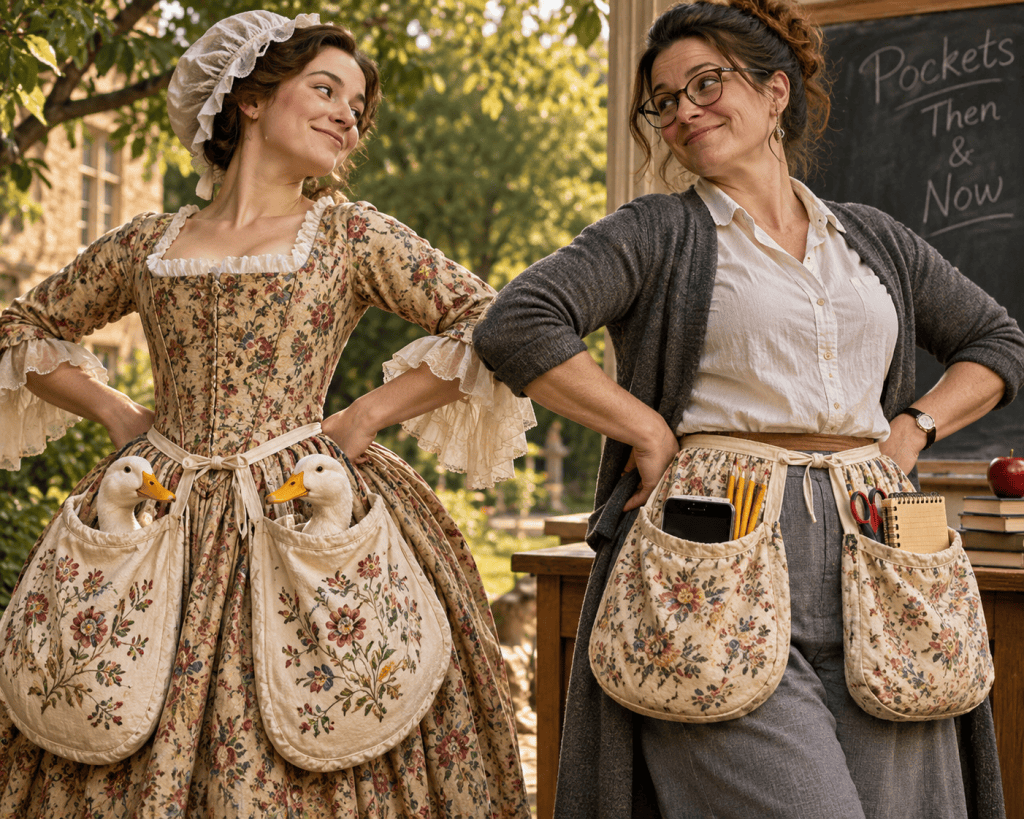
I have a friend who’s a teacher. She needs to carry things around her classroom, and she needs her hands free to teach. A purse isn’t exactly practical when you’re moving between desks, helping students, and managing all the little necessities that come with a school day.
So she came up with a solution.
She began making eighteenth-century-style pockets. The kind women used to tie around their waists beneath their skirts.
Two generously sized pockets, connected by a waistband, ready to hold whatever the day requires.
And then she started making them to sell to other teachers.
Think about that for a moment.
In 2026, a teacher has discovered that one of the best solutions to the problem of women’s pockets was popular three hundred years ago.
Which raises another question.
What on earth happened to our pockets?
When Women Had Pockets Big Enough for Ducks
Believe it or not, women once had pockets that would make today’s cargo pants look downright stingy.
During the seventeenth and eighteenth centuries, women commonly wore separate pockets tied around their waists. These weren’t sewn into their dresses or skirts. They were individual fabric pouches, often worn in pairs, accessible through openings in the clothing layered over them.
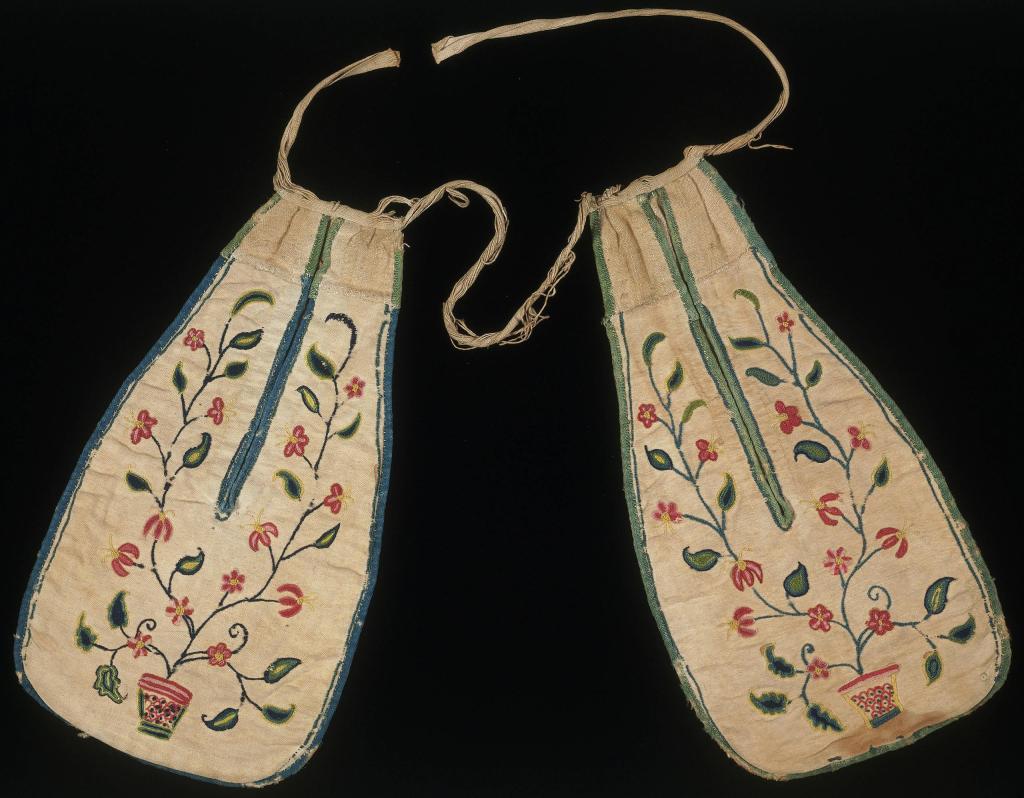
And they could be enormous.
Colonial Williamsburg has a surviving pair dating from approximately 1785 to 1810, each measuring a little over sixteen inches long and eleven inches wide.
That’s not a pocket.
That’s a small tote bag with ambitions.
Women carried keys, money, sewing supplies, letters, handkerchiefs, spectacles, food, and all sorts of personal belongings.
Some pockets were beautifully embroidered. Others were plain and practical, made from available fabric and intended to do a job rather than impress anybody.
And although we often picture them concealed beneath skirts, working women sometimes wore their pockets where they were more readily accessible, including beneath an apron.
Practicality mattered.
And then there’s the story of Jane Griffith.
Historians Barbara Burman and Ariane Fennetaux, authors of The Pocket: A Hidden History of Women’s Lives, 1660–1900, recount an incident from 1777 in which Jane Griffith concealed two live ducks belonging to Thomas Wainwright in her pockets while crossing some fields.
Two.
Live.
Ducks.

I don’t know what Jane’s original plans were, but I have questions.
How big were those pockets? How cooperative were the ducks? And how long did she think she could keep this arrangement a secret?
Now, I’m not suggesting we bring back poultry-sized pockets as a fashion requirement.
But wouldn’t it be nice if we could at least fit a cellphone in one?
A Little Privacy, Please
The contents of those pockets tell us something else about women’s lives.
They weren’t simply convenient places to carry everyday necessities. They also offered a measure of privacy.
Think about life in the eighteenth century.
For married women in England and its American colonies, the legal doctrine of coverture generally placed significant restrictions on their independent property rights and legal identities. The details varied by place and circumstance, and unmarried women and widows often had different legal rights.
But the larger point remains: women’s economic and personal independence was frequently constrained by laws and social expectations.
And yet, tucked beneath their skirts, women carried small collections of things that belonged to their daily lives.
Money. Keys. Letters. Keepsakes.
Things they might want close at hand without displaying them to everyone around them.
A pocket could be a private space in a world where women didn’t always have many.
And yes, sometimes those private spaces attracted suspicion.
Historical accounts include men making jokes about the mysterious contents of women’s pockets. Satirical portrayals often suggested that women’s pockets were hopelessly chaotic, despite evidence that women organized their belongings quite carefully.
There are also documented cases of women concealing stolen goods in them.
In 1765, a London servant named Frances Burk attracted her employer’s attention because her pocket appeared unusually bulky.
When her employer, Ann Clough, examined it, she discovered a remarkable collection of belongings that Frances had taken, including a silk handkerchief, a linen apron, a pair of stays, flowered cotton, and a linen bib.
Apparently, Frances wasn’t particularly concerned about preserving her silhouette.
But here’s where we need to be careful.
It’s tempting to turn these stories into a sweeping claim that men were so frightened of women’s independence that they deliberately eliminated women’s pockets.
That’s a wonderfully dramatic explanation.
Unfortunately, history doesn’t give us enough evidence to support it.
What we can say is that pockets offered women practical freedom, privacy, and control over personal belongings.
And that makes the changing fashions of the following centuries all the more interesting.
When Fashion Got in the Way
So if women had these wonderfully useful pockets, why did they become less common?
Fashion, my friends.
Fashion.
During the late eighteenth and early nineteenth centuries, some fashionable women’s clothing began moving away from the enormous skirts and structured silhouettes that had conveniently concealed those generous pockets.
The lighter, narrower dresses associated with the Regency period presented a problem.
You couldn’t easily hide two large fabric pouches beneath a slim dress without changing the shape of the garment.
And apparently, the shape of the garment was terribly important.
Small handbags called reticules became fashionable accessories during this period.
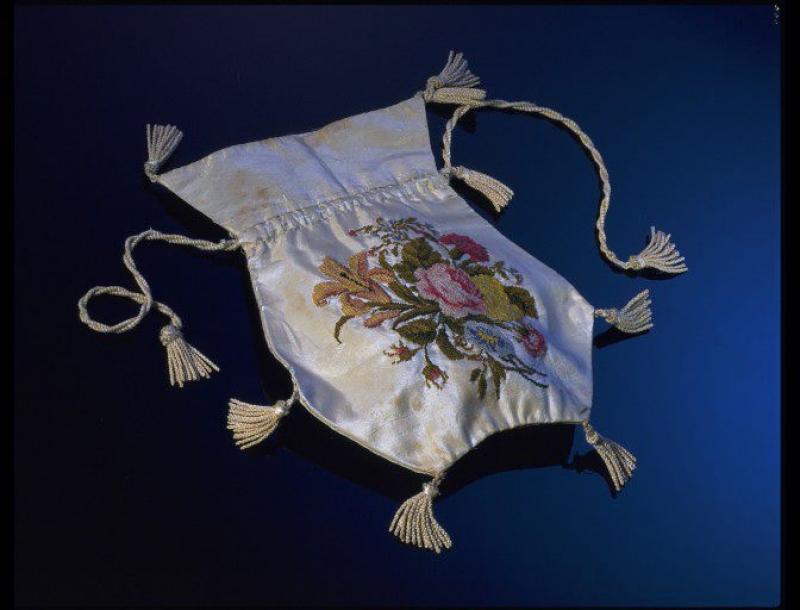
These were often delicate drawstring bags, carried in the hand or over the wrist.
Some were beautifully made.
But they weren’t necessarily practical replacements for the enormous pockets women had been wearing.
Now, this transition didn’t happen overnight. In fact, it wasn’t a simple transition at all.
Women had used various bags alongside their pockets for centuries. Detachable pockets remained popular well into the nineteenth century, and some women continued wearing them even later. Sewn-in pockets also appeared in women’s garments.
The Victoria and Albert Museum makes an important point: handbags and pockets weren’t necessarily competing inventions. They often served different purposes.
Fashion history is rarely as tidy as we’d like it to be.
But changing silhouettes did make traditional tie-on pockets less convenient with certain styles of dress.
And over time, carrying belongings in a separate bag became an increasingly familiar part of women’s fashion.
The trade-off between appearance and practicality, however, didn’t disappear with the Regency era.
The Pocket Problem Never Went Away
Women’s clothing has changed enormously since the eighteenth century.
We’ve had bustles, corsets, bloomers, tailored suits, flapper dresses, trousers, miniskirts, jeans, leggings, and practically every imaginable variation on the theme.
And yet the pocket problem persists.
Men’s clothing generally comes with the assumption that the wearer will need somewhere to put things.
Women’s clothing? Not so much.
Sometimes we get perfectly functional pockets.
Sometimes we get tiny pockets that appear to have been designed for a single breath mint.
Sometimes we get decorative stitching that creates the illusion of a pocket without providing any actual storage.
And sometimes we get absolutely nothing.
Now, there are practical reasons certain garments don’t have pockets. Fabric, fit, construction, and intended use all influence design.
A pocket can add bulk or affect how a garment hangs.
Fine.
But those considerations don’t explain why practical storage has so often been treated as optional in women’s clothing.
And they certainly don’t explain why we’re still so delighted when we discover that a dress has pockets.
You know the moment.
Someone compliments your dress.
You smile, put your hands in the pockets, and announce:
“THANKS! IT HAS POCKETS!”
As though you’ve just revealed that it can also make coffee and file your taxes.
The enthusiasm is genuine.
Because finding a dress with functional pockets still feels like winning a small lottery.
And the frustration behind that little celebration has a longer history than most of us realize.
Pockets, Independence, and the Right to Be Practical
By the late nineteenth and early twentieth centuries, women’s clothing reformers were openly questioning the restrictions imposed by fashionable dress.
The debates weren’t limited to pockets.
Women challenged heavy garments, restrictive corsets, impractical skirts, and clothing that interfered with movement and work.
As women pursued greater access to education, professions, public life, and political participation, practical clothing became part of a much larger conversation.
Pockets were one piece of that puzzle.
And one of the women making the connection was Elizabeth Cady Stanton.
Yes, that Elizabeth Cady Stanton.
The suffragist and women’s rights advocate who spent much of her life fighting for women’s equality also had something to say about the indignity of clothing without pockets.
In 1899, she wrote an article titled A Trailing Dress and No Pocket.
The title alone tells you quite a bit about her frustration.
Imagine that.
Women were fighting for political representation, legal rights, educational opportunities, and economic independence.
And somewhere in the middle of all those conversations, there was still the matter of having somewhere to put their belongings.
Of course, a pocket isn’t the same thing as the right to vote.
But everyday independence is made up of practical details.
Being able to carry money securely. Having your keys close at hand. Keeping your personal belongings accessible.
Moving through the world without needing someone else to hold your things.
These aren’t revolutionary demands.
They’re ordinary conveniences.
And ordinary conveniences have a way of revealing whose needs society takes for granted.
Which brings me back to that teacher and her sewing machine.
Everything Old Is New Again
My friend didn’t set out to revive eighteenth-century fashion.
She needed a practical way to carry the tools of her trade, and modern clothing wasn’t meeting that need.
So she made something that would.
And when other teachers recognized how useful those pockets were, she began making them for sale.
I love that.
Not simply because it’s clever, but because it connects women across centuries through something so ordinary.
An eighteenth-century woman might have tied on her pockets before heading out to market, keeping her money and household necessities close at hand.
A modern teacher can tie on hers before stepping into a classroom, ready for whatever the school day brings.
Different centuries. Different lives.
But the same simple idea: clothing ought to help us do what we need to do.
And I wonder what those eighteenth-century women would think of our modern predicament.
Would they marvel at our technology, our opportunities, and the extraordinary changes in women’s lives?
Certainly, there would be plenty to marvel at.
But I suspect they’d also be a little puzzled that we managed to invent smartphones before figuring out where women were supposed to carry them.
Somewhere to Put Our Keys
The history of women’s pockets isn’t a straightforward story of someone deciding women shouldn’t have them.
Fashion changed. Clothing construction evolved. Handbags became popular. Practicality and appearance competed for attention.
But the underlying question remains.
Why has practical storage so often been treated as optional in women’s clothing?
It’s a small question on the surface.
Underneath it is something larger about the assumptions we build into everyday objects, and whose needs we consider when designing them.
I don’t think every dress needs to accommodate two live ducks.
Although, apparently, that was once an option.
I’d simply like somewhere to put my keys.
And perhaps that’s what I like most about my friend’s solution.
She didn’t wait for fashion to catch up.
She made what she needed.
Sometimes progress means inventing something entirely new.
And sometimes it means remembering what worked in the first place.
Now, if you’ll excuse me, I have to go find my purse.
Y’all come sit a spell.
Research and Further Reading
- Victoria and Albert Museum — Women’s Tie-on Pockets. A detailed examination of detachable pockets, their construction, contents, use, and relationship to women’s independence.
- Colonial Williamsburg — Pockets, 1785–1810. A surviving pair of linen pockets, including measurements and construction details.
- Barbara Burman and Ariane Fennetaux — The Pocket: A Hidden History of Women’s Lives, 1660–1900. Historical scholarship documenting women’s everyday possessions, Frances Burk, and Jane Griffith’s two ducks.
- The Selected Papers of Elizabeth Cady Stanton and Susan B. Anthony — An Awful Hush, 1895–1906. Includes Stanton’s June 24, 1899 article, A Trailing Dress and No Pocket.
- Victoria and Albert Museum — Make Your Own Tie-on Pockets. Historical pocket patterns and instructions for constructing traditional detachable pockets.


Leave a Reply