
Welcome, y’all. Come on up, grab something to sip on, and find yourself a comfortable spot on the porch.
We’ve spent much of this month exploring the history we thought we knew, the stories we were taught, and the things that were left out.
But today is different.
When I started planning this month’s You Don’t Know What You Don’t Know series, I made a list of historical events and subjects I wanted to explore. Some were familiar. Some were things I’d heard about but never really investigated.
And then I added My Lai.
I didn’t know anything about it.
I had no particular reason for choosing it beyond the fact that it was a piece of American history I hadn’t learned. And wasn’t that the whole point of this project?
So I put it on the calendar.
When I finally sat down to research it, I was completely unprepared for what I discovered.
On March 16, 1968, American soldiers killed hundreds of unarmed Vietnamese civilians in the Sơn Mỹ village area, including My Lai, in South Vietnam.
Women. Children. Elderly people. Entire families.
I was horrified.
But as I continued reading, I learned something that shook me even more.
There were witnesses. There were people who reported what happened. There were investigations.
And after all of it, only one man was convicted for the killings.
He spent approximately three and a half years in custody, most of it under house arrest.
I was so angry I was physically shaking.
Nausea, horror, indignation, fury, sadness, and shame. I felt all of it.
I wanted to reread what I’d found because I couldn’t quite believe I had understood it correctly.
But I wasn’t sure I could bear to read it again.
And there, staring at my computer screen, I realized that I was experiencing exactly what I’ve been writing about all month.
I didn’t know what I didn’t know.
Now I do.
And I cannot unknow it.
So today, we’re going to talk about My Lai.
Not because I want to make anyone feel ashamed of being American. Not because I believe every soldier who served in Vietnam should carry responsibility for the actions of those who committed this atrocity.
We’re going to talk about My Lai because hundreds of human beings were murdered, because some people tried to stop it, because others helped conceal it, and because the people who suffered deserve to be remembered.
Sometimes learning the truth is deeply uncomfortable.
That doesn’t make it any less important.
Before My Lai Became a Name in History
My Lai was a hamlet within the larger Sơn Mỹ village area in Quảng Ngãi Province, South Vietnam.
Before March 16, 1968, it was home.
Families lived there. Children grew up there. People tended fields, prepared meals, cared for their animals, and went about the ordinary business of being alive.
Their lives were already affected by war. Military operations, destruction, displacement, and danger had become part of daily life in rural communities throughout the region.
American forces were fighting North Vietnamese and Viet Cong forces. Guerrilla warfare made it difficult to distinguish combatants from civilians, particularly in areas where fighters operated among villages.
But difficult is not the same as impossible, and uncertainty is not permission to kill.
The people of Sơn Mỹ were not simply figures on a military map.
They had names.
They had families.
They had lives that mattered long before Americans learned the name My Lai.
March 16, 1968
In early 1968, the Tet Offensive had shaken American confidence in the progress of the war. Although American and South Vietnamese forces had inflicted heavy losses on communist forces, the offensive demonstrated that the conflict was far from over.
Charlie Company, part of the U.S. Army’s 11th Infantry Brigade, had experienced casualties from mines and booby traps. The soldiers were operating in a dangerous, frustrating environment.
On March 16, Charlie Company entered the Sơn Mỹ area as part of an operation intended to find enemy forces.
The soldiers had been led to expect Viet Cong fighters.
Instead, they encountered villagers.
There was no significant armed resistance during the assault on My Lai.
And yet American soldiers began killing civilians.
People were shot in their homes, along paths, and in groups. Women, children, and elderly residents were among the victims. Homes were burned. Livestock was killed. Investigations also documented sexual violence and other abuses.
Some villagers were gathered together before being murdered.
Others tried to hide or flee.
The killing continued for hours.
The precise number of victims remains disputed. The U.S. Army’s Peers Inquiry concluded that at least 175 noncombatants had been killed in the wider Sơn Mỹ operation and that the number might exceed 400. Vietnamese memorial records commemorate 504 victims.
The figures differ, but the essential fact does not.
Hundreds of unarmed civilians were killed by American soldiers.
And they were not enemy combatants.
The People Behind the Numbers
Numbers are necessary when we study history. They help us understand the scale of what happened.
But numbers can also distance us from the people they represent.
So I want you to meet a few of the people of Sơn Mỹ.
Phạm Thành Công was eleven years old when the soldiers arrived.
He and his family hid in a shelter beneath their home. American soldiers attacked the shelter, killing his mother and siblings. Công was seriously wounded but survived.
His father rescued him, but died two years later.
Imagine losing your family in a single morning, surviving your own injuries, and then losing your remaining parent while still a child.
Years later, Công became director of the Sơn Mỹ memorial site. He also wrote a book about the massacre, preserving his memories for future generations.
He did not have the luxury of leaving My Lai behind as an unpleasant chapter in a history book.
It was his childhood.
Trần Nam was six years old.
He was eating breakfast with his extended family when American soldiers entered their home and began shooting.
Nam survived by hiding beneath a bed while members of his family were killed.
As an adult, he worked as a gardener at the Sơn Mỹ memorial site, helping care for the grounds where his community’s history is preserved.
And then there is Trương Thị Lệ, who survived with her young son but watched her daughter die.
For these survivors, March 16 was not an abstract discussion about military strategy, political responsibility, or national reputation.
It was the day their families were torn apart.
At the memorial museum, visitors can see possessions belonging to people who died: a cooking vessel, religious objects, a child’s slipper, and marbles belonging to two young brothers.
Marbles.
I keep coming back to those marbles.
Because somewhere in the middle of all our discussions about war, responsibility, orders, investigations, and justice, there were two little boys who owned marbles.
And they should have had the opportunity to grow up.
The Americans Who Refused to Look Away
There is another part of this story that deserves to be told.
Not every American soldier who encountered the massacre accepted what was happening.
Warrant Officer Hugh Thompson Jr., a helicopter pilot, was flying an observation mission with crew members Lawrence Colburn and Glenn Andreotta.
From the air, they saw bodies and wounded civilians. As they continued observing, they realized American troops were killing people who posed no threat.
Thompson landed his helicopter.
At one point, he positioned it between American soldiers and Vietnamese civilians who were trying to escape.
He instructed his crew to protect the civilians, even if that meant confronting fellow American soldiers.
Think about that for a moment.
In the middle of a war, an American helicopter crew recognized that the immediate danger to innocent people was coming from their own side.
And they acted.
They helped evacuate villagers, rescued a wounded child, and reported what they had witnessed.
Their intervention saved lives.
Thompson’s reports also helped bring about an order to stop the killing.
These men wore the same uniform as the perpetrators. They were subject to the same pressures, dangers, and chain of command.
But they made a different choice.
That distinction matters.
We cannot excuse atrocities by suggesting that everyone in the same circumstances would have behaved the same way.
Some people did not.
In 1998, thirty years after the massacre, Thompson, Colburn, and Andreotta were awarded the Soldier’s Medal for their courage. Andreotta, who had died in combat just weeks after My Lai, received the honor posthumously.
Thirty years.
It took thirty years to formally recognize their actions with those medals.
The Truth That Was Suppressed
If the story ended with the massacre itself, it would already be horrifying.
But it doesn’t.
In the immediate aftermath, official military reports portrayed the operation as a successful engagement against enemy forces.
The mass killing of civilians was not accurately reported to the public.
Although warnings and allegations reached people within the military command structure, they did not produce the thorough, timely investigation the circumstances demanded.
The subsequent Army inquiry documented failures to report, failures to investigate, misleading statements, and the withholding of information.
Some failures were deliberate. Others involved negligence, inadequate procedures, or an unwillingness to challenge the accounts provided by fellow officers.
Their combined effect was devastating.
The truth remained largely hidden.
And the longer it remained hidden, the harder accountability became.
The Men Who Helped Bring My Lai Into the Open
One of the people responsible for bringing My Lai to wider attention was Ronald Ridenhour, a former soldier.
Ridenhour had not witnessed the massacre himself.
Instead, he heard accounts from soldiers who had been connected to the operation. Disturbed by what he learned, he gathered information and wrote letters in March 1969 to government officials, members of Congress, and military authorities.
He was asking for an investigation.
His efforts helped force the Army to examine allegations that had previously been dismissed or inadequately pursued.
Later that year, journalist Seymour Hersh reported on the massacre.
In November 1969, the American public began confronting the story of what had happened at My Lai.
Photographs taken by Army photographer Ronald Haeberle also became part of the public record, making the horror more difficult to deny.
By then, more than a year and a half had passed since the killings.
Consider what that means.
Survivors had been living with their losses while the wider American public remained largely unaware of the massacre.
And only then was the truth becoming impossible to ignore.
An Investigation That Revealed More Than Murder
The Army eventually appointed Lieutenant General William Peers to lead an extensive inquiry into the massacre and the military’s handling of reports about it.
The Peers Inquiry examined hundreds of witnesses and produced thousands of pages of testimony and findings.
It documented the killing of civilians, sexual violence, failures of leadership, and the suppression of information.
It also identified individuals who had known about serious wrongdoing but failed to report it, failed to investigate, or helped conceal it.
This is where my anger returned as I researched.
Because the question was no longer simply how American soldiers could murder unarmed civilians.
It was how so many opportunities to confront the truth had been lost.
A helicopter crew had reported what it saw.
Other military personnel had information.
A former soldier had written to government officials.
Journalists had pursued the story.
Investigators eventually assembled a substantial record.
Yet the legal consequences would fall far short of the scale of the crimes.
When Justice Falls Short
Multiple military personnel faced charges connected to the massacre or its concealment.
Several were tried.
Only one was convicted.
Lieutenant William Calley was convicted in March 1971 of the premeditated murder of at least twenty-two Vietnamese civilians and assault with intent to murder a child.
He was sentenced to life imprisonment.
That sentence did not stand.
President Richard Nixon intervened concerning Calley’s confinement during the appeals process, and Calley spent much of the following years under house arrest rather than in a military prison.
His sentence was subsequently reduced, first to twenty years and later to ten.
In November 1974, he was released on parole.
He had spent approximately three and a half years in custody, mostly under house arrest, with about four months in a military stockade.
Other defendants were acquitted or had charges dismissed. Some officers experienced administrative consequences, but no one else was criminally convicted for the massacre.
There are legal distinctions worth recognizing. An investigation is not a conviction. A charge is not proof of guilt. Every accused person is entitled to due process.
But acknowledging those principles does not require us to pretend that the outcome was adequate.
Hundreds of civilians were dead.
Families had been destroyed.
The Army’s own investigation documented serious failures throughout the chain of command.
And only one criminal conviction resulted.
I cannot reconcile that outcome with the magnitude of what happened.
Perhaps you can.
I cannot.
The Question of Responsibility
It’s tempting to search for one explanation that makes My Lai understandable.
The pressures of combat.
Fear.
Anger.
Poor leadership.
A military culture that encouraged treating entire communities as potential enemies.
The difficulty of fighting guerrilla forces.
All of these belong in an examination of the conditions surrounding the massacre.
But explanations are not excuses.
The laws of war distinguish between combatants and civilians. They do not permit the deliberate killing of unarmed villagers because soldiers are frustrated, frightened, or angry.
And following orders does not erase individual responsibility for unlawful acts.
At the same time, responsibility is not identical for every person involved.
Those who killed civilians bear responsibility for their actions. Those who gave unlawful orders bear responsibility for theirs. Those who knowingly concealed crimes must be examined for their own conduct.
And those who intervened to protect civilians deserve recognition for doing so.
We should be precise about these distinctions.
We owe that precision both to the victims and to the historical record.
My Lai Did Not End in 1968
There is something important about the way Americans often tell stories like this.
We describe what happened.
We investigate the scandal.
We discuss the trials, the public outrage, and the consequences for American institutions.
And then we move on.
But the people who survived My Lai did not simply move on.
They continued living with injuries, missing family members, destroyed homes, and memories that could not be erased.
Children grew into adults carrying the losses of childhood.
Parents lived with the absence of their children.
A community had to rebuild around places where entire families had disappeared.
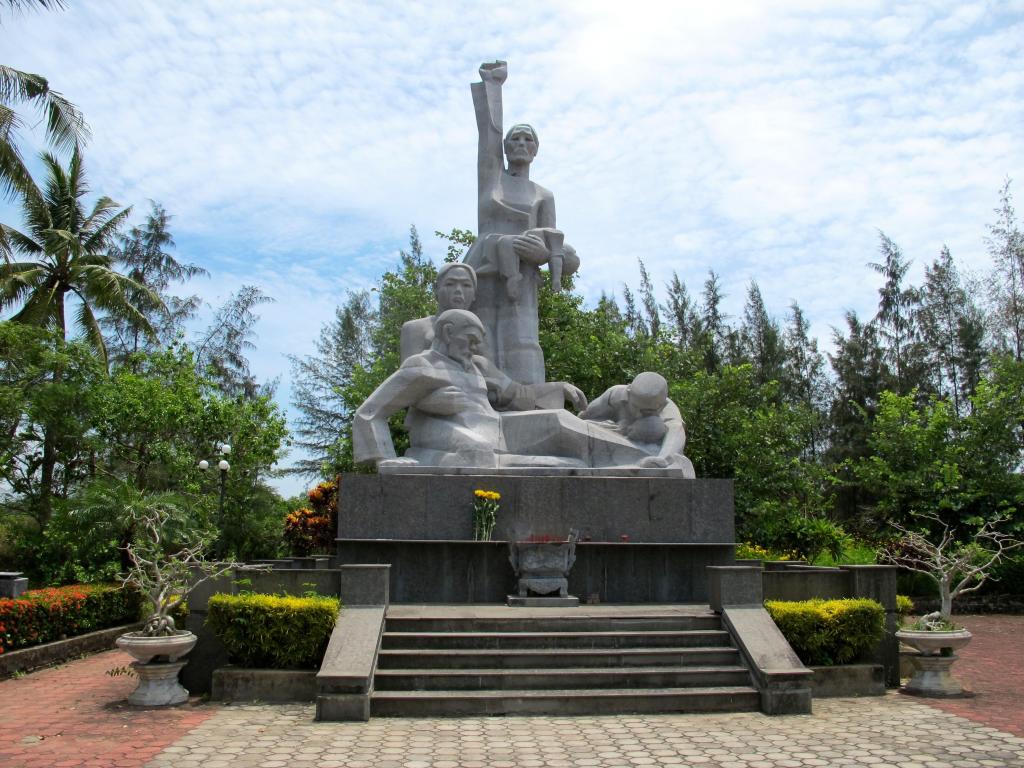
Today, the Sơn Mỹ memorial site preserves the memory of those who died.
The memorial includes names of victims, remnants of destroyed homes, photographs, documents, and personal belongings.
Each March 16, people gather to remember.
Some survivors have spoken about forgiveness. Others have described grief and anger that remain decades later.
There is no single response we should demand from them.
Forgiveness belongs to the person who was harmed. It is not something outsiders are entitled to request, expect, or celebrate on someone else’s behalf.
And remembrance does not require forgiveness.
What matters is that the victims are not forgotten and that survivors retain the right to tell their own stories.
One of the most meaningful things about the Sơn Mỹ memorial is that it returns attention to the people whose lives were taken.
Not merely to the Americans who killed them.
Not merely to the Americans who tried to stop the killing.
Not merely to the officers, investigators, politicians, or journalists.
To the people who lived there.
To the families.
To the children.
To the little boys with their marbles.
We Look at Her in the Light
I had to step away from this research.
Not because I no longer wanted to tell the story, but because I needed to find a way to look at it without being consumed by the anger.
And when I returned, I remembered why I started this series in the first place.
We cannot change what happened.
We cannot bring back the people who died.
We cannot give those children the lives they should have lived.
And we cannot promise that justice will always be served.
I’m going to hold your hand when I tell you this.
Justice isn’t always served.
Sometimes the people responsible for terrible acts never face consequences equal to the harm they’ve caused.
Sometimes institutions fail the very people they are supposed to protect.
Sometimes the truth comes too late.
And sometimes we have to live with the knowledge that the world did not make something right.
But that does not mean we stop caring.
It does not mean we stop asking questions.
And it certainly does not mean we look away.
My Lai happened. Her people lived, suffered, resisted, survived, and remembered.
We owe them the dignity of telling their story accurately.
We owe ourselves the honesty of examining what happened and why.
And we owe future generations the opportunity to recognize the warning signs when human beings begin treating other human beings as expendable.
Remembering My Lai cannot guarantee that another atrocity will never happen.
But refusing to remember makes it easier to ignore the dangers that allow atrocities to occur.
That’s why we’re telling her story.
Not to leave ourselves sitting in the darkness.
Not to pretend that remembering somehow repairs the damage.
But because the truth deserves to be seen.
We look at her in the light.
And here at the Grove, we’ll hold one another’s hands while we do.
Y’all come sit a spell.
Sources
- U.S. Army — Peers Inquiry, Volume I
- U.S. Army — My Lai at 50
- U.S. Army — Maintaining the High Ground
- PBS American Experience — Charlie Company and the Massacre
- PBS American Experience — Meet the Participants
- Smithsonian Magazine — The Ghosts of My Lai
- Voice of Vietnam — Survivor Writes Book on My Lai Massacre
- U.S. Court of Appeals — Calley v. Callaway, 1975


Leave a Reply