
Welcome, y’all. Come on up, grab something to sip on, and find yourself a comfortable spot on the porch. We’ve got some history to untangle today, and I think you’re going to want to settle in for this one.
I want you to imagine something.
Imagine waking up one morning and discovering that you’re living in a different country.
You haven’t packed a suitcase. You haven’t crossed a river or traveled a single mile. Your home is exactly where you left it. Your neighbors are the same people you’ve known for years. Your family’s graves are still in the same cemetery.
But a war has been fought, a treaty has been signed, and the country you’ve always called home is now governed by someone else.
Of course, changes in government don’t happen quite that neatly. The transition can take years, and its consequences can unfold over generations.
But the experience of finding yourself under a new government without ever leaving home was very real.
They didn’t cross the border. The border crossed them.
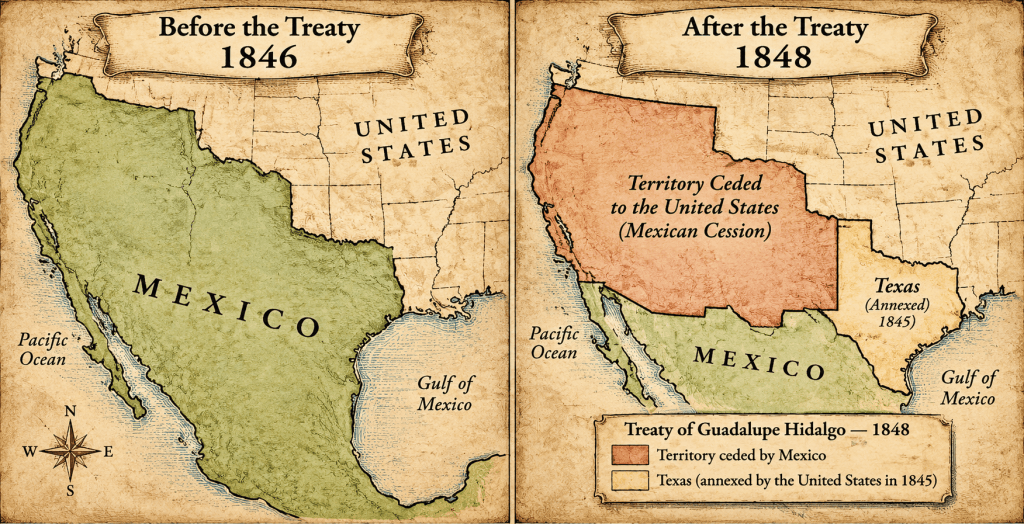
Most of us learned about the Mexican-American War and the Treaty of Guadalupe Hidalgo as part of America’s westward expansion. We saw maps showing the United States growing larger. We heard about Manifest Destiny, the acquisition of California, and America’s eventual reach to the Pacific Ocean.
One color on the map became another. A boundary shifted. A country grew.
But those maps rarely told us much about the people already living there.
And once I began looking for those people, I found a story considerably more complicated than the maps suggested.
A Petition for a Place to Call Home
In November 1794, a man named Lorenzo Márquez approached the Spanish governor of New Mexico with a request.
He was speaking for himself and 51 other men who wanted to establish a settlement along the Pecos River.
Márquez explained that their existing land was inadequate. Their families were large, their holdings were small, and water was scarce.
In the petition, preserved in English translation in an 1897 Supreme Court decision, he explained that the land they possessed was:
“not sufficient for our support”
It was a practical request from people trying to build sustainable lives for their families.
The petition also included an interesting detail: 13 of the petitioners were identified as Indigenous. The proposed settlement was intended to accommodate not only the original applicants but also others in the province who needed land.
On November 25, 1794, the governor approved the grant.
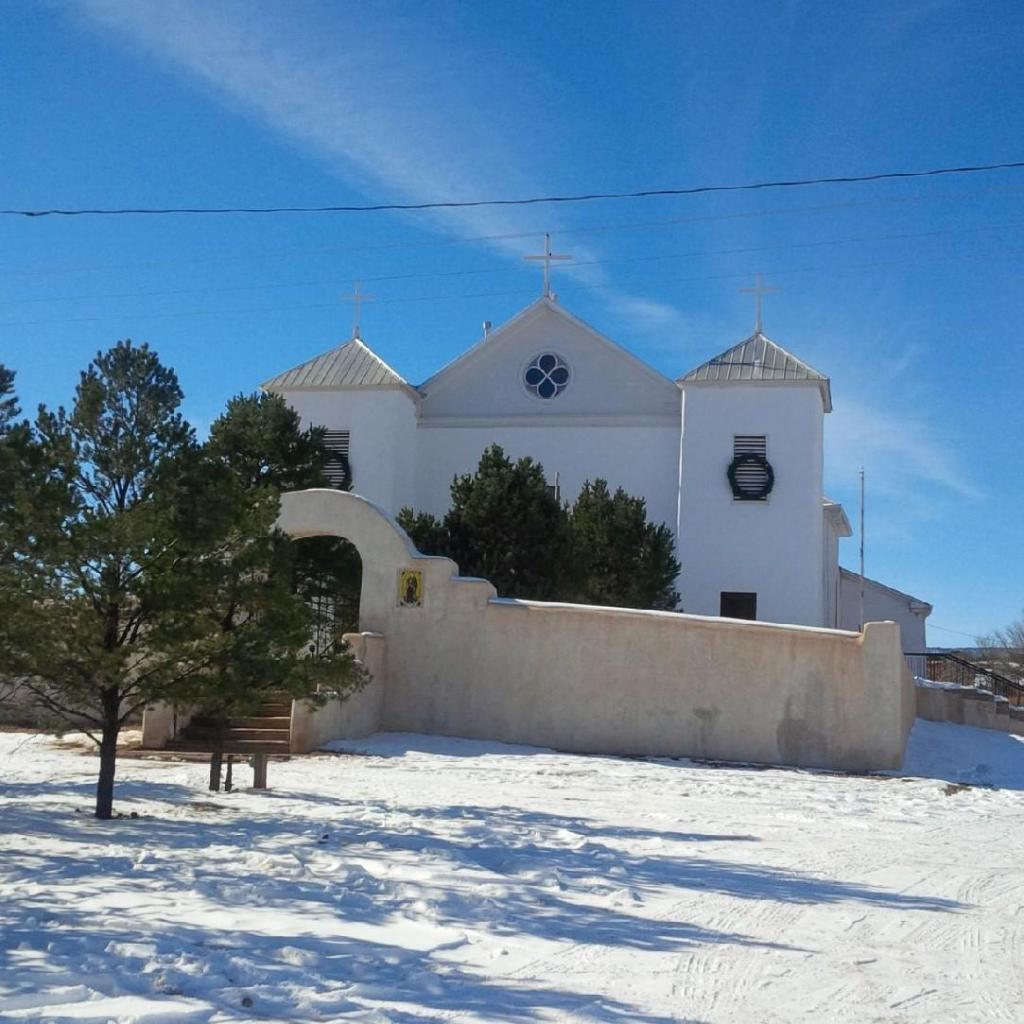
The settlement became known as San Miguel del Vado.
Families established homes and cultivated individual plots. They also depended on surrounding common lands for grazing, water, and other resources.
The original grant conditions explicitly provided for shared use by settlers who joined the community.
That distinction would eventually become enormously important.
The community wasn’t simply a collection of individually owned farms. Access to shared resources helped sustain the settlement.
And for decades, that was how people lived.
In 1821, Mexico gained independence from Spain. New Mexico became part of the new Mexican nation.
The people of San Miguel del Vado experienced a change in government, but the community continued.
Then came the Americans.
A War Over Territory
To understand what happened to San Miguel del Vado, we need to travel east for a moment, to Texas.
Texas declared independence from Mexico in 1836. Mexico did not recognize that independence, and a territorial dispute remained unresolved.
Texas claimed that its southern boundary extended to the Rio Grande. Mexico maintained that the boundary lay farther north, at the Nueces River.
When the United States annexed Texas in 1845, it stepped directly into that dispute.
President James K. Polk was an enthusiastic supporter of territorial expansion. His administration wanted California and New Mexico, and diplomatic efforts to acquire those territories had failed.
Polk ordered American troops into the disputed territory between the Nueces and the Rio Grande.
In April 1846, Mexican forces attacked an American patrol.
Polk told Congress that Mexico had shed American blood on American soil.
Congress declared war in May.
But there was a rather significant problem with that explanation.
Whether the fighting had occurred on American soil was precisely what the two countries disputed.
The location of the boundary wasn’t a settled fact. It was part of the conflict.
And not everyone in the United States accepted the president’s justification.
Not Everyone Agreed
In December 1847, a young Illinois congressman named Abraham Lincoln challenged President Polk to identify the exact spot where American blood had been shed.
Lincoln wanted to know whether that location had actually belonged to the United States before the fighting began.
His questions became known as the Spot Resolutions.
Other Americans also opposed the war, although their reasons varied.
Some questioned the president’s actions. Others feared that acquiring new territory would allow slavery to expand. Still others believed the United States was using its military strength to take land from a weaker country.
Those objections were not all motivated by concern for the Mexican people. American politics, particularly the conflict over slavery, played a substantial role.
But the opposition matters because it reminds us that the war’s justification was contested even at the time.
Ulysses S. Grant offers another perspective.
Grant served in the Mexican-American War as a young Army officer. Years later, in his memoirs, he condemned the conflict as unjust, describing a stronger nation seeking territory from a weaker one.
His criticism was retrospective, unlike Lincoln’s questions during the war.
Still, it came from someone who had participated in the fighting.
We sometimes look back at troubling historical events and assume that nobody questioned them because everyone thought differently then.
But people did question this war.
The disagreement is part of the historical record.
And while Americans argued over the war’s legitimacy and its consequences for their country’s future, the people living in the territories being fought over had their own futures at stake.
A Treaty, a Payment, and a New Map
On February 2, 1848, the United States and Mexico signed the Treaty of Guadalupe Hidalgo, formally ending the Mexican-American War.
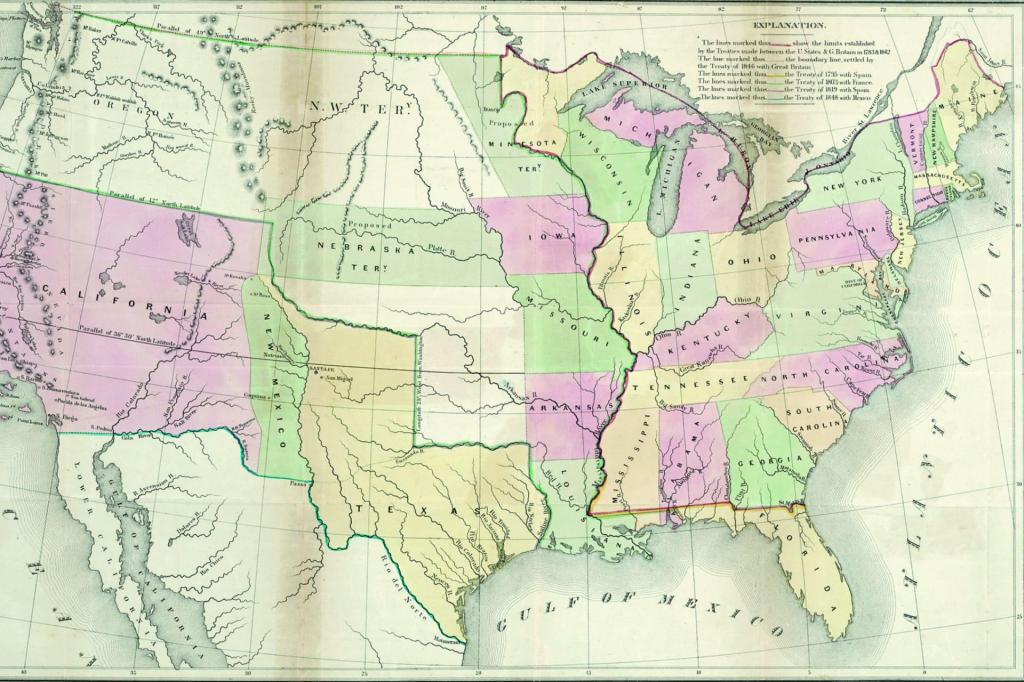
Mexico ceded an enormous territory that included present-day California, Nevada, Utah, New Mexico, most of Arizona, and portions of several other states.
Mexico also relinquished its claims to Texas and accepted the Rio Grande as the international boundary.
The United States agreed to pay Mexico $15 million and assume certain financial claims.
In all, Mexico relinquished roughly 55 percent of the territory it had claimed before the war.
For the United States, it was a tremendous territorial expansion.
For Mexico, it was a devastating loss.
But the territory wasn’t empty.
People lived there.
They owned homes, farmed fields, raised livestock, operated businesses, and maintained communities whose histories stretched back generations.
The treaty recognized that reality, at least in part.
Articles VIII and IX addressed the rights of Mexican residents living in the transferred territories.
They could remain where they lived or relocate to Mexico. Those who remained had options concerning nationality, and the treaty provided for their incorporation into the United States under its terms.
Their property was supposed to be respected.
Their liberty and religious freedom were also protected.
These were written commitments in an international agreement.
And yet, as we so often discover when examining history, the distance between a promise and its fulfillment can be considerable.
The Article That Disappeared
The original treaty contained a provision specifically addressing Mexican land grants.
Article X was intended to protect grants made by Mexican authorities, subject to the conditions described in the article.
But when the treaty reached the United States Senate, the Senate removed Article X before ratification.
Now, we need to be careful here.
Removing Article X did not automatically eliminate every property right held by Mexican residents.
Articles VIII and IX still contained protections, and the United States remained obligated to respect valid property rights.
But the removal of Article X left important land-grant questions to be resolved through American administrative and judicial processes.
And those processes could be expensive, complicated, and painfully slow.
Imagine having to prove to a new government that the land your community had used for generations was legally yours.
Imagine searching for old documents, translating records, hiring attorneys, and trying to explain a system of communal land use to officials working within a different legal framework.
And imagine what might happen if the court decided that your understanding of your community’s rights didn’t match the law it believed applied.
For the people of San Miguel del Vado, that was no longer a hypothetical question.
Fifty Years Later, a Courtroom
In 1897, nearly half a century after the Treaty of Guadalupe Hidalgo, the United States Supreme Court decided United States v. Sandoval.
The case involved the San Miguel del Vado land grant.
The community’s claim covered approximately 315,300 acres.
The dispute centered on the legal status of the common lands surrounding the individually allotted parcels.
Under the original settlement arrangement, residents had used those lands for grazing and other community needs.
But did the community actually own them?
Or had the unallotted lands remained property of the Spanish government, then the Mexican government, and finally the United States?
The Supreme Court concluded that the unallotted common lands had remained under governmental ownership and passed to the United States when sovereignty changed.
The individually allotted lands stood on a different legal footing.
The Court was not saying that the United States could simply seize private property in violation of the treaty.
It was deciding that the community’s claim to the broader common lands did not constitute the kind of private title the court could confirm.
That is an important legal distinction.
But consider what it meant in practical terms.
For generations, access to common lands had helped families raise livestock and obtain resources necessary for daily life.
The court’s interpretation of ownership meant that their longstanding use did not, by itself, establish an enforceable private title to those lands.
The land itself hadn’t disappeared.
The families hadn’t moved.
But the rules determining their rights to that land had changed.
And the consequences reached far beyond the courthouse.
I keep thinking about Lorenzo Márquez.
In 1794, he had petitioned for land because his family and his neighbors needed enough resources to support themselves.
More than a century later, their successors were still trying to establish what the community was entitled to keep.
And that brings us to another question.
But Whose Land Was It Before That?
We’ve been talking about land granted by Spain, governed by Mexico, and acquired by the United States.
But the legal documents of those governments don’t tell the whole story of the Southwest.
Indigenous nations had occupied these territories long before Spanish colonization. They had their own governments, cultures, economies, and relationships with the land.
Even our San Miguel del Vado petition reminds us that Indigenous people were part of the region’s communities. Thirteen petitioners were identified as Indigenous.
But being identified as an Indigenous settler within a Spanish land-grant community was not the same political or legal circumstance as belonging to a sovereign Indigenous nation whose homeland was claimed by competing governments.
That difference matters.
The Treaty of Guadalupe Hidalgo addressed the rights of Mexican residents. It did not negotiate a settlement with the Indigenous nations whose homelands lay within the transferred territory.
Those nations were not parties to the agreement.
Article XI acknowledged Indigenous peoples living in the region, but addressed them primarily as a matter of security and conflict between the two governments.
The treaty used the phrase “savage tribes.”
Those are the words of the historical document, not mine.
And they tell us something about the assumptions underlying the agreement.
Two governments were negotiating authority over vast territories while discussing the Indigenous peoples living there as populations to be controlled.
Their homelands were involved.
Their futures were at stake.
But they had no seat at that negotiating table.
To understand what that meant, we need to follow another documentary trail.
The Diné: A Country of Their Own
The Diné, also known as the Navajo people, had lived in the Southwest for generations.
Their homeland encompassed areas of what are now Arizona, New Mexico, Colorado, and Utah.
Their connection to that land was not simply economic. It was woven into their identity, spiritual traditions, and understanding of the world.
After the United States acquired the region, American officials and Diné leaders negotiated an 1849 treaty intended to establish peace.
But conflict continued.
In the 1860s, the United States military launched a campaign to force Diné submission.
Troops under Kit Carson destroyed crops, livestock, and other resources, making it increasingly difficult for families to survive.
Thousands of Diné were then forcibly removed from their homeland and sent to Bosque Redondo in eastern New Mexico.
The forced marches became known as the Long Walk.
People suffered from hunger, exposure, exhaustion, violence, and disease.
Conditions at Bosque Redondo were disastrous. The land was poorly suited to supporting the population held there, food was inadequate, and many people died.
This forced removal was not ordered by the Treaty of Guadalupe Hidalgo.
It resulted from later military policies and conflicts.
But it unfolded within the broader expansion of American authority over lands the United States had acquired from Mexico.
And here, at Bosque Redondo, we encounter a voice that I don’t think any of us should forget.
“Except My Own Country”
In 1868, American commissioners came to negotiate with Diné leaders.
General William Tecumseh Sherman considered relocating the Diné to Indian Territory, in what is now Oklahoma.
But the Diné wanted to return to their own homeland.
One of their leaders, Barboncito, spoke about the suffering his people had endured.
He described the deaths, the loss of livestock, and the terrible conditions at Bosque Redondo.
He explained that their ancestors had taught them where their people belonged.
And then he made a plea recorded in the negotiations:
“I hope to God you will not ask me to go to any other country except my own.”
Read that again.
He wasn’t asking for wealth.
He wasn’t asking for the territory of another people.
He was asking to go home.
His words were recorded through the translation and transcription practices of the time, so we should recognize that we are reading an English rendering of his appeal.
But the meaning is unmistakable.
And Barboncito was not acting alone.
Diné women also pressed the commissioners to allow their people to return. Their determination was part of the successful effort to secure a return to the homeland.
In June 1868, Diné leaders and the United States signed a treaty establishing a reservation within part of the Diné homeland.
The Diné had negotiated the right to return.
It was an extraordinary achievement, although the treaty did not restore every part of their traditional territory or end the restrictions imposed by American rule.
Then came the journey home.
When They Saw the Mountain
Diné leader Manuelito later recalled the return from Bosque Redondo.
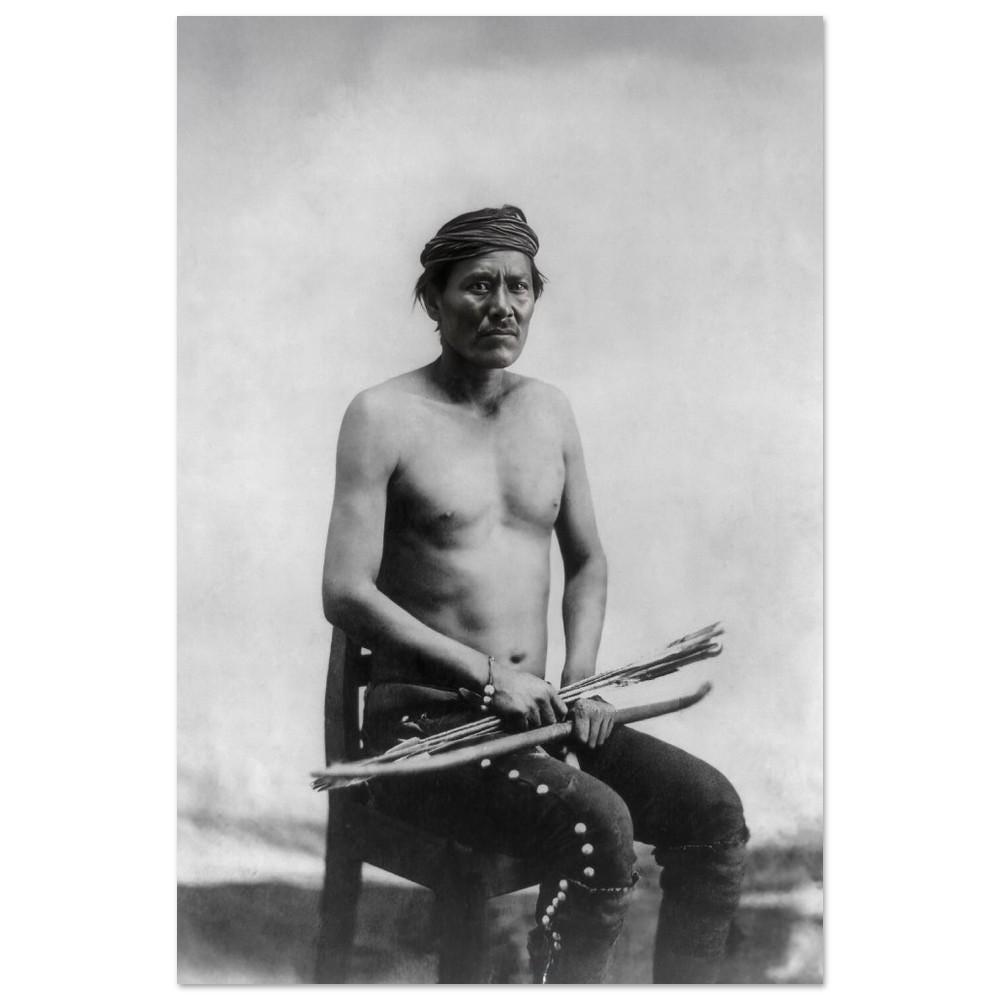
He remembered how eager the people were to begin the journey.
And he described the moment when they saw the familiar mountains of their homeland.
In a recollection preserved in later historical writing, Manuelito said:
“we felt like talking to the ground, we loved it so”
He remembered elderly people crying with joy when they reached home.
I find that almost impossible to read without emotion.
After years of displacement, hunger, and loss, the sight of familiar land meant that much.
And it tells us something that a treaty or a military report cannot fully express.
For the Diné, returning home wasn’t simply a matter of being assigned a different place to live.
It was a return to the land that shaped their identity and sustained their people.
The Diné story includes tremendous suffering.
But it also includes resistance, negotiation, persistence, and survival.
They were not passive recipients of American policy.
They fought to determine their own future.
And they succeeded in securing something the government had initially been unwilling to grant.
The right to go home.
The Pueblo Peoples: Another Fight for the Land
The Diné weren’t the only Indigenous people whose relationship with the United States would be shaped by territorial expansion.
In New Mexico, Pueblo communities faced a different set of challenges.
Their villages, agricultural traditions, irrigation systems, ceremonial practices, and governments had histories extending back centuries before Spanish colonization.
Some Pueblo landholdings had received formal recognition under Spanish and Mexican rule.
But recognition under one government did not guarantee that another government would interpret those rights in the same way.
Under American rule, questions arose about Pueblo sovereignty, the legal status of their lands, and whether outsiders could acquire property within Pueblo communities.
The consequences continued well beyond the nineteenth century.
By the early 1920s, Pueblo leaders were confronting proposed federal legislation associated with Senator Holm O. Bursum of New Mexico.
The Bursum bill would have strengthened certain claims by non-Indigenous settlers occupying Pueblo lands.
For Pueblo communities, the issue wasn’t merely whether individual parcels had been occupied by outsiders. It was whether federal law would protect their longstanding land rights or further weaken them.
And they were not willing to leave that decision entirely to others.
Pueblo leaders organized, petitioned, traveled to Washington, and worked with allies to oppose the proposal.
Pablo Abeita of Isleta Pueblo was among the prominent Pueblo advocates involved in the wider struggle for Pueblo rights.
The Bursum bill was defeated.
But that victory did not end the dispute.
In 1924, Congress passed the Pueblo Lands Act, creating a process to investigate and resolve competing claims. Some non-Indigenous claims were recognized, and the resulting settlements did not fully restore all disputed Pueblo lands.
The legal questions were complicated, but the underlying concern was familiar.
Who had the authority to determine what belonged to a community?
What happened when one system of landholding encountered another?
And whose understanding of ownership would prevail?
The Pueblo peoples did not share one identical history, nor was their experience the same as that of the Diné.
But their organized opposition to the Bursum bill reminds us that they were political actors defending their own interests.
They weren’t simply waiting for federal officials to decide their fate.
They spoke.
They organized.
They resisted.
And they continued working to protect their communities.
When a Promise Meets the Law
We’ve traveled a long way from Lorenzo Márquez’s petition in 1794.
We’ve followed a war, an international treaty, a Supreme Court decision, forced removal and return, and twentieth-century battles over Pueblo land rights.
These events did not all arise from the same legal circumstances.
San Miguel del Vado involved a dispute over the nature of a Spanish community land grant.
The Diné struggled against military policies that forced them from their homeland before they negotiated a treaty allowing their return.
Pueblo communities confronted disputes over sovereignty, property, and the recognition of their longstanding land rights.
We should not flatten those differences.
Nor should we assume that every land claim was valid or every court decision lacked a defensible legal rationale.
But understanding the legal arguments doesn’t mean we should overlook their human consequences.
The Treaty of Guadalupe Hidalgo promised protections to Mexican residents. Determining how those protections applied could require decades of litigation.
For Indigenous nations, the treaty between Mexico and the United States did not settle their own rights to their homelands. Those struggles continued through separate treaties, military conflicts, and federal legislation.
The common thread is not that every community experienced the same injustice.
It is that a change in sovereignty could profoundly alter people’s lives without changing where they lived or how deeply they belonged to the land.
And the people affected had to navigate, challenge, or resist the systems imposed upon them.
The People the Map Left Out
I keep coming back to those maps we saw in school.
The ones showing the United States expanding westward.
They’re useful. They tell us when territory changed hands and how national boundaries developed.
But they can also make the process look strangely simple.
A country gains territory.
Another country loses it.
The boundary changes.
And we move on to the next chapter.
Except the people living there couldn’t simply move on.
The families of San Miguel del Vado still needed land and water to support themselves.
The Diné still belonged to their homeland, even when they were forcibly removed from it.
Pueblo communities still had to defend their rights, their lands, and their independence under changing governments.
Their histories did not begin when the United States arrived.
And they did not end when American officials drew new lines on a map.
These were communities with histories, traditions, and institutions of their own.
They had leaders who spoke for them.
They had families who depended on them.
And they had people willing to fight, negotiate, petition, and endure in order to preserve them.
They Didn’t Cross the Border
When I began researching the Treaty of Guadalupe Hidalgo, I expected to find a story about a war, a treaty, and a territorial acquisition.
And those things are certainly part of it.
But what stayed with me wasn’t the size of the territory or the amount of money exchanged.
It was Lorenzo Márquez, asking for enough land and water to support his community.
It was the families whose claims to common lands would still be argued in court a century later.
It was Barboncito, standing before American commissioners and asking to return to his own country.
It was Manuelito remembering the joy of seeing the mountains of home.
And it was the Pueblo leaders who continued defending their communities’ land rights decades after the treaty had been signed.
Those are the people I want us to remember.
Because when we study territorial expansion, we usually ask what one country gained and another lost.
Those are important questions.
But we should also ask what happened to the people who were already there.
What happened to their homes?
Their land?
Their rights?
Their communities?
And what did it cost them to remain?
A border is more than a line on a map.
Sometimes it is a decision made far away, by people who will never meet the families whose lives it changes.
Sometimes it comes with promises.
Sometimes those promises are difficult to enforce.
And sometimes the people left to live with the consequences spend generations trying to protect what was already theirs.
They didn’t cross the border.
The border crossed them.
And their stories deserve to be part of the history we tell.
Y’all come sit a spell.
Sources
- National Archives — Treaty of Guadalupe Hidalgo (1848)
- U.S. Supreme Court — United States v. Sandoval, 167 U.S. 278 (1897)
- U.S. Government Accountability Office — Treaty of Guadalupe Hidalgo: Community Land Grant Claims in New Mexico
- National Archives — The Navajo Treaty Travels to the Navajo Nation
- Smithsonian National Museum of the American Indian — Navajo Treaty of 1868
- Utah History to Go — A History of Utah’s American Indians, Chapter 7
- New Mexico History Museum — Straight Back to Our Own Country
- [U.S. Congress — Congressional Record and


Leave a Reply