
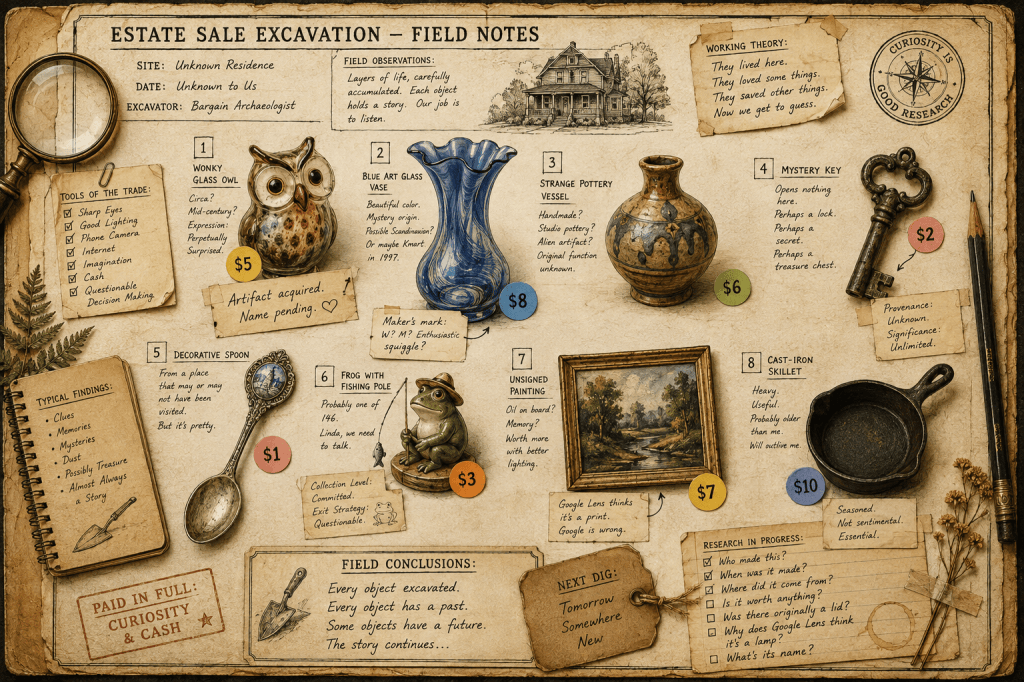
Come sit a spell.
I love an estate sale.
Not just because there might be a fabulous piece of glass sitting unnoticed on a back shelf for eight dollars.
Although let’s not pretend that isn’t a factor.
I love estate sales because they are essentially archaeology with price tags.
You walk through the front door of a house belonging to someone you’ve never met and, within fifteen minutes, you have developed an entire theory about their life.
You don’t mean to.
It just happens.
There are three sets of china in the dining room.
She entertained.
The garage contains every tool known to mankind, including seventeen screwdrivers that appear to be exactly the same.
He didn’t trust anybody to put his tools back.
There’s a sewing room with fabric stacked to the ceiling.
She had plans.
There is a cabinet containing approximately four hundred plastic grocery bags.
Depression-era parents. Those bags were never going to be wasted.
You know these people now.
Or at least you think you do.
That’s part of the fun.
Estate sales are different from antique stores.
An antique store has already edited the story.
Someone has selected the interesting things, cleaned them up, researched them, arranged them attractively and attached a little tag that says:
Mid-Century Italian Art Glass — $185
An estate sale says:
Blue Vase — $8
Now we’re talking.
Because that blue vase is sitting exactly where somebody left it.
Maybe it spent forty years on that mantel.
Maybe it was a wedding gift.
Maybe Aunt Margaret brought it back from Italy in 1963.
Maybe somebody bought it at Kmart in 1997.
We don’t know.
But suddenly I need to know.
So I pick it up.
Turn it over.
Look for a signature.
Hold it toward the light.
Squint at the bottom.
Take a picture.
Google something vague like blue glass vase weird bottom possibly Scandinavian.
This is research.
Do not question my methods.
Meanwhile, the house continues telling its story.
You learn which holidays mattered.
Christmas people are easy to identify.
There are bins.
So many bins.
Entire closets devoted to ornaments.
Possibly a ceramic village extensive enough to require municipal zoning.
Sometimes you encounter a person who clearly had a thing.
Owls.
Roosters.
Elephants.
Lighthouses.
Precious Moments figurines.
At some point this person casually mentioned liking frogs and made the catastrophic mistake of doing so within earshot of friends and family.
For the next thirty-seven years, every gift-giving occasion produced another frog.
Birthday?
Frog.
Christmas?
Frog.
Retirement?
Congratulations. Here is a frog holding a fishing pole.
Eventually the house contains 146 frogs and everyone attending the estate sale assumes the deceased had a lifelong passion for amphibians.
Maybe.
Or maybe Linda bought one frog in 1984 and lost control of the situation.
We will never know.
Then there are the collections nobody understands.
A drawer containing twenty-seven bottle openers.
Nine decorative spoons from places the owners may or may not have visited.
A basket of keys that open absolutely nothing currently located on the property.
Every estate sale has keys.
No one knows what they unlock.
No one is willing to throw them away.
They have simply been passed down through generations like tiny metal family secrets.
And then you find the good stuff.
Not necessarily the valuable stuff.
The interesting stuff.
A strange little piece of pottery.
An unsigned painting.
A wonderfully wonky glass owl.
Something handmade by somebody who clearly had a vision, although what that vision was remains open to interpretation.
That’s the moment I love.
Because everyone else has walked past it.
And something about it makes me stop.
Sometimes I know immediately what it is.
Sometimes I haven’t got a clue.
Sometimes I buy it specifically because I haven’t got a clue.
Those are dangerous words at an estate sale:
“What the hell is that?”
That’s how things come home with me.
Then the investigation begins.
Who made it?
When?
Where?
Is that signature a W?
An M?
Possibly a very enthusiastic squiggle?
Is this worth anything?
Was there originally a lid?
Why does Google Lens think it’s a lamp?
And, most importantly:
What’s its name?
Because apparently archaeology eventually becomes adoption around here.
But there’s another part of estate sales that sneaks up on you.
Every once in a while, you stop looking at the objects individually and see the whole house.
A life is being dismantled.
The dishes people ate from.
The chair somebody sat in every evening.
The Christmas decorations they unpacked year after year.
The tools.
The cookbooks.
The half-used box of birthday candles.
The good towels.
The ridiculous frog collection.
All the ordinary things that accumulate around a person simply because they were busy living.
It’s strangely intimate.
And strangely humbling.
Eventually, most of our possessions become things somebody else has to decide what to do with.
Keep.
Sell.
Donate.
Throw away.
Eight dollars for the blue vase.
Three dollars for the frog.
Free box by the driveway.
That could make estate sales unbearably sad.
But I don’t usually find them sad.
There’s something hopeful about them, too.
Because the story doesn’t necessarily end when the house is emptied.
Somebody walks in and notices the blue vase.
Someone else takes home the old cast-iron skillet.
A granddaughter keeps the Christmas ornaments.
A woodworker buys the tools.
And some woman who absolutely does not need another piece of glass spots a weird little owl on a table and says:
“Well, look at you.”
Five dollars later, he has a new house.
Probably a name.
Possibly an entire backstory.
And another chapter begins.
So yes, I go to estate sales looking for treasures.
Sometimes I even find something valuable.
But that’s not really why I keep going.
I like the hunt.
I like the mystery.
I like objects with history.
And I like walking into a house full of seemingly ordinary things and trying to figure out what they tell me about the people who lived among them.
It’s archaeology.
Except the artifacts have little round stickers on them.
And occasionally the archaeologist gets to take one home.


Leave a Reply