
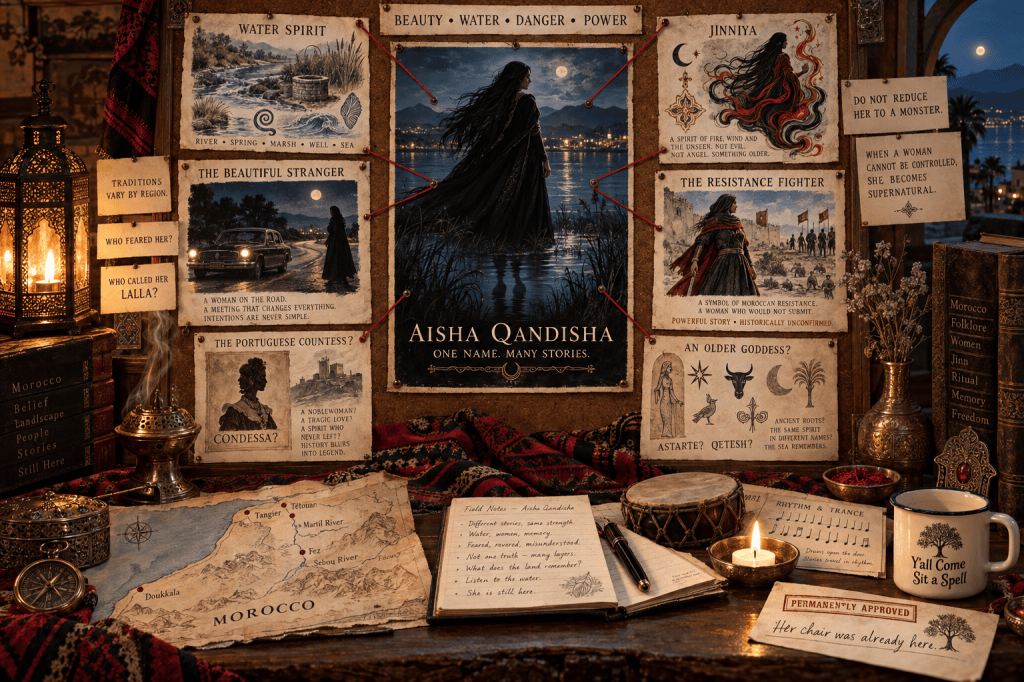
There are several things a man traveling alone at night in Morocco is advised not to do.
Do not linger beside isolated water.
Do not follow a beautiful stranger into the darkness.
Do not assume the woman asking for a ride is exactly what she appears to be.
And if you happen to look down and discover that she has the legs of a camel or goat, understand that the evening has taken a significant turn.
Her name is Aisha Qandisha.
Probably.
She has many names, several histories, multiple forms, and no particular obligation to explain herself to us.
Who Is Aisha Qandisha?
Aisha Qandisha is one of the best-known female spirits in Moroccan folklore.
Her name appears in several spellings, including Aicha Kandicha, Aïcha Qandisha, and Aisha Qandisa. She is also known by regional names and titles, including Lalla Aisha, a respectful form meaning Lady Aisha.
Descriptions vary across Morocco.
She is often portrayed as a strikingly beautiful woman with long dark hair and alluring clothing. She appears near rivers, springs, marshes, drainage canals, wells, or the sea.
She may approach men traveling alone after dark.
At first, everything seems promising.
Then they notice her feet.
Beneath the beautiful human form are the legs or hooves of a camel, goat, donkey, or other animal.
This is generally the point at which the evening ceases to feel promising.
Aisha may seduce the man, possess him, drive him mad, render him helpless, or kill him.
In some modern road stories, she asks a lone driver for a ride. He does not realize who she is until he sees the hooves.
Because apparently checking the passenger’s feet before allowing an unknown woman into the car is one more safety procedure men must learn through folklore.
She Belongs to the Water
Although the details change from region to region, Aisha Qandisha is consistently associated with water.
Near Tangier, she may belong to the sea.
Near Tétouan, she is connected to the Martil River.
In Fez, stories place her near canals.
Other traditions associate her with the Sebou River, springs, marshes, wells, and wet places where the ordinary world feels slightly less secure.
Water is a natural home for stories like hers.
It conceals.
It reflects.
It changes shape without losing itself.
A person standing beside dark water cannot see what waits beneath the surface, and reflections are perfectly capable of showing a familiar face attached to something else entirely.
Aisha is sometimes said to control water or alter it.
She may be called Aisha of the Sea or Lady of the Marsh.
But there may not be one single Aisha.
In some Moroccan spiritual traditions, several female spirits carry the name. They have different temperaments, colors, preferences, and relationships with the people who encounter or invoke them.
Trying to compress them into one standardized monster profile may say more about our need for tidy categories than it does about Aisha.
She is not interested in fitting neatly onto a cryptid identification card.
Jinn, Spirit, Woman, or Something Older?
Aisha Qandisha is often described as a jinniya, a female jinn.
That translation is useful, but incomplete.
In Morocco, traditions surrounding jinn are diverse and deeply woven into religion, place, family stories, healing practices, music, and everyday caution.
Aisha is not merely a spooky creature parents mention to keep children away from dangerous water.
For some communities, she is a meaningful spiritual presence connected to possession and healing rites.
The Hamadsha, Moroccan religious fraternities associated with music, trance, and therapeutic ritual, have traditions involving Aisha. She may be invoked, negotiated with, honored, appeased, or understood through possession.
Music, rhythm, incense, color, movement, and ritual can become part of the relationship between the spirit and the person affected by her.
This is considerably more complex than calling her a demon and moving along.
Aisha may harm.
She may possess.
She may also reveal an illness, create a role for the afflicted person, or participate in a process through which suffering becomes understandable and manageable.
In other words, this is living cultural and spiritual territory.
We should remove our muddy cryptid boots before entering.
Where Did She Come From?
Nobody knows.
That has not prevented people from offering theories.
One suggestion connects Qandisha to the Portuguese word condessa, meaning countess. Portuguese forces occupied several Moroccan coastal cities beginning in the fifteenth and sixteenth centuries, and later stories sometimes identify Aisha as a Portuguese noblewoman.
Another theory reaches much farther back, connecting her to ancient Mediterranean or North African goddesses associated with sexuality, war, and water.
Names such as Astarte and Qetesh appear in these discussions.
The similarities are interesting.
They are not proof of an unbroken historical line.
Folklore rarely travels through history carrying identification papers.
Stories merge. Names shift. Older beliefs settle inside newer religious traditions. Foreign words are reshaped by local speech. A frightening tale in one region becomes a sacred story in another.
Then there is the resistance fighter.
The Woman Who Fought the Portuguese
One popular modern version says Aisha Qandisha began as a real Moroccan woman during the Portuguese occupation.
In some tellings, soldiers attacked her village or killed members of her family. Aisha responded by using her beauty to lure Portuguese soldiers away from their camps.
Once they followed her into the woods or darkness, she killed them.
The colonizers began warning one another about the dangerous woman.
Over time, the resistance fighter became something supernatural.
Her ability to move unseen became magic.
Her beauty became enchantment.
Her courage became predation.
Her successful ambushes became the work of a demon.
It is a powerful story.
It is also difficult to verify historically.
There is no firm evidence establishing one documented resistance fighter as the origin of Aisha Qandisha.
The story may be old oral history.
It may be a later attempt to reclaim a frightening female spirit as an anti-colonial heroine.
It may be both.
Folklore does not become meaningless because it cannot be confirmed.
Sometimes the way a story changes tells us what people need it to mean.
The Beautiful Woman Is Dangerous Again
We have just left the sirens sitting comfortably on the Grove porch.
Now another beautiful woman waits near the water while men insist that she is responsible for what happens when they follow her.
There appears to be a pattern.
Aisha is beautiful, but her beauty is treated as a weapon.
Men desire her.
Men approach her.
Men follow her.
Men lose control.
The story concludes that she must be monstrous.
Her animal legs reveal the danger supposedly hidden beneath female beauty.
But they also expose the man’s failure to look beyond the part of her he wanted.
He saw a beautiful woman alone at night and built the rest of the story himself.
Then the hooves arrived.
Perhaps Aisha is a warning about lust.
Perhaps she is a warning against wandering near dangerous water after dark.
Perhaps she protects places where men are not welcome.
Perhaps she remembers colonizers who thought a beautiful woman could not also be a threat.
Perhaps the monster is what happens when a culture tries to explain female desire, rage, power, illness, or independence without allowing any of those things to belong fully to a woman.
Or perhaps she is a jinniya with camel feet who will absolutely ruin your evening.
Multiple interpretations remain available.
What Evidence Do We Actually Have?
Centuries of oral tradition.
Regional stories from across Morocco.
Accounts of possession.
Rituals, music, and healing practices associated with Aisha and related spirits.
Modern encounter stories.
Films, songs, books, and art.
Possible historical and linguistic connections.
No body.
No hoofprints scientifically connected to a supernatural woman.
No verified photograph.
No confirmed Portuguese countess transforming into a jinn.
No historical record proving that one resistance fighter became the Aisha Qandisha known today.
But unlike many cryptids, Aisha does not depend on zoological proof.
She does not need to be an undiscovered animal hiding beside a river.
She exists as folklore, spiritual presence, cultural memory, warning, explanation, fear, and rebellion.
Those are not lesser forms of existence.
They are simply harder to pin beneath museum glass.
The Grove Take
I do not think there is one correct Aisha Qandisha.
I think she has carried too many meanings for too many people to be reduced to a beautiful predator with camel feet.
She may contain memories of older water spirits.
She may carry traces of goddesses whose names were nearly lost.
She may express the terror of possession and mental illness.
She may offer a language through which suffering can be recognized and treated.
She may warn children away from water and men away from strangers.
She may preserve the story of a woman who resisted foreign occupation.
She may also represent something we keep encountering in folklore.
When a woman cannot be controlled, she becomes supernatural.
When she uses beauty deliberately, she becomes dangerous.
When men desire her and suffer for it, she becomes responsible.
When she fights back, history calls her a monster.
I cannot prove that Aisha Qandisha began as a resistance fighter.
But I understand why people want that version remembered.
A beautiful woman lured armed occupiers away from their camps and killed them.
The soldiers called her a demon.
Her people called her Lalla.
Lady Aisha.
Perhaps both names tell us exactly who feared her and who did not.
Does She Get a Chair on the Porch?
Aisha Qandisha does not need our permission to sit on the porch.
Her chair is already there.
It will be placed near the water, but not so near that anyone can claim we failed to establish reasonable safety precautions.
We will greet her respectfully as Lalla Aisha.
We will not demand that she choose one origin story, one body, one name, or one explanation for herself.
We will not ask to inspect her feet.
That seems rude.
The sirens are nearby, so she will have company familiar with being blamed when men follow beautiful women toward water.
There will be no attempts to summon, control, test, provoke, or photograph her.
There will be music if she requests it.
There will be silence if she does not.
Men traveling alone after dark are responsible for their own decisions.
Her chair is approved.
Permanently.
Bring your own boundaries.


Leave a Reply