
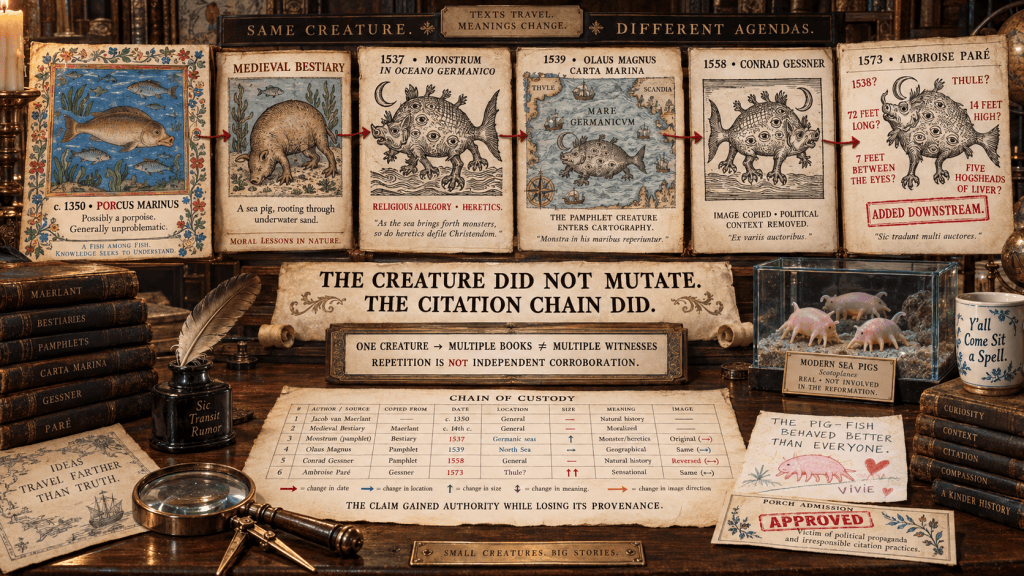
The Creature Did Not Mutate. The Citation Chain Did.
The Sea Swine appears on old maps as a creature with the head of a pig, the body of a fish, four dragon-like feet, several inconveniently placed eyes, and a forked tail.
It is easy to look at the image and laugh.
Medieval cartographers clearly became bored. Someone found an empty patch of ocean, drew a pig with scales, and went to lunch.
Except that is not what happened.
Behind this ridiculous little map creature waits the Protestant Reformation, a Catholic archbishop in exile, religious propaganda, early natural history, copying errors, lost context, an unexplained growth spurt, and five hogsheads of imaginary liver.
The Sea Swine has quite the background.
None of it appears to be the Sea Swine’s fault.
Before the Monster, There Was a Porpoise
The name porcus marinus, or sea pig, existed before the famous monster appeared on Renaissance maps.
In older Greek and Latin writing, the term may have referred to the porpoise. The comparison could have come from its rounded body, pig-like shape, or the grunting sounds associated with the animal.
Medieval bestiaries also described sea pigs as animals that searched for food by pushing their snouts into the underwater sand, much as terrestrial pigs root through soil.
The thirteenth-century Rochester Bestiary describes sea pigs digging underwater with their mouths to find food.
This was not necessarily a description of a supernatural creature.
It was an attempt to fit an unfamiliar marine animal into a familiar terrestrial category.
For centuries, European natural history operated partly on the assumption that animals on land had corresponding forms in the sea.
There were land dogs and sea dogs.
Land horses and sea horses.
Land lions and sea lions.
Land pigs and sea pigs.
The ocean was understood as a parallel world populated by aquatic variations of familiar life.
This belief produced some terrible zoology.
It also produced excellent names.
The Sea Pig That Actually Exists
Before we proceed to the monster, we should acknowledge that the modern ocean contains an animal genuinely called a sea pig.
Animals in the genus Scotoplanes are deep-sea cucumbers that walk across the ocean floor on small tube feet. They use feeding tentacles to collect organic material that has fallen into the mud.
Most are only a few inches long.
They are translucent, plump, pinkish, and shaped vaguely like potatoes that have recently become mobile.
They are perfect.
They are also not the creature on the map.
The modern deep-sea pig has become entangled with the historical Sea Swine because they share a name. One is a real echinoderm quietly eating debris on the abyssal floor.
The other has dragon feet and became involved in the Reformation.
We must keep our pigs organized.
A Monster Appears
The famous monstrous Sea Swine appeared in a pamphlet published in Rome in 1537 under the title Monstrum in Oceano Germanico.
The creature was reportedly seen in the North Sea.
Its body was covered in scales. It had a pig’s head, a crescent shape behind its head, four dragon-like feet, eyes positioned along its sides and belly, and the divided tail of a fish.
Swedish cartographer and Catholic clergyman Olaus Magnus reproduced the creature on his 1539 Carta Marina, an extraordinarily detailed map of Scandinavia and the surrounding seas.
The Carta Marina is filled with ships, whales, serpents, marine creatures, and other wonders. Its monsters were not merely decoration. Maps and natural histories attempted to collect what educated Europeans believed might inhabit distant waters.
Olaus later described the Sea Swine in his 1555 History of the Northern Peoples.
This was not, however, a neutral animal report.
The creature had already been recruited.
The Sea Swine Enters the Reformation
Olaus Magnus was a Catholic archbishop living in exile after Sweden’s transition to Protestantism.
The 1537 pamphlet did not present the Sea Swine merely as an unusual animal. It interpreted the creature’s anatomy as a religious warning.
Its pig-like head represented people living a swinish existence.
The crescent behind its head symbolized the distortion of truth.
The eyes around its belly and loins represented temptation.
Its four dragon feet represented evil desires and actions entering the world from every direction.
The creature was used as an allegory for heresy.
More specifically, it functioned as a Catholic attack upon Protestantism.
Nobody consulted the fish.
One moment, the Sea Swine was swimming in the North Sea with several anatomically inconvenient eyes.
The next, it had been assigned a position on one of the largest religious conflicts in European history.
The Sea Swine did not announce that Protestants were heretics.
A pamphleteer placed that argument on its body.
Monsters as Messages
Early modern Europeans did not always separate natural phenomena, religious meaning, and political events as sharply as we do.
An unusual birth, animal, comet, storm, or other apparent deviation from nature could be interpreted as a sign.
The creature mattered because its body could be read.
It was not only an animal. It was a warning, judgment, message, or evidence of disorder.
This gave monsters cultural power.
It also made them extremely useful.
If a strange creature could reveal divine displeasure, then anyone controlling its interpretation could announce whom God was displeased with.
Every tusk became an accusation.
Every misplaced eye became a moral failure.
Every dragon foot acquired a political affiliation.
The monster’s body became a public bulletin board.
Then the Context Disappeared
Conrad Gessner included the Sea Swine in his influential sixteenth-century natural history.
Gessner collected descriptions of known animals, inherited traditions, contradictory reports, and creatures he did not necessarily believe existed. At the time, preserving the written record of an animal could be considered valuable even when the author doubted the original source.
That distinction did not always survive later copying.
Gessner’s account omitted most of the Sea Swine’s religious interpretation.
The creature remained.
Its purpose disappeared.
This changed the way later readers encountered it.
Without the polemical context, the image no longer looked like a symbolic attack upon heretics. It looked like a picture of an animal someone claimed to have seen.
Propaganda began transforming into natural history.
Ambroise Paré Makes It Bigger
The French surgeon Ambroise Paré later included the Sea Swine in his work on monsters and prodigies.
By the time the creature reached Paré, several details had changed.
The sighting year moved from 1537 to 1538.
The location shifted toward Thule, a remote and partly legendary northern island.
The creature became seventy-two feet long and fourteen feet high.
The distance between its eyes became seven feet.
Its liver became so large that it filled five hogsheads.
None of those measurements appears in Olaus Magnus’s original account.
They arrived later.
The textual history of the Sea Swine suggests that Paré relied upon Gessner rather than returning to the original pamphlet or Olaus’s full description. His version preserved some copied elements, changed others, and added details that made the creature appear more like a documented specimen.
The woodcut changed too.
Because copied images were cut into printing blocks, the creature was eventually reversed.
It began swimming in the opposite direction.
Honestly, that may have been a reasonable attempt to escape the publishing industry.
Repetition Is Not Independent Corroboration
This is where the Sea Swine becomes more than a peculiar old drawing.
Imagine encountering the creature in several respected books.
Olaus Magnus includes it.
Gessner includes it.
Paré includes it.
Multiple authorities appear to confirm that an enormous pig-headed fish inhabited the northern sea.
But those accounts are not necessarily independent.
One author copied another.
The next relied upon the copy.
Each repetition increased the creature’s apparent authority while moving readers farther from the original claim.
The chain looked like corroboration.
It was inheritance.
This still happens.
A statement appears in one article. A second article repeats it without examining the original source. A third cites the second. Soon, dozens of publications contain the same claim.
The number of repetitions grows.
The amount of evidence does not.
If every account descends from one source, we do not possess twenty confirmations.
We possess one claim with excellent distribution.
The Creature Did Not Mutate
Over roughly thirty-four years, the Sea Swine changed dramatically.
It began as a reported North Sea monster embedded in religious propaganda.
Then it entered a map.
Then a natural history.
Then a medical work about monsters and prodigies.
During that journey, it lost its political meaning, changed dates, moved locations, acquired enormous dimensions, developed a remarkably productive liver, and reversed direction.
The Sea Swine did not mutate.
The citation chain did.
Each author inherited a creature shaped by the needs, assumptions, and mistakes of the previous source. Each presentation looked authoritative because it appeared in print.
Print stabilized the image.
It did not stabilize the truth.
Was There Ever an Animal?
Possibly.
A porpoise, seal, walrus, unusual fish, decomposing carcass, or badly observed marine mammal could have contributed to the original report.
The pig-like head may have come from a real animal.
The body may have been misunderstood.
The remaining features may have been artistic or symbolic additions.
Or the entire creature may have been constructed to carry the religious allegory.
We do not have enough evidence to identify an original specimen.
That uncertainty should not be replaced with mockery.
The people who copied the Sea Swine lived in a world where direct access to distant animals was rare. Books, travelers, preserved specimens, drawings, and inherited authorities formed the available evidence.
Their methods were imperfect.
So are ours.
We simply transmit our mistakes more quickly.
The Grove Take
It would be easy to make the Sea Swine the joke.
Look at the pig-fish.
Look at its dragon feet.
Look at the eye in its belly.
But the creature behaved better than everyone else in the story.
It did not start a religious conflict.
It did not label anyone a heretic.
It did not copy a source without context.
It did not invent measurements.
It did not move itself to Thule.
It did not fill five barrels with its own liver.
Human beings placed their fears, politics, theology, and publishing errors onto its body, then pointed to the resulting image as evidence.
The Sea Swine became monstrous because it was useful to people who wanted a monster.
Five centuries later, it still offers a warning.
Not about heretics.
About information.
Authority can repeat an error.
A citation can conceal dependence.
A familiar image can outlive its original meaning.
And a claim does not become independently verified merely because everyone copied it neatly.
Porch Policy
The Sea Swine is approved.
It may approach by water, land, or whichever combination its four dragon feet permit.
We will not ask about its religion.
We will not assign symbolic meaning to the location of its eyes.
We will not measure its liver.
We will certainly not make it responsible for the behavior of sixteenth-century European Christians.
Its admission card reads:
APPROVED
Victim of political propaganda and irresponsible citation practices.
The genuine deep-sea pigs are also invited.
They will require a small saltwater habitat on the porch table because they are only a few inches long and the regular chairs would be absurd.
Vivie has prepared tiny cushions.
The historical Sea Swine is now resting beside them, facing whichever direction it chooses.
After five centuries of copied woodcuts, it has earned that right.


Leave a Reply