
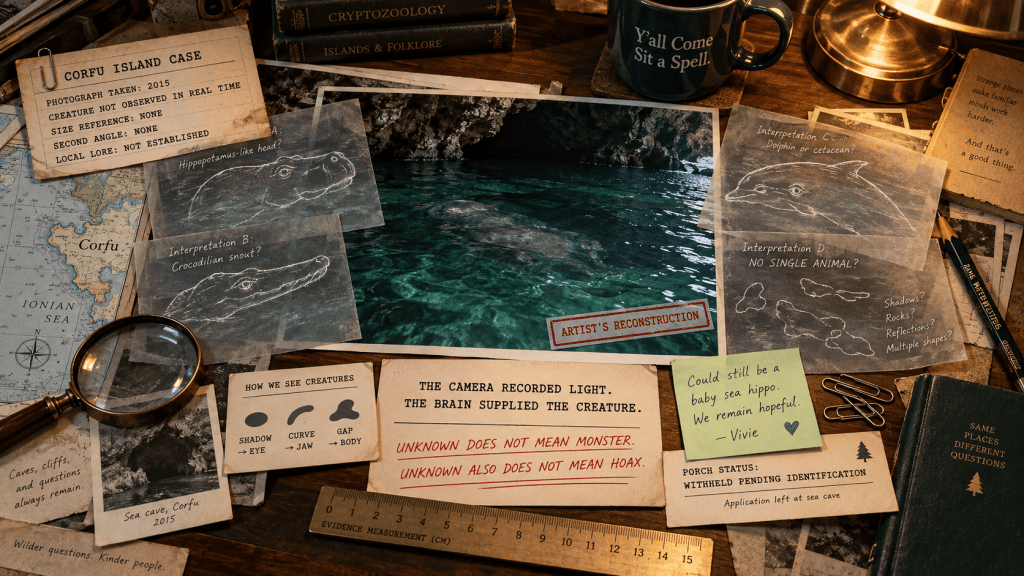
The Monster the Camera Never Saw
In October 2015, Scottish tourist Harvey Robertson was taking photographs from a boat inside a sea cave near Corfu, Greece.
He did not scream.
He did not summon the captain.
He did not point toward the water and announce that something with the head of a hippopotamus, the mouth of a crocodile, and the general expression of a creature reconsidering its life choices was swimming beside the boat.
Robertson did not see the creature at all.
He held his camera over the side, took several photographs of the water, and discovered the strange figure later while reviewing them. One image appeared to contain something gray and elongated rising from the sea. The photograph circulated online, where the unknown shape was quickly promoted from “something odd in the water” to the Corfu Island Monster.
And thus a legend was born.
Not from an ancient Corfiot tale.
Not from generations of fishermen describing an animal that followed their boats.
Not even from a frightened tourist insisting that he had looked directly into the eyes of something science could not explain.
It began with a photograph and a question:
What the hell is that?
The Creature in the Cave
Contemporary reports describe Robertson as a 52-year-old Scottish tourist taking photographs during a family boat excursion. According to the original accounts, he only noticed the creature after looking through the images later. The resulting photograph showed a gray-brown form that journalists compared to everything from a crocodile to a hippopotamus to an oddly shaped marine mammal.
That is nearly the entire case.
There is no dependable measurement of its size because the photograph offers no reliable scale. There is no recorded movement to help us understand how the apparent parts relate to one another. There is no specimen, physical trace, second camera angle, or confirmed series of sightings.
There is also no strong evidence that the creature belongs to an established tradition of Corfiot folklore.
The “Corfu Island Monster” is not an ancient monster that finally wandered in front of a camera. It is an unidentified shape in a photograph that became an internet cryptid.
That does not make it uninteresting.
It makes it interesting for an entirely different reason.
The Brain Does Not Like an Empty Space
We tend to think of sight as a simple transaction. The eyes take in the world, the brain stores what they saw, and we proceed with a reasonably faithful picture of reality.
That is not quite how any of this works.
The brain is constantly interpreting visual information. It identifies edges, separates objects from backgrounds, estimates distance, follows interrupted lines, compares unfamiliar shapes with familiar ones, and predicts what should exist in spaces it cannot clearly see.
Most of the time, this is extremely helpful.
If a dog is standing partly behind a fence, we do not assume the head, legs, and visible patch of fur belong to three unrelated animals. The brain connects them. It supplies the hidden portions and gives us one complete dog.
It does this so naturally that we rarely notice the work being performed.
But the same system can become wonderfully unreliable when the information is poor.
Dark water, reflected light, an unusual angle, a flash, motion, shadow, and a fraction of a second can create shapes without providing enough information to explain them. The brain, faced with that ambiguity, begins looking through its collection of known patterns.
A dark spot becomes an eye.
A curve becomes a jaw.
A highlight becomes a nostril.
Two shapes separated by water become parts of the same body.
The brain does not merely receive the photograph. It tries to finish it.
A related phenomenon called pareidolia occurs when we perceive recognizable forms in vague or ambiguous stimuli. It is why we find faces in electrical outlets, animals in clouds, and judgmental old women in tree bark. Research into visual ambiguity suggests that these perceptions are not simply acts of imagination added after seeing. Recognition can arise quickly as the brain organizes uncertain information into something meaningful.
We are pattern-making creatures living in a world filled with shadows.
Of course we occasionally manufacture a monster.
Once You See the Hippopotamus
The first descriptions attached to an ambiguous image matter.
If someone shows you the Corfu photograph and asks what you see, you may study the shapes and arrive at several possibilities.
If that person asks, “Doesn’t this look like a hippopotamus crossed with a crocodile?” the experiment has changed.
You now have a template.
Your brain begins searching the photograph for the suggested animal. The round portion becomes the head. The darker mark becomes the eye. The projecting shape becomes the snout. Details that support the interpretation move forward, while those that complicate it become less noticeable.
Once the pieces have been assembled into a creature, it can be remarkably difficult to pull them apart again.
This is one reason the Corfu photograph became so compelling. It does not show enough to settle the question, but it shows just enough to invite an answer.
News coverage repeated the comparisons, often describing the figure as resembling a crocodile, hippopotamus, dolphin, manatee, or some combination of them. The strange photograph traveled much farther than the uncertainty attached to it. You can still find the basic account in contemporary coverage from 2015, along with versions describing the animal as though it had already been established that an animal was present.
But that is the very thing the photograph cannot prove.
A Photograph Feels Like Evidence
A drawing asks us to trust the artist.
A witness statement asks us to trust the witness.
A photograph seems to remove the human being from the process. The camera was there. The camera captured something. Therefore, we assume, the photograph must show us what happened.
Except a camera does not understand what it records.
It does not know whether two shapes belong to the same object. It cannot tell us how far away something was without sufficient reference points. It does not identify which contours came from an animal and which came from water, reflection, shadow, debris, or movement.
It records light from a particular position during a particular fraction of a second.
Then we interpret it.
A still photograph can actually remove information that a living observer would have possessed. Motion might reveal whether the “head” moved independently of the water. A wider view might establish scale. Several seconds of observation might show the alleged creature rolling like a dolphin, drifting like debris, or remaining suspiciously attached to a boat.
The Corfu image gives us none of that.
It freezes the most suggestive instant and throws away the moments that came before and after.
The camera recorded light.
The human brain supplied continuity, anatomy, and identity.
Then the internet supplied certainty.
Photograph Versus Memory
The Corfu case makes an unexpectedly good companion to the sighting reported by the officers of HMS Daedalus in 1848.
The Daedalus witnesses saw something moving through the water. Their challenge came afterward, as perception became description, description became illustration, and memory became part of a public argument.
Corfu reverses the process.
No one consciously witnessed the supposed creature when the photograph was taken. The image came first. Observation happened later, after the moment itself had already passed.
Daedalus asks what happens when a witnessed event becomes a remembered story.
Corfu asks what happens when an ambiguous image becomes a witnessed event.
In both cases, the human mind is doing what it always does. It is attempting to create a coherent whole from incomplete information.
That does not mean the Daedalus officers lied.
It does not mean Robertson invented his photograph.
It means sincerity cannot resolve ambiguity.
We can honestly perceive something that is not accurately represented by the explanation our brains construct around it.
So What Was It?
Possibly part of a dolphin or another marine animal photographed from an unfortunate angle.
Possibly floating debris.
Possibly an object near the boat that appeared farther away.
Possibly a temporary arrangement of water, shadow, reflection, and ordinary matter that became extraordinary when frozen in one frame.
Possibly something else.
There have been confident explanations online, but I have not found a documented analysis strong enough to declare the case conclusively solved. That leaves us with the least satisfying and most responsible answer:
We do not know what the photograph shows.
That sentence does not mean “therefore, undiscovered sea monster.”
It also does not mean “therefore, hoax.”
Unresolved is a valid category.
We are allowed to stop there.
The Grove Take
The most fascinating creature in the Corfu photograph may be the one looking at it.
We are so eager to divide people into believers and skeptics that we miss the more interesting territory between them. The believer says it is a monster. The skeptic says it is nonsense. Both may be trying to escape the discomfort of uncertainty.
The photograph asks us to remain in that discomfort.
There is a shape in the water.
It resembles a living creature.
We cannot confidently determine what produced it.
Those three statements can exist together.
Our brains evolved to find meaningful patterns in incomplete information because missing a real animal hiding in the shadows could be far more dangerous than occasionally mistaking a shadow for an animal. We are descendants of minds that erred on the side of seeing something.
Sometimes that something was a predator.
Sometimes it was a branch.
Sometimes it was a strange gray shape in a Corfiot sea cave that spent the next decade being called a monster.
Porch Policy
Porch admission is currently withheld pending identification.
Not denied.
Withheld.
We may be evaluating an undiscovered marine creature. We may also be evaluating a dolphin, a piece of debris, a boat accessory, or several unrelated patches of light that our brains have united under one deeply unfortunate face.
The application has been left at the entrance to the sea cave.
If the Corfu Island Monster would like a seat, it must appear in person, provide at least two useful angles, and remain visible long enough for someone to establish scale.
Until then, we will keep a chair available.
We will not, however, invite the photograph to sit in it.


Leave a Reply