
The Whale We Called Lonely
Somewhere in the North Pacific, a whale made a sound that caught a researcher’s attention.
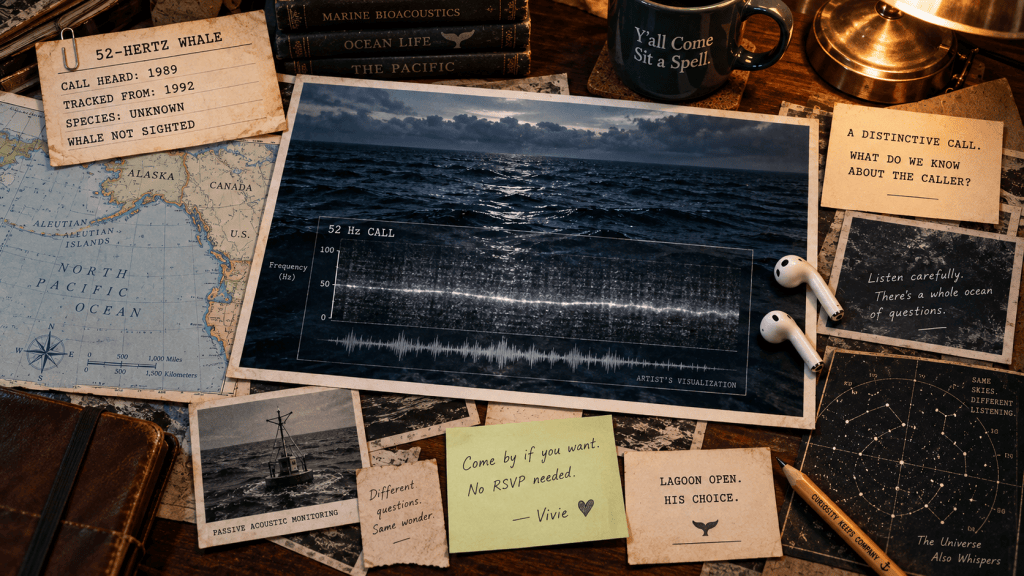
The call emphasized a frequency around 52 hertz. Researchers heard it in 1989 and tracked similar calls across the ocean beginning in 1992. Over twelve years of recordings, they found one sequence of those distinctive calls at a time. They could follow the sound. They could not tell us what species made it, or show us the animal itself. Their published study is here.
Naturally, we gave the whale a name: the loneliest whale in the world.
I understand the impulse. One voice, sounding unlike the others researchers were tracking, moving through an ocean too large for my brain to hold all at once. You hear that story and your heart starts writing ahead of the evidence.
Mine does, too.
But the recordings tell us about a call. They do not tell us whether the whale traveled with others, whether another whale heard him, or whether he wanted an answer. They certainly do not tell us how he felt. An unusual voice is not a diagnosis of loneliness.
And still, I want to know who he is.
He could have an unusual body. He could be a hybrid. He could be something the researchers hadn’t anticipated. The Woods Hole Oceanographic Institution discussed those possibilities, but possibilities are all they are. Until someone can connect that voice to a visible whale, his life stays larger than our explanations.
That may be what I love most about him. We know he called. We know someone heard him. Everything else requires a little humility.
Then I look up.
We have sent signals and messages into the void of space, hoping someone might detect a trace of us. We listen, too. We point instruments toward the dark and ask whether anyone is out there.
Are we lonely?
Sometimes, yes. I think a lot of us know what it is to speak and wait for a reply. But reaching outward can mean other things. Curiosity. Hope. A wish to understand a universe bigger than the part we occupy.
If no answer comes, what have we learned? Perhaps our signal missed its audience. Perhaps the audience has a different way of listening. Perhaps there is no one within reach. We do not know.
Silence tells us what we haven’t heard. It doesn’t tell us who’s alone.
We heard the whale’s call and filled the quiet around it with a story about solitude. We listen to space and risk doing the same thing to ourselves. I would rather keep asking the question than pretend the unanswered part has already been settled.
The Grove Take
I believe the sound. I believe the researchers followed something remarkable across the North Pacific. I do not believe a hydrophone can tell us whether its owner was lonely.
The story we made from the call says something real about us. We recognized ourselves in a voice that seemed to go unanswered. There is tenderness in that. There is also a responsibility to remember that the whale has a life of his own.
I want to meet him, if meeting means learning who made that sound and how he lives. I don’t need him to be heartbroken for the encounter to matter.
Porch Policy
If the 52-hertz whale desires to join us, there is a place for him in the porch lagoon. He may bring his unusual voice. He may arrive with company. He may swim straight past.
We do not decide whether he needs our invitation. We offer it, and the choice is his.
Come sit beside the water with me. We can listen without demanding a song, and we can talk about what it means to call into a vast place without knowing who might answer. I’ll leave room in the lagoon. I’ll leave room in the story, too.


Leave a Reply