
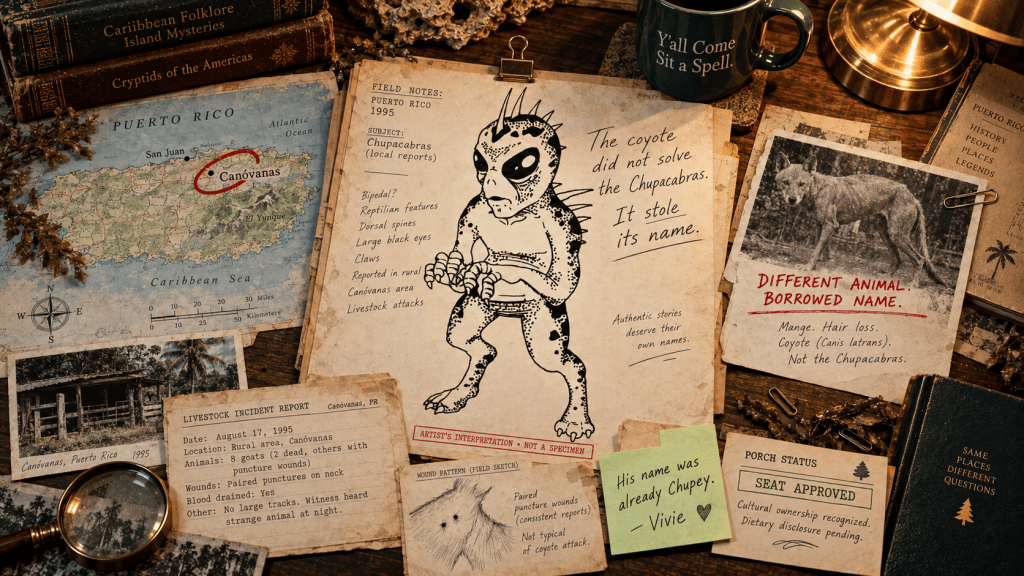
The Monster That Had Its Name Stolen
If the creature standing in front of you looks like a hairless coyote, you may have found a coyote with mange.
You have not necessarily found the Chupacabras.
That distinction matters because the creature Puerto Rico introduced to the world in 1995 did not look like a sick dog. It did not trot along dusty Texas roads on four legs. It did not appear conveniently dead beside a fence so someone could photograph it, call the local news, and wait for a wildlife biologist to explain mites.
Puerto Rico’s Chupacabras stood upright.
Witnesses described a creature four or five feet tall with large red or dark eyes, thin limbs, strange hands or claws, and a row of spines or quills running down its back. Its skin was greenish-gray, leathery, or reptilian. Some said it moved in long, kangaroo-like leaps. Others gave it wings, an unbearable smell, or the ability to disappear into the dark before anyone could get a proper look.
It was not a coyote.
It was Chupey.
Something Was Killing the Animals
The modern story began in Puerto Rico in 1995, although the island already had experience with mysterious livestock deaths. Twenty years earlier, animals around the town of Moca had reportedly been found dead with puncture wounds, inspiring stories about El Vampiro de Moca.
Then the killings began again.
Sheep, goats, chickens, rabbits, and other animals were found dead. Owners reported small puncture wounds, often near the neck or chest, and little blood around the bodies. Some believed the animals had been drained.
Officials and veterinarians disputed that claim. One veterinarian working with Puerto Rico’s Department of Agriculture reportedly examined hundreds of supposed victims and found that the animals had not been emptied of blood. Predators can kill in ways that look strange to anyone who arrives after the struggle is over. Blood settles inside a body. Puncture wounds can be difficult to see. Fear is very good at filling whatever space evidence leaves open.
Still, something was killing animals.
That fact is sometimes lost in the rush to laugh at the people who tried to explain it.
In August 1995, Madelyne Tolentino reported seeing a creature near Canóvanas. Her description helped establish the image that would become Puerto Rico’s Chupacabras. Upright. Spined. Alien-looking. Nothing like any known predator on the island.
The reports multiplied. So did the attention.
Canóvanas mayor José “Chemo” Soto even organized searches for the creature. Reporters arrived. Television crews arrived. The rest of the world arrived carrying microphones, cameras, and the confident assumption that Puerto Rico had produced something delightfully ridiculous.
Puerto Rico had produced a monster.
The world produced a punchline.
Naming the Goat-Sucker
Puerto Rican comedian and radio personality Silverio Pérez is widely credited with popularizing the name chupacabras, formed from the Spanish words for “suck” and “goats.”
The goat-sucker.
It was a perfect name. Dramatic, funny, specific, and just ridiculous enough to travel.
And travel it did.
The Chupacabras moved quickly beyond Canóvanas. Sightings were reported across Latin America, the Caribbean, and eventually the United States. Every unexplained livestock death became a possible attack. Every unfamiliar shadow could carry red eyes. The creature appeared in newspapers, television programs, toys, T-shirts, cartoons, and movies.
Puerto Rico’s local terror became an international celebrity.
That transformation was not entirely unwelcome. Chupey became a joke Puerto Ricans could make for themselves, a cultural figure both frightening and funny. The creature was absorbed into the island’s storytelling and sold back with a wink.
There is power in claiming your own monster.
There is less power in watching someone else claim it for you.
Then Came the Coyotes
By the early 2000s, alleged Chupacabras began appearing in Texas and elsewhere in the American Southwest.
These creatures looked nothing like the one described in Puerto Rico.
They were four-legged. Doglike. Nearly hairless. Their skin was gray and rough. They had long snouts, prominent teeth, and an appearance unsettling enough to make an ordinary animal seem unnatural.
Testing repeatedly identified the bodies as coyotes, dogs, raccoons, or related animals. Many were suffering from severe mange, a miserable condition caused by mites that can strip away fur, thicken the skin, weaken the body, and alter an animal’s appearance.
The explanation made sense.
Then something peculiar happened.
The explanation for the Texas carcasses was presented as the explanation for the Chupacabras itself.
A Puerto Rican creature with spines, red eyes, and two-legged movement was quietly replaced by a North American canid with mange. The borrowed name remained while nearly every defining feature of the original creature disappeared.
The coyote did not solve the Chupacabras.
It stole its name.
A mangy coyote may explain a dead animal found in Texas. It does not explain what people reported seeing in Canóvanas. It does not explain why the Puerto Rican creature took the shape it did. It does not explain the conditions that allowed the story to grow, or why the island embraced the monster after the outside world mocked it.
It certainly does not give us permission to pretend the original story never existed.
Monsters Do Not Grow in Empty Ground
Skeptic Benjamin Radford proposed that Madelyne Tolentino’s description may have been influenced by the creature Sil in the 1995 film Species, which Tolentino had seen. There are striking visual similarities between the movie monster and the Puerto Rican Chupacabras.
That possibility deserves consideration.
Human memory is not a recording. We interpret unfamiliar things using images already stored in our minds. A frightening glimpse, a recently watched movie, and an island full of disturbing animal deaths could combine into something that felt absolutely real.
But even if a movie helped shape one description, it does not explain the entire legend.
Folklore does not form because one person sees one strange thing. It grows when a story finds ground already prepared to hold it.
Puerto Rico in 1995 was living with the daily realities of an unequal relationship with the United States. American military operations had occupied parts of the island for decades. Decisions were made elsewhere. Information was withheld. Rumors of secret experiments, contamination, and government activity did not arise in a place where power was transparent and trust had been earned.
Some versions of the Chupacabras story claimed the creature had escaped from a secret American military or genetic experiment. There is no evidence that it did.
There was, however, plenty of evidence that powerful institutions could operate in Puerto Rico without fully answering to the people who lived there.
The rumored laboratory may not have existed.
The secrecy did.
The imbalance of power did.
The feeling that Puerto Rico could be used as a testing ground while someone elsewhere controlled the information certainly did.
That does not prove the existence of a red-eyed creature. It explains why a story about one could feel possible.
Who Gets to Define the Monster?
When international reporters came to Canóvanas, residents initially welcomed the attention. Then many felt betrayed when their accounts were taken away, stripped of context, and presented as proof that rural Puerto Ricans were foolish or superstitious.
The witnesses became characters in someone else’s story.
That pattern is older than Chupey.
Outsiders arrive. They rename what they find. They decide which voices sound credible. They extract the entertaining pieces and leave the history behind. Then they explain the culture back to the people who live inside it.
Even the debunking followed the pattern.
The mainland found a mangy coyote, attached Puerto Rico’s name to it, and declared Puerto Rico’s mystery solved.
Except it had solved a different creature.
Perhaps no spined animal ever stalked the roads outside Canóvanas. Perhaps predators, disease, memory, movies, rumor, and fear built the Chupacabras together. Folklore has never required a single set of footprints. It requires a community trying to make meaning from something that official explanations have failed to settle.
Puerto Rico did more than invent a monster.
It created a modern folk figure that carried fear, humor, political suspicion, cultural pride, and the experience of being watched by the world without being heard by it.
Then Puerto Rico gave the creature a nickname.
Chupey belongs to the island that recognized him first.
The Grove Take
Do I believe a four-foot reptilian creature with glowing red eyes drained livestock across Puerto Rico?
I believe animals died.
I believe people saw things they could not explain.
I believe memory can borrow from movies and fear can give bones to a shadow.
I also believe governments create the exact conditions in which conspiracy grows when they operate behind locked doors and then act offended that no one trusts them.
Most of all, I believe finding a sick coyote in Texas does not give anyone the right to rewrite Puerto Rico’s monster.
The original Chupacabras deserves to be examined in the place and culture that created it. Not because every claim must be accepted as fact, but because the people telling the story deserve more than ridicule. Their monster carried their history long before someone pasted its name onto an unfortunate canine.
The world asked whether Chupey was real.
Puerto Rico’s story asks a better question.
Who gets to decide what he was?
Porch Policy
Chupey gets a seat.
Not the hairless coyote. That poor baby gets veterinary care, a warm meal, and its own name back.
Puerto Rico’s Chupey gets the chair at the shadowy end of the porch, where the lamplight catches the spines but does not quite reach the eyes. He may stay as long as he respects the livestock, keeps the mysterious puncture wounds to himself, and understands that glowing after bedtime is inconsiderate.
The goats have declined to attend.
Vivie has left him a snack but refuses to disclose what is in it.
No coyotes may claim his reservation.
Porch Status: Seat Approved
Cultural ownership recognized
Dietary disclosure still pending


Leave a Reply