
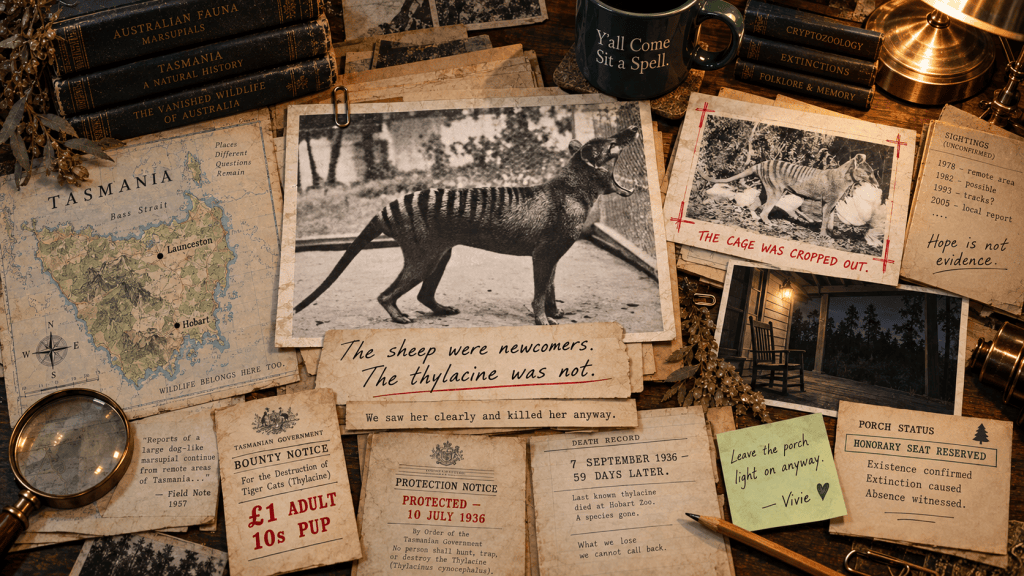
The Animal We Turned Into a Ghost
The thylacine was not a tiger.
It was not a wolf.
It was not a dog with stripes.
It was a marsupial predator unlike anything still living, the last surviving member of an ancient family that had once ranged across Australia and New Guinea.
European settlers looked at its narrow head and called it a wolf. They saw the dark stripes across its back and called it a tiger. They watched it move through the Tasmanian landscape and decided it was a threat.
The Tasmanian Aboriginal peoples already knew the animal.
The thylacine had lived on the island for thousands of years. It belonged to that place long before Europeans arrived carrying sheep, fences, guns, and the conviction that anything interfering with their plans had to go.
The sheep were newcomers.
The thylacine was not.
A Predator Made Guilty
When British settlers expanded sheep farming across Tasmania during the nineteenth century, the thylacine became the obvious suspect whenever livestock disappeared.
It looked enough like a wolf to inherit every European fear attached to wolves. That resemblance was superficial. The thylacine was a marsupial, more closely related to the Tasmanian devil than to any canine. Its long jaw could open astonishingly wide, but its build was lighter and more delicate than the livestock-killing predator settlers imagined.
The evidence against it was never as strong as its reputation.
Thylacines may have taken poultry or an occasional sheep, particularly when natural prey became scarce. Yet the scale of their alleged destruction was almost certainly exaggerated. Poor fencing, feral dogs, domestic dogs, theft, disease, and other causes of livestock loss were harder to turn into a single striped villain.
A predator already living on the land was easier to blame.
Photographs helped seal the verdict. One famous image showed a thylacine with a chicken in its mouth, creating the perfect visual shorthand for a livestock killer. The photograph was staged, but the accusation had already become more useful than the truth.
Settlers did not need to prove the thylacine was responsible for every dead sheep.
They only needed the public to believe it.
One Pound for a Body
Private bounties began early. In 1888, the Tasmanian government made the campaign official.
One pound was paid for a dead adult thylacine. Ten shillings for a pup.
The government paid more than two thousand bounties before the program ended in 1909. Historians estimate that human hunters killed at least 3,500 thylacines between the 1830s and the 1920s.
The true number may have been higher.
Habitat destruction, introduced dogs, declining prey, disease, and the species’ limited genetic diversity probably contributed to the collapse. Extinction rarely arrives carrying a single weapon.
But humans pulled the trigger often enough.
Thylacines were trapped, snared, poisoned, shot, and sold. Their bodies became proof that someone had completed a government-approved task.
The animal had been tried without evidence, sentenced without appeal, and converted into currency.
Then people began noticing that they were becoming difficult to find.
That is one of humanity’s more reliable habits.
We call an animal a pest while it is plentiful.
We call it precious when there are almost none left.
Protection Arrived Two Months Early
The last known wild thylacine was shot in 1930 by a farmer named Wilf Batty.
Three years later, another thylacine was captured in the Florentine Valley and sold to the Beaumaris Zoo in Hobart. For decades, people repeated the story that this final captive animal was a male named Benjamin.
Later research found no contemporary evidence for the name. The rediscovery of the animal’s remains in a museum collection showed that she was female.
Even the last thylacine had been given a story that did not belong to her.
Tasmania finally granted the species legal protection on July 10, 1936.
The last known thylacine died at the zoo on September 7.
Fifty-nine days.
That was the distance between protection and extinction.
Accounts have often claimed that she died from exposure after being locked outside her shelter during extreme weather. Some researchers dispute the precise circumstances of her death, and there was no proper investigation at the time.
That absence is part of the story too.
The final known member of an entire species died in captivity, and no one preserved a reliable account of what happened.
Her body was transferred to the Tasmanian Museum and Art Gallery, where the skin and skeleton were used for educational purposes. Then they were miscatalogued and effectively lost inside the collection for decades.
We hunted her species until she was the last one.
Then we misplaced her.
The Film
There is footage of her.
That may be the most devastating part.
The grainy black-and-white film shows the last known thylacine walking around her enclosure. She turns. She paces. She stretches her jaws into that extraordinary gape. The dark stripes across her back move with her body.
She is not a reconstruction.
She is not an artist’s interpretation.
She is not a shadow at the edge of a modern photograph.
She was alive.
The footage lasts less than a minute. We can watch an animal humanity will never see again moving through the final years of her life behind wire.
There is no mystery about whether the thylacine existed.
There is only the unbearable knowledge that we saw her clearly and killed her anyway.
Then We Started Looking
Reports of living thylacines did not stop in 1936.
People saw striped animals crossing remote roads. Bushwalkers found unfamiliar tracks. Farmers reported creatures moving at the edges of paddocks. Blurry photographs, brief videos, and distant shapes kept the possibility alive.
Expeditions searched Tasmania’s forests.
Cameras were mounted.
Rewards were offered.
Every few years, a new sighting revived the hope that somewhere in the island’s remote wilderness, a few thylacines had survived.
None of the evidence has been conclusive.
That does not stop people from looking.
Perhaps the persistence of the sightings says less about what remains in the forest and more about what remains in us.
We want the thylacine to have escaped.
We want her to have slipped through the traps, outlasted the bounty, avoided the roads, and found some hidden corner of Tasmania where human beings could not reach her.
We want at least one small population to have survived our certainty that the land and everything on it existed for our use.
A living thylacine would be a scientific miracle.
It would also feel like absolution.
We would get to say we did not quite finish the job.
From Animal to Emblem
The thylacine now appears everywhere in Tasmania.
Two of them stand on the state’s coat of arms. The animal appears on government logos, license plates, artwork, beer labels, souvenirs, and tourism material.
She became a symbol of the place after being removed from it.
There is a particular cruelty in turning an exterminated animal into a mascot.
The image is safe now. It cannot take a sheep. It cannot cross a newly fenced paddock. It cannot object when its striped body is used to represent the people and institutions that failed to protect it.
The thylacine is easier to celebrate as a ghost than she was to tolerate as a neighbor.
Now there are projects attempting to bring something like her back through genetic engineering. The science is fascinating, and conservation techniques developed through such work may help living species.
Still, there is something painfully familiar in the ambition.
We could not make room for the animal when she already knew how to live.
Now we want to manufacture her.
Whose Land Was It?
The thylacine was not destroyed because it failed to belong in Tasmania.
It was destroyed because settlers decided the sheep belonged there more.
European agriculture arrived with its own rules about which animals had value. Sheep produced wool. Dogs served people. Native predators interfered with profit.
The landscape was reorganized around the needs of those who claimed ownership.
The thylacine became guilty not because it had invaded farmland, but because farmland had invaded its world.
That distinction was inconvenient, so it disappeared from the story.
Colonization does that.
It redraws the map, replaces the names, moves the fences, and then punishes whatever does not understand the new boundaries.
After enough time passes, the newcomers call themselves natural and the original inhabitants become the problem.
The bounty did not simply pay people to kill an animal.
It enforced a decision about whose life mattered on newly claimed land.
The Grove Take
Do I think thylacines still survive somewhere in Tasmania?
I desperately want them to.
I want one to step cleanly into the light of a trail camera, turn its striped back toward us, and disappear into the forest before anyone can build a gift shop.
But wanting is not evidence.
No modern sighting has produced the clear photograph, body, DNA sample, or breeding population needed to show that the species survived.
The thylacine does not owe us a miraculous return.
We owe her an honest extinction story.
She was not a fantasy creature. She was not an evolutionary failure. She was not a ravenous sheep killer that had to be removed so civilization could proceed.
She was an animal living where she had always lived until other animals arrived, claimed the land, and placed a price on her body.
Now we search the shadows for proof that she survived us.
Perhaps she did.
Probably she did not.
Either way, the lesson remains.
Protection offered after the killing is nearly complete is not protection.
Regret is not conservation.
A symbol is not a living species.
And extinction is not something that happened to the thylacine.
It is something we did.
Porch Policy
The thylacine receives an honorary seat.
The chair will remain empty at the edge of the porch, facing the tree line. Not because she is unwelcome, but because pretending she might arrive if we wait long enough would make her absence easier than it should be.
Her name is carved into the back.
No bounty may be collected here.
No fence grants ownership of everything inside it.
No animal will be declared a monster simply because a settler has decided its home would be more profitable without it.
Vivie has left the porch light on anyway.
Just in case.
Porch Status: Honorary Seat Reserved
Existence confirmed
Extinction caused
Absence witnessed


Leave a Reply