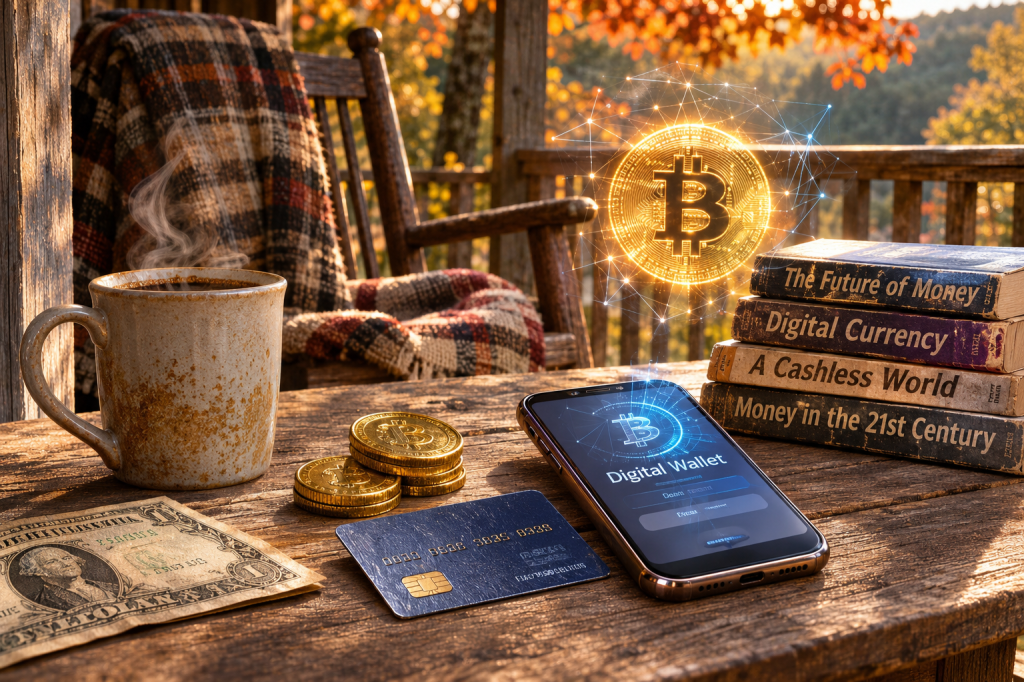
Come on in, pull up a chair, and pour yourself something warm. The coffee is fresh, and today we’re going to talk about money. Or, more specifically, money that doesn’t seem to exist anywhere except inside a computer.
Now, I’ll be the first to admit that cryptocurrency is not a subject I know a great deal about. I’ve heard of Bitcoin, blockchain, digital wallets, and people making fortunes seemingly overnight. I’ve also heard about people losing fortunes just as quickly.
And somewhere in the middle of all that, I’m sitting here with my coffee wondering when exactly we wandered into a science fiction novel.
Because that’s what cryptocurrency feels like to me. Science fiction.
Not necessarily the flying-cars-and-robot-butlers kind, although I wouldn’t turn down a robot that did laundry. More the kind where someone in 1975 imagines a future in which money is nothing but numbers floating around in an enormous computer network.
Back then, we might have laughed at the idea.
Today, apparently, we’re investing in it.
How Did We Get Here?
I think part of my discomfort with cryptocurrency goes back much farther than Bitcoin.
In 1971, President Nixon ended the dollar’s convertibility into gold for foreign governments and central banks. The American monetary system had already been moving away from gold for decades, but that decision marked a major turning point.
Money was no longer tied to gold in the way it once had been.
Now, I understand that economics is considerably more complicated than a dollar bill being worth a particular amount of gold. The gold standard had problems of its own, and there are legitimate arguments for the monetary system we use today.
But I can’t help wondering whether some of our current financial difficulties grew out of the changes that followed.
Over time, credit became an increasingly ordinary part of American life. Credit cards, car loans, mortgages, financing plans, and eventually the ability to buy practically anything with a few taps on a screen.
We became very comfortable spending money we hadn’t earned yet.
Of course, credit existed long before the 1970s, and leaving the gold standard didn’t single-handedly create our culture of borrowing. But when I look at the relationship we have with money today, I wonder whether we’ve lost some of our connection to what it actually represents.
And then along comes cryptocurrency.
Apparently, the next logical step was to invent money that doesn’t even pretend to be something you can put in your pocket.
Wait. What’s It Actually Worth?
This is where my understanding starts getting a little fuzzy.
I know cryptocurrency uses technology that allows transactions to be recorded and verified across computer networks. I know that some cryptocurrencies, like Bitcoin, have limits on how many units can exist. And I understand that supporters see advantages in a system that doesn’t depend entirely on traditional banks or governments.
I’m not dismissing those possibilities.
But I keep coming back to one question.
What makes it worth what someone says it’s worth?
If a cryptocurrency is worth one amount today and a wildly different amount tomorrow, what exactly changed?
Did something tangible become more valuable? Did someone produce a new product? Did the underlying technology suddenly become twice as useful?
Or did enough people simply decide they were willing to pay more for it?
Now, before someone points out that our regular dollars aren’t backed by gold anymore either, I know. The value of the dollar also depends on confidence, institutions, economic activity, and our collective willingness to accept it.
And gold itself has value partly because people agree that it does.
I understand that.
But there is something about cryptocurrency that feels like we’ve taken the abstraction of money one step beyond where I’m comfortable following.
We’ve gone from gold to paper, from paper to plastic, from plastic to electronic transactions, and now to digital coins that aren’t really coins at all.
At what point do we stop and ask whether we’re making things better or simply making them more complicated?
Is Every Innovation Progress?
I am not opposed to technology.
I appreciate the convenience of online banking. I like being able to pay bills without writing checks, standing in line, or hunting down a stamp. There are technological advances that have genuinely made everyday life easier.
And I certainly don’t think everything was better in the good old days. Plenty of things weren’t.
But I also don’t believe that every new invention automatically represents progress.
Sometimes we get so caught up in what we can do that we forget to ask whether we should.
Cryptocurrency may turn out to be an important part of our financial future. There are people who understand it far better than I do and who see genuine potential in the technology. Some believe it offers greater financial freedom, more control over personal assets, and alternatives to institutions they don’t trust.
Interestingly enough, some of those people distrust the very financial system I’ve been questioning.
We simply arrive at different conclusions about what should replace it.
Where they see independence, I see uncertainty.
Where they see opportunity, I see speculation.
And where they see the future of money, I see something that sounds suspiciously like a plot device from a science fiction paperback.
Perhaps they’re right. Perhaps cryptocurrency will eventually become as ordinary as using a debit card.
But I don’t have to invest in something simply because it’s new, popular, or potentially profitable.
And I certainly don’t have to pretend I understand something that I don’t.
I’ll Keep My Coffee, Thank You
Maybe what bothers me most isn’t cryptocurrency itself.
Maybe it’s the feeling that our relationship with money has become increasingly disconnected from the work, resources, and real-world necessities it is supposed to represent.
Money was never quite as simple as a pile of gold coins in a wooden chest. I know that.
But somewhere between gold-backed dollars, revolving credit, electronic accounts, and cryptocurrency, I feel as though we’ve wandered a little too far into the abstract.
And perhaps that’s just where I draw my personal line.
I don’t know enough about cryptocurrency to tell anyone else what they should do with their money. If you’ve researched it, understand the risks, and believe in its potential, that’s your decision.
As for me, I’m content to watch this particular chapter of the science fiction story unfold from the comfort of the Grove porch.
I’ve got coffee in my mug, bills that are real enough, and absolutely no desire to gamble on something I don’t fully understand.
So, cryptocurrency?
You can keep my imaginary money. I haven’t really lost anything.
Until next time, the coffee’s always on, there’s room at the table, and you’re welcome to come sit a spell.



Leave a Reply