
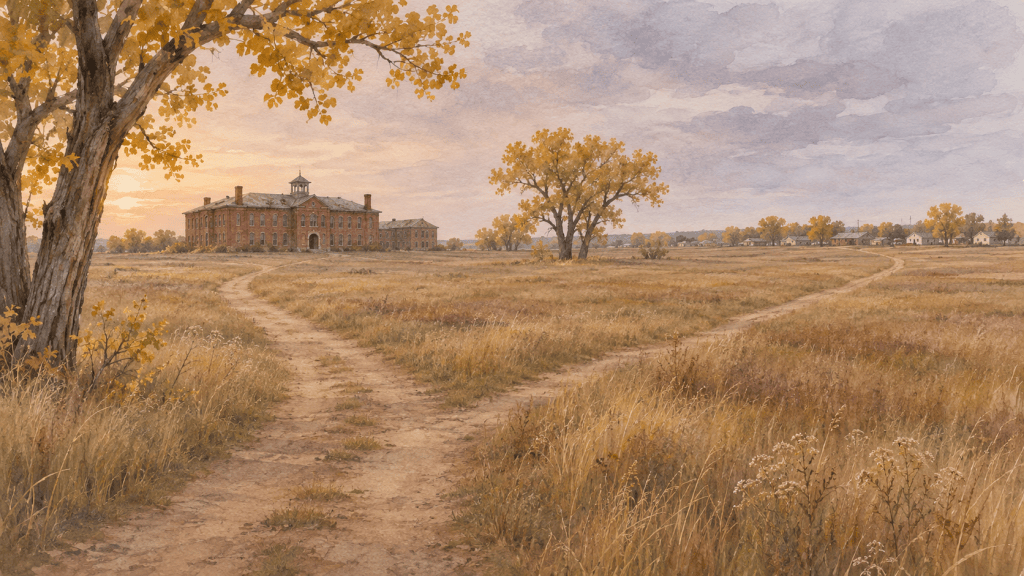
I saw a news story the other day about researchers identifying the graves of 14 girls who died while attending the Good Shepherd Industrial School in Milwaukee. Many of the graves were unmarked or had markers that didn’t give the girls’ names. [1] This is difficult history, and I don’t want to dress it up with a neat ending.
When I think back to what I learned, I remember a vague outline: Native children were separated from their families for a while, and then the practice stopped sometime in the 1960s or ’70s. I don’t remember learning why the schools existed, how families were pressured, what children endured, or how long the schools remained open.
That gap matters. “For a while, and then it stopped” makes a long policy of coercion sound like a short, finished chapter.
In 1819, Congress passed the Civilization Fund Act. It authorized federal support for teaching Native children reading, writing, arithmetic, and agriculture, under the stated goal of introducing what the law called the “habits and arts of civilization.” Federal money went to missionary and benevolent societies that established schools. The language of the act makes clear that education was tied to a larger assumption: Native people and their ways of life needed to be changed. [2]
There were schools shaped by Native nations and local choices, too. Among the Chickasaw, Charity Hall opened in 1820 and Monroe in 1822; Chickasaw leaders later established and funded additional schools. Choctaw Academy opened in Kentucky in 1825 at Choctaw request. Those histories matter because Native people valued education and made their own plans for it. They also show why we have to distinguish those schools from the later federal system built to remove children from home and assimilate them. [3]
In 1868, the Fort Laramie Treaty with Sioux bands and the Arapaho required signatory peoples to compel their children, ages six to sixteen, to attend school. The treaty made the federal agent responsible for enforcing the requirement. [4]
In 1879, Carlisle Indian Industrial School opened in Pennsylvania. It is commonly identified as the first federal school in the large off-reservation boarding-school system that followed. Its model took children far from home and sought to assimilate them into white society. Chilocco opened in Oklahoma in 1884. [5–6]
In an 1886 congressional debate, a representative described an agent taking Sac and Fox children, ages five to seven, to Chilocco while their parents were away, without notifying them. The children were taken in winter and traveled roughly 150 miles. This is not an abstract policy. It is a record of small children being removed from their families without their parents’ knowledge. [7]
Congress then made attendance pressure explicit in law. An 1892 law made school attendance compulsory for Native children under federal jurisdiction. In 1893, Congress authorized officials to withhold rations, clothing, or other support from parents who did not send their school-age children to school. In 1894, Congress required voluntary parental consent before a child could be sent from a reservation to a school beyond the state or territory; in 1895, it prohibited officials from using withheld rations or other improper means to obtain that consent. These provisions addressed different circumstances. The consent rule did not erase the pressure created by compulsory attendance or the threat of losing necessities. [8]
By 1928, the federal government’s own Meriam Report was criticizing boarding-school conditions. It described inadequate care and said that removing children from home for years “largely disintegrates the family.” Families did not need a report to know what separation had done. But the report confirms that the damage was visible, even to the government responsible for the system. [9]
Federal policy shifted over time. The Indian Reorganization Act of 1934 introduced Native history and culture into BIA school curricula. The 1975 Indian Self-Determination and Education Assistance Act gave tribes authority to operate BIA-funded schools and shape programs for their children. Those changes mattered. They did not undo what had happened, and they did not close every boarding school. [10]
By Chilocco’s later years, the circumstances of attendance were different from the forced removals described in 1886. I haven’t found evidence that children were routinely seized there in the same way near the school’s closure. A 1973 federal report said Chilocco served students from remote communities without nearby schools, students whose educational needs could not be met locally, and children who needed care away from home for social or economic reasons. A family facing those conditions might technically have a choice while having very few workable options. [11]
Chilocco closed in 1980. Holy Childhood in Harbor Springs, Michigan, continued as a boarding school until 1983. The policy changed, and individual schools closed, but there was no single date when the whole story ended. [12]
The official timeline tells part of this history. Survivor testimony tells us what it felt like.
Suquamish Elder Peg Deam was sent to Chilocco as a young teenager. She described the isolation: “You have no family. You’re just floating out there, trying to survive and get through each day.” She recalled Native languages and ceremonies being forbidden. She also remembered children finding ways to protect one another. When a girl wanted to perform a ceremony after her grandfather died, her dormmates created a distraction so she could do it. Deam remembered how proud they were of her. The cruelty of the rules and the care the children showed each other belong in the same account. [13]
Chilocco alumna Dolly BaDonie remembered begging her mother to let her attend, even though her mother had survived boarding school herself. BaDonie described the students as “just like another extended family.” Her memories deserve to be heard in her own words. They do not cancel Peg Deam’s account, or the policies that punished children for holding onto their language and traditions. Students’ experiences differed; the system’s coercive purpose remains part of the history. [14]
Maybe I wasn’t taught enough to ask these questions when I was in school. A nationwide study of state history standards found that only five states mentioned Indian boarding schools. That cannot tell us exactly what any one teacher taught. It does show how easily this history could be left out of the official story. [15]
I support education and believe government should provide free appropriate education to all children. Families and communities deserve a say in how that education happens. The anger I feel is about the coercion, separation, and cultural suppression imposed in education’s name. Some students found friendship, skills, or opportunity, and that matters. They do not erase the harm.
I don’t want the next person to leave this history with the same thin summary I remember: the children were separated “for a while,” and then it stopped. We need to say what the policy was, how it changed, when schools closed, and what survivors remember. Anything less makes the ending sound cleaner than the history.
Sources
- “At least a dozen graves of Milwaukee Indian boarding school students uncovered,” ICT News
- Civilization Act of 1819, United States Statutes at Large, Library of Congress; Congressional Research Service, Indian education history
- “Chickasaw Schools,” Oklahoma Historical Society; Choctaw Academy history
- Treaty of Fort Laramie (1868), National Archives
- Carlisle Federal Indian Boarding School National Monument, National Park Service
- “Chilocco Indian Agricultural School,” Encyclopedia of Oklahoma History and Culture
- Congressional Record, March 10, 1886
- 1892 attendance law discussion, U.S. Government Publishing Office; Title 25, United States Code, §§ 283 and 286, GovInfo
- The Meriam Report: General Summary of Findings and Recommendations (1928)
- Bureau of Indian Education history and tribal control, Indian Affairs
- “Indian Civil Rights Issues in Oklahoma,” U.S. Commission on Civil Rights (1974)
- “The Indian School Journal,” National Archives; “Indian children forced to assimilate at white boarding schools,” National Park Service
- “Boarding School Survivor Peg Deam shares her story,” Suquamish Tribe
- Dolly BaDonie oral history, Oklahoma State University
- Truth & Healing Curriculum, National Native American Boarding School Healing Coalition


Leave a Reply