
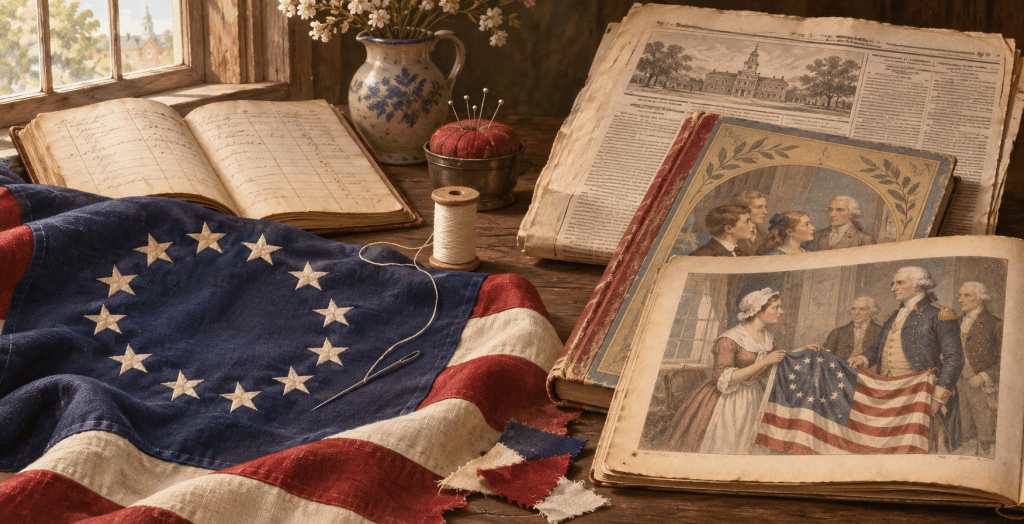
Y’all come sit a spell. Pour yourself something warm, and let’s talk about a story many of us met in a schoolbook: George Washington visits Betsy Ross, asks her to make a flag, and she suggests changing the stars from six points to five. A few stitches later, a young nation has its first flag.
It is a tidy story. It gives us a room we can picture, a famous visitor, a practical woman with a good idea, and a memorable moment when the United States seems to take shape right there at her sewing table. It is also a story whose details have been repeated so often that they can feel like settled fact.
But our November question is not simply whether Betsy Ross sewed the first American flag. It is this: How did one family’s account of the story become a piece of accepted American history?
To answer that, we need to hold two things in our hands at once. Betsy Ross was a real woman who worked as an upholsterer and seamstress, and records show that she made flags. The famous account of her meeting with Washington and making the first national flag, however, entered the public record much later. The difference between those two statements is where the history gets interesting.
The story we learned
The familiar version usually begins in 1776. Washington and a small group of important men come to Ross’s shop with a rough design for a flag. She looks at the stars and recommends five points instead of six, explaining that they will be easier to cut and sew. Washington agrees. Ross makes the flag, and the visitors return to Congress with it.
That account gives the flag a birth scene. It turns a complicated period of debate and change into one conversation and one clever suggestion. It also places a woman at the center of a founding moment, not as a spectator but as a skilled craftswoman whose advice shapes a national symbol. No wonder the story stayed with people.
The historical record is less cinematic. The Continental Congress passed its flag resolution on June 14, 1777, specifying thirteen stripes and thirteen white stars on a blue field. It did not specify the stars’ points or arrangement, and surviving flags from the era varied. The familiar visit is said to have happened in 1776, but no contemporary record documents that meeting or identifies Ross as the maker of the first flag.
That absence does not prove she was never asked to make one. It does mean we should not treat the story’s dialogue and details as documented fact.
A real flag maker—and a late-told story
Ross’s life does not need a legend to be worth remembering. She was born Elizabeth Griscom, worked in Philadelphia as an upholsterer, and continued the trade through three marriages and a large family. In 1777, the Pennsylvania State Navy Board recorded a payment to Elizabeth Ross for making “Ships’ Colours etc.” The wording is brief, but it places her work in the world of early American flags while the Revolution was underway.
The story about Washington came into public view in 1870, when Ross’s grandson William Canby presented it to the Historical Society of Pennsylvania. He said it was a family tradition: his grandmother had told him that Washington and other men had visited her and commissioned a flag. Canby gathered affidavits from relatives who said they had heard Ross tell the story. Those statements show the story circulated in the family. They are not eyewitness accounts of a 1776 meeting; they were recorded decades later.
Here is the distinction that often disappears when a story is retold: a family’s testimony is evidence, but it is a different kind of evidence from a letter, account book, committee minute, or flag order written at the time. Researchers have not found a contemporary record of the famous visit, the proposed flag committee, or Ross’s role in creating the first national flag. They have found records that Ross made flags.
How a family account traveled
Canby’s account did not leap from his family’s kitchen directly into every classroom. It moved through a growing network of publications, images, celebrations, and institutions.
Canby corresponded with flag historian George Henry Preble, who included the story in a footnote in his 1872 history of the American flag. In 1873, Harper’s New Monthly Magazine retold it for a much larger audience, and newspapers carried versions of the story around the country. The approach of the nation’s 1876 Centennial gave Americans another reason to look back toward the Revolution and its symbols. The account was new to the wider public, but it arrived at a time when people were eager to tell stories about the country’s beginnings.
And the story did not stay fixed. In 1878, another Ross descendant, J. Franklin Reigart, published a more elaborate version. As it grew in the telling, Ross could become more than the maker of a flag: she might be credited with shaping the design or even with adding words to it. The familiar five-point-star detail became part of a story that felt complete, even though the original congressional resolution says nothing about who chose the stars’ shape.
Then came the image many of us recognize even if we have never seen the painting itself: Betsy Ross seated with a flag while Washington and the other men watch. Artist Charles Weisgerber’s Birth of Our Nation’s Flag gave the story a memorable scene. In the 1890s, a campaign to preserve the Arch Street building identified as Ross’s home used reproductions of the painting in its fundraising. Schoolchildren were invited to send contributions and received certificates bearing the image. The house became a place people could visit, and the painted scene gave visitors something concrete to imagine inside it.
A newspaper story can be forgotten; a story taught to children, printed on certificates, shown in a painting, attached to a historic house, and repeated at patriotic celebrations keeps meeting people in new places. Familiarity begins to feel like confirmation.
Why this story fit its moment
Historians have also asked why the Betsy Ross story appealed so strongly in the late nineteenth century. There is no single motive, and not everyone who repeated the story did so for the same reason. But the period offers useful context.
The country was still living with the consequences of the Civil War. Americans were looking for ways to rally around shared national symbols. Flag-centered patriotism was growing, and celebrations such as the Centennial invited people to imagine a common founding story. Betsy Ross offered a human beginning for the flag: not a committee room or a legislative resolution, but one skilled woman at work.
That mattered at a time when women were pushing for a larger place in public life. The story put a woman close to the nation’s founding and made her work consequential. At the same time, it cast her in a role audiences already understood: the seamstress, carefully making something at home. The tale could honor women’s contribution while still fitting the familiar boundaries of women’s domestic labor. That combination made Ross a remarkably flexible figure. Different generations could emphasize patriotism, women’s work, family tradition, or the romance of the founding.
These are explanations historians offer for the story’s popularity, not proof that a coordinated group invented it for one purpose. A story can be repeated sincerely, marketed, adapted for new audiences, and accepted as fact—all at once.
When repetition becomes “what everyone knows”
By the late nineteenth century, the story was appearing in schoolbooks. Once children encountered it as part of a lesson about the American Revolution, it could pass from one generation to the next with the authority of the classroom. A simplified story is easy to remember and easy to teach. It also leaves less room for the uncertainty that historians have to live with: the missing records, the different kinds of testimony, the questions about how the flag’s design developed.
The image helped, too. Most of us can picture the scene even if we have never read Canby’s account. We have seen it on a page, a poster, a stamp, a souvenir, or in our mind’s version of a schoolbook illustration. Once an image becomes familiar, it can feel like a window onto the past. But Weisgerber’s painting was made more than a century after the supposed visit. It shows us how people imagined the story in the 1890s; it is not a photograph of 1776.
None of this requires us to accuse Canby of making the whole thing up. He may have believed his family’s account and wanted to honor his grandmother. His relatives may have been sincerely repeating what they remembered her saying. The point is not to claim we can see inside their minds, but to notice how the story changed status: family recollection, published history, popular image, patriotic landmark, school lesson.
A version can become widely accepted not because one piece of decisive new evidence settles it, but because many familiar forms repeat it until the question of evidence stops being asked.
What we know, and what we leave open
There is a documented Betsy Ross behind the legend. She was a working craftswoman in Revolutionary Philadelphia. A payment record connects her to making ship colors in 1777, and later records show that her flag-making business continued. She lived through extraordinary changes and supported a family with skilled labor. Those facts deserve a place in the story.
What the evidence does not establish is that she designed and sewed the first national flag after a visit from Washington in 1776, or that she introduced the five-pointed star. Another name appears in the historical discussion: Francis Hopkinson, a government official who later sought payment for designing the U.S. flag. His claim is documented, though it does not resolve every question about how the design took shape. The flag’s origins may be less a single creation scene than the gradual work of committees, makers, military needs, and changing designs.
So we do not have to choose between “Betsy Ross did everything the legend says” and “Betsy Ross had nothing to do with flags.” The evidence supports a more careful answer: she made flags, and her family preserved a story about her role in making the first one. That story became famous through print, art, schooling, commemoration, and the powerful appeal of seeing a woman’s hand in the nation’s founding. Its most memorable details remain unverified.
That is the turn in the story. We begin with a woman and a flag. We end up asking how a nation decides what counts as its history—and how often the stories that feel most certain are the ones we have heard the most.
The next time Betsy Ross comes to mind, we can remember both things: the skilled Philadelphia maker whose work appears in the records, and the much later story that grew around her. One is not made less meaningful by examining the other. Looking closely lets us honor the real woman without asking her to carry details the evidence cannot confirm.
Sources for this draft
- Charles Hardy III, A Mother for America: How Betsy Ross Became the Most Famous Woman in American History, Oxford University Press, 2026.
- “All Wrapped Up in the Flag,” TeachingHistory.org, Roy Rosenzweig Center for History and New Media, George Mason University.
- “Betsy Ross,” Museum of the American Revolution.
- Pennsylvania State Navy Board minutes, May 29, 1777, transcribed in the Navy of the American Revolution.
- “Francis Hopkinson’s Claim,” Smithsonian National Postal Museum.


Leave a Reply