
I was already an adult, college behind me, when I first heard the term sundown town.
I was working on a criminal justice research project, something involving racial profiling, if memory serves. Somewhere along the way, someone mentioned sundown towns.
Sundown towns?
I had no idea what they were talking about.
And if you know me at all, you know what happened next.
Down the rabbit hole I went.
What I discovered was an entire chapter of American history that had somehow escaped my education. Not a minor footnote or some obscure incident involving a handful of people, but a widespread practice that shaped where Americans could live, work, travel, and raise their families.
I knew about Jim Crow. I knew about segregation, separate schools, drinking fountains, and the struggle for civil rights.
But communities that deliberately kept entire groups of people from living within their boundaries?
That was something I hadn’t understood.
And perhaps the most surprising discovery was where those communities existed.
Because if you’re picturing a little Southern town with a weathered sign warning Black travelers to be gone before sunset, you’re not entirely wrong.
But you’re missing a very large part of the story.
The Places That Kept People Out
A sundown town was a community that deliberately excluded Black Americans, and sometimes other racial or ethnic groups, from living there or even remaining there after dark.
The name came from warnings, sometimes displayed on signs, that certain people had to leave before sunset.
But not every sundown town had a sign.
Not every town passed an ordinance.
And not every boundary was marked on a map.
Some communities enforced exclusion through violence. Others used housing restrictions, discriminatory business practices, intimidation, or the threat of arrest. Sometimes the rules were understood so thoroughly that nobody needed to write them down.
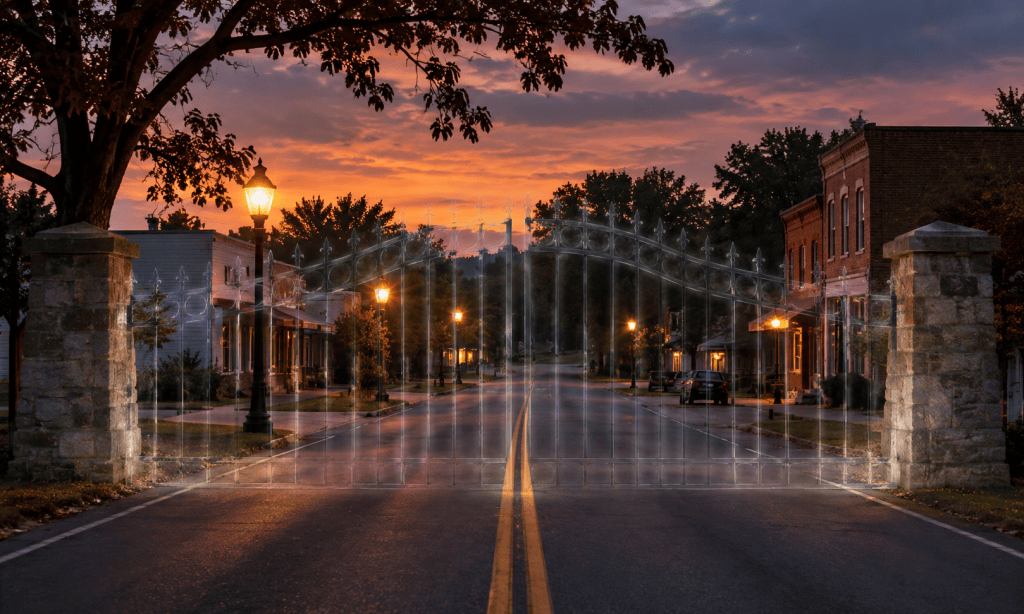
I think of them as ungated gated communities.
No guardhouse at the entrance. No fence around the perimeter. No security code required to enter.
Just an invisible boundary that everybody was expected to understand.
And if you were among the people being excluded, crossing that boundary could carry very real consequences.
Historian James W. Loewen spent years investigating these communities, eventually publishing Sundown Towns: A Hidden Dimension of American Racism in 2005.
His research helped bring attention to a practice that had largely escaped mainstream historical education.
It also challenged something many of us assumed we knew about American racism.
Its geography.
This Wasn’t Just a Southern Thing
Let’s get something straight right here.
Sundown towns were not exclusively Southern.
Not even close.
They existed throughout the Midwest, Northeast, and West, as well as the South. They included rural towns, industrial communities, suburban developments, and entire counties.
And this is where our familiar understanding of American segregation begins to get complicated.
In much of the Jim Crow South, racial segregation was built around a system that depended on Black labor while denying Black residents equal rights and opportunities.
Black people lived in these communities, worked in them, and contributed to their economies, even as laws and customs restricted virtually every aspect of their lives.
But elsewhere, some communities pursued a different objective.
They didn’t want Black residents separated from white residents.
They didn’t want Black residents at all.
That doesn’t mean every Northern or Western town practiced exclusion, or that Southern communities never did. Both segregation and exclusion existed in multiple regions, often overlapping.
But the distinction matters.
One system sought to control where people could go and what they could do within a community.
The other sought to prevent them from becoming part of that community in the first place.
And the national research is revealing.
A scholarly dataset published in Scientific Data in 2025 identified 2,248 historical places with evidence of sundown-town practices.
Of those, 1,821 were outside the former Confederate South.
That’s approximately 81 percent.
Now, that number requires some care. The dataset incorporates historical research with varying levels of supporting evidence. It doesn’t mean every location has been proven to the same standard, and it isn’t a complete census of every sundown community that ever existed.
But it makes one thing unmistakable.
This was never simply a Southern phenomenon.
It was an American one.
Research: A National Data Set of Historical US Sundown Towns for Quantitative Analysis
Anna, Illinois: When Everybody Knows the Rules
Let’s visit Illinois.
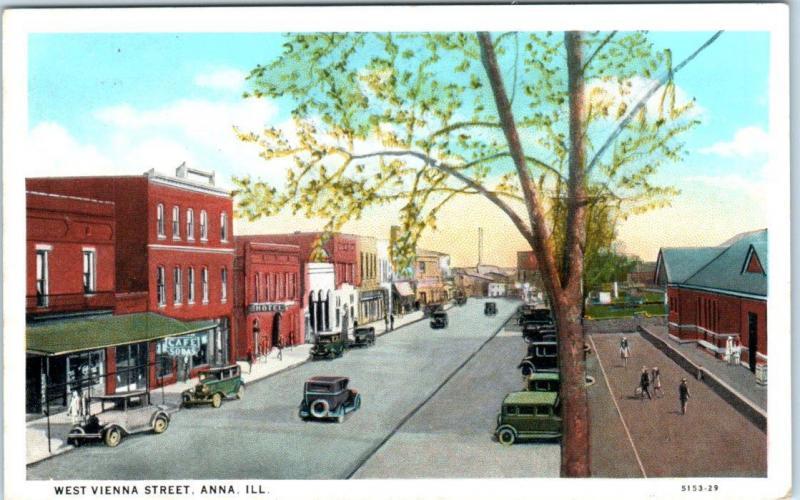
Not Chicago, but Anna, a small community in the southern part of the state.
Anna developed a longstanding reputation for excluding Black residents, a history investigated by journalist Logan Jaffe in a 2019 ProPublica report.
The investigation uncovered newspaper evidence of racial hostility and exclusion dating back to the early twentieth century.
And yet one of the most revealing aspects of the story wasn’t a particular ordinance or a photograph of a warning sign.
It was the persistence of the town’s reputation.
Generations of people understood that Anna was a place where Black Americans might not be welcome.
Some residents acknowledged the history. Others disputed particular stories, questioned how much of the reputation was deserved, or wanted their community to move beyond it.
And that distinction is important.
A community’s reputation isn’t automatically proof of every story told about it.
But neither does the absence of a surviving sign erase documented discrimination.
Historical evidence can be found in newspapers, census records, testimony, property records, and the experiences of people who lived through these practices.
The lesson from Anna isn’t that every resident shared the same beliefs or participated in exclusion.
It’s that a community can develop a powerful system of racial boundaries without every person having to enforce them personally.
Sometimes knowing what might happen was enough.
Research: ProPublica — The Legend of A-N-N-A
Glendale, California: The Gates of Suburbia
Now let’s travel west.
To Glendale, California.
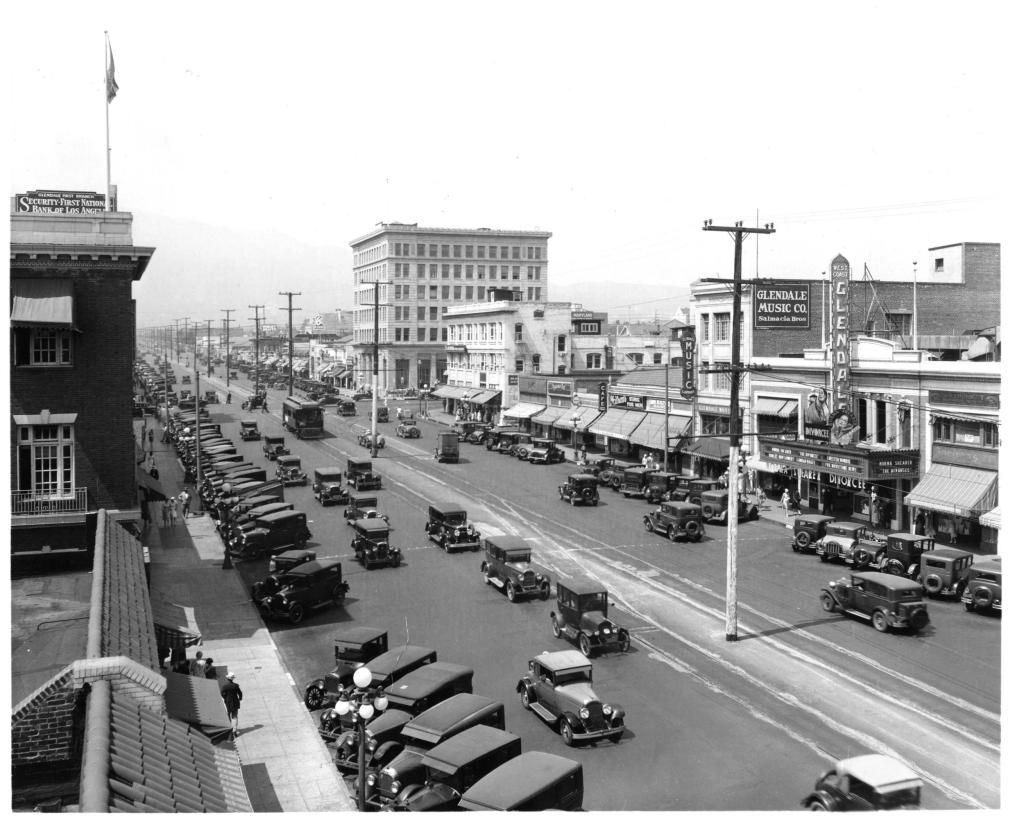
Yes, California.
A state that often occupies a very different place in our imagination when we talk about American racial history.
Glendale’s historical exclusion was intertwined with discriminatory housing practices, including racially restrictive property covenants and other barriers that limited who could purchase or occupy homes.
These restrictions helped shape the community’s development.
And Glendale wasn’t unique in this respect.
Across the country, discriminatory real estate practices helped determine who could establish roots in growing suburbs, purchase property, and participate in the wealth-building opportunities that homeownership often provided.
Think about that for a moment.
A family might have the money for a house.
They might have steady employment, excellent references, and every intention of becoming good neighbors.
But if the seller refused to sell, the real estate agent refused to show the property, or a restrictive covenant prohibited the transaction, their qualifications didn’t matter.
The gate was invisible.
But it was there.
And Glendale gives us something particularly valuable for this discussion.
On September 15, 2020, the Glendale City Council formally acknowledged the city’s racially exclusionary past as a sundown town and apologized.
That acknowledgment did not mean historians had located every alleged ordinance or verified every story about the city’s past.
It meant the city recognized the documented pattern of exclusion.
There is something significant about that distinction.
We don’t need to embellish history to make it meaningful.
We need to examine the evidence, acknowledge what happened, and be willing to confront the uncomfortable parts.
Glendale’s acknowledgment demonstrates that a community can choose to examine its history publicly, even when that history conflicts with the image it would prefer to present.
Research: City of Glendale — Historical Acknowledgment Report
Forsyth County, Georgia: When the Gates Were Violence
And now we return to the South.
Forsyth County, Georgia, offers one of the most extensively documented examples of racial expulsion and prolonged exclusion.
In 1912, approximately 1,100 Black residents lived in the county.
They weren’t merely passing through.
They had homes. Farms. Churches. Businesses. Families. Histories.
Some owned land.
They were part of the community.
Then, following accusations of assaults against white women, racial violence erupted. White mobs terrorized Black residents, and nearly the entire Black population was driven from the county.
Churches were burned. Families fled. Property was abandoned, sold under pressure, or ultimately acquired by others.
The violence didn’t simply change the county’s population.
It dismantled a community.
Historical research identifies approximately 60 Black property owners in Forsyth County before the expulsion. The Atlanta History Center’s Mapping 1912 project identified 59 property owners in the 1912 tax records, representing at least 1,988 acres of land.
According to historian Elliot Jaspin’s research, only 24 of the 58 landholders he identified managed to sell their property.
Consider what that meant.
A home wasn’t simply a roof overhead.
Land wasn’t simply acreage.
Property represented years of work, financial security, and something that might have been passed from one generation to the next.
And suddenly, families were forced to leave it behind.
One documented landowner, Alex Hunter, had purchased a farm for $1,500 in 1912. After the violence, he sold it for $550.
That’s $950 less than he had paid, a loss of approximately 63 percent of the purchase price.
And that’s without accounting for the disruption of his family’s life or the opportunities that property might have provided in the years ahead.
That’s not simply a change of address.
That’s a loss of wealth, stability, and opportunity.
And the exclusion didn’t end when the violence subsided.
For decades, Forsyth County maintained a reputation for keeping Black residents out through threats and intimidation.
The county’s history illustrates how a single campaign of violence could establish a racial boundary that endured long after the original perpetrators were gone.
And it raises a question that doesn’t have an easy answer.
What happens to the descendants of families who lost land they should have been able to inherit?
And what happens to the descendants of those who acquired it?
Research: New Georgia Encyclopedia — Race and Reckoning in Forsyth County
How Do You Keep Someone Out Without a Gate?
By now, you may be wondering how a community could maintain exclusion without a law requiring it.
The answer is that there wasn’t just one method.
Some places posted warnings.
Others used discriminatory property restrictions or refused to rent and sell homes to Black families.
In some communities, police officers or local officials participated in exclusionary practices or failed to protect people facing threats.
Elsewhere, violence and intimidation made the consequences of crossing racial boundaries unmistakable.
And sometimes the pressure was economic.
If you couldn’t find a landlord willing to rent to you, a business willing to employ you, or a seller willing to sell you a home, how were you supposed to settle there?
You didn’t necessarily need a sign at the town limits.
You needed enough people and institutions working together, or simply refusing to intervene, to make exclusion effective.
That’s what makes the idea of an ungated gated community so unsettling.
The barrier wasn’t necessarily a law that could be challenged in court.
It might be a network of decisions made by neighbors, employers, business owners, real estate agents, and public officials.
And the people making those decisions could tell themselves they were merely following local customs.
But customs have consequences.
Especially when they determine who gets to belong.
When the Laws Changed
Of course, American civil rights law changed dramatically during the twentieth century.
The Civil Rights Act of 1964 prohibited discrimination in several major areas of public life, including public accommodations and employment.
The Fair Housing Act of 1968 prohibited discrimination in housing transactions on specified grounds, including race.
Those were enormously important changes.
But legislation doesn’t instantly erase generations of exclusion.
A family that was prevented from buying property in 1940 couldn’t go back in 1968 and purchase that same house at its original price.
Land that had been taken or sold under duress didn’t automatically return to its former owners.
Neighborhoods developed under discriminatory practices didn’t immediately become integrated.
And attitudes that had been reinforced for generations didn’t disappear because Congress passed a law.
This is where the historical story becomes more complicated than a timeline of legislation.
The laws could prohibit discriminatory conduct.
They couldn’t turn back the clock.
And even after legal protections existed, enforcement and compliance remained significant challenges.
The Difference Between an Empty Record and a Hidden History
There’s another piece of this story that deserves attention.
How do we know whether a particular community really was a sundown town?
It’s tempting to look at historical census records, see a town with almost no Black residents, and draw a conclusion.
But that isn’t enough.
A community might have had a small Black population for any number of reasons, including geography, economic conditions, settlement patterns, or employment opportunities.
An overwhelmingly white population doesn’t automatically establish deliberate exclusion.
Historians look for supporting evidence.
Newspaper reports. Municipal records. Housing covenants. Accounts of threats or violence. Oral histories. Changes in population following documented expulsions.
Sometimes the evidence is substantial.
Sometimes it’s incomplete.
And sometimes a town’s reputation is better documented than the particular incidents associated with it.
We need to be careful with those distinctions.
Because this isn’t about attaching labels to communities based on suspicion.
It’s about recovering histories that can be demonstrated through evidence.
And sometimes the absence of evidence presents its own challenge.
A town that enforced exclusion informally might never have passed an ordinance.
A warning sign might have disappeared decades ago.
People who witnessed intimidation might have died without recording their experiences.
Historical research often means piecing together fragments rather than discovering a perfectly preserved record.
Which is another reason these stories are so easily overlooked.
What Happens When the Gates Come Down?
Here’s the question I’ve been circling since we started this journey.
What happens to a community after the rules change?
After the warning signs disappear?
After discriminatory covenants become legally unenforceable?
After people who once enforced exclusion are gone?
Does the community simply become something different?
Sometimes communities do change, substantially.
People move in. New generations develop different expectations. Local institutions acknowledge their histories. Former barriers are challenged and dismantled.
But history doesn’t always leave quietly.
Consider the effect of decades of exclusion on property ownership.
If families were prevented from purchasing homes during periods when property values were relatively low, they may have missed opportunities to accumulate equity and pass assets to their children.
If a community excluded particular groups from employment or business ownership, those lost opportunities could have consequences beyond the individuals directly affected.
And if a town developed without a meaningful history of racial diversity, the social patterns established during exclusion might persist even after formal barriers disappeared.
That doesn’t mean every community with a small minority population today is maintaining a sundown policy.
Nor does it mean that present-day residents are personally responsible for decisions made generations ago.
It means that history can influence the conditions people inherit.
And understanding those conditions requires looking beyond the present.
Glendale’s public acknowledgment is one example of a community choosing to examine that inheritance.
Forsyth County’s history reminds us that some losses can be measured in land, money, and families displaced.
Anna’s story illustrates how reputations, memories, and historical evidence can remain contested long after the original practices developed.
Different communities.
Different histories.
But a common question.
Who was allowed to belong?
When the Sun Still Matters
Here’s something else we need to talk about.
Sundown towns are often discussed as though they belong entirely to the past. As though the warning signs came down, the laws changed, and the problem simply disappeared.
But I have Black friends who are still hesitant to visit certain communities, particularly after dark.
Not because they’ve necessarily encountered a posted warning or an official restriction.
Because they don’t feel comfortable. Because they’ve heard stories. Because they know the reputation of a place, or because their own experiences have taught them to be cautious.
And I think we need to listen to that.
For someone who has never had to consider whether their race might affect their safety in a particular town, planning a trip around such concerns may seem difficult to understand.
But other people make those calculations.
Where will we stop for gas?
Will we be comfortable walking into that restaurant?
What happens if the car breaks down?
Do we want to be driving through this area after dark?
Those aren’t questions everyone has to ask for the same reasons.
And these concerns aren’t simply stories passed down from the distant past.
In a 2019 ProPublica investigation of Anna, Illinois, a Black woman described filling her gas tank before going to work in town so she wouldn’t need to stop there unnecessarily.
Another woman, Easter Smith, had moved to Anna with her children despite warnings about the town’s reputation. She described the continuing burden of considering how her family and visiting friends might be treated.
In 2024, The Washington Post interviewed a Black woman traveling to visit family in South Carolina. She described avoiding nighttime driving, making sure she had enough fuel and food, and checking when the sun would set.
Think about that.
In the twenty-first century, the setting sun still influences how some Americans plan their journeys.
And there is research suggesting that the legacy extends beyond travel.
A study published online in 2025 examined public park visitation in Missouri. Researchers found that racial disparities in visitation were wider for parks located in areas with sundown-town histories. The difference was driven largely by greater visitation from predominantly white neighborhoods, rather than a demonstrated decline in Black visitation.
The study doesn’t establish that fear caused those differences, but it provides evidence that historical exclusion remains associated with patterns of public-space use.
Now, we need to be careful here.
A person’s discomfort doesn’t automatically establish that a community currently practices organized racial exclusion.
Some communities have changed considerably. Others are actively examining their histories and trying to build a more welcoming future.
But a town’s reputation can outlive the practices that created it. And contemporary experiences of discrimination can reinforce concerns that have existed for generations.
We shouldn’t assume that every community with a troubling history remains dangerous today.
But we shouldn’t assume that the passage of time has made everyone feel welcome, either.
Because there is a difference between having the legal right to enter a community and feeling genuinely safe and welcome once you’re there.
And perhaps that’s another consequence of the ungated gated community.
The gate may no longer be enforced.
The sign may be gone.
But for some people, the question of whether they can safely cross that invisible boundary hasn’t entirely disappeared.
The History We Didn’t Learn
I keep coming back to that original research project.
I don’t remember every detail of what I was investigating. I believe it involved racial profiling.
But I remember encountering the term sundown town.
And I remember wondering how I had reached adulthood without knowing about them.
I had studied American history.
I knew about slavery, Reconstruction, Jim Crow, and the Civil Rights Movement.
But somehow, I hadn’t understood that entire communities across the United States had deliberately kept Black Americans and other groups from settling within their boundaries.
Not just in Georgia or Mississippi.
In Illinois.
In California.
Throughout the Midwest and beyond.
And that matters.
Because when we confine the history of racial exclusion to the South, we overlook how deeply these practices were woven into the development of communities across the country.
We create a geographical boundary around the history itself.
And in doing so, we risk missing the larger story.
This isn’t about deciding which region was worse.
It’s about understanding that discrimination didn’t stop at state lines.
It took different forms, operated through different institutions, and left different kinds of evidence.
But it was never the exclusive property of one part of America.
The Invisible Boundary
I’ve been thinking about those ungated gated communities.
About the places where no fence was necessary because the boundary was understood.
About families who knew which roads they could travel safely, which towns they should avoid, and where they might never be allowed to establish a home.
About the property they couldn’t buy.
The businesses they couldn’t open.
The opportunities they couldn’t pursue.
And the histories that were never passed down because the communities themselves had been dismantled.
I’ve also been thinking about the towns that have begun examining those histories, acknowledging what happened, and asking what responsibility comes with knowing.
Because acknowledging history isn’t the same thing as condemning everyone who lives in a place today.
It’s recognizing that the story of a community includes more than the people who remained.
Sometimes it includes the people who were forced to leave.
Sometimes it includes the people who were never allowed to arrive.
And sometimes the most revealing thing about a town isn’t who lives there.
It’s who was prevented from living there, and why.
That’s the thing about history.
We can’t learn from the parts we refuse to examine.
And we can’t recognize what we’ve never been taught to see.
You don’t know what you don’t know.
Until somebody mentions something, you get curious, and down the rabbit hole you go.
Y’all come sit a spell.
Research and Further Reading
- James W. Loewen, Sundown Towns: A Hidden Dimension of American Racism (2005).
- A National Data Set of Historical US Sundown Towns for Quantitative Analysis, Scientific Data (2025).
- Logan Jaffe, The Legend of A-N-N-A, ProPublica Illinois (2019).
- City of Glendale, California, Acknowledgement of the City’s Historical Contributions to Racism (2020).
- New Georgia Encyclopedia, Race and Reckoning in Forsyth County, 1912–2020.
- Atlanta History Center, Mapping 1912.
- The Washington Post — The traditional Black family summer road trip to the rural South fades (2024).
- Ethnic and Racial Studies — Sundown towns and the durability of racialized public space (2025).
- Los Angeles Times — Glendale confronts its racist past (2020).
- U.S. Department of Housing and Urban Development, Fair Housing Act history and protections.


Leave a Reply