It’s the last day of September, and another beautiful day is in the forecast. The coffee is hot, the Grove is looking toward fall, and Cryptid season is almost here. Today’s prompt asked for five simple exercises you can do at home. It made me think about how important it is to exercise our mental and emotional health, too. Those parts of us need care and practice, just like our bodies do. Here are five exercises I’m recommending. 1. Stretch your beliefs. This doesn’t mean you have to change what you believe. It means actively engaging with those beliefs. Ask yourself where they came from, what they mean to you, and what you’ve learned since you first formed them. You may finish the exercise believing exactly what you did before, only with a clearer understanding of why. 2. Walk back your assumptions. When you catch yourself deciding what someone meant or why something happened, pause and retrace your steps. What do you know for sure? What did you fill in on your own? Walking back an assumption gives you a chance to check your understanding before you act on it. 3. Bend toward another perspective. Try looking at a situation from someone else’s point of view. You don’t have to agree with them to make room for the possibility that their experience looks different from yours. A little flexibility can help us listen more openly. 4. Step into someone else’s shoes. Think about what another person might be carrying with them: their history, worries, responsibilities, or hopes. We can’t know another person’s whole experience, but we can make the effort to consider it before deciding we understand their choices. 5. Flex your empathy. Empathy takes practice. It asks us to notice how someone might be feeling and respond with care. That includes offering ourselves some kindness, too. We’re all learning, and nobody gets every step right. These exercises don’t require special equipment. They can happen in a conversation, during a quiet moment with your coffee, or when you realize you might want to reconsider something you thought you had all figured out. The practice is in staying engaged, curious, and willing to pay attention. And tomorrow, Cryptid season begins in the Grove! All through October, I’ll be sharing a new mysterious creature each day. Subscribe to Y’all Come Sit a Spell and come meet the strange neighbors joining us in the Grove. Pull up a chair. It’s going to get interesting.
Which relationship has taught you the most about yourself?
Good morning from the Grove, where National Coffee Day is being observed with the proper reverence. The sun is coming up on a gorgeous morning, the pups are waiting for breakfast, and today’s question is sitting beside my coffee: Which relationship has taught you the most about yourself? I don’t know that I can name just one. Big relationships have the potential to teach us big lessons. The people who share our lives for years can show us what we need, what we fear, where we bend too far, and what we are willing to stand up for. There can be a lot to learn in loving someone, raising someone, working alongside someone, or trying to stay connected when life pulls you in different directions. But a relationship doesn’t have to be big to teach you something. There’s that saying about how you can tell a lot about someone by the way they treat the waitstaff. It’s true. A small moment can show you what someone does when they have power, when they’re impatient, or when they think nobody important is watching. And the same little moments can show us things about ourselves. How did I respond when I was tired? Did I listen, or was I only waiting for my turn to talk? Was I kind because I meant it, or because I wanted something? Did I notice the person in front of me, or only what they could do for me? Any relationship can teach you about yourself if you are open to the lesson. The size of the relationship doesn’t decide whether there’s something to learn. Sometimes the lesson arrives in a long, complicated story. Sometimes it comes in a passing conversation, an awkward exchange, or a moment you keep thinking about after it’s over. But if you aren’t open to the lesson, the question is moot. You can move through all kinds of relationships and never ask what your part was, what you felt, or why a moment stayed with you. You can decide there’s nothing to see and leave it there. Being open doesn’t mean blaming yourself for everything or turning every interaction into a grand revelation. It means being willing to look honestly. Maybe there’s something you want to do differently next time. Maybe you learned where a boundary belongs. Maybe you found out you were more patient, more generous, or more hurt than you expected. So I can’t point to one relationship and say, That one taught me the most. Different relationships have taught me different things. The useful question may be whether I was listening when the lesson showed up. Maybe today, over coffee, I’ll pay attention to what the small moments are trying to tell me. The pups, for one, have made their position on breakfast very clear. I hear them.
I do not remember the precise moment we became friends. I remember recognizing someone smart, mouthy, and funny enough to make the place survivable.
She recognized the same things in me.
I have often said that if we had not ended up as friends, we would have burned the building down around us.
Our friendship may have begun as a public-safety measure.
Some friendships arrive slowly. Two people circle each other carefully, exchanging small pieces of themselves until enough trust has accumulated to call the relationship real.
Ours did not feel like that.
Something in her recognized something in me.
There you are.
We were sisters from the start.
The Gift of Being Ridiculous
We can laugh together, which is wonderful.
More importantly, we can laugh at each other.
That requires a different level of trust.
There is no fragile performance between us where every word must be polished and every flaw politely ignored. We have both been wrong, ridiculous, dramatic, stubborn, and occasionally full of shit.
We know this because the other one was there and has retained documentation.
Neither of us is required to pretend the other is perfect. We can point at the foolishness, laugh until we cannot breathe, and continue loving each other without placing the relationship in danger.
We have never needed one of us to become smaller so the other could feel secure.
We can be smart in the same room.
We can be funny in the same room.
We can disagree, compete with the problem instead of each other, and celebrate what the other person does well.
We can tell the truth.
That may be one of the reasons we have lasted.
A friendship built on performance becomes exhausting. Eventually, someone gets tired of auditioning.
We stopped auditioning almost immediately.
More Than Affection
Over the years, we have worked beside each other and for each other.
She has hired me for more than one job.
That matters.
Friendship can make someone believe in your heart. Hiring someone means believing in her competence, judgment, and ability to get the damn thing done.
It means attaching your own name to that trust.
The first time might be explained as generosity, sentiment, or a favor.
The second time is evidence.
She did not simply love me.
She respected what I could do.
She saw my ability clearly enough to place responsibility in my hands, sometimes when I was not particularly good at seeing it myself.
Our roles changed over the years. Coworker. Boss. Employee. Friend. Sister.
The titles changed.
The recognition did not.
Six Months and No Distance
We can go six months without speaking.
That might sound strange to people who measure friendship by the frequency of text messages or the number of times two names appear together on a calendar.
But life gets loud.
Work expands. Families need things. Health changes. Grief arrives. Responsibilities multiply. Sometimes a person looks up and realizes an entire season has passed while she was trying to manage an ordinary Tuesday.
Our friendship does not keep an attendance sheet.
There is no punishment for being swallowed by life. No formal accounting of who called last. No ceremonial period of catching up before we are allowed to belong to each other again.
One of us picks up the phone.
The other answers.
And we have not missed a beat.
The time between conversations does not become evidence that the friendship is fading. The line remains open even when nobody is speaking through it.
We do not confuse frequency with permanence.
The People We Carry
You can bury a lot of people in thirty-five years.
Parents.
Siblings.
Friends.
People we thought would remain longer than they did.
A friendship that lasts this long does not accumulate only funny stories, old photographs, and badly remembered adventures.
It accumulates absences.
We have stood beside each other as the number of people who remember our beginnings has grown smaller.
A newer friend can love the person you are now. A friend of thirty-five years remembers versions of you that existed before certain funerals. She remembers who you were when those people were still alive.
She knows the names without needing the history explained.
She remembers the voice, the habit, the family story, and the part of you that changed when the chair at the table became empty.
She may remember pieces you have forgotten.
I carry those versions of her too.
That is one of the sacred functions of a lifelong friendship. We become part of each other’s living archive.
When grief makes memory unreliable, someone else still knows.
Someone else remembers the younger woman, the old joke, the terrible decision, the person who died, and who we were before losing them rearranged us.
We carry the stories for each other.
We carry the people too.
Written Into the Structure
When a form asks who should be called if something happens to her children, my name is there.
Emergency contact.
Two small words printed beside an enormous trust.
I am not “like family” in the decorative sense. This is not a sentimental phrase brought out for birthdays and holiday cards.
I am written into the structure of their lives.
If something goes wrong, call her.
If the ordinary plan fails, call her.
If my children need someone I trust, call her.
There are friends you love.
Then there are friends your life is built around.
Thirty-five years ago, neither of us could have known what we were beginning. We were simply two smart, mouthy women trying to survive big-box retail without becoming the subject of a criminal investigation.
Somehow, we became infrastructure.
Still Making Plans
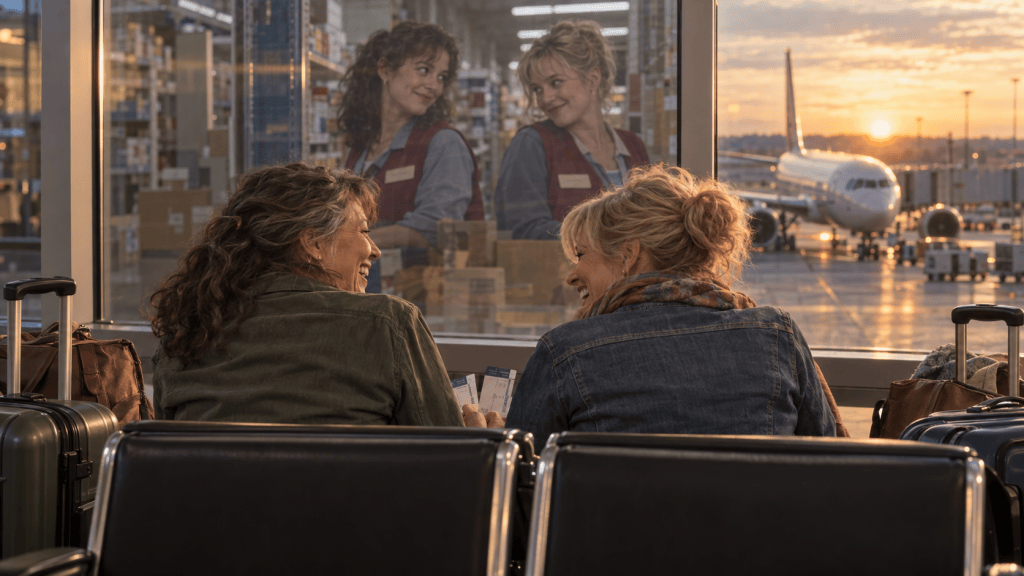
We are travel companions too.
This matters because travel reveals things.
It reveals how people behave when they are tired, hungry, delayed, lost, overheated, overpacked, under-caffeinated, and standing in an airport while someone insists the gate has changed again.
Travel strips away ceremony.
You learn who can adapt, who can laugh, who needs a moment, who remembers the tickets, and who should not be trusted with directions.
You do not choose just anyone for that.
Thirty-five years later, we are still choosing each other.
She and her husband are going to Mexico with Billie and me in January. We are not sitting together talking only about what we used to do.
We are still making plans.
Some old friendships become museums. You visit them occasionally and admire what has been preserved. You tell the same stories, remember the same people, and look fondly at who you used to be.
Ours contains a museum. Big-box retail hell has its own wing.
But the friendship is not trapped there.
There are still tickets to book, bags to pack, places to see, meals to share, and new stories waiting for us to make them properly inappropriate.
The history is long.
The future is not empty.
There You Are
Thirty-five years is not one continuous golden stretch.
It is work and distance. Laughter and silence. New jobs and old grief. Children, partners, obligations, funerals, journeys, mistakes, and all the different women we have each had to become.
We have known each other through versions of ourselves that no longer exist.
We did not remain unchanged.
We remained recognizable.
Something in her recognized something in me before either of us had enough evidence to understand what it meant.
Thirty-five years later, the evidence is overwhelming.
She has chosen me as a friend, colleague, employee, travel companion, emergency contact, family, and keeper of the stories.
I have chosen her right back.
We met in big-box retail hell.
I have always said that if we had not become friends, we would have burned the building down around us.
We did not.
We built something instead.
Thirty-five years later, we are still adding rooms.
If you could start a new business right now, what would it be?
Good morning from the Grove. Coffee beside me, trees just visible in the morning light outside, and today’s prompt has me imagining what I’d build if I could start over. I don’t have to think long.
I’d find a piece of cozy mountain woods and build a little village of ten or twelve tiny cabins. Each one would have its own personality. A witchy cabin. A cabin for book people. A few inspired by the local stories and history. I’d want guests to walk in and feel like they’d found the one that was waiting for them.
There’d be primitive campsites tucked among the trees, too. Dogs would be welcome, of course. I can picture people bringing the whole crew, setting up camp, and letting the dogs sniff out every interesting leaf and visitor.
Then there’s the bonfire. That’s where the village comes together. Themed weekends, weekly storytelling, music around the fire. Some nights somebody has a story to tell. Some nights somebody brings a guitar. And some nights you just sit there with your dog at your feet and listen to the woods.
I keep thinking about people coming back every year. They’d have a favorite cabin, or a favorite place to sit by the fire. Maybe they’d bring friends along, and by the end of the weekend those friends would be talking about coming back, too.
That’s the part I can see most clearly: the fire going, dogs under the chairs, familiar faces among the new ones. A little village in the mountains that slowly becomes part of people’s stories—and then, somehow, part of who they are. They’d leave with the promise to return, carrying the warmth of the fire with them. And when they came back, the cabins, the trees, and the people around the bonfire would be waiting—not like visitors, but like they’d finally come home.
I read the morning prompt and thought, Are there no sacred spaces? “What are your best healthy eating habits?” I don’t want to write about healthy eating habits. I don’t want to read about them either. They’re everywhere already: meal planning, prepping, more vegetables, fewer carbs, less red meat, Mediterranean, heart healthy. Blah, blah, blah. I know someone could feel that way about any prompt. But food, eating, and weight aren’t neutral subjects for a lot of people. They can carry shame, worry, money problems, health concerns, and years of being told what we should be doing better. Sometimes a cheerful little question lands like one more reminder that we’re supposed to have this figured out by now. I don’t. Most days, I do good to get water and vegetables in. That’s the honest answer. Not a tip. Not a routine I’ve perfected. Just where I am. And maybe somebody else has a list of habits that work beautifully for them. Good. I’m glad. But I don’t have to turn my own uncertainty into advice just because a prompt asks for it. So, at the end of the day: I’ve got nothing for ya, WP. I’m still trying to figure it out myself. And this morning, I don’t want to read about it either.
Not because I had some desperate need to receive a package at precisely 12:47, but because a delivery window is useful information.
I can work with a window.
Do the morning things. Be home from 12:30 to 1:30. Get the package. Move on with my life.
Easy.
Then UPS extended the window to 2:30.
Okay.
They opened it a crack.
Things happen. Traffic exists. Deliveries take longer than expected. Somewhere, somebody has probably ordered a sectional sofa that requires seventeen separate boxes.
Fine.
I rearranged a couple of things and went on with my day.
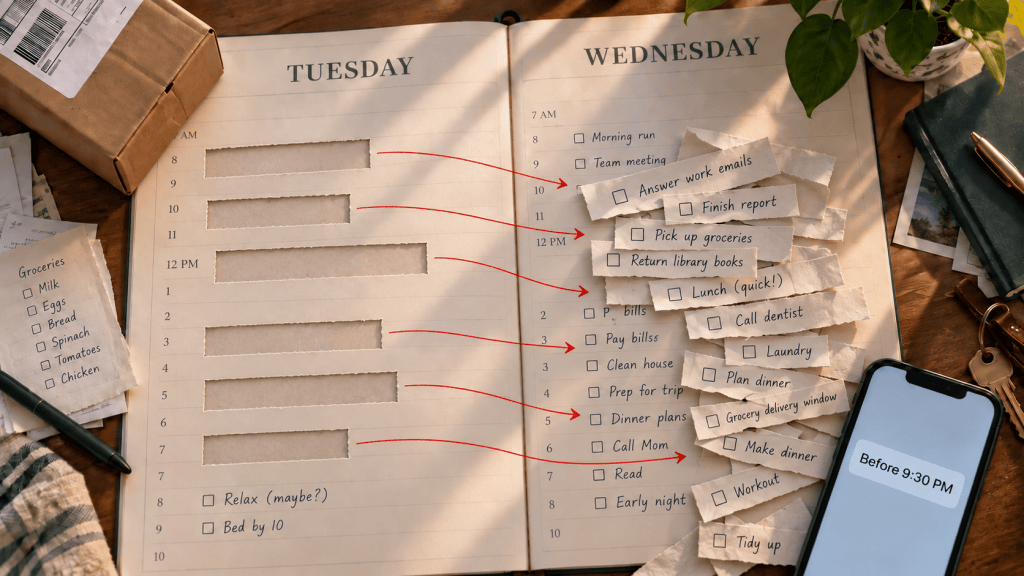
Then, at approximately 2:20, ten minutes before that newly extended delivery window closed, I checked again.
Sometime before 9:30 p.m.
Excuse me?
They had given me a delivery window, then opened it a crack, but suddenly I found the damn thing flung wide open, letting all the AC out.
And that’s when I got pissed.
Not because my package was late.
The package being late was never really the problem.
Had UPS told me that morning, “Hey, your package will be there sometime before 9:30 tonight,” I wouldn’t have particularly liked it, but I could have worked with it.
Instead, they’d given me information I could reasonably use to make decisions.
So I made decisions.
Then they changed the information.
So I changed the decisions.
Then they changed it again.
And days don’t work like delivery windows. You can’t just stretch one end six hours to the right and expect everything else to politely make room.
Things have a place.
I don’t necessarily mean a place on a calendar. I’m not walking around with my day scheduled in fifteen-minute increments. Quite the opposite.
But in my head, things have an order.
This happens, then I do that. Once that’s done, I can leave and do this other thing. Tomorrow I’ll take care of those things because today’s things will already be finished.
It’s not a schedule so much as a line of dominoes.
And UPS put its finger on the first one.
Because I was waiting, I didn’t do the thing I would have done if I’d known I had several hours.
Then that thing had to move.
It couldn’t disappear. It still needed to be done. So it got shoved into the next available space, where something else was already living.
That thing moved.
Which moved another thing.
Something got pushed into tomorrow.
Tomorrow, rather rudely, already had plans.
And suddenly a package that was a few hours late had managed to fuck with approximately 48 hours of my life.
That’s the part that’s hard to explain.
People hear late delivery and measure the inconvenience in minutes.
Twenty minutes late.
An hour late.
Four hours late.
But sometimes an hour doesn’t cost you an hour.
Sometimes it knocks over the next thing, which knocks over the next thing, which knocks over the next thing until you’re standing in the middle of tomorrow wondering how the hell Wednesday got screwed up by something that was supposed to happen Tuesday afternoon.
And yes, theoretically, I could simply adjust.
I did adjust.
For 48 fucking hours.
That’s what all the rearranging was.
Every time the plan changed, I had to pick everything back up and build the order again.
Okay. We’re not doing that now. We’re doing this now. That moves there. This can happen afterward. No, wait, now that won’t work because—
New plan.
Again.
And I think that’s the part I hadn’t really understood before.
Uncertainty takes up space.
It occupies time you technically still have because you can’t confidently give that time to anything else.
A definite inconvenience can be surprisingly easy to accommodate.
Tell me you’re coming at 8:00 tonight? Fine.
Tell me you’re coming tomorrow? Annoying, but fine.
Give me a one-hour window, extend it by an hour, and then ten minutes before that expires fling the damn thing open until 9:30 at night?
Now you’ve made yourself an all-day possibility.
And possibilities take up space.
The package eventually arrived.
Of course it did.
From UPS’s perspective, that was probably the end of the story.
Delivered.
Case closed.
Meanwhile, I was still putting the dominoes back up.
So no, I wasn’t pissed because my package was late.
I was pissed because Tuesday reached over and fucked with Wednesday.
I think the essay is less about hacks and more about permission.
It is a beautiful fall morning. The coffee is warm, the air has finally stopped trying to smother us, and I have already been out yard-sale surfing.
That probably sounds like a life hack to somebody. Get there early. Carry cash. Know what you are looking for. Know what you are not. Do not bring home twelve mystery objects because they were cheap and might possibly be something.
Honestly, that last one is still a work in progress.
The morning prompt asked what life hacks I practice. There are the usual answers, of course. Lists. Timers. Putting things where I can see them. Buying three pairs of the inexpensive shoes that do not hurt my feet because when I find a thing that works, I do not need to keep shopping for a better answer.
But I think most life hacks are personal cheat sheets.
There are absolute shortcuts in the world. I am not disputing that. But a lot of what gets called a hack is simply someone figuring out how their particular brain works, then having the nerve to keep doing it even when it does not look like the way everybody else does it.
I spent most of my life trying to do things the way they seemed to work for other people. Follow the steps. Make the system. Be consistent. Do not need three reminders, a visible cue, and a deadline that has gotten just close enough to bite.
Then I was diagnosed with ADHD, and I could finally see how much I had already hacked my own life just to keep it moving.
I had built workarounds. I had made lists. I had learned that if something mattered, it needed to live where I could see it. I had learned that a planner only works if I will actually open it. I had learned that sometimes the shortest path between “I need to do this” and actually doing it is making it a little prettier, a little more interesting, or a little more urgent.
That is not cheating. That is learning your own operating system.
Maybe your hack is doing dishes while the coffee brews. Maybe it is setting out tomorrow’s clothes before your brain has time to argue with you. Maybe it is refusing to buy the fancy organizational thing because a dollar-store basket by the front door works better.
Maybe it is buying the good socks in bulk.
The point is not whether it would work for everyone else. The point is whether it works for you.
And if it does, write it down. Keep it. Use it without apology.
I opened the back door this morning and took my first fresh breath of fall.
Not fall is technically coming and the calendar says so fall. Actual fall. Cool air sliding in through the door, carrying that little promise that summer has finally loosened its hot, sticky grip on all of us.
It is Dolly Day and Comic Book Day. I have coffee. The dogs are doing whatever dogs do when they are very certain that I should be doing it with them. And WordPress asked me whether I believe in karma.
Baby, I am all the way up.
I think we have made karma into something much smaller than it is. We use it like a threat sometimes. Karma will get them. We mean that somebody who hurt us will eventually get what is coming to them, preferably where we can see it happen. A flat tire in the rain. A public humiliation. Their own bad behavior boomeranging around and smacking them directly in the forehead.
And listen. I understand the appeal.
But that is not really what I mean when I say I believe in karma.
The religious and traditional idea is much deeper than a cosmic revenge machine. It is about action, intention, consequence, and the things we set in motion by how we move through the world. Modern folks have distilled it down to “what goes around comes around,” which is not entirely wrong, but it leaves out the part that matters most to me.
Karma is more than keeping score.
We all leave a trail behind us. Like a carbon footprint, except it is made of the energy we bring into rooms, relationships, jobs, homes, and communities. Do people feel safer after we have been there? Do they feel seen? Do they have a little more room to breathe?
Or do they brace themselves?
You can feel it in places.
The best compliment I have ever received was from someone who came into my house and said it felt like walking into a hug. The energy was so good.
That mattered to me more than any compliment about the furniture or the paint color or whether I had managed to keep the kitchen from looking like a small herd of raccoons had held a union meeting in it. Because a house does not feel like a hug by accident.
A house holds what is poured into it.
It holds the welcome. The laughter. The animals who belong there. The people who have been allowed to come in, sit down, get comfortable, and be themselves without having to audition for a place at the table. It holds the hard conversations that ended in love anyway. It holds the coffee, the grief, the small celebrations, the people who knew they could show up as they were.
That is karma to me.
And the same is true in the opposite direction. We have all been in houses where the air feels tight. Workplaces where old meanness is so embedded in the walls that a new person walks in already braced for impact. Families where everybody knows what cannot be said, who cannot be disappointed, which peace must be kept at all costs.
Nothing supernatural has to happen for us to understand that something has been left there.
People leave things behind.
That does not mean every good person gets rewarded in a neat little package with a bow. Evil people thrive sometimes. Cruel people make money. Mean people get promoted. The world is not tidy enough to promise otherwise, and I am suspicious of anybody trying to sell me a spiritual explanation that requires us to ignore what is right in front of our faces.
But we do not know the cost.
We see the up a lot of times. We see the money, the title, the pretty vacation pictures, the applause. We do not see what it costs somebody to live inside the energy they create. We do not know what follows them home after the audience is gone. We do not know whether they are surrounded by people who love them or people who need something from them.
And honestly, I do not have to see karma in motion to know it is there.
All I have to do is pay attention.
Pay attention to who gathers when someone is hurting. Pay attention to the way people’s faces change when a beloved person’s name is mentioned. Pay attention to whether a place makes people feel smaller or safer. Pay attention to what remains after somebody has passed through a life, a room, a home, or this world.
Today is Dolly Day.
That celebration did not appear because grief got bored one afternoon and needed a hobby. That is here because Dolly put something good into the world. She gave people love worth remembering, joy worth repeating, a piece of herself worth carrying forward.
And we are still seeing the response.
People will say her name. They will share the things that made them laugh and cry and feel. They will make room for her. That is karma in motion too. Not punishment. Not scorekeeping. Not a celestial ledger balancing itself for our satisfaction.
Love leaving a mark.
That is the kind of karma I believe in.
So I am going to keep trying to leave places a little warmer than I found them. I am going to keep making room at the table. I am going to keep building a house, a porch, a Grove that feels like walking into a hug.
Because what we put into something holds energy.
And because someday, whether I get to see it or not, I hope somebody feels a little more welcome because I was here.
And there is something strange about receiving a diagnosis late in life.
At first, there is relief.
Things make sense.
There is an explanation for patterns and struggles that have followed you for years. Things you thought were personal failings suddenly have names. There are reasons. There are tools. There are ways to work with your brain instead of spending your life fighting against it.
That part can be liberating. But there is the other side.
Nobody adequately prepares you for the grief.
Because eventually you start looking backward.
And somewhere back there, you find a child.
I found a little girl who had been told she was lazy.
She was smart.
Everyone agreed about that.
That almost made it worse.
Because if you’re smart and you aren’t performing the way people think you should, there has to be a reason.
The obvious conclusion was that you weren’t trying hard enough.
You weren’t applying yourself.
You weren’t living up to your potential.
You were careless.
Unmotivated.
Lazy.
That word followed me for a very long time.
Lazy.
The terrible thing about labels given to children is that eventually they stop sounding like opinions.
They become facts.
Adults know things.
Teachers know things.
Parents know things.
So if the adults around you repeatedly tell you that the problem is effort, eventually you believe them.
I believed them.
For years.
Decades, really.
And then, as an adult, someone finally handed me a different explanation.
ADHD.
Suddenly I began learning about executive function. Attention regulation. Working memory. Time blindness. Task initiation. Hyperfocus.
I learned that ADHD doesn’t necessarily look like the little boy bouncing out of his chair that so many of us were taught to recognize.
And I began recognizing myself.
Not just the adult me.
Her.
The little girl.
And that was when relief became something else.
Because she wasn’t lazy.
She was struggling.
There is a profound sorrow in realizing that.
I wish someone had understood her.
I wish someone had looked beyond the unfinished work and inconsistency and asked why a bright child who clearly could do something sometimes couldn’t seem to do it at other times.
I wish someone had helped her find ways to work with the brain she actually had instead of repeatedly telling her to try harder with it.
Mostly, I wish she hadn’t believed them.
That’s the part that hurts.
Because when you’re told something about yourself often enough as a child, you build around it.
You lower expectations.
You explain your failures with it.
Sometimes you explain your successes around it, too.
You develop elaborate systems for compensating without understanding what you’re compensating for.
You wonder why things that seem effortless for other people can require enormous effort from you.
And somewhere underneath all of that remains the original explanation:
I’m lazy.
Then comes the question I suspect many people diagnosed later in life eventually ask.
What if I’d known?
What if someone had recognized it when I was eight?
Or twelve?
Or sixteen?
What opportunities might I have taken?
What might I have finished?
What would school have looked like?
What choices might I have made if I hadn’t spent so much time believing that the difficulty itself was evidence of a character flaw?
Who might I have become?
There is no answer to that question.
That’s another difficult part.
There is no alternate life available for comparison.
Maybe everything would have been different.
Maybe very little would have changed.
I’ll never know.
But I think I’m allowed to grieve the possibility.
More importantly, I’m allowed to grieve for that child.
Not because her life was terrible.
Not because nobody loved her.
Not because every struggle she ever had can be explained by one diagnosis.
But because she deserved to understand that difficulty was not a moral failing.
She deserved help instead of a label.
She deserved tools instead of judgment.
She deserved to know that trying harder isn’t always the answer when you’re being asked to function in a way your brain doesn’t naturally function.
She deserved better than lazy.
So did the teenager she became.
So did the young woman.
And so did every version of me that carried that word forward without ever questioning whether it was true.
I can’t go back and give that little girl what she needed.
I can’t tell her teachers what we know now.
I can’t sit beside her when she’s staring at something she knows she should be able to do and explain why wanting to do it and being able to make herself begin it aren’t always the same thing.
I can’t change her story.
But I can change the way I tell it.
She wasn’t lazy.
I wasn’t lazy.
I was living with a brain that worked differently, without knowing it worked differently.
There is sorrow in finally understanding that.
There is anger sometimes, too.
But there is also grace.
Because after all those years of believing I knew what was wrong with me, I finally get to put that word down.
And perhaps that’s one of the unexpected gifts of being diagnosed late.
You don’t get your childhood back.
But you do get to go back and look at that child again.
This time with understanding.
This time with compassion.
And this time, when somebody calls her lazy, you can finally be the adult who stands beside her and says:
How do you write what people actually want to read?
The easy answer is, “I write for myself.”
And I do. Mostly.
I write about the things that get lodged under my skin. The small indignities of being a grown-up. The grief that changes shape but does not entirely leave. The weird glass animals that make me happy. The things we are told not to say out loud because they are too tender, too angry, too complicated, too human.
If I did not care about the subject myself, I do not think I could make it worth anyone else’s time. Writing has to begin with something true. Otherwise, it is just content-shaped wallpaper. Somebody may scroll past it, maybe even click a little heart, but it will not have much life in it.
So yes. I write for myself first.
But I do not think that is the whole truth for most of us who put our words out into the world.
Because if I truly did not care whether anyone read it, I could keep it in a notebook. I could tuck it in a folder on my computer with a dramatic little filename and let it live there forever. There is nothing wrong with that. Some writing is private, and some things belong only to the person who needed to get them out.
But sharing is different.
Sharing says, “I have been thinking about this. Maybe you have too.”
It says, “I do not have a tidy answer, but I pulled up a chair.”
That is what I picture when I write here. Not a stage. Not a lecture hall. Certainly not me standing on a mountaintop with a polished little nugget of wisdom and a ring light.
A porch.
There is a favorite beverage involved. Coffee, tea, Coke, water in the good cup, whatever is getting you through this particular Tuesday. We sit down together and have a conversation. Sometimes it is funny. Sometimes it is about a glass pig or a tree or why adulting is stupid. Sometimes it is grief, ADHD, anger, faith, friendship, or the complicated truth that nobody has put words to quite right.
I am flawed. You are flawed. Thank goodness.
People without flaws do not exist, and if they did, they would be boring as hell. The things that make us hesitate before we speak are often the very things that let someone else recognize themselves in us. Not because our stories are identical, but because the feeling underneath them is familiar.
Maybe somebody reads a post and thinks, “Well damn. Me too.”
That is connection.
I am not writing for an audience in the way that phrase often gets used. I am not trying to reverse-engineer a person into clicking, staying, buying, agreeing, or behaving. I cannot write from a place of trying to please everybody. That would make me miserable, and it would make the writing dull.
But I am writing toward people.
Toward the person who needs to know they are not the only one who loses track of people when they cannot see them. Toward the person who wonders whether everybody else got a handbook for being an adult and somehow they missed the mail. Toward the person who still needs a little joy, a little beauty, a little reminder that oddness is not a defect.
I write for myself because I need to say it.
I share it because I hope it reaches somebody else who needs to hear it.
That feels like enough of a reason to keep the porch light on.