What’s the most spontaneous thing you’ve ever done?
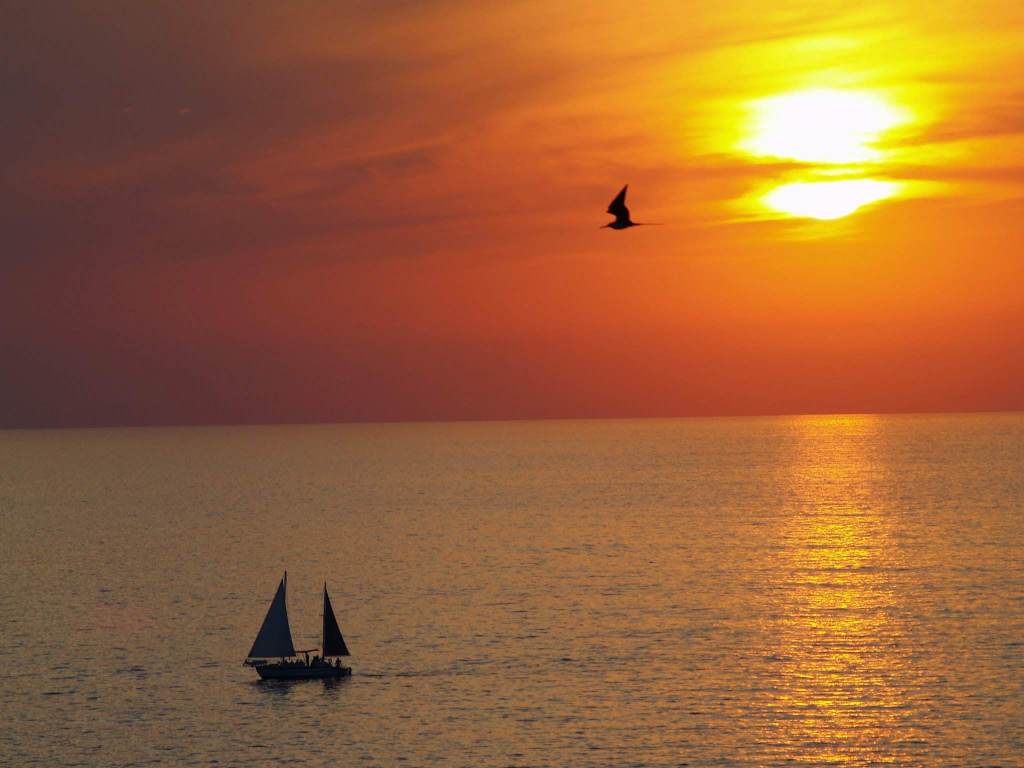
Puerto Vallarta Sunset, photo taken by Author
Greetings from the Grove. We are enjoying our coffee on the porch this morning while the weather has finally decided to cut us a break. Rain is moving through, the temperatures have backed off a little, and I am grateful for every bit of it.
Today’s prompt asks about the most spontaneous thing I have ever done.
Sixteen years ago, I had just graduated from grad school when a friend put up a Facebook post. He needed someone with a passport and enough time to go to Puerto Vallarta, Mexico, with him for orthopedic surgery.
That is not the sort of post most people expect to see while minding their own business on Facebook.
He had found an orthopedic surgeon in Puerto Vallarta because the math was ridiculous. What would have been an outpatient procedure here was cheaper there as an inpatient procedure, including the hospital stay and home visits from the doctor afterward. That is a whole separate conversation about American healthcare, Big Pharma, and the fact that we have let “can people afford to be well?” become a reasonable question.
But there he was, needing help, and there I was with a passport, a little time, and about two weeks to get ready.
So I went.
We stayed in a gated high-rise, which felt awfully fancy for two freshly graduated people who were really there because somebody needed orthopedic surgery. The whole trip held those contrasts. We had the beautiful condo, the doctor coming by to check on him, and wonderful sushi. Then we would step outside and see the very real disparity of wealth around us. Puerto Vallarta was generous and gorgeous and complicated, all at the same time.
What I remember most, though, is the kindness of the people and the food.
There was a little place down the street from the condo. A hole in the wall, of course, because that is always where the best food is hiding. They served fish caught from the bay, roasted with vegetables, and fresh-made guacamole. I have had good guacamole here. I can make good guacamole here. It is still not the same.
There is nowhere for mediocre ingredients to hide in guacamole. Fresh avocado, lime, cilantro, chile, whatever magic somebody’s grandmother has been doing with it for fifty years. When it is all that fresh, it becomes a different food entirely.
And the tortillas.
Mexican tortillas handmade by somebody’s grandmother hit so different. I did not need beans, meat, guacamole, or sauce on them right away. Ma’am, please just keep putting three plain, warm tortillas on my plate. Then we can discuss the rest of the meal.
The sushi was good. It was genuinely good. It did not come close to that fish and guacamole.
That trip is where I learned all of this. Alaska opened my heart. Rome speaks to my soul. Mexico belongs to my palate and my flavor. None of those things matters less than the others. A place can teach you what awe feels like, or history, or beauty. It can also teach you that food is welcome. Food is memory. Food is a conversation you can have even when you do not share the same language.
While I was there, I lost my extra-grandmother. It was not completely unexpected. My family and I had talked about the possibility before I left, and I knew the risk of being far away. Still, grief does not wait for a convenient time or a better setting. It arrives where it arrives.
So Puerto Vallarta will always hold more than one thing for me. It holds a friend trusting me enough to ask for help. It holds a healthcare system that made more sense than the one at home. It holds generosity beside inequality, a beautiful high-rise beside ordinary people making a living, and the freshest meal I can still taste sixteen years later.
It also holds the reminder that sometimes the best decisions are not the ones you planned for years.
Sometimes they are the ones that arrive in a Facebook post, asking whether you have a passport.
Mabon is coming, and I’ve been looking around the Grove wondering what this year has grown.
There’s the blog, for one. I finally opened the porch and started putting my words out where other people can find them. There are books in the world that used to exist only in my head. There are conversations here I might once have been too afraid to start.
And there’s Becky, who would like it entered into the official record that she needs a bigger pot. I hear you, Becky.
The autumn equinox feels like a good time to take stock. I want to be grateful for what grew without pretending everything I hoped for came to harvest. Some plans are still plans. Some things took longer than I wanted. Some things surprised the hell out of me.
I can sit with all of that.
Maybe I’ll light a candle and have something good to eat. Maybe I’ll go outside and listen to the trees. I’ll certainly take a moment to thank the people who have come to this porch, read a story, and stayed to talk.
That’s enough of a celebration for me. Notice what’s here. Welcome the changing season. Leave room for a little magic.
And, Becky, before I leave for Barcelona, we’re going to discuss your real estate.
The question was simple enough: how do you make time for self-care?
My immediate answer was, “I don’t.”
Not because I never take care of myself. I do. I like a good bubble bath, preferably one with Jacuzzi jets powerful enough to rearrange a spine. I enjoy coffee in a quiet house. I will absolutely take a nap if the opportunity presents itself.
But “self-care” has become one of those phrases that comes with a whole prepackaged image attached. Candles. Face masks. Wine in a stemmed glass. A woman in a fluffy robe looking peacefully out a window she apparently never has to clean.
That has never quite been me.
My self-care looks like letting the inner five-year-old run free for a while.
She is not especially efficient. She has no respect for a sensible itinerary. She will interrupt an otherwise ordinary afternoon because a glass pig needs a name, a new project needs to begin immediately, or a character in a pet-care book clearly deserves a meadow full of companions.
She likes purple pens. She wants to make the world prettier. She sees a weird little rabbit in an estate-sale booth and believes, with her whole heart, that it ought to come home. She has strong opinions about the proper name for a paperweight and will not be rushed while forming them.
Frankly, she is a menace.
She is also the reason I still know how to play.
For a long time, I treated those impulses like distractions. I had work to do. Responsibilities. A house full of people and dogs and dishes and things that required an adult who knew how to stay on task. There was always a practical reason not to follow the shiny thought.
But somewhere along the way, I learned that the five-year-old was not trying to derail me. She was trying to save me from becoming nothing but a person who completed tasks.
So now, sometimes, I let her have the purple pen.
I let her name the animals. I let her build imaginary meadows. I let her get excited about a new idea before it has justified itself with a business plan, an audience, or a dollar sign. I let her make something simply because it delights her.
That is self-care for me.
Not the performance of having my life together. Not a product someone can sell me. Permission to be curious. Permission to make room for joy before I have earned it. Permission to create a small, strange, lovely world and live in it for a little while.
And when she has had her run, I can come back to the grown-up things with a clearer head.
Sometimes self-care is a bubble bath.
Sometimes it is a purple pen.
Sometimes it is letting the five-year-old take the wheel long enough to remind you that life is supposed to have meadows in it.
I did not wake up one morning and decide that what my life needed was a growing population of glass animals, pottery creatures, unidentified inherited objects, and the occasional paperweight with an attitude.
It happened slowly.
One piece caught my eye from across a booth. Another felt too strange or beautiful to leave behind. Some came from family members who had kept them for years before passing them to me. Others were sitting quietly on thrift-store shelves, waiting for someone to notice what they were.
Then they began acquiring names.
That is usually the point of no return.
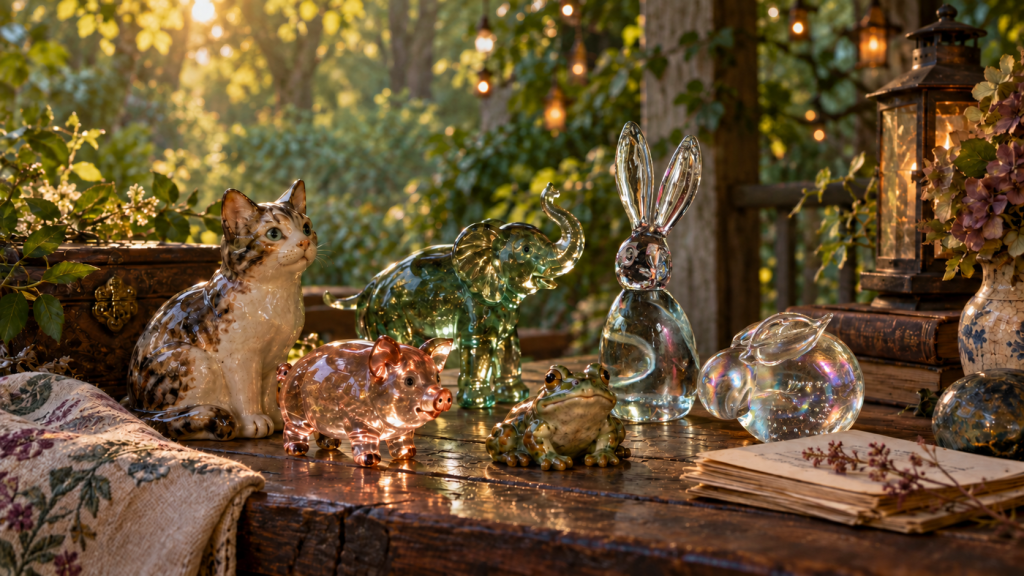
A glass cat became Zelda. An elephant became Douglas. The rabbits became Bevin and Calliope. Agatha the frog arrived with enough personality to launch herself onto an entirely new social-media platform.
Some pieces come home because I recognize the maker or see the possibility of resale. Those are visitors. I research them, photograph them, tell their stories, and help them find the next person who will appreciate them.
Others take one look around and become permanent residents.
There is not always a sensible explanation for the difference.
A valuable paperweight may be destined for resale while a twelve-dollar glass pig receives immediate lifetime residency because she looked at me from two booths away and I whispered, “I’m coming.”
I do not make the rules.
Over time, I realized I was not simply collecting objects. I was becoming their keeper.
Glass and pottery survive because somebody decides they matter. Somebody carries them carefully through moves, wraps them in old newspaper, remembers which grandmother owned them, and refuses to leave them sitting unnoticed on the bottom shelf.
Not every piece is rare. Not every piece is signed. Not every piece will ever be worth much money.
Value and worth are not always the same thing.
The Sunstone Grove Menagerie is where these creatures get their names, their histories when I can find them, and their mysteries when I cannot. It is part collection, part research project, part rescue operation, and part evidence that I should never be left unsupervised near an estate sale.
I may have brought them home.
But I suspect they were building the Menagerie long before I realized I had been appointed keeper.
As an avid traveler, I’m often asked which place I love most and why everyone should go there. The first part is easy. Alaska. The second part is where I become difficult.
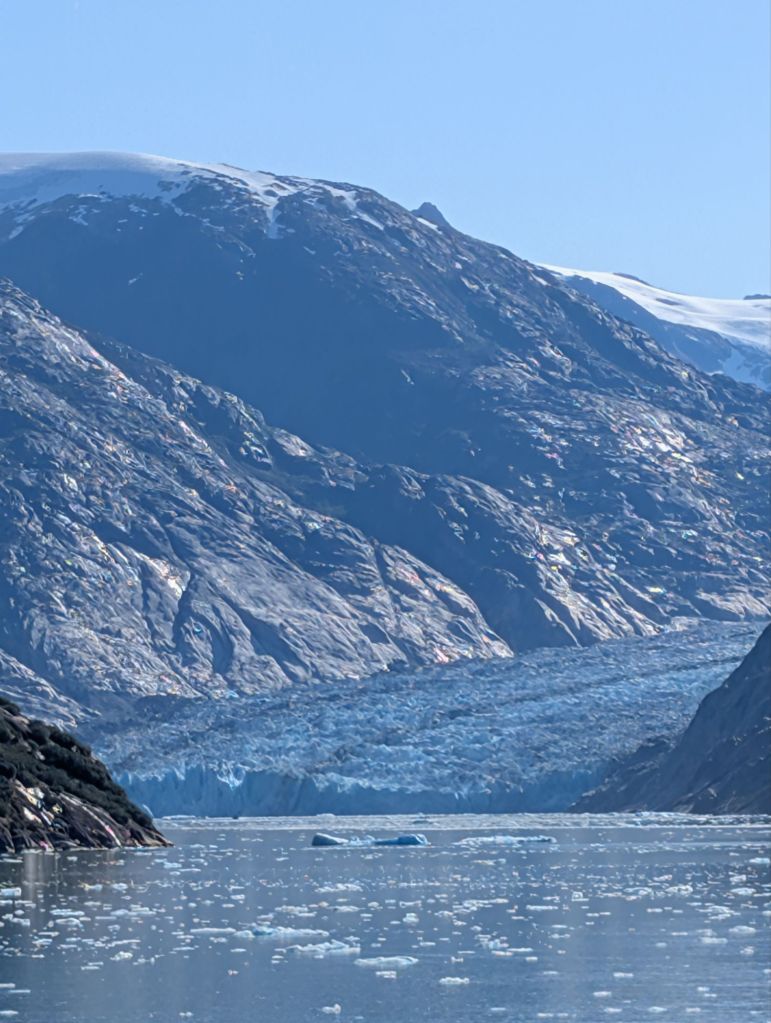
Glacier Icy Strait Point taken by author
I lived there for six months and have gone back three times. I love her. I’ll show you my pictures and tell you why she gets under my skin, but I’m going to have to trust you with her. I’m not entirely sure I trust us with beautiful things.
See? Difficult already.
I could give you the usual list. Mountains. Glaciers. Wildlife. Water that stretches farther than your eyes seem prepared for. All true, and none of it quite explains why I speak about Alaska as though she might overhear me.
She might.
In 1992, I watched Mount Spurr erupt. I stood there watching the ash cloud drift, aware that the landscape in front of me was making a decision of its own. You can read about a volcano or see one in a photograph. Watching the sky change because the earth beneath it has moved gives you a different understanding of the word landscape.
Alaska never promised to sit still and look pretty for us.
I don’t say that to make her sound cruel. It’s one of the things I love about her. There are places that seem to invite you to arrange them into a pleasant background for your life. Alaska has never felt like one of them to me. She was there before I arrived. She would be there after I left. My job was to notice, not to direct.
I learned that on much quieter days, too.
For my twenty-fifth birthday, I had a beach bonfire beside Cook Inlet. We brought a bucket of grocery-store fried chicken and carrot cake. Nothing fancy. Just food, fire, and people I wanted beside me.
The light seemed to last forever. For about six hours, sunset and sunrise blurred together as the sun passed behind the mountains. And out in the inlet, a pod of belugas swam by.
I remember the chicken. I remember the cake. I remember sitting by that fire while the sky kept changing and the belugas moved through the water. Alaska didn’t arrange any of it for my birthday. We were simply lucky enough to be there together.
If you’re looking for a reason to see Alaska, I could stop with that birthday. I could show you a picture, if I have one, and say, Look what she can do. But I can’t promise you belugas with your cake. I wouldn’t want to. The moment belonged to a place that was living its own life, and I happened to get a seat beside it.
Another time, I was halibut fishing in a thirty-two-foot boat when a gray whale surfaced beside us.
I had gone out to fish. The whale had other plans. For a moment the boat, the fishing, and whatever I’d expected from the day became considerably less interesting than the enormous living creature sharing the water with us.
That’s a pattern with Alaska. You make your plans, and she reminds you that they are yours alone.
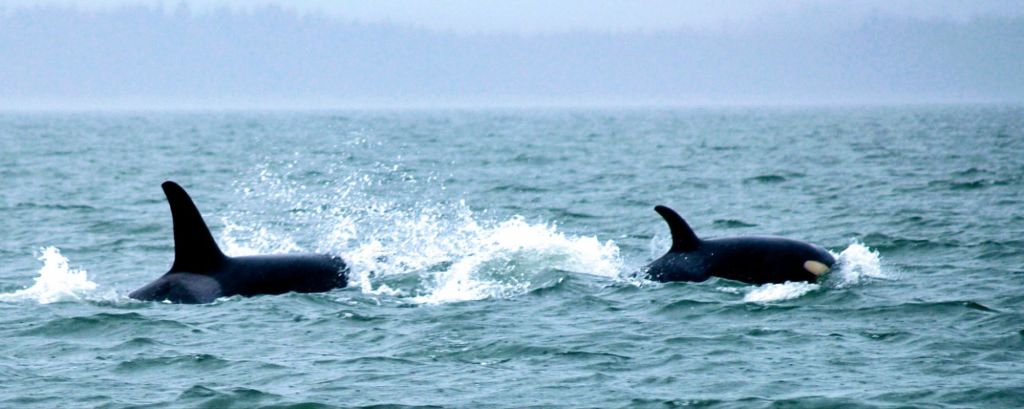
My most revealing whale encounter, though, came on a whale-watching tour. A resident pod of orcas swam past the boat. We had the water, a glacier-cut valley, mountains, and a pod of wild orcas moving through a place that was theirs.
Resident Orca Pod near Juneau taken by author
Another passenger called them boring. You could see orcas at SeaWorld, she said.
No, ma’am. Absolutely not.
You could see an orca there. You could not see this.
I wanted to wave my arms at the entire valley. At the mountains. At the water. At the pod that had chosen its own course and owed us nothing. I wanted to ask what she thought she’d come all this way to find.
Perhaps she wanted the whales to perform. Perhaps the mountains were so big she’d stopped seeing them. I don’t know her, and I won’t pretend to know what was in her head. I know what her comment brought up in me.
We can travel somewhere magnificent and still arrive carrying the expectation that it should entertain us on command.
That worries me.
I love to travel. I know that my own visits have an impact, too. I have taken the boat tours and gone to see the wildlife. I am not standing outside the gates telling everyone else to leave a place untouched while I keep the key. I’m asking myself the same question I’d ask anyone who wanted to go: How will you behave when she doesn’t give you the moment you came for?
If no whale surfaces, can you still look at the water?
If the weather hides the mountain, can you accept that the mountain isn’t obliged to reveal herself?
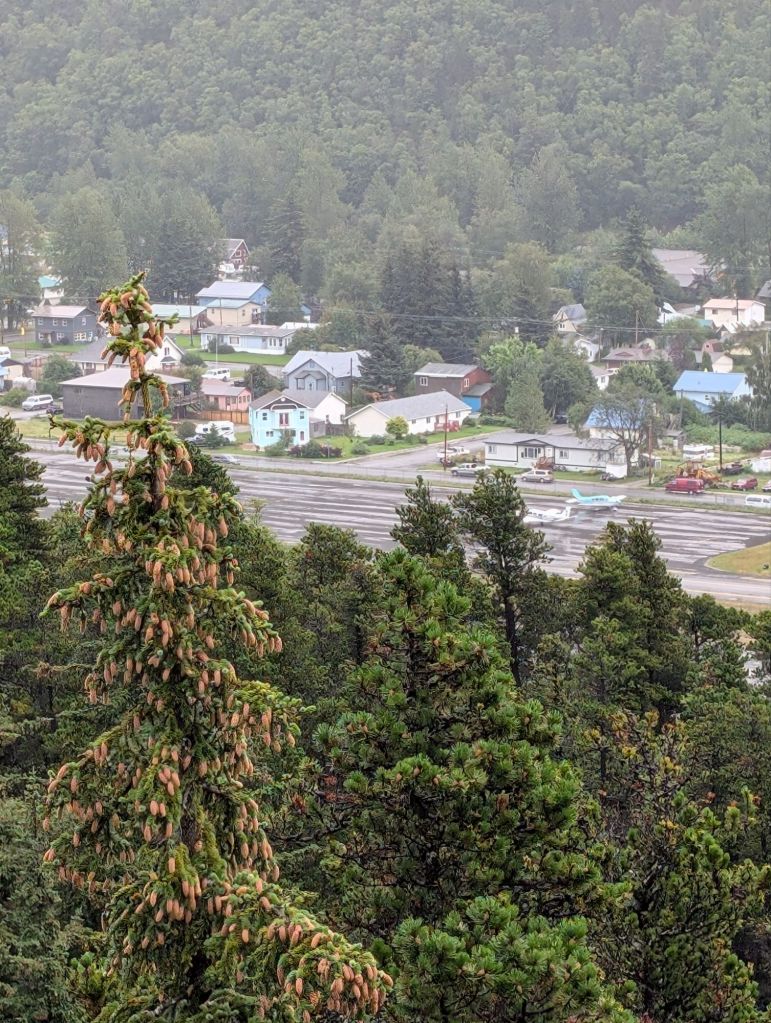
Skagway from an overlook taken by author
If the orcas swim past without breaching, can you understand that you have seen something extraordinary?
The natural world doesn’t need to exceed our expectations to deserve our attention. Sometimes we need to arrive with better expectations.
My Alaska memories are spectacular in ways I could never have arranged. An eruption. Belugas on my birthday. A gray whale beside the boat. Orcas in a glacier-cut valley. I understand how they sound when I put them together like that. It’s enough to make someone ask for my itinerary, as though following my route would reproduce my life.
It won’t.
The fried chicken came from a grocery store. The whales came from the inlet. I didn’t schedule either one.
I can tell you where I stood, what I saw, and what it meant to me. I can’t sell you a guaranteed version of it. That’s part of the love letter. I want Alaska to keep being a place where a person can be surprised by something real, not a collection of promised experiences that must happen before the trip counts.
I also want her creatures to remain creatures. An orca is not an attraction that failed because it didn’t put on a show. A beluga is not a charming accessory to my birthday story. The gray whale was not part of our fishing charter. They were living their lives while we had the astonishing good fortune to witness a piece of them.
Maybe that’s why “I love her” is the only phrase that feels right to me. I don’t love Alaska because she exists to please me. I love her because she doesn’t.
She has beauty that doesn’t ask to be owned, wildness that doesn’t need our approval, and a scale that can make a person feel small without making her feel unimportant. I have been grateful to stand in that space and remember I am one living thing among many.
And yes, I worry about what happens when more of us arrive.
We bring money that can support people and places. We also bring noise, demands, waste, and the very human habit of wanting a beautiful thing to be easier to access, easier to package, and easier to consume. I can’t pretend travel is harmless because I happen to do it with good intentions. Loving a place means thinking about the marks I leave on it.
It means listening to people who live there instead of treating their home as scenery. It means giving wildlife room. It means accepting a canceled plan, an ordinary sighting, or a day when the view stays behind the clouds. It means asking whether I’m helping care for the place I came to see, or merely collecting evidence that I went.
I am still working on those questions. I hope you will, too.
People sometimes talk as though a destination is ours once we’ve visited it. We say we’ve done Alaska, checked it off, and moved on to the next place. I lived there for six months and returned three times, and I don’t feel remotely finished with her.
How could I be? She isn’t a task.
I know why women choose the bear. Alaska does, too. She doesn’t need me to make her tame so I can recommend her comfortably. I’d rather love her as she is and ask us to make ourselves better guests.
So, should you see Alaska?
Yes. I want you to know the feeling of standing somewhere that interrupts every little plan you brought with you. I want you to see the mountains even if they refuse to fit into one photograph. I want you to look out over the water and understand that everything beneath it has a life you didn’t come here to direct.
I’ll show you my own pictures. I’ll tell you about the ash cloud in 1992 and the birthday bonfire with fried chicken and carrot cake. I’ll tell you how a gray whale took over a fishing trip and how a pod of orcas taught me, again, that seeing an animal in the wild is about seeing the world it belongs to.
I’ll probably tell you more than you asked. I love her.
That’s why I’m reluctant to invite you.
But if you go, take that reluctance with you as a request. Be curious. Be careful. Let her surprise you without asking her to perform. Remember that the people and creatures who call her home will still be there after your pictures are taken.
Go see Alaska. Just don’t make her regret letting you in.
That was the entire plan. One thing, followed by the pleasant feeling of having done it.
Then I looked at the thing.
Before I could start, I needed to move something out of the way. That something needed a home. Its home was full of other things, several of which I had been meaning to deal with for weeks. One needed a label. I couldn’t find the pen. Finding the pen led me to the drawer, and the drawer had apparently been waiting for this moment to tell me everything wrong with my life.
My original task was still sitting there, untouched, while twenty-seven others introduced themselves.
People call this task paralysis. From the outside, it can look like I’m refusing to do a simple chore. From where I’m sitting, I can see every step attached to it, including the steps I’ll have to undo if I get halfway through and run out of time.
I’m not lying on the couch thinking, I would love to neglect this.
I’m thinking, Where does this actually begin?
Sometimes I choose a tiny starting point and get moving. Sometimes that works beautifully. Sometimes starting reveals another six jobs I hadn’t noticed, and I have to stop before the whole afternoon disappears into a drawer I never intended to open.
And yes, there are days when I do all sorts of useful things while the original task waits patiently for me to remember it.
I can make a book, write an essay, take pictures of every side of a paperweight, and solve a problem nobody asked me to solve. Then I’ll stand in front of something ordinary and feel as though it requires a committee, a map, and permission from the Goddess Mother.
That’s the frustrating part. Being able to do something complicated doesn’t mean I can reliably start something simple. The complicated thing may have a clear first step, or it may be interesting enough that I’m already halfway in before I notice. The “simple” thing might have hidden conditions. It might be boring. It might mean deciding what to keep, what to move, and what counts as finished.
Becky needs a bigger pot.
I know this because I can see her every day. She can see me, too, and has taken to drooping dramatically whenever she would like to discuss it. Repotting her means getting into her enclosure, getting her out without making a mess of everything around her, finding the right pot and soil, and putting the whole little neighborhood back together.
I’ll probably water her today. She’ll perk up. Next week we’ll have this conversation again.
I need to repot her before I leave for Barcelona, so the task isn’t going away. Nor is it a mystery. I know what needs doing. The hard part is crossing the distance between I know and I’ve begun.
If you live with a brain like mine, you may know that distance. You can care deeply about a thing and still keep walking past it. You can remember it every day and still find it hard to start. You can be annoyed with yourself, which, in my experience, does absolutely nothing to make the pot larger.
So I’m trying to speak to myself more honestly. Becky’s repotting is a project. I can gather the supplies before I open the enclosure. I can clear a place to work. I can do those parts without demanding that the entire job happen the instant I notice her drooping.
And when I finally get her into a bigger pot, the other plants are going to look over and ask how Becky secured such high-class treatment in this neighborhood.
She’ll tell them, “Location, location, location.”
I was going to do one thing. It brought twenty-seven friends. I’m allowed to ask which one actually needs me first.
What’s one thing you wish you had started doing earlier in life?
I was never quiet.
People who know me are probably staring at that sentence and wondering if I have confused myself with someone else.
I can tell a story across a crowded room. I laugh loudly. I have opinions, and I am not generally shy about sharing them. I talk to strangers, animals, plants, and glass creatures in antique stores. I once spotted a glass pig from two booths away and assured her I was coming to get her.
Volume has never been my problem.
Except when it mattered.
I knew how to be loud when I was being funny. I could speak with confidence when I was defending someone else. I could advocate for the people I loved, solve their problems, anticipate what they needed, and make sure their voices were heard.
But when the subject was me, my volume dropped.
I did not always say, “That hurt me.”
I said, “It’s fine.”
I did not always say, “I need help.”
I said, “I’ve got it.”
I did not always say, “This isn’t working for me.”
I adjusted myself until it worked for everyone else.
There is a difference between being outspoken and speaking up for yourself. It took me far too long to understand that.
You can be the loudest person at the table and still never ask for what you need. You can fill a room with laughter while quietly making yourself smaller. You can have strong opinions about everything in the world except whether you deserve better from it.
I thought being easygoing was a virtue. I thought being strong meant carrying the weight without complaining. I thought keeping the peace was more important than saying the thing that might disturb it.
The trouble with constantly keeping the peace is that the peace usually belongs to everyone except you.
So I swallowed words.
I swallowed disappointments because I did not want to seem ungrateful. I swallowed anger because I did not want to be difficult. I swallowed needs because other people had bigger ones. I softened my no until it sounded like maybe. I dressed my hurt in jokes so nobody would feel uncomfortable looking at it.
Then I wondered why people did not understand.
The truth is, I had trained them not to.
I had taught people that I would manage. I would adapt. I would forgive before anyone apologized. I would find a way around whatever had been placed in front of me.
And I usually did.
That does not mean I should have had to.
If I could go back, I would not tell my younger self to become louder. She was already plenty loud. I would tell her to use that voice in the places that frightened her.
Say what you need.
Say what you want.
Say when something hurts.
Say when the joke is not funny.
Say no without attaching a five-paragraph explanation and three alternate solutions.
Speak while your voice is still steady instead of waiting until silence has turned into resentment.
Most of all, stop believing that keeping everyone comfortable is more important than telling the truth about your own life.
I am learning to turn up my volume now.
Not to speak over anyone. Not to dominate every conversation. Not to make myself the most important person in every room.
I am turning it up so I do not disappear from my own story.
I am learning that “I want” is a complete beginning. “I need” is not an accusation. “That hurt” is not an attack. “No” is not cruelty.
My voice does not become less kind when I use it for myself.
I wish I had understood that earlier.
I wish I had known that being seen is not the same as demanding attention. Being heard is not the same as silencing someone else. Taking up my share of the room does not steal space from anyone.
I cannot go back and hand that knowledge to the woman I was.
But I can refuse to lower my voice for the woman I am becoming.
If you could pick any fictional animal to be your lifelong companion (like a Pokémon or fantasy pet), what would it be?
My sentimental answer is Blue, the dog from Emily Kimelman’s Sydney Rye series.
Blue is the kind of dog you do not simply choose. Blue chooses you. He is loyal, intelligent, protective, and deeply connected to the people he loves. He would understand the household, keep watch over everyone, and probably know exactly when I needed comfort without waiting for me to ask.
Unfortunately, Blue and Rowdy could not live in the same house.
Rowdy does not like boy dogs. This is not a minor personality difference. This is a firm policy position. Bringing Blue into the house would create a canine diplomatic crisis, complete with territorial negotiations, emotional speeches, and at least one party refusing to participate in the peace process.
So Blue is my sentimental winner.
My dream companion would be a dragon.
Not necessarily a giant, castle-sized dragon. I am thinking more along the lines of a warm, opinionated house dragon who sleeps in a basket, guards the glass menagerie, hoards shiny stones, and occasionally sets fire to something that deserved it. A dragon would be magnificent. A dragon would make errands more interesting. A dragon would also eliminate the need to explain certain personal boundaries.
But my final answer is Remy from Ratatouille.
I have reached the age where I no longer wish to cook. I want a tiny French mouse in a chef’s hat to take over the kitchen and prepare beautiful meals while I sit nearby and offer emotional support.
I would accept Remy’s judgment. He could criticize my pantry, reorganize my spices, and look personally offended by my shortcuts. He could stare at me in silence when I suggested dinner might come from a box. I would endure it all for the privilege of waking up to coffee, a perfectly balanced breakfast, and dinner that did not require me to stand over a stove wondering what fresh hell I had volunteered for.
Remy would have standards. I could live with that.
He would approve of smoked meats, respect the proper preparation of fried pickles, and understand that pineapple belongs on dessert pizza and nowhere else. He would probably object to sweet meat, which means we would already have a strong foundation for friendship.
Blue is the dog I would choose with my heart.
The dragon is the creature I would choose with my imagination.
Remy is the one I am bringing home because I am not cooking anymore.
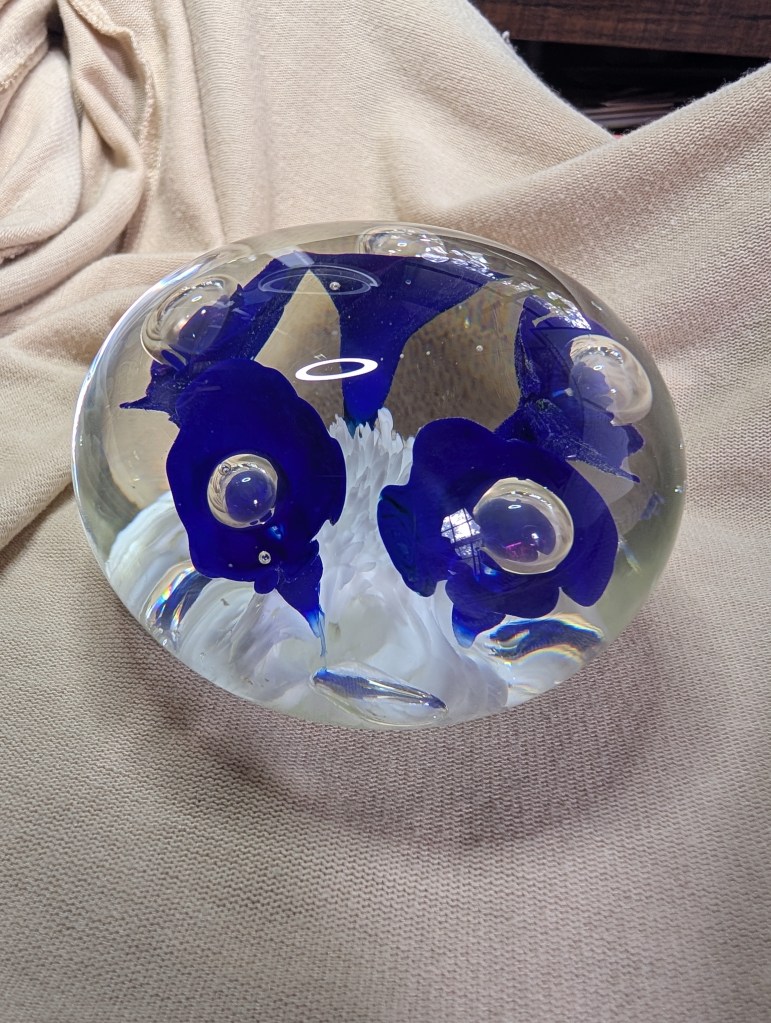
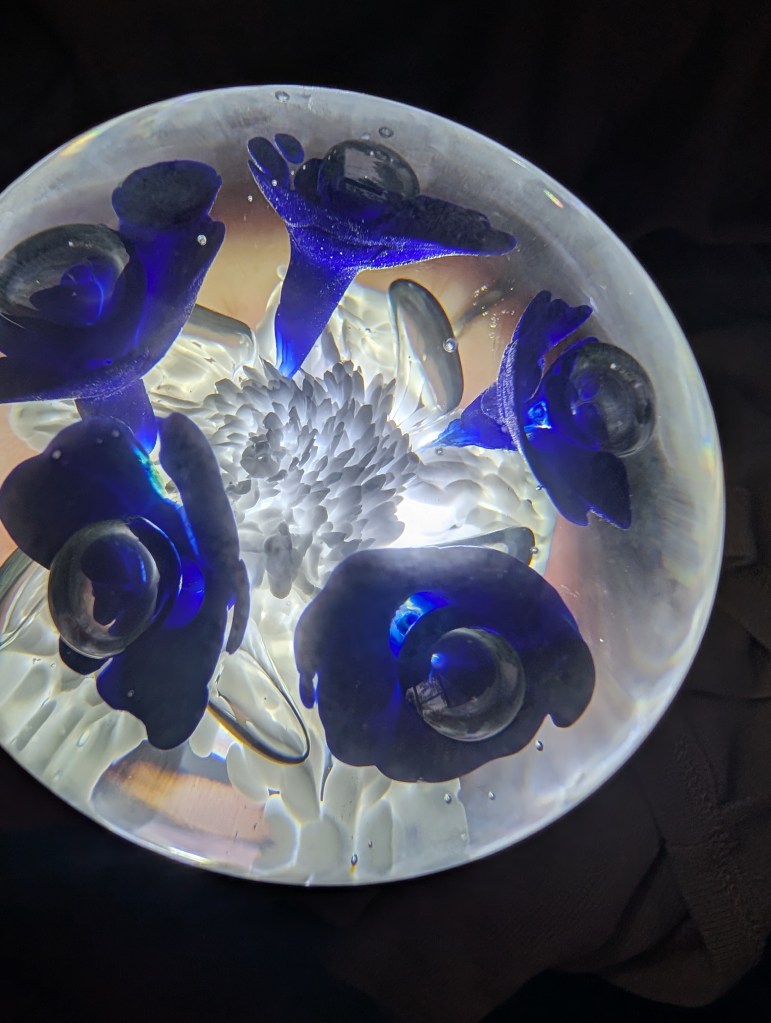
This one is a St. Clair paperweight I’ve named Magnum. She is a substantial little world of cobalt-blue flowers arranged around a white center, with clear bubbles caught among the petals. You can look through the side and see flowers overlapping one another. Look down from above and the arrangement changes again.
That is the trouble with paperweights. Someone can call them decorative objects, and technically they’re right. But then I pick one up, turn it toward the light, and lose fifteen minutes of my life looking at a place no bigger than my palm.
Magnum is especially good at this.
In ordinary light, the blue flowers are bold and the white center seems quiet. Put a light beneath her and quiet goes right out the window. The white flares. The blue glows. Suddenly I can see depth where, a moment earlier, I thought I had seen the whole thing.
I haven’t. I probably never will.
Her base bears a St. Clair mark. The St. Clair family’s history stretches through generations of glassmaking in Elwood, Indiana, and flowers in glass became one of their traditions. I love knowing that. I also love that I felt pulled toward Magnum before I had the family history sorted out. Sometimes my eye gets there first and the research catches up later.
I have learned to listen when a piece makes me stop.
I’ll take pictures of it. I’ll turn it over, look for a mark, hold it up to a window, and try to decide whether I’m admiring it or taking it home. These are separate activities in theory. In practice, there is a point where I’ve taken seven pictures and given the thing a name, and we all know how this is going to end.
Magnum came home.
Now she gets to sit where I can change the light and look at her again. That isn’t an inspection. It’s the pleasure of finding that she still has something to show me.
Maybe that’s why I collect glass. I like beautiful things, obviously, but I particularly like beautiful things that reward attention. Something made by a person’s hands has survived long enough to land in mine. I get to notice the colors they put together, the small details I missed yesterday, and the way light can make an old object feel entirely new.
Magnum has five blue flowers and one very persuasive white center. She has a family name pressed into her base and more than one good side. She also has the considerable advantage of living with someone who will happily spend an afternoon photographing her from all of them.
Welcome home, Magnum. Try not to encourage the others.
If you had to switch lives with a fictional character for a week, who would you choose?
Morticia Addams.
There is no need to assemble a list of candidates. No interviews will be conducted. The position has been filled.
But before I agree to anything, I need to see the contract. What exactly does “switch lives” entail?
I assume I remain myself. I simply move into Morticia’s home and take over her daily life for one week. She comes here and takes over mine. This is a household exchange, not a romantic one. Gomez remains devoted to Morticia, Billie remains mine, and everybody keeps their hands to themselves.
Now that we have cleared that up, I’m ready to pack.
Let’s be honest. I will never fit into Morticia’s dresses, and that is perfectly okay. I don’t need her body or her wardrobe. I’m not trying to become Morticia.
I want her house.
That glorious, gloomy mansion with its endless rooms, secret passages, enormous staircases, dusty corners, and complete lack of beige. I want to wander through hallways where nobody has ever suggested adding a cheerful throw pillow. I want to discover an abandoned conservatory and fill it with plants, books, comfortable chairs, and every member of the Sunstone Grove Menagerie.
There would finally be enough shelving.
I’d drink my coffee while Thing handed me whatever I had misplaced. Lurch could reach everything on the top shelf. Grandmama and I could discuss plants, potions, and which ingredients are technically frowned upon by the homeowners association.
Wednesday would silently judge me, which is fine. I have survived teenagers before.
I would also like to spend some time with Morticia’s carnivorous plants. I feel certain they are misunderstood. Most creatures improve considerably when someone learns what they need and stops demanding that they behave like something else.
Of course, I’m not going alone.
Maya is coming with me.
This is not really my decision. Maya would see the suitcase, attach herself to my leg, and personally amend the contract. She is emotionally dependent on me and would not accept “I’m spending a week with the Addams family” as a reasonable explanation for my absence.
She would love the mansion anyway. Acres of shadowy carpet to patrol, mysterious noises behind the walls, and plenty of people who would admire her intensity rather than ask her to calm down.
Rowdy can stay with Morticia.
He would adore her.
Rowdy is not emotionally dependent on me. He is emotionally dependent on having an audience, and Morticia would appreciate his dramatic range. He would greet her with one of his long, mournful speeches, and she would call his voice exquisite.
That would be the end of it.
By the second day, he would be following her from room to room like a tiny banshee. She would encourage him terribly. When I returned, he would have a black velvet collar and several new vocal exercises.
Dani would stay home too. Someone has to supervise Billie and maintain a thread of normalcy while Morticia and Rowdy conduct their gothic recital.
Vivie, naturally, would ignore the rules of the exchange. She would forge credentials granting herself unrestricted access to both homes. She would hold staff meetings at the mansion, return to Fort Mill to check Morticia’s progress, and submit a full report before either of us realized she had appointed herself executive producer.
This is beginning to sound less like a fictional-life swap and more like the greatest lost episode of Wife Swap.
At the end of the week, the families would gather for the traditional meeting.
Morticia would calmly report that Billie was cooperative, Dani was sensible, and Rowdy had tremendous untapped potential.
I would explain that the Addams mansion now contained more plants, several dozen glass animals, and one comfortable reading corner that nobody was permitted to disturb.
Then the producers would ask what we had learned.
I would say I learned that I do not want to be Morticia Addams.
I do not need her dresses, her figure, or her particular brand of elegance.
I just want to spend one week in a house where strange things are not hidden, unusual creatures are welcomed, and nobody is expected to make themselves smaller, quieter, brighter, or more ordinary for the comfort of visitors.
And yes, I would come home when the week was over.