
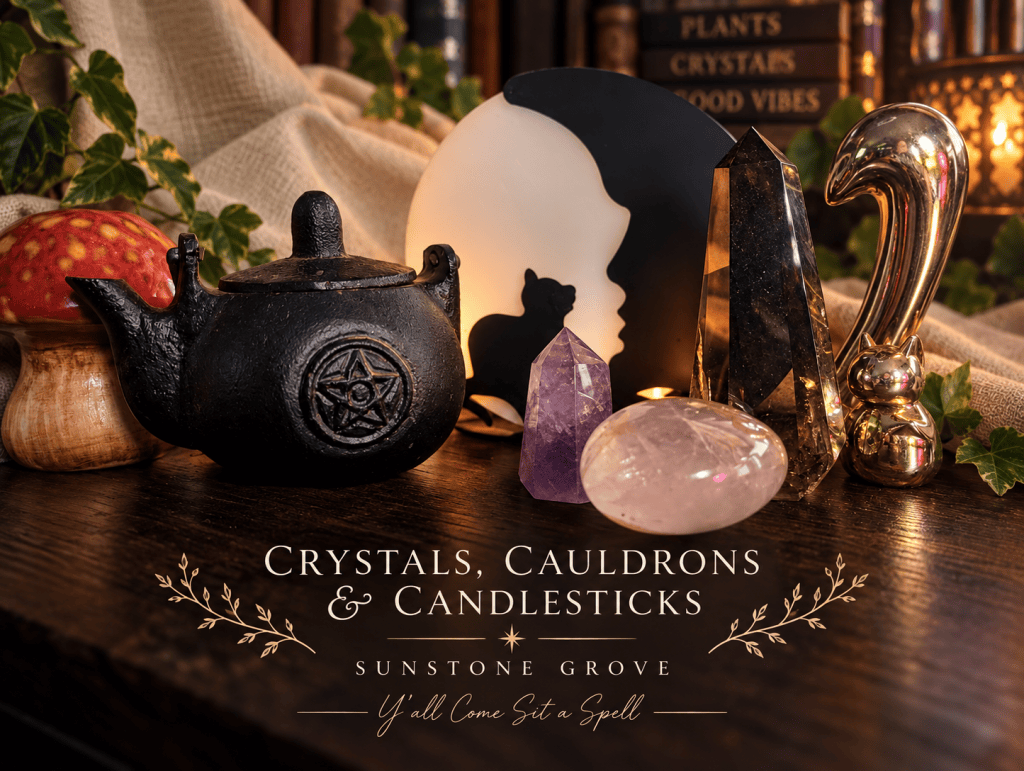
There is something about a cauldron.
You can call it a pot. You can point out that, historically speaking, people cooked in the damn things. You can remind me that most modern “cauldrons” have never simmered anything more dangerous than potpourri.
I do not care.
Put a heavy black cauldron in the corner of a room, add a few old candlesticks, scatter some interesting rocks nearby, and suddenly the place has possibilities.
Not necessarily supernatural possibilities.
Although I’m not ruling anything out.
I have always been drawn to things that feel as though they have a story. Old glass. Tarnished silver. Stones that look like somebody picked them up beside a river seventy years ago and couldn’t quite bring themselves to throw them away. Bowls with worn edges. Candlesticks with wax still clinging to them. Things made by somebody’s hands.
And, apparently, things that make other people ask:
“What are you going to do with that?”
Listen.
If I knew what I was going to do with everything I brought home, half the fun would be gone.
The Crystal Situation
Crystals are particularly entertaining because people tend to fall into camps.
There are the people who can tell you exactly which stone belongs with which chakra, moon phase, planetary alignment, emotional crisis and Tuesday afternoon.
There are the people who think all of that is complete nonsense.
And then there are people like me, standing somewhere in the middle, holding a particularly pretty piece of labradorite up to the light and saying:
“Well, whatever else it does, LOOK AT THAT.”
Because perhaps rose quartz attracts love.
Perhaps amethyst brings calm.
Perhaps black tourmaline protects your energy.
Or perhaps human beings have been picking up beautiful rocks since the beginning of human beings because beautiful things make us happy.
Those ideas are not mutually exclusive.
I don’t need a crystal to pass a peer-reviewed double-blind study before I allow it to sit on my windowsill and make me feel better about the state of the world.
We give meaning to things constantly.
Wedding rings.
Grandmother’s china.
A shell picked up on vacation.
A concert ticket tucked into a drawer for twenty years.
A coffee mug nobody else in the house is allowed to use.
Nobody demands scientific proof that those things hold something for us.
They simply do.
And Then There’s the Cauldron
The cauldron has suffered terribly from public relations.
Thanks to several centuries of witches being depicted hunched over bubbling green goo, you cannot put one anywhere without somebody assuming eye of newt is imminent.
Which is unfortunate, because the cauldron might be one of the most practical symbols we have.
You put things in.
They change.
That’s it.
Soup does it.
Stew does it.
Herbs steep in water.
Wax melts.
Plants become dye.
One thing goes in and something different comes out.
If you want a metaphor for transformation, humanity has been using the same cookware for thousands of years.
There is nothing particularly silly about that.
Besides, I find it deeply comforting that one of the great symbols of witchcraft is basically a sturdy piece of kitchen equipment.
Of course it is.
Women have been doing astonishing things with whatever was within reach forever.
Candlesticks Are Where We Get Fancy
Candles may be my favorite because they require almost no explanation.
We understand candles.
We put them on birthday cakes and make wishes.
We light them in churches.
We light them when someone dies.
We light them at dinner because apparently pasta becomes 37 percent more sophisticated in low lighting.
We light them when the power goes out.
We light them because they smell like apples and cinnamon and somebody at Target convinced us September had arrived six weeks early.
Flame marks things.
Beginnings. Endings. Celebration. Mourning. Hope. Memory.
You can call lighting a candle a ritual or you can call it Tuesday night.
Again, the line is thinner than we pretend.
Maybe That’s What I Like About All of It
The older I get, the less interested I am in arguing about what counts as magic.
There is enough mystery in ordinary life.
Seeds know when to break open underground.
Trees spend an entire season appearing dead and then casually return.
The moon moves oceans.
A smell can put you back in a kitchen that no longer exists with a person who has been gone for years.
Tell me again how thoroughly we have everything figured out.
I am comfortable leaving a few question marks lying around.
I don’t need every old practice to be sacred.
I don’t need every superstition to be true.
I don’t need every crystal to vibrate at precisely the correct frequency or every herb hanging by a doorway to be protecting the house from anything more sinister than an enthusiastic mosquito.
Sometimes a thing can simply remind us of what we want.
Peace.
Protection.
Courage.
Abundance.
Rest.
A little more beauty.
A little less bullshit.
That seems useful enough.
The Women Who Came Before Us Knew Something
Not necessarily spells.
Not necessarily secrets whispered beneath a full moon.
Just things.
Which plant soothed a cough.
What weather was coming by the smell of the air.
When to plant.
When to preserve.
How to feed six people with almost nothing.
What tea settled a stomach.
What neighbor could be trusted.
When somebody walking up the road meant trouble.
Some of it was passed down. Some of it was learned the hard way. And a whole lot of it came from simply paying attention.
Knowledge gets romanticized once enough generations pass.
What we now call folklore was often simply somebody paying very close attention.
And I think there is something worth reclaiming in that.
Not some fantasy version of the past where every grandmother was secretly brewing potions in the holler.
They weren’t.
But generations of women carried knowledge, habits, rituals and instincts through ordinary life. Much of it never made its way into official histories because it happened in kitchens, gardens, sickrooms, fields and conversations between one generation and the next.
It didn’t have to be mystical to matter.
They knew things because they watched. They listened. They remembered. And then they taught somebody else.
That is plenty magical for me.
So Yes, There Will Be Crystals
There will probably be candlesticks.
There may very well be a cauldron sitting somewhere with flowers growing out of it because I contain multitudes and apparently one of them is a slightly feral garden witch.
There will be herbs.
There will be old things whose original purpose I do not know.
There will be things collected purely because they are beautiful.
And there will always be room for a little mystery.
Somewhere along the way, all of that acquired a name.
Crystals, Cauldrons & Candlesticks.
Of course it did.
It wasn’t really a brand when the name appeared. It was more of a shorthand for this particular corner of the Grove. The curious things. The beautiful things. The things with stories, and the things that make us wonder whether they might have stories even when we don’t know what they are.
Apparently, once you give something a name, it has a tendency to grow.
We’ll see where it goes.
In the meantime, you are welcome to believe every crystal has a purpose.
You are welcome to believe it is just a rock.
Either way, hand me that smoky quartz.
It would look fantastic beside the cauldron.
 Y'all Come Sit a Spell
Leave a comment