
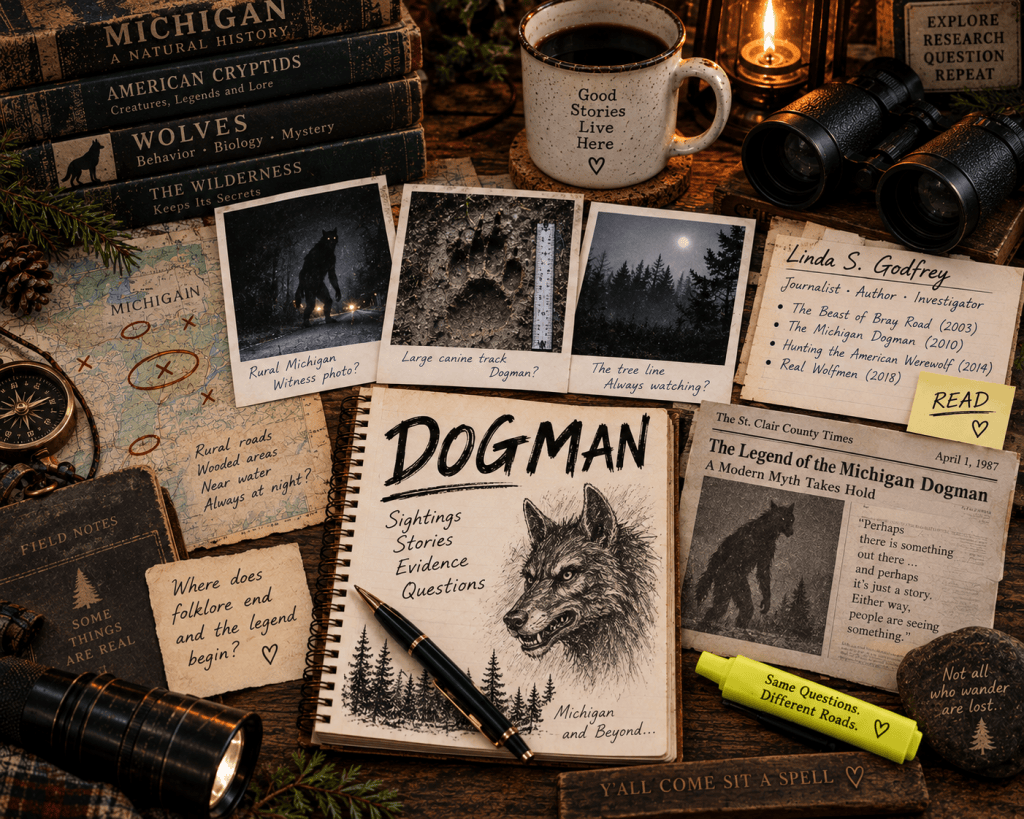
The Dogman Was an April Fools’ Joke. Then the Phone Rang.
If you make up a creature for an April Fools’ radio prank, you expect people to laugh, groan, or call the station to tell you to try harder next year.
You do not expect someone to call and say they’ve seen it.
In 1987, Steve Cook worked at WTCM in Traverse City, Michigan. He wrote a poem, set it to music, and called it “The Legend.” His Dogman was a creature of northern Michigan, part dog and part man, imagined by someone who loved folklore and wanted a fresh idea for the station’s April Fools’ broadcast.
Cook has been clear about that beginning: he invented the character.
Then the song played. At first, nothing happened. About an hour after the morning show ended, a listener called to ask about the creature. He told Cook that, decades earlier, he had been fishing near the Muskegon River when a pack of dogs surrounded him and one stood up on its hind legs.
That is how Cook recounted the call to WCMU. More reports followed.
Well, shit.
I can see why Cook would have felt the hair rise on his arms. He had put a fictional creature into a song, and a stranger answered with a memory he said he had kept to himself for fifty years. The timing is extraordinary.
It is also difficult to interpret.
The man’s experience, whatever happened, preceded the song. His telling of it came after he heard the song. Both facts matter. Cook did not invent that man’s memory on the spot. We also cannot hear the original experience without the years that passed, the song that prompted the call, and the name that was now available to give it.
I don’t think that means the caller was lying. I think it means a person can sincerely recognize something in a story without the story proving what he saw.
And I understand the urge to call.
Imagine carrying a strange, frightening memory for years, then hearing somebody describe a creature that sounds like it. You might finally tell someone. You might feel relieved that another person has a name for it. Neither feeling requires the Dogman to be real to matter.
Cook’s joke did something no one at the station planned. It gave people a way to talk about experiences they had not known how to explain. It also gave new stories a shape to grow around. Once people knew what “Dogman” was supposed to look like, a sound in the woods or an animal glimpsed briefly on two legs could be understood through that name.
That is how a legend can become part of a place. It travels by radio, by phone call, by retelling. Eventually it feels older than the moment somebody first said it aloud.
Does a real Dogman live in Michigan? I don’t know. Cook says he has heard compelling stories, but he has not seen evidence that settles it for him. That is a reasonable place to stand.
I also don’t need to solve every caller’s experience to appreciate what happened in that little radio studio. A man invented a creature. People listened. Some of them heard an answer to a question they had been carrying alone.
The Dogman may have been fictional from his first breath. The phone calls were real.
The Grove Take
I’m interested in both ends of that telephone line.
Cook knew where his Dogman came from. The callers knew what they remembered. Those truths can sit together without either one proving an undiscovered animal.
A story can make it easier to speak about something strange. It can also change how we describe that strange thing once we have a name for it. I want to listen to the witnesses without quietly turning their sincerity into zoological evidence. I want to credit Cook for what he created without pretending his April Fools’ song explains every encounter someone has ever reported.
And I admit I love the uncomfortable middle: a prank that drew out stories nobody expected.
Porch Policy
Witnesses are welcome to tell us what happened. They don’t have to arrive with a perfect explanation or defend a memory from decades ago. We’ll offer a seat and listen carefully.
Cook gets a seat, too. Anyone who made an April Fools’ joke and then had to answer that phone call has earned a conversation.
As for Dogman himself, the invitation remains at the porch. If a living creature wants to come forward, we can make room without demanding that he perform, and without deciding what he is from a glimpse between the trees.
Until then, the song can visit. The stories can visit. We will not mistake either one for a guest who has arrived in person.


Leave a comment