
For the past four days, we’ve met giant hairy bipeds, upright dogs, haunted pants, and a possibly prehistoric forest guardian with questionable personal hygiene.
Today we’re going to New Jersey.
That sentence may be frightening enough on its own.
But we’re specifically heading into the Pine Barrens, more than a million acres of forest, wetlands, sandy roads, abandoned settlements, and exactly the sort of landscape where you would expect somebody to eventually say:
There’s something in those woods.
And people have.
For centuries.
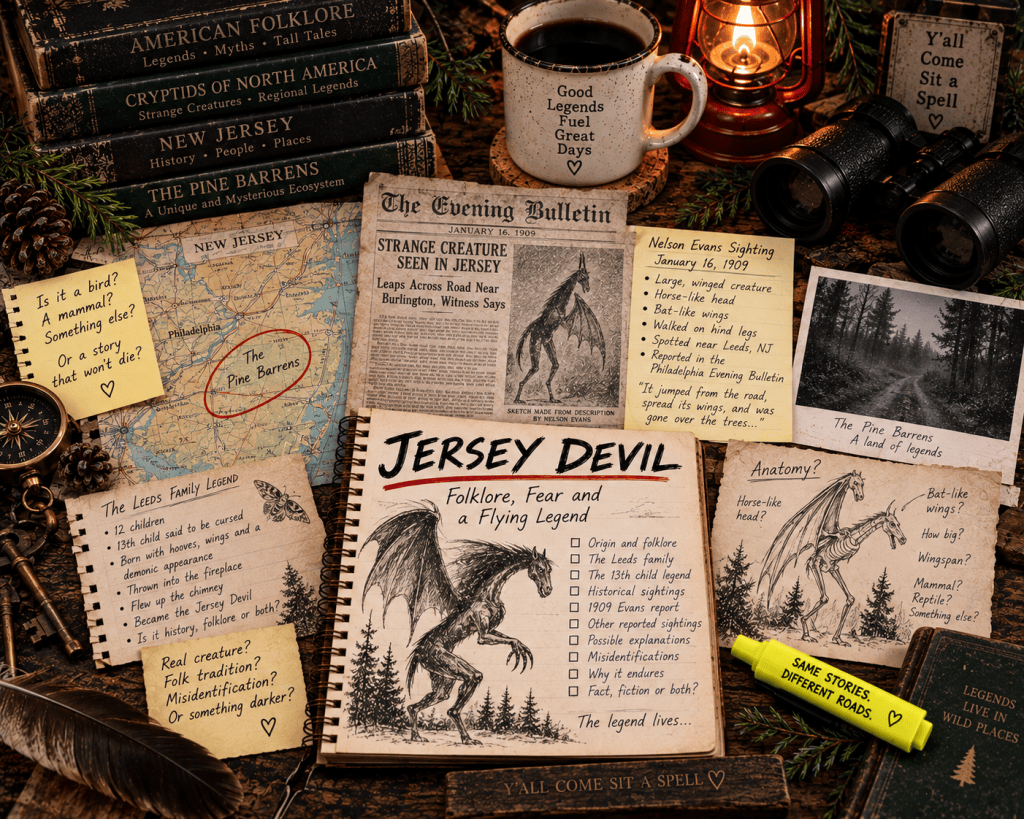
Meet the Jersey Devil.
The Creature
Descriptions of the Jersey Devil vary wildly, which will become something of a theme today.
But the version most people recognize is a creature that appears to have been assembled from whatever parts were left in the bin.
Horse-like head.
Long neck.
Bat-like wings.
Cloven hooves.
Claws.
Long or forked tail.
Sometimes short front legs.
Sometimes none.
Often glowing red eyes.
It walks on two legs.
Except when it walks on four.
It flies.
It screams.
And depending on which witness you ask, it may resemble a horse, kangaroo, dog, goat, crane, dragon, enormous bat, or something assembled after somebody lost the instructions.
It has reportedly haunted southern New Jersey’s Pine Barrens for hundreds of years.
At least that’s the legend.
The history is considerably messier.
And, frankly, much more fun.
Mother Leeds Has Had Enough
The traditional origin story takes us to 1735.
A woman known as Mother Leeds was supposedly pregnant with her thirteenth child.
Having apparently reached the reasonable limit of her enthusiasm for childbirth, she cursed the pregnancy and declared that the child might as well be the Devil.
This was, according to legend, an unfortunate choice of words.
The baby was born human, or nearly so, but quickly transformed into something monstrous.
Horse head.
Hooves.
Claws.
Bat wings.
Tail.
The newborn creature attacked those around it, flew up the chimney, and disappeared into the Pine Barrens.
And thus the Jersey Devil was born.
It’s a fantastic story.
We have a small problem.
We can’t establish that it happened.
There Really Was a Leeds Family
This is where folklore and documented history begin tangling themselves together.
A prominent Leeds family really did live in southern New Jersey.
Daniel Leeds settled in colonial New Jersey in the seventeenth century and became an almanac publisher, surveyor, landowner, and eventually a man who managed to irritate a substantial portion of his religious community.
Leeds was a Quaker.
Until things went badly.
His almanacs included astrology and other material some fellow Quakers considered inappropriate or blasphemous. The disagreement escalated into an extremely public religious and political feud.
Daniel Leeds eventually broke with the Quakers, converted to Anglicanism, supported the British Crown, and published writings attacking his former religious community.
His opponents responded in kind.
And somewhere in all that seventeenth-century subtweeting with pamphlets, the Leeds name became associated with the Devil.
Not metaphorically subtle, these people.
And Then Benjamin Franklin Got Involved
Because apparently this story wasn’t already good enough.
Daniel’s son Titan Leeds continued publishing the family almanac.
Unfortunately for Titan, another almanac publisher entered the market.
Benjamin Franklin.
Yes.
That Benjamin Franklin.
Franklin’s Poor Richard’s Almanack competed with Titan Leeds’s publication, and Franklin decided that ordinary marketing was for cowards.
He predicted that Titan Leeds would die.
When Leeds objected to reports of his own death, Franklin responded by insisting that Titan Leeds must indeed be dead and that whoever was protesting was an imposter using his name.
Franklin continued the joke for years.
So now we have a family already associated with religious controversy, astrology, political disputes, accusations involving the Devil, and a Founding Father publicly insisting that one of them was dead.
And we’re still not finished.
The Leeds family crest featured wyverns.
Winged, dragon-like creatures.
At this point folklore barely had to do any work.
So Where Is Mother Leeds?
That’s harder.
Various attempts have been made to identify the legendary Mother Leeds with actual women in the family.
Deborah Leeds is frequently suggested because records indicate that she and her husband Japhet had twelve children, making another pregnancy fit rather nicely into the thirteen-child legend.
But fitting nicely isn’t documentation.
There is no contemporary record showing Deborah Leeds giving birth to a monster.
Which feels like the sort of thing somebody might have written down.
Historians studying the legend argue that the familiar Mother Leeds birth story developed later from a much messier collection of family history, religious hostility, political insult, local storytelling, and eventually popular entertainment.
In other words:
There probably wasn’t one night in 1735 when the Jersey Devil suddenly entered the world.
People built him.
And then, in 1909, he exploded.
The Week New Jersey Lost Its Mind
In January 1909, strange tracks began appearing in the snow around southern New Jersey.
Hoof-like tracks.
They crossed yards.
Roads.
Fields.
And, according to newspaper reports, even rooftops.
Then came the sightings.
People reported a bizarre winged creature.
Schools reportedly closed or experienced widespread absences.
Workers were frightened.
Posses formed.
People armed themselves.
Dogs sent after the creature supposedly refused to follow its trail.
Newspapers published breathless reports as sightings spread through New Jersey and into Pennsylvania and Delaware.
Witness descriptions were wonderfully inconsistent.
One creature had a crane-like neck and a collie-like head.
Another had monkey-like hands and feet.
Others described wings, hooves, long hair, glowing eyes, or something resembling a kangaroo.
For several days, the region had itself a full-blown monster panic.
And newspapers were delighted.
Then Somebody Caught One
Sort of.
A creature advertised as the Leeds Devil was eventually displayed in Philadelphia.
People could pay to see it.
There was just one problem.
It was reportedly a kangaroo fitted with artificial wings.
Which is objectively magnificent showmanship but very poor cryptozoological evidence.
A former newspaperman and theatrical publicist named Norman Jeffries has long been associated with the hoax and with helping turn the 1909 panic into a publicity opportunity.
That doesn’t necessarily explain every footprint or every reported sighting from that week.
But it does remind us of something we’ve already learned during our first five days together:
Once people expect to see a monster, they start seeing the monster.
What Evidence Do We Actually Have?
A great deal of folklore.
Centuries of stories.
Newspaper reports.
Eyewitness accounts.
Tracks of uncertain origin.
Occasional photographs and videos.
And an impressive number of people who remain absolutely convinced that something unusual lives in the Pine Barrens.
What we don’t have is physical evidence establishing the existence of an unknown winged animal.
No verified body.
No bones.
No tissue.
No DNA.
No specimen.
And the wildly inconsistent anatomy creates its own problems.
A horse-headed, bat-winged, hoofed biped with tiny arms and a forked tail would represent an animal unlike anything currently known to science.
Which doesn’t technically make it impossible.
It does substantially increase the amount of evidence we’re going to require.
A strange footprint in the snow isn’t going to get us there.
What Might People Be Seeing?
Several ordinary animals have been nominated over the years.
Owls.
Large bats.
Deer.
And especially sandhill cranes.
A sandhill crane can stand roughly four feet tall, has an enormous wingspan, long legs, a long neck, and can make calls that sound deeply inappropriate coming from an animal you weren’t expecting to encounter in the dark.
Could a crane explain every Jersey Devil sighting?
No.
Could an unexpectedly large bird seen briefly at night account for some reports of a tall, winged creature?
Absolutely.
Hoaxes explain others.
Folklore probably shapes still more.
And then there’s the Pine Barrens themselves.
Huge.
Forested.
Historically isolated.
Filled with abandoned places and dark roads.
If you wanted to build a monster somewhere, you could do much worse.
The Grove Take
I adore the Jersey Devil.
Not because I think a horse-headed demon baby flew up somebody’s chimney in 1735.
I don’t.
I love him because you can practically watch humans manufacture a monster around him.
A real family has religious disagreements.
Politics gets ugly.
People call each other devils.
An almanac publisher uses astrology.
His family crest has dragons.
Benjamin Franklin decides to troll his competitor for several years.
Stories get told.
Stories get embellished.
Something makes strange tracks in the snow.
Newspapers smell blood.
People start looking.
People start seeing.
Some jackass puts wings on a kangaroo.
And three hundred years later, we’re still talking about the Jersey Devil.
That is spectacularly human.
We don’t simply encounter monsters.
Sometimes we make them.
And every generation adds a little something until nobody can quite remember where history ended and the creature began.
Honestly?
That may be more interesting than finding an actual monster in the woods.
Porch Ruling
The Jersey Devil is absolutely welcome on the Porch.
He’s been blamed for enough shit he probably didn’t do.
Come on up, sweetheart.
We’ll get you a cup.
But the wings stay folded.
The porch isn’t that big, and I don’t need you knocking over the plants.
Also, if you happen to see Benjamin Franklin wandering around out there?
Send him up too.
I have questions.


Leave a comment