
We need to begin today with a confession.
The Snoligoster is not, strictly speaking, a cryptid.
I know.
Before anybody writes to inform me of this oversight, save your keystrokes.
He’s a fearsome critter, part of an American tradition of increasingly ridiculous creatures told about in logging camps and wilderness communities.
But I recently learned that American folklore contains a giant furry Florida swamp creature with an alligator face, a spike on his back, and a propeller for a tail, and there was absolutely no scenario in which I was going to know that information and not make it your problem too.
Our definition of cryptid has been temporarily expanded.
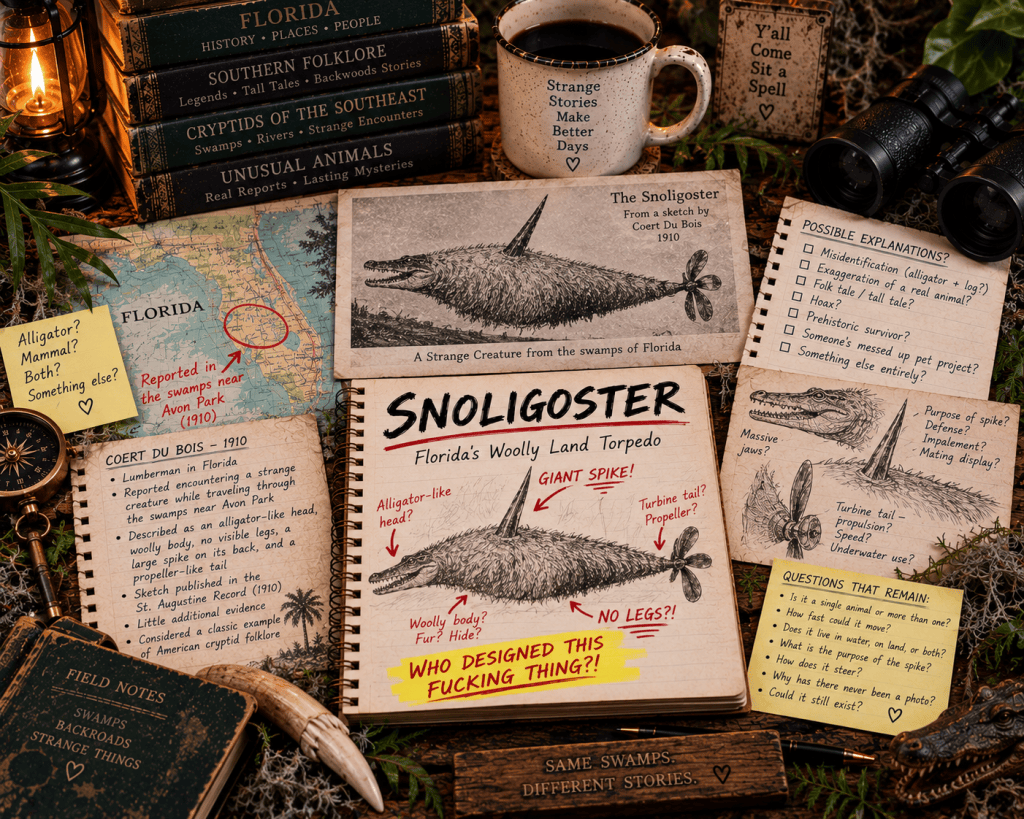
Meet the Snoligoster.
The Creature
The Snoligoster was described in William T. Cox’s 1910 book Fearsome Creatures of the Lumberwoods, With a Few Desert and Mountain Beasts.
Cox placed him in the cypress swamps of the South, particularly around Lake Okeechobee, Florida.
And apparently ordinary swamp anatomy was deemed insufficient.
The Snoligoster is enormous.
He resembles a huge crocodile or alligator, except he’s covered in long, glossy fur.
He has no legs.
No fins.
Instead, one enormous spike projects from his back.
Already we have several engineering concerns.
But you’re probably wondering how a giant, legless, furry alligator gets around a Florida swamp.
Don’t worry.
Nature provided.
He Has a Propeller.
At the end of the Snoligoster’s tail are three large bony plates.
They rotate.
According to Cox, these plates function much like the propeller on a steamboat, spinning fast enough to propel the Snoligoster through water and mud like a torpedo.
I need you to understand that this is not a modern embellishment.
The propeller is right there in 1910.
Somebody looked at the basic design of an alligator and thought:
Needs marine propulsion.
And the tail isn’t merely transportation.
The Snoligoster reportedly uses it as a weapon and, eventually, as something resembling a food processor.
Because apparently the spike wasn’t enough.
What Exactly Is a Fearsome Critter?
This is where the Snoligoster differs from most of the creatures we’ve met so far.
Nobody was conducting a serious zoological search for this thing.
Fearsome critters belonged to the tall-tale culture associated particularly with lumber camps and other wilderness work.
The stories featured impossible animals with equally impossible adaptations.
Creatures might explain strange noises in the woods, disappearing supplies, dangerous terrain, accidents, or whatever other mystery required an animal considerably more entertaining than the actual explanation.
They were also an excellent way to mess with the new guy.
Someone unfamiliar with the woods could be told, with an entirely straight face, about the terrifying creature lurking just beyond camp.
The details could become increasingly absurd.
And if the newcomer continued believing you?
Well.
Now everybody had entertainment for the evening.
The Snoligoster belongs to that world.
Which means our usual question, “What evidence do we actually have?”, becomes rather easy today.
None.
He’s made up.
There.
Cryptid journalism accomplished.
Unfortunately, that isn’t the end of the story.
We Need to Talk About the Original Story
Cox’s 1910 account contains something considerably less amusing than a propeller-tailed swamp monster.
It is explicitly racist.
The story uses racist language for Black people and describes the Snoligoster as preying upon them. Cox relates a supposed account from a Florida man named Inman F. Eldredge in which a Black man is found dead on the creature’s spike.
The story then treats the killing as beneficial because the victim is characterized as a criminal.
I’m not going to reproduce the language here.
You don’t need it to understand what the story says.
And I’m also not going to pretend that part isn’t there so we can get back to laughing about the propeller.
Because folklore doesn’t arrive from some culturally neutral place.
People make stories.
And people bring themselves with them.
Their humor.
Their fears.
Their prejudices.
Their ideas about who matters and who doesn’t.
Sometimes a hundred-year-old joke remains funny.
Sometimes another part of the same joke tells you something ugly about the world in which it was told.
Both can be true.
We’re human.
We’re extremely good at holding contradictory things at the same time.
So Why Keep the Snoligoster?
Because the ugly part doesn’t belong exclusively to the Snoligoster.
It belongs to the history surrounding him.
Erasing the creature doesn’t erase that history.
And stripping the uncomfortable part out so we can present him as nothing more than a charming bit of American folklore doesn’t tell the truth either.
So we keep the whole story.
We acknowledge what it was.
And then we get to decide what we carry forward.
I choose the absurdity.
A furry alligator-shaped swamp torpedo powered by a biological steamboat propeller is objectively magnificent nonsense.
We don’t need the racism to make him interesting.
Frankly, he has a propeller for a tail.
The man was never hurting for material.
But Why “Snoligoster”?
Excellent question.
I wish I had an excellent answer.
Cox calls the creature the Snoligoster and even supplies the wonderfully scientific-sounding name Dorsohastatus caudirotula.
He doesn’t explain where “Snoligoster” came from.
There is, however, an older American word that looks suspiciously familiar.
Snollygoster.
The word was in use during the nineteenth century and eventually came to describe a clever, unscrupulous person, particularly a politician.
It is very tempting to assume that Snoligoster grew from Snollygoster.
Maybe it did.
But tempting isn’t evidence.
I couldn’t find documentation establishing that Cox deliberately borrowed the word for his swamp creature.
So we’re going to do something that will happen occasionally during these 31 days.
We’re going to say:
I don’t know.
It’s much better than making something up and waiting for the internet to copy us.
The Grove Take
I love that humans invented fearsome critters.
Of course we did.
Imagine spending weeks in a logging camp before television, phones, streaming services, or an internet capable of supplying you with haunted pants on demand.
Eventually somebody was going to look across the fire at the new guy and say:
“You know about the Snoligoster, right?”
And somebody else knew enough to shut the hell up and let him cook.
Maybe the next person added the spike.
Maybe somebody improved the tail.
Maybe the story got a little bigger every time it was told.
That’s not evidence of an undiscovered animal.
It’s evidence of something we already know exists.
Humans entertaining each other.
We’ve apparently always loved ridiculous monsters.
We’ve always loved making stories bigger.
And we’ve always enjoyed watching somebody’s face while deciding exactly how long we can keep the bullshit going.
A century later, we’re still doing it.
We just have better distribution.
Porch Ruling
Application denied.
Nothing personal.
It’s actuarial.
Let’s review.
Alligator face.
Enormous dorsal spike.
Human-eating history.
No legs.
And a tail-mounted propulsion system capable of driving several tons of furry swamp creature through mud at torpedo speed.
Sunstone Grove welcomes weirdness.
But our homeowners policy has limits.
The Snoligoster is welcome to remain in the swamp, where we will happily admire him from a respectful distance.
We have dogs.
We have plants.
One startled tail movement and we’ve lost three planters, a section of railing, somebody’s ankle, and possibly a load-bearing porch spindle.
There is simply too much liability here.
Sorry, sweetheart.
We’ll wave.


Leave a comment