
We’ve spent the last week investigating giant hairy bipeds, upright dogs, haunted pants, forest guardians, flying devils, propeller-powered swamp hazards, and one possibly very successful barn owl.
Today we have a cat.
Possibly.
A very large cat.
Possibly.
And unlike several of our previous residents, this one has a rather inconvenient advantage when it comes to the question of whether it could exist.
We already know large black cats are real.
The question is what one might be doing wandering around southwest England.
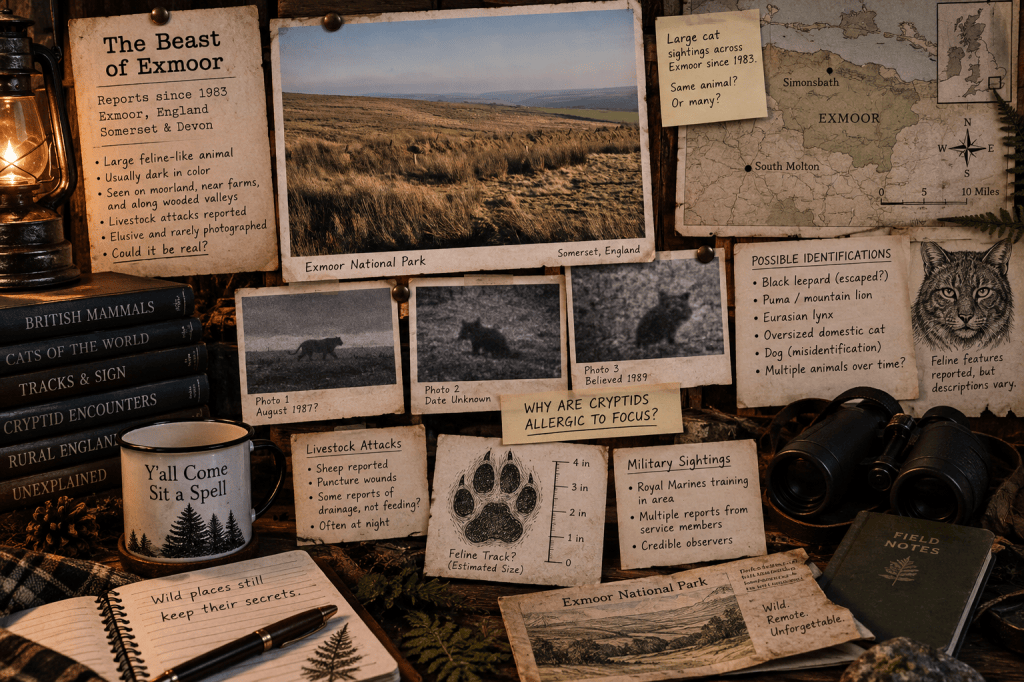
Meet the Beast of Exmoor.
The Creature
The Beast of Exmoor is generally described as a large, dark-colored cat roaming Exmoor and the surrounding countryside of Devon and Somerset in southwest England.
Most witnesses describe something black or very dark brown.
Low to the ground.
Muscular.
Long-bodied.
With a long tail.
Estimates of its size vary considerably, which should surprise absolutely no one after eight days of this.
Some witnesses describe an animal comparable to a large dog.
Others describe something much bigger.
The usual suspect is a melanistic leopard, commonly called a black panther.
Quick zoological housekeeping:
A black panther is not its own species.
The term is generally used for a melanistic leopard or jaguar, meaning an animal whose genetics produce unusually dark pigmentation.
Under the right light, a black leopard’s familiar spots can still be visible beneath the dark coat.
So the animal people are describing is not biologically impossible.
Leopards exist.
Black leopards exist.
What Britain does not have is a recognized native population of them.
Which leaves us with a rather more interesting question than usual.
Something Was Killing Sheep
Stories of unusual large cats in southwest England existed before the 1980s, but the Beast of Exmoor became nationally famous after a series of livestock deaths in 1983.
Sheep were being killed around Exmoor.
A lot of sheep.
Reports described carcasses with injuries that some people believed were inconsistent with attacks by ordinary dogs or native wildlife.
Farmers were understandably unhappy.
The story grew.
Newspapers got involved.
And eventually the British government took the reports seriously enough that Royal Marines were reportedly sent into the area to look for the animal.
They didn’t find one.
Which, to be fair, is an extremely cat outcome.
Where Would a Leopard Come From?
This part is surprisingly plausible.
Britain has a history of people privately keeping exotic animals.
Lions.
Pumas.
Leopards.
Other animals that most of us would regard as a rather ambitious household commitment.
Then came the Dangerous Wild Animals Act of 1976, which introduced licensing requirements for people keeping certain exotic species.
One long-standing theory suggests that some owners, faced with the cost and regulation involved in legally keeping their animals, simply released them.
That would be spectacularly irresponsible.
It would also provide a straightforward explanation for at least some reports of large non-native cats appearing in the British countryside during the following decades.
Escapes are another possibility.
So unlike our usual cryptid problem, we aren’t asking whether an unknown species somehow evolved unnoticed in England.
We’re asking whether known animals might have ended up somewhere they aren’t supposed to be.
That requires considerably less biological gymnastics.
And Britain Has Produced Actual Big Cats
This is where things get awkward for anyone who wants to dismiss every British big-cat report as nonsense.
Individual exotic cats have unquestionably turned up loose in Britain.
There have been captures and carcasses involving non-native cats over the years.
That does not establish that every reported black panther exists.
It does establish something much narrower and much more useful:
Large non-native cats have been loose in Britain before.
And recently, the evidence became considerably more interesting.
We Have DNA
In 2022, black hairs were collected from barbed wire near the site of a sheep kill in Gloucestershire.
Laboratory analysis reportedly produced a 99.9 percent mitochondrial DNA match to leopard.
Then another sample appeared.
In 2023, material was collected from a sheep carcass in Cumbria.
Professor Robin Allaby at the University of Warwick later analyzed a swab from the carcass and identified DNA from the genus Panthera, most likely leopard.
That result was reported publicly in 2024.
Allaby had previously remained open-minded about Britain’s alleged big cats.
The result was strong enough that he said it changed his mind about whether non-native big cats were present in the British countryside.
Now.
Everybody remain seated.
This does not prove the Beast of Exmoor.
Gloucestershire is not Exmoor.
Cumbria is definitely not Exmoor.
It doesn’t tell us how many animals there are.
It doesn’t establish a breeding population.
It doesn’t prove that every farmer, hiker, driver, dog walker, or mildly startled pub patron who has reported a giant black cat actually saw a leopard.
But it does make one sentence considerably harder to say with confidence:
“There are no big cats roaming wild in Britain.”
Apparently there may very well be.
What Evidence Do We Actually Have for the Beast?
This is where we need to separate British big cats from the Beast of Exmoor.
For the Beast itself, we have decades of eyewitness reports.
Livestock deaths.
Tracks and prints of disputed origin.
Photographs and videos of varying quality.
And descriptions from people who insist that what they saw was far too large to be a domestic cat.
What we do not have is a verified Exmoor leopard.
No captured animal.
No carcass.
No clear photograph universally accepted as showing a large exotic cat on Exmoor.
No DNA sample that establishes a leopard specifically living there.
And scale is an enormous problem with photographs.
Put a black domestic cat in a field with no useful reference point and congratulations:
You have invented a panther.
Our brains are not particularly good at estimating the size of unfamiliar objects at a distance without something nearby for comparison.
Some alleged big-cat photographs undoubtedly show ordinary cats.
Others are harder to dismiss.
But “harder to dismiss” and “identified as a leopard” remain two different things.
Could a Leopard Live There?
Yes.
That’s another problem for the skeptics.
Leopards are extraordinarily adaptable animals.
Across their natural range they occupy forests, mountains, grasslands, scrub, and landscapes surprisingly close to human settlement.
They are secretive.
Mostly solitary.
Often active at night.
They can travel significant distances.
They hunt deer-sized prey.
Britain has plenty of deer.
And a large cat attempting to avoid humans is much easier to hide than, say, an eight-foot ape wandering around Washington State with an entire extended family.
But one leopard surviving quietly in the countryside is one thing.
A self-sustaining population is another.
Breeding animals require multiple individuals.
Multiple large predators require prey and territory.
Over generations, animals die.
Bodies remain.
Animals cross roads.
They leave scat.
Hair.
Tracks.
DNA.
At some point, a population should become considerably harder to hide.
That’s why the evidence for individual escaped or released cats is much easier to accept than the claim that Britain contains an established hidden population of black leopards.
The Grove Take
This may be the first creature this month where my answer is:
Yeah. Maybe.
Not necessarily the Beast of Exmoor.
I don’t think one immortal black panther has been wandering around Devon since 1983, periodically stopping to scare farmers before disappearing dramatically into the mist.
Because, among other things:
Cat.
He has other shit to do.
But do I think it’s possible that people in Britain have genuinely seen large exotic cats roaming free?
Absolutely.
At this point, we have evidence that makes dismissing every sighting out of hand seem unreasonable.
And I love that.
Because sometimes the monster in the field doesn’t require an unknown species.
Sometimes the strange thing really is exactly what the witness thought it was.
A cat.
Just a considerably larger cat than anybody expected to find there.
And naturally, being a cat, it has declined to participate further in the investigation.
No press conference.
No scheduled appearances.
No cooperation with photographers.
No respect whatsoever for our need for conclusive evidence.
Just:
You saw me.
Prove it.
Honestly, that’s the most convincing evidence of feline involvement we’ve encountered yet.
Porch Ruling
Should the Cat Distribution System deem us worthy, the Beast of Exmoor is welcome.
We’ll provide fresh water, a comfortable chair, and a perfectly lovely bed, all of which will be ignored.
There is currently a puddle of sunshine warming three boards at the far end of the Porch.
That belongs to him now.
We didn’t give it to him.
That’s not how cats work.
And should a mysterious enormous black cat appear one afternoon, stretch luxuriously in that sunshine, refuse to explain where he came from, and behave as though he has always lived here?
Well.
The system has spoken.


Leave a comment