
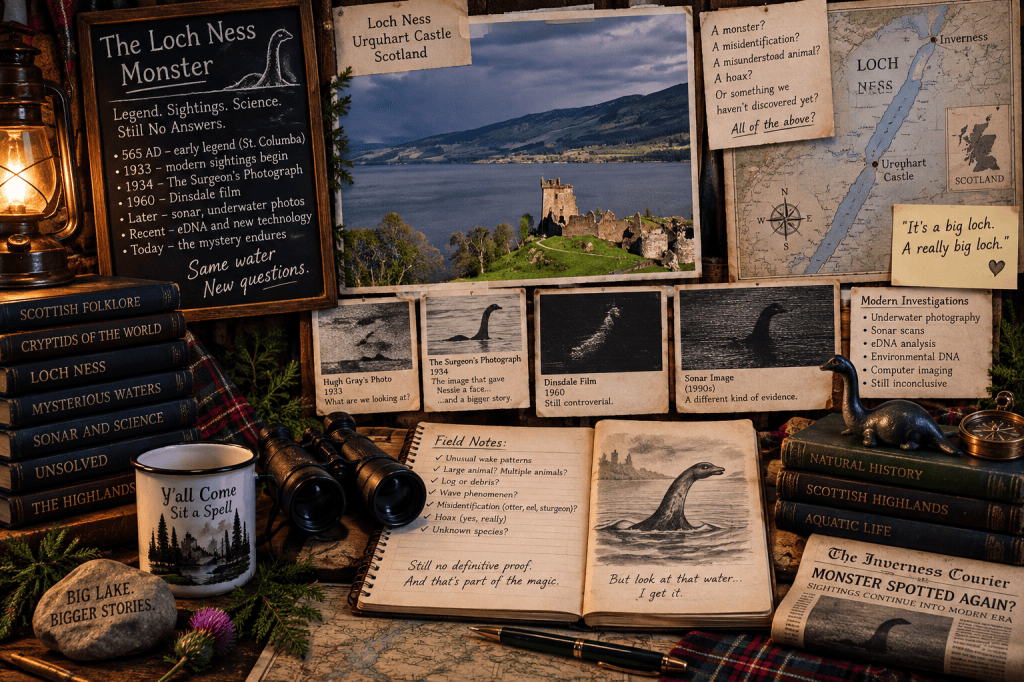
31 Days of Cryptids: Day 9
The Loch Ness Monster
We’ve made it nine days.
We’ve examined evidence.
We’ve questioned witnesses.
We’ve separated folklore from zoology, identified hoaxes, considered camera artifacts, contemplated the possibility of bug legs, and denied Porch access to exactly one creature on actuarial grounds.
I believe we’ve demonstrated that we take our responsibilities seriously.
Good.
Because today I’m going to need some accumulated credibility.
It’s Nessie Day.
And I love her.
Let’s get that out of the way now.
The Creature
The Loch Ness Monster, affectionately known as Nessie, is said to inhabit Loch Ness in the Scottish Highlands.
Descriptions vary, because of course they do.
A long neck.
A small head.
A large body.
One or more humps rising from the water.
Dark or gray skin.
Sometimes flippers.
Sometimes a tail.
The version most of us picture looks vaguely like a plesiosaur, one of the long-necked marine reptiles that disappeared in the same mass extinction that took the non-avian dinosaurs about 66 million years ago.
This is biologically problematic for several reasons we’ll get to.
But first we need the loch.
Because if you’re going to hide a monster somewhere, Loch Ness is an excellent piece of real estate.
Loch Ness Is Enormous
Loch Ness stretches for roughly 23 miles through the Scottish Highlands.
It is deep, reaching around 750 feet at its deepest points, and contains more fresh water than all the lakes in England and Wales combined.
Its water is dark.
Peat washed down from the surrounding land stains it brown, dramatically reducing underwater visibility.
Stand beside Loch Ness and look across it and you immediately understand why stories live there.
It’s big.
It’s dark.
It’s deep.
And you cannot see what is underneath you.
Humans have historically handled that particular combination extremely well.
Has Nessie Been There for 1,500 Years?
This is where we need to clean up one of the most repeated pieces of Nessie lore.
You’ll often read that the first recorded sighting of the Loch Ness Monster occurred in 565 CE, when the Irish monk St. Columba encountered a monster in the River Ness.
According to a biography written about a century after Columba’s death, a creature attacked a swimmer in the river. Columba commanded the beast to go no farther, and it fled.
Great story.
It is not a 565 eyewitness report.
It was written later by Adomnán as part of a saint’s life, a literary form filled with miracles intended to demonstrate the holy person’s power.
The story also takes place in the River Ness, not Loch Ness itself.
Could it reflect older local traditions involving dangerous water creatures?
Possibly.
Does it establish that people were documenting Nessie in the sixth century?
No.
Our modern monster arrives much later.
1933: Nessie Gets Famous
In 1933, a new road along the north side of Loch Ness made the water considerably more visible to motorists and visitors.
That year, hotel manager Aldie Mackay and her husband reportedly saw something large disturbing the surface of the loch.
The Inverness Courier published an account in May.
The word monster was attached to Loch Ness.
And things escalated rapidly.
Sightings followed.
Newspapers arrived.
Tourists arrived.
Monster hunters arrived.
And then George Spicer and his wife reported something especially strange.
They didn’t see it in the water.
They saw it crossing the road.
Excuse Me, She Did What?
In July 1933, the Spicers were driving near Loch Ness when they claimed a large creature crossed the road in front of their car.
They described a long-necked animal with a bulky body.
It reportedly moved across the road and disappeared toward the loch.
This is one of those reports I adore because it creates considerably more problems than it solves.
A mysterious shape in dark water?
Fine.
Waves happen.
Logs happen.
Animals surface.
Light behaves strangely.
But once Nessie has left the lake and entered traffic, we’ve increased our evidentiary burden considerably.
No photograph was taken.
No physical evidence confirmed the encounter.
But the story helped transform Nessie from something unusual in the water into an animal with a recognizable body.
And then came the photograph.
You know the one.
The Surgeon’s Photograph
In 1934, the Daily Mail published a photograph showing what appeared to be a small head and long neck rising from Loch Ness.
It became the image of Nessie.
The photograph was associated with London physician Robert Kenneth Wilson, which gave it the respectable nickname the Surgeon’s Photograph.
For decades, it was treated as some of the strongest visual evidence for the monster.
It wasn’t.
The photograph was a hoax.
And the story behind the hoax is magnificent.
Enter Marmaduke Wetherell
The Daily Mail had previously hired big-game hunter Marmaduke Wetherell to search for Nessie.
Wetherell found enormous footprints along the shore.
Evidence!
Except experts at the Natural History Museum examined them.
The tracks had been made using a dried hippopotamus foot.
One likely source was the sort of hippopotamus-foot object that existed at the time as an umbrella stand or novelty item.
The Daily Mail publicly humiliated Wetherell.
Apparently he did not take this well.
Years later, the Surgeon’s Photograph was revealed as part of a hoax involving Wetherell, his son Ian, Wilson, and others.
The monster was reportedly a small model mounted on a toy submarine.
Which means one of the most iconic monster photographs in history was essentially:
an extremely successful bathtub toy.
Nessie survived it.
Of course she did.
But People Kept Seeing Something
And this is where Nessie becomes more interesting than one famous fake photograph.
Sightings continued.
Photographs continued.
Film appeared.
Sonar contacts were reported.
In 1960, aeronautical engineer Tim Dinsdale filmed a moving object crossing the loch, footage that generated years of debate.
During the 1970s, Robert Rines led sonar and underwater-photography expeditions that produced images some interpreted as a large flipper and even a creature’s body.
Later analysis made those interpretations considerably less convincing.
Then in 1987 came Operation Deepscan.
A line of boats equipped with sonar swept down Loch Ness attempting to detect large animals.
They recorded several unexplained sonar contacts.
Interesting?
Absolutely.
Evidence of Nessie?
No.
Sonar tells us that something reflected sound.
Identifying what produced that reflection is the harder part.
What Evidence Do We Actually Have?
A tremendous amount of testimony.
Photographs.
Film.
Sonar contacts.
Stories.
And more than ninety years of people staring very hard at a large, dark lake.
What we do not have is a verified large unknown animal.
No body.
No bones.
No tissue.
No confirmed tooth.
No carcass.
No unambiguous photograph.
No DNA identifying a giant unknown vertebrate.
And that last one is particularly interesting because scientists went looking for it.
Scientists Tested the Loch
In 2018, an international research team collected hundreds of water samples from locations around Loch Ness.
They were looking at environmental DNA, or eDNA.
Animals constantly leave genetic material behind in their environment through skin cells, mucus, feces, scales, and other biological material.
If a large population of unusual animals lived in the loch, researchers hoped its DNA might show up in the water.
The results were announced in 2019.
No evidence of plesiosaurs.
No evidence of sharks.
No evidence of catfish large enough to explain the legend.
No DNA pointing toward a giant unknown reptile.
But there was rather a lot of one animal.
Eel.
Oh, For Fuck’s Sake. Eels.
European eels live in Loch Ness.
The eDNA survey found their genetic material throughout the loch.
Professor Neil Gemmell, who led the project, noted that the results could not rule out the possibility of an unusually large eel.
Now let’s be clear.
The study did not discover a giant eel.
It established that eels are abundant in Loch Ness.
Which we already knew.
But a large eel at the surface could potentially account for some long, serpentine sightings.
Other explanations proposed over the years include swimming deer.
Seals.
Otters.
Large fish.
Floating logs.
Boat wakes.
Standing waves.
Birds.
And one phenomenon particularly relevant to Loch Ness called a seiche, in which water inside the loch oscillates and produces unusual surface effects.
There are many ways to make something strange happen on a very large body of dark water.
None requires a surviving plesiosaur.
And About That Plesiosaur
I know.
She’s prettier this way.
But we need to talk about it.
Plesiosaurs were marine reptiles.
Loch Ness is freshwater.
The modern loch was shaped by glaciers and reached its current form long after plesiosaurs went extinct.
So we don’t have a little Scottish Jurassic refuge that simply remained untouched for 66 million years.
We would also need more than one Nessie.
A population surviving for generations requires enough animals to reproduce without collapsing genetically.
Large animals need food.
They die.
They leave bones.
They shed biological material.
And despite decades of searching, we’ve found no convincing physical evidence of a breeding population of enormous reptiles in Loch Ness.
Scientifically?
The plesiosaur is having a very bad day.
The Grove Take
I don’t care.
There.
I said it.
I have spent eight days behaving myself.
I have examined evidence.
I have rejected unsupported claims.
I have told you when stories were folklore, when footage was inconclusive, when photographs were hoaxed, and when something was probably an owl.
Today I am exercising my right as a human being to understand all of the evidence and still say:
But I want Nessie.
No offense to the eel.
I’m sure he’s lovely.
I want the long neck.
I want the humps.
I want one enormous ancient lady quietly living beneath that dark water, surfacing just often enough to make somebody drop their camera and swear.
I know the biology doesn’t work.
I know the DNA isn’t there.
I know the famous photograph was a toy.
I know people mistake wakes and logs and birds and perfectly ordinary animals for extraordinary things.
I know.
I still want her.
Because humans can hold two things at once.
We can understand what the evidence says.
And we can leave a tiny bit of room for wonder anyway.
Nessie has lived in that room for nearly a century.
I’m not evicting her today.
Porch Ruling
Oh, sweetheart.
Of course you’re welcome.
There is, however, a logistical issue.
We do not have a loch.
We have a Porch.
And I’m fairly certain putting a 23-mile freshwater lake in the backyard violates at least one county ordinance.
So Nessie gets special accommodations.
She can remain exactly where she is.
We’ll come to her.
We’ll sit beside the water with a cup, stare out across the loch, and wait.
Maybe we’ll see a wake.
Maybe a bird.
Maybe an eel.
Maybe absolutely nothing.
And if, just once, a little head rises above that dark water followed by one long, impossible neck?
I promise not to ask for DNA.


Leave a Reply