
Most cryptid stories begin with someone walking alone through the woods.
This one begins with two scientists sealing themselves inside a steel ball and asking to be lowered half a mile into the Atlantic Ocean.
There was no steering system.
There was no way to collect anything they saw.
There was no quick exit.
There was one cable connecting the sphere to the ship above, an oxygen system, a telephone line, and a small quartz window looking into a part of the world no human being had ever seen alive.
Then something enormous moved through the light.
Welcome to the case of William Beebe and the fishes nobody has found again.
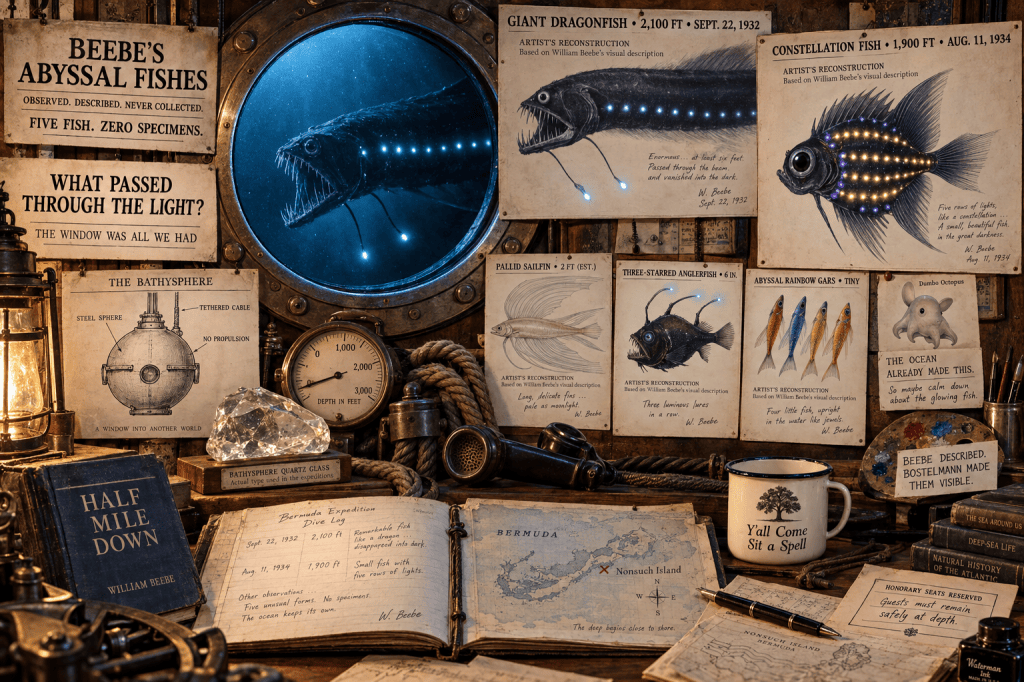
Meet the Bathysphere
In the early 1930s, naturalist William Beebe wanted to see deep-sea animals where they actually lived.
Scientists already knew strange creatures existed below the reach of sunlight. Nets dragged through deep water returned with animals that seemed assembled from spare parts.
Huge mouths.
Transparent bodies.
Eyes mounted on stalks.
Teeth too large for the face containing them.
Lights growing directly from flesh.
But a net could only show what survived being caught, hauled through changing pressure, and dragged hundreds or thousands of feet to the surface.
Beebe wanted to watch these animals alive.
Engineer Otis Barton designed the Bathysphere, a hollow steel ball large enough for two men to sit inside if neither valued personal space.
It had no independent propulsion. The Bathysphere was lowered from a ship by a steel cable and hung beneath it like the world’s most scientifically important wrecking ball.
In 1930, Beebe and Barton began diving off Nonsuch Island in Bermuda.
On August 15, 1934, they reached 3,028 feet.
At the time, no human beings had ever descended so deeply into the ocean and returned alive.
Inside the sphere, Beebe looked through the window and described what he saw over a telephone line to Gloria Hollister aboard the ship.
Scientific artist Else Bostelmann later worked with his descriptions to paint the animals.
This detail matters.
The famous images of Beebe’s abyssal fishes are not photographs.
They are reconstructions based on what Beebe reported seeing through a small window, in darkness, while suspended thousands of feet beneath the Atlantic Ocean.
That does not make them worthless.
It does make them complicated.
The Giant Dragonfish
On September 22, 1932, at approximately 2,100 feet, Beebe saw two large creatures pass through the Bathysphere’s light.
He estimated that each was at least six feet long.
They had short heads, open jaws, and long dark bodies lined with pale blue lights. Two luminous-tipped appendages appeared to hang beneath each fish.
Beebe believed they resembled dragonfish, a real group of deep-sea predators known for sharp teeth, dark bodies, and bioluminescence.
There was one significant problem.
Known dragonfish were nowhere near six feet long.
Beebe gave the creature the scientific name Bathysphaera intacta.
The name has been interpreted as the “untouchable Bathysphere fish.”
That is painfully appropriate.
He could see it.
He could describe it.
He could not reach it.
No six-foot dragonfish has ever been collected.
The Pallid Sailfin
During a 1934 descent, Beebe saw a very different fish.
He encountered it twice, at depths between approximately 1,500 and 2,500 feet.
The creature was at least two feet long and shaped somewhat like a cigar. It had a small eye, a moderate mouth, broad filament-like pectoral fins, dramatically extended upper and lower fins, and a tiny tail that Beebe compared to a button.
It did not glow.
Its color was pale, sickly olive.
Beebe described it as resembling water-soaked flesh.
Charming.
He named it Bathyembryx istiophasma, the pallid sailfin.
The scientific name poetically suggests something from the deep abyss swimming with ghostly sails.
No specimen was collected.
Nobody has positively identified one since.
The Five-Lined Constellation Fish
At roughly 1,900 feet on August 11, 1934, Beebe saw one of the loveliest creatures he encountered during the Bathysphere dives.
It was a small, disc-shaped fish, perhaps five inches high and six inches long, with large eyes and vertical fins.
Along its body were five rows of pale yellow lights. Each larger light appeared to be surrounded by tiny purple photophores.
Against the absolute darkness, the fish looked like a living constellation.
Beebe named it Bathysidus pentagrammus, the five-lined constellation fish.
He wrote that it remained in his memory as one of the most beautiful things he had ever seen.
Other scientists were less enchanted.
Ichthyologist Carl Hubbs suggested that Beebe might have seen a comb jelly distorted through the Bathysphere window. Light, curved glass, movement, and an unfamiliar transparent body could have combined to create the appearance of a fish lined with impossible stars.
Or Beebe saw exactly what he said he saw.
Nature does not appear to have been consulted for a follow-up.
The Three-Starred Anglerfish
During the same August 1934 descent, at approximately 2,470 feet, another small black fish entered the light.
It was about six inches long and shaped like an anglerfish.
Anglerfish are already real creatures that appear to have been designed during a meeting nobody adequately supervised.
Many species possess a modified fin ray called an illicium, tipped with a glowing lure used to attract prey in the darkness.
Beebe’s fish had three.
Each one ended in a pale yellow light.
He called it Bathyceratias trilychnus, the three-starred anglerfish.
More than two hundred species of anglerfish are now known, and the deep ocean continues producing forms that look unreasonable even when they are lying directly on a laboratory table.
A species with three lures does not feel impossible.
It has simply never been confirmed.
The Abyssal Rainbow Gar
Then came the little show-off.
At approximately 2,500 feet, Beebe switched on the Bathysphere’s powerful light and saw four slender fish hanging almost vertically in the water.
They were only about four inches long.
Their pointed heads and jaws were bright red. Their bodies were blue. Their tails were yellow.
They remained stiffly upright before swimming away into the darkness.
Beebe called them abyssal rainbow gars, although he readily admitted they might not have been gars at all.
Unlike four of his other mystery fishes, he did not assign this one a formal scientific name.
Perhaps they were an unknown species.
Perhaps they were squid or another familiar animal seen at an unfamiliar angle.
Perhaps red, blue, and yellow simply seemed like the appropriate uniform for a group of tiny fish determined to make an entrance.
They have never been identified.
Five Fish or Four?
You will sometimes see references to five formally described Bathysphere fishes.
That is not quite accurate.
Beebe described five memorable mystery forms associated with the dives, but he gave formal scientific names to four of them.
The abyssal rainbow gar remained an informal name.
None of the five is currently recognized as a confirmed species.
That does not mean Beebe was an amateur inventing monsters for attention.
He was a respected naturalist whose work helped identify dozens of legitimate species. His Bermuda research involved years of deep-water sampling and produced a substantial body of scientific work.
It also does not mean he could not be mistaken.
Beebe was trying to identify moving animals through a small window in darkness. He could not pursue them, photograph them clearly, capture them, examine their anatomy, or compare a specimen against known species.
Sometimes he had seconds to observe them.
That is not how scientists usually describe a new species.
A formal species description generally requires a physical specimen that other researchers can examine. Measurements can be repeated. Bones, fins, scales, teeth, organs, and tissues can be compared.
Beebe had his eyes, his experience, his memory, Barton beside him, a telephone connection to the surface, and Bostelmann’s extraordinary ability to translate language into images.
It was groundbreaking.
It was also not enough to prove that the fishes existed exactly as described.
Did Beebe Invent Them?
There is no compelling reason to believe he did.
Beebe did not need five fictional fish to make his expedition interesting.
He and Barton had already survived a descent no human beings had made before. They were observing living deep-sea animals in their natural environment decades before modern remotely operated vehicles made such footage familiar.
The truth around them was already extraordinary.
Barton also supported Beebe’s observations, although the confined viewing position and brief encounters limited what either man could verify independently.
The more reasonable possibilities are less dramatic.
Beebe may have seen known animals from strange angles.
The quartz window and artificial light may have distorted proportions and colors.
Several animals may have overlapped in the beam.
A transparent squid, comb jelly, or other invertebrate might have looked like a fish.
He may have correctly observed species that remain unidentified because the deep ocean is enormous, sparsely explored, and profoundly indifferent to our desire for confirmation.
More than one explanation may be true.
Perhaps the constellation fish was a comb jelly.
Perhaps the pallid sailfin was a distorted view of a known deep-sea species.
Perhaps somewhere below Bermuda, a six-foot dragonfish remains deeply committed to avoiding scientists.
What Evidence Do We Actually Have?
Beebe’s written descriptions.
His telephone reports during the dives.
Otis Barton’s supporting observations.
Else Bostelmann’s reconstructions.
Beebe’s scientific publications and his 1934 book, Half Mile Down.
No specimens.
No bones.
No preserved tissue.
No definitive photographs.
No later confirmed sightings.
The evidence is stronger than a campfire story told by one frightened hiker.
It is weaker than the evidence required to establish a species.
That puts Beebe’s fishes in a particularly delicious cryptid category.
They were reported by a trained scientist conducting serious research in the exact environment where unknown animals are most likely to exist.
And we still cannot prove he saw what he believed he saw.
The Grove Take
I believe William Beebe saw something.
More accurately, I believe he saw several somethings.
I do not believe every detail of every reconstruction must be correct for the encounters to matter.
Imagine sitting inside a steel sphere almost half a mile beneath the ocean.
Above you are thousands of feet of black water.
Outside the window is a world humans have never directly entered.
Your light reaches only a short distance before the darkness swallows it.
Then a living shape passes through the beam.
You have seconds.
Describe it.
Measure it.
Remember every fin, color, light, movement, and proportion.
Do it while knowing it may disappear before anyone else can see it.
Beebe tried.
Perhaps he named the fishes too quickly. Perhaps some of his confidence exceeded what the evidence could support.
But I understand why he did it.
He had traveled farther into their world than any human before him. For a few seconds, the darkness opened and showed him something.
Then it closed again.
Nearly a century later, we have better cameras, stronger submersibles, remotely operated vehicles, and entire institutions devoted to deep-sea exploration.
We are still discovering animals that look impossible.
We have documented the Dumbo octopus, a soft-bodied little creature that drifts through the abyss by flapping two ear-like fins and looks as though the ocean designed an animated character during lunch.
That animal is real.
So I am reluctant to declare a glowing constellation fish implausible merely because nobody has brought one upstairs yet.
Also I am not prepared to tell William Beebe that all five of his fishes were mistakes.
The ocean has hidden stranger things.
Do They Get a Chair on the Porch?
Every one of them.
The giant dragonfish will require the reinforced section.
The pallid sailfin may have the chaise because anyone described as swimming with ghostly sails deserves room to drape.
The constellation fish will be seated where we can properly admire the lights.
The three-starred anglerfish must keep all lures away from the other guests.
The rainbow gars can share. They are four inches long and apparently travel as a committee.
There is, unfortunately, a practical problem.
These fishes belong thousands of feet beneath the surface. Bringing them onto the porch would be inhospitable, scientifically irresponsible, and probably explosive.
So their chairs will remain symbolically reserved.
William Beebe and Otis Barton may sit in them and tell us what passed outside that window.
Else Bostelmann gets a chair too. Someone had to turn voices from the darkness into pictures the rest of the world could see.
The fishes may remain safely in the abyss.
If they are still there, they already know we are talking about them.


Leave a Reply