
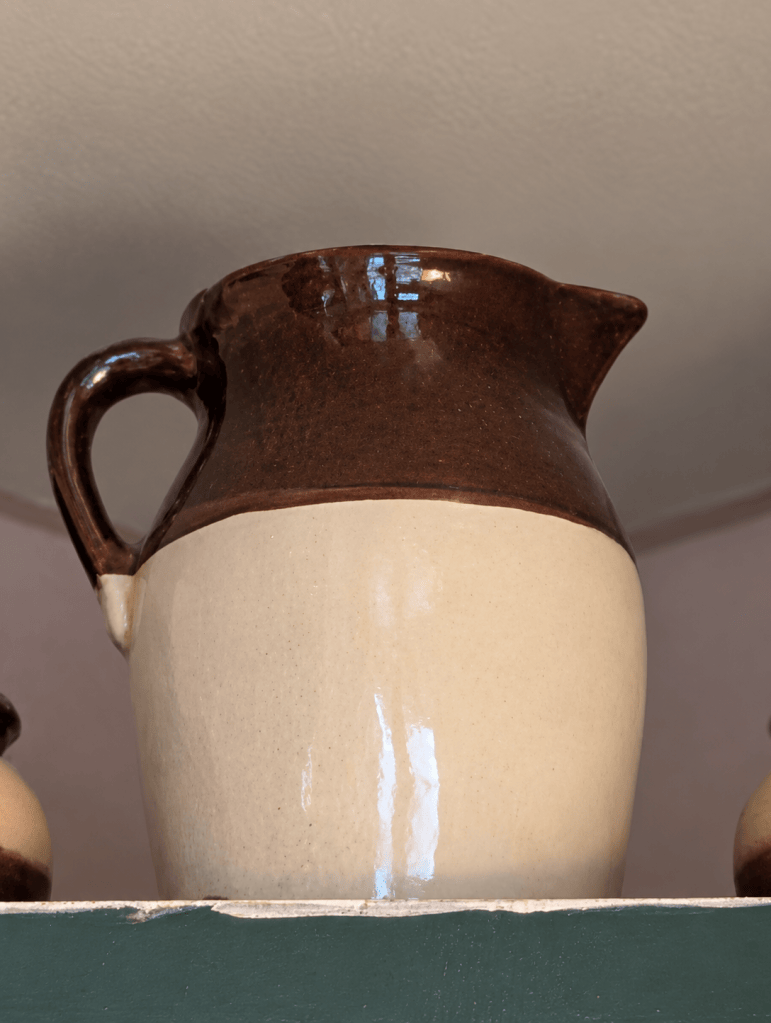
Come sit a spell.
When my grandmother died, my mother asked me if there was anything of hers I wanted.
I didn’t have to think about it.
Her brown pottery tea pitcher.
What I didn’t know was that my mother had already put it aside for me.
We had never discussed the pitcher.
We had never had a conversation about my grandparents’ brown ware or what it meant to me. I had never told her, “If anything ever happens to Grandma, that’s what I want.”
But somehow, when my mother began sorting through her mother’s things, she looked at that chipped everyday tea pitcher and thought:
Elizabeth will want this.
She was right.
There were probably plenty of things I could have chosen.
Jewelry.
A purse.
Something tucked away for special occasions.
Something valuable.
But the only thing I wanted was the pitcher.
It wasn’t a valuable piece of pottery.
It wasn’t a name brand.
It wasn’t pristine.
In fact, it was chipped.
But it had been part of the background of my grandparents’ home for as long as I could remember.
It wasn’t displayed carefully behind glass.
Nobody took it down twice a year and told us to be careful with it.
It was used.
It held tea.
It sat on the table.
It was part of ordinary days.
And somehow my mother understood, before I ever said a word, that the ordinary thing was the important thing.
I still have it.
I also collect Hull brown ware now.
My grandparents had brown pottery dishes when I was growing up. Their set wasn’t Hull, but Hull’s brown ware reminds me of it.
So when I see those warm brown dishes, something in my brain recognizes them.
Not as antiques.
As home.
That’s an interesting thing about the objects we keep.
Their monetary value and their actual value frequently have almost nothing to do with each other.
We understand this perfectly well, and yet we still use the same word for both.
Value.
An appraiser can tell you what something is worth.
Twenty dollars.
Two hundred dollars.
Two thousand dollars.
But an appraiser can’t tell you its value.
Those are different things entirely.
Sometimes the least expensive thing in the house is the one you’d grab first.
A chipped bowl.
An old pocketknife.
A recipe card.
A Christmas ornament made from construction paper and enough glue to survive a direct nuclear strike.
A rock picked up on a trip.
A coffee mug nobody else is allowed to use.
None of these things would cause a bidding war at Sotheby’s.
But try throwing one away.
Absolutely not.
Because objects collect things other than dust.
They collect associations.
That pitcher doesn’t contain tea anymore.
It contains my grandmother’s kitchen.
It contains family meals.
It contains the particular shade of brown pottery that my brain apparently filed decades ago under This Is What Home Looks Like.
You can’t put a price on that because nobody else can buy it.
Someone else could own the exact same pitcher.
Same manufacturer.
Same shape.
Same glaze.
Same age.
Maybe theirs wouldn’t even have a chip.
It still wouldn’t be mine.
Because mine was hers.
I think that’s also why some inherited things don’t resonate with us the way we’re told they should.
We’re expected to want the jewelry.
The china.
The silver.
The things traditionally considered valuable enough to pass down.
Sometimes we do.
But sometimes Grandma’s diamond ring isn’t the thing that makes you think of Grandma.
Maybe it’s the dented aluminum measuring cup she used every Sunday.
Maybe it’s the ugly lamp beside her chair.
Maybe it’s the wooden spoon she stirred gravy with.
Maybe it’s the chipped pitcher that held the tea.
Those are the things we actually saw them use.
They’re connected not to the ceremonial parts of someone’s life, but to the ordinary ones.
And perhaps ordinary is where most of our memories actually live.
We remember holidays and weddings and big occasions, certainly.
But a life isn’t mostly made of big occasions.
It’s made of Tuesday afternoons.
It’s made of dinner.
It’s made of coffee in the morning and tea on the table and somebody sitting in the same chair every night.
It’s made of thousands of tiny moments nobody thinks to photograph because nobody realizes they’re going to miss them someday.
The objects were just there.
Until the person wasn’t.
Then suddenly that old pitcher isn’t just a pitcher anymore.
It’s evidence.
She was here.
She held this.
She poured tea from this.
This ordinary thing was part of her ordinary life.
And I got to be part of that life, too.
Maybe that’s why I love old things now.
Maybe that’s part of why I can walk through an estate sale and become fascinated by something another person has walked right past.
Objects have stories.
Sometimes we know them.
Usually we don’t.
And sometimes we bring an object home and let it start another one.
My grandmother’s pitcher won’t ever be particularly valuable.
It’s still chipped.
It’s still anonymous brown pottery.
And I wouldn’t trade it for a pristine piece of Hull.
Because I can buy Hull.
I can’t buy another pitcher that sat on my grandmother’s table.
So when my mother asked what I wanted, I didn’t choose the thing that was worth the most.
I chose the thing that was worth the most to me.
There’s a difference.
And sometimes the difference is everything.


Leave a Reply