
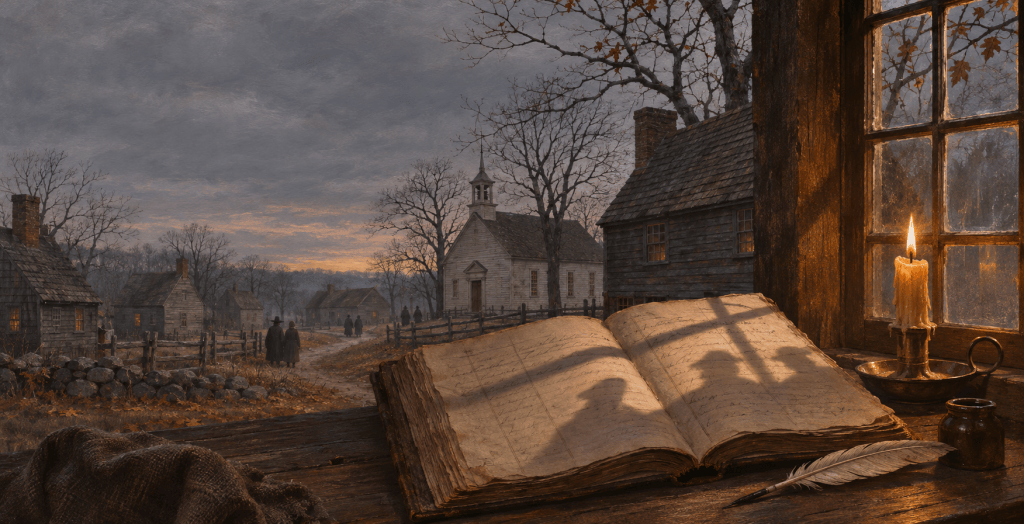
The picture many of us carry of the Salem witch trials is a fire: women tied to stakes, flames rising around them. But that familiar image belongs to other times and places. In colonial New England, people accused of witchcraft were hanged. At Salem in 1692, nineteen people were executed by hanging; Giles Corey, who refused to enter a plea, was pressed to death beneath heavy stones. Five of the people hanged were men. The most common image gets the method wrong—and the phrase “witch trials” can make the victims sound like figures from folklore instead of neighbors caught in a legal and political crisis. [1]
The story also reaches further back than Salem. In 1647, Alse Young was executed for witchcraft in Windsor, Connecticut, decades before the Salem crisis. She was not part of the Salem trials; her story belongs to an earlier chapter of New England’s history of witchcraft accusations. Keeping those events distinct helps us see that Salem was neither the beginning nor the whole story. It was a particular outbreak, in a particular place and time, that became the one most remembered. [2]
What are we taught about Salem? Often, the lesson arrives as a cautionary tale about superstition: a frightened village, a few false accusations, and a crowd that loses its reason. That version is not entirely wrong, but it is too neat. It can leave us imagining that the trials were simply a sudden burst of irrationality, detached from the ordinary structures of authority. In fact, accusations moved through courts, ministers, magistrates, jails, and a government trying to reestablish control. Fear mattered, but so did the institutions that gave fear the force of law.
In early 1692, Betty Parris and Abigail Williams, the daughter and niece of Salem Village’s minister, Samuel Parris, began suffering episodes that their community could not explain. The girls’ behavior was interpreted as evidence of witchcraft. Three women were among the first accused: Sarah Good, Sarah Osborne, and Tituba, an enslaved woman in the Parris household. Their circumstances differed sharply. Good was poor and socially vulnerable; Osborne’s choices had brought her into conflict with local expectations; and Tituba lived under Parris’s authority. The accusations did not fall on people with equal power to defend themselves. [3]
Tituba’s role needs particular care. Colonial records describe her as an “Indian woman servant,” but they do not establish a clear account of her origins. Later retellings often give her a confident identity and a dramatic backstory that the surviving record cannot verify. What the records do show is that she was questioned and pressured within a system where her position left her exposed. Her confession helped intensify the crisis, but it should not be treated as a free, reliable account detached from the conditions under which it was made. It also fed the court’s growing belief that the threat was organized and spreading. [4]
That belief took hold in a community already under strain. Salem Village was divided by disputes over its minister and its relationship with Salem Town. The region faced political uncertainty, conflict on the colonial frontier, and deep religious anxieties about the presence of evil in daily life. These pressures do not explain the trials by themselves, and historians have not identified one cause that accounts for everything. They do help explain why alarming behavior and rumor could become persuasive—and why the fear did not remain a private matter among a few families. [5]
Once the accusations entered the courts, the process gave them a structure and an authority of their own. Accused people could be examined for supposed “witch marks.” Testimony about invisible spirits—claims that an accused person’s specter had appeared to torment someone—was admitted as evidence. This spectral evidence was especially difficult to answer: how could a person prove that an apparition had not been sent by them? The court’s procedures made it possible for suspicion to be presented as proof, while the accused had little power to challenge the premise. [6]
Rebecca Nurse’s case shows how that machinery could turn even a respected reputation into no protection at all. Nurse was an elderly, well-regarded member of the community. Neighbors testified in her support, and she denied the charges. At first, the jury found her not guilty. The court sent them back to reconsider, and the jury returned a guilty verdict. Before her execution, Nurse petitioned for another examination, asking that women be allowed to search her body for the marks alleged against her. She wrote, “my life lies now in your hands.” Her words make the distance between an abstract account of “mass hysteria” and the lived reality of the trials harder to ignore: people’s lives depended on decisions made by officials who treated disputed claims as evidence. [7]
The victims were not all women, though women made up roughly four out of five of those accused and faced the greatest share of the violence. Men were accused too, including John Proctor and Giles Corey. Children were drawn into the proceedings as well: Dorothy Good, Sarah Good’s four-year-old daughter, was jailed after being accused. Mentioning these cases doesn’t soften the gendered pattern; it makes the picture more accurate. The crisis reached across a community, but its burdens were unevenly distributed. [8]
The trials did not end because everyone suddenly agreed on what had gone wrong. Doubts about the court’s methods grew, and the governor dissolved the special court that had overseen the proceedings. Later courts were less willing to accept spectral evidence, and convictions stopped. In 1711, the Massachusetts government formally reversed some convictions and provided compensation to surviving victims and their families. These actions acknowledged that grave wrongs had been done, though no official correction could restore the lives taken or fully repair the damage to those who survived. [9]
The familiar Salem story often ends with a lesson about how easily people can be fooled. The record asks us to look at more than the fear itself. It asks how fear became evidence, how evidence became a verdict, and why the machinery of authority continued to act even as lives were at stake. The tragedy was not only that people believed in witchcraft. It was that a community’s beliefs were carried into a court that could punish people for claims they had no fair way to disprove.
Sources
[1] Salem Witch Museum, Frequently Asked Questions; Library of Congress, Today in History: March 1.
[2] Massachusetts Archives, Power & Persecution.
[3] Massachusetts Archives, Prelude to the Salem Witch Trials; New England Humanities, The Records of the Salem Witch Trials.
[4] University of Virginia, Tituba; New England Humanities, The Records of the Salem Witch Trials.
[5] Massachusetts Archives, Prelude to the Salem Witch Trials; Congregational Library & Archives, Salem Witch Trials Research Guide.
[6] Massachusetts Archives, The Trials.
[7] Rebecca Nurse, Petition for a Further Examination; University of Virginia, Rebecca Nurse’s Examination.
[8] Massachusetts Archives, Power & Persecution; Library of Congress, Today in History: March 1.
[9] Massachusetts Archives, The Aftermath.


Leave a Reply