
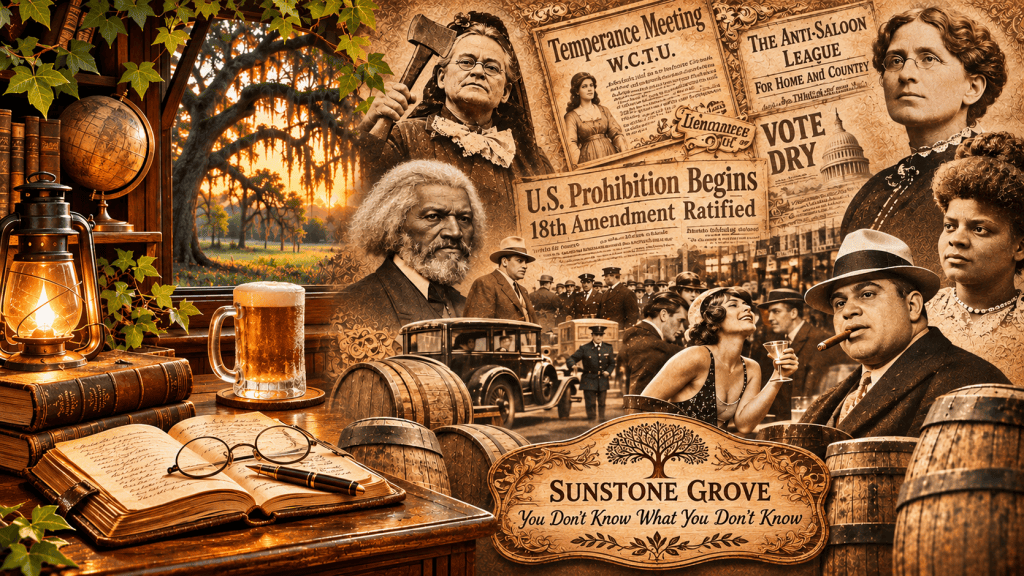
Come on up to the Grove, pull up a chair, and sit a spell. I’ve got a cold beer in hand today, which seems particularly appropriate considering where our journey through American history is taking us.
Prohibition.
A little over a century ago, selling the beer I’m enjoying could have landed someone in federal court. Not because it was contaminated, stolen, or sold to a child, but because the United States had decided that alcohol posed such a threat to society that its commercial production and distribution needed to be prohibited by the Constitution.
And here’s the interesting part.
A great many Americans thought that was an excellent idea.
Not just a handful of religious crusaders, either. Millions supported Prohibition, including women fighting for safer homes, reformers concerned about poverty, employers worried about productivity, and politicians hoping to reshape American society.
So how did a movement with such broad support become one of the country’s most famous cautionary tales?
Pour yourself something you enjoy, alcoholic or otherwise, and let’s talk about what we think we know.
What We Were Taught
If your American history education was anything like mine, Prohibition came packaged with the Roaring Twenties.
Flappers in fringed dresses, jazz pouring out of underground clubs, secret passwords at speakeasy doors, and gangsters in expensive suits making fortunes selling illegal whiskey.
Al Capone became practically synonymous with the era. Federal agents smashed barrels, bootleggers raced across back roads, and apparently the entire country spent thirteen years pretending it wasn’t drinking.
Somewhere in the background stood Carrie Nation, wielding her famous hatchet and declaring war on saloons.
The lesson was straightforward: a bunch of uptight reformers tried to outlaw alcohol, Americans ignored them, organized crime flourished, and eventually the government admitted defeat.
The Eighteenth Amendment was repealed by the Twenty-first Amendment in 1933, and everyone could finally have a drink again.
End of story.
Except, of course, it wasn’t.
If Prohibition was such an obviously terrible idea, how did its supporters manage to amend the United States Constitution?
That’s not something a few cranky neighbors accomplish over coffee.
To understand how we got there, we need to travel backward, well before the jazz clubs and bathtub gin.
Before the Country Went Dry
Alcohol was deeply woven into early American life.
Taverns served as gathering places, meeting halls, and centers of political discussion. Beer, cider, rum, and whiskey were familiar parts of everyday culture. By modern standards, Americans in the early nineteenth century consumed remarkable quantities of alcohol.
But heavy drinking created serious problems.
Families suffered when wages disappeared into saloons. Alcohol dependence contributed to poverty, illness, and instability. In some households, drinking was associated with violence and neglect.
And here’s where we need to consider the position of women.
For much of the nineteenth century, married women had limited legal, political, and financial independence. Their rights varied by state, but many had little practical recourse when a husband’s drinking threatened the household.
Imagine depending on someone else’s wages to feed your children, only to watch that money disappear at the saloon. Imagine having no vote, limited access to your own income, and few realistic options for leaving an abusive marriage.
Now imagine someone telling you that eliminating the saloon might protect your family.
Suddenly, the temperance movement looks a little different.
Carrie Nation, whom we remember for attacking saloons with a hatchet, understood the issue personally. Her first marriage had been devastated by her husband’s alcoholism.
In her 1908 autobiography, Nation declared:
“A woman is stripped of everything by them.”
She was describing the damage she believed saloons inflicted upon women and their families.
We remember the hatchet because it makes such a memorable picture. What we tend to forget is the woman holding it, and why she believed she needed to.
Nation wasn’t alone.
The Woman’s Christian Temperance Union (WCTU), founded in 1874, became one of the country’s most influential women’s organizations. Under leaders such as Frances Willard, it expanded beyond alcohol to women’s suffrage and other social reforms.
Frances Ellen Watkins Harper, a Black abolitionist, writer, and suffragist, also connected temperance with women’s rights and family welfare.
The WCTU endorsed women’s suffrage in 1881, recognizing that women needed political power to influence the laws governing their lives.
Think about that.
A movement we remember for restricting personal freedom also helped bring women into organized political activism.
History rarely fits neatly into the boxes we build for it.
And the movement becomes even more complicated when we examine the other groups supporting it.
Not Everyone Wanted the Same America
The temperance movement was never a single group united by a single vision.
For some, alcohol threatened their families. For others, it threatened their faith, their businesses, or their understanding of what America ought to be.
Many Protestant reformers believed alcohol encouraged moral decline and weakened families. Churches became centers of temperance organizing, and opposition to drinking was frequently presented as a Christian obligation.
But Christianity wasn’t united on the subject.
Catholic and Lutheran communities, among others, had different traditions surrounding alcohol. Wine was used in religious observances, and moderate drinking wasn’t universally regarded as sinful.
The disagreement wasn’t simply about whether alcohol was harmful. It was also about whose religious expectations should shape American law.
Industrialization brought additional interests.
Factories needed workers who arrived on time, remained sober, and operated machinery safely. Some employers supported temperance to improve productivity and reduce accidents.
Others saw sobriety campaigns as opportunities to regulate workers’ behavior beyond the workplace.
There was a meaningful difference between wanting safe working conditions and believing employers should influence how workers spent their wages and leisure time.
Then there was immigration.
For many immigrant communities, saloons and beer gardens were more than places to drink.
German American beer gardens offered music, recreation, and opportunities to maintain cultural traditions. Irish American saloons frequently served as neighborhood institutions, informal employment networks, and political gathering places.
These establishments helped newcomers find community in a country where they often faced suspicion and discrimination.
Yet to some temperance reformers, those same establishments represented foreign customs threatening their vision of respectable American life.
That tension sharpened during World War I.
Germany was America’s enemy, and anti-German sentiment spread throughout the country. German language, music, businesses, and cultural institutions came under suspicion.
Because German Americans were closely associated with brewing, the beer industry became an especially convenient target. Wartime restrictions on grain use and a growing atmosphere of nationalism strengthened the campaign against alcohol.
Opposition to drinking could now be wrapped in the language of patriotism.
In some circles, supporting Prohibition became a declaration about what kind of American everyone else should be.
A Different Understanding of Freedom
Even among temperance supporters, ideas about freedom differed considerably.
In October 1845, Frederick Douglass addressed a temperance gathering in Cork, Ireland.
Douglass had escaped slavery seven years earlier. He understood the destructive effects of alcohol, but he brought a perspective that many in his audience could never fully share.
He declared:
“I was not a slave to intemperance, but a slave to my fellow-men.”
Douglass was reminding his listeners that the enslavement of human beings wasn’t merely a metaphor for harmful habits. It was a living reality.
Black Americans had long participated in temperance organizing, often connecting sobriety with education, economic stability, and civil rights.
But participation in the same reform movement didn’t guarantee equal respect.
Frances Willard and Ida B. Wells
One of the clearest examples of that contradiction involved two remarkable women.
Frances Willard was president of the WCTU and one of the most influential reformers of her generation. She championed women’s political participation and helped build a powerful national organization.
Ida B. Wells was a journalist, suffragist, and fearless investigator of lynching. She challenged the lies used to justify racial violence and demanded accountability from people who claimed to stand for justice.
Both women believed in reform and understood the power of political organizing.
But they disagreed profoundly about race.
In an 1890 interview with the prohibitionist newspaper The Voice, Willard insisted:
“So far as I know, I have not an atom of race prejudice.”
Yet the interview included racist stereotypes about Black communities, portraying Black voters as obstacles to Prohibition and invoking claims that Black men threatened white women.
Those weren’t harmless assumptions.
In the post-Reconstruction South, such accusations helped justify disenfranchisement, segregation, and lynching.
Wells knew this intimately.
Her investigations documented how allegations of sexual violence were used to excuse the murder of Black men, often without evidence and sometimes to conceal other motives, including economic competition and the enforcement of white supremacy.
Wells condemned what she called:
“the old threadbare lie that negro men rape white women”
Her language was deliberately forceful. She was confronting a justification for racial terror.
During her 1894 speaking tour in Britain, Wells brought Willard’s earlier statements back into public view and challenged her to use the WCTU’s considerable influence against lynching.
Willard defended herself, and the confrontation became public. The WCTU eventually adopted resolutions condemning lynching, but that didn’t erase the underlying disagreement.
Wells was asking a fundamental question.
How could an organization claim to protect women while repeating rhetoric that endangered Black Americans?
Willard could sincerely believe she was improving society while accepting prejudices that reinforced racial injustice. Wells could support temperance while refusing to overlook racism within the movement.
Their disagreement wasn’t simply about whether women deserved protection.
It was about which women, which families, and which communities were included in that promise.
The temperance movement could advance women’s political participation while perpetuating racial prejudice. It could recognize genuine suffering while supporting restrictions that burdened immigrant communities.
An employer could care about workplace safety while seeking control over employees’ private lives.
And a politician could support Prohibition because it appealed to voters, regardless of personal conviction.
The movement succeeded partly because these different interests could rally behind the same solution.
But agreement on a solution didn’t mean agreement on the problem.
That distinction would become enormously important once Prohibition became law.
How Do You Ban a Nation’s Booze?
Turning those competing motivations into a constitutional amendment required decades of organizing.
Temperance advocates had campaigned for alcohol restrictions throughout the nineteenth century. Communities adopted local prohibitions, and several states experimented with statewide bans.
The Anti-Saloon League, founded in 1893, became particularly effective at turning the issue into political leverage.
Unlike organizations pursuing broad social reforms, the League concentrated on eliminating the legal liquor trade. It supported candidates who favored Prohibition and opposed those who didn’t, often regardless of their positions on other issues.
The strategy worked.
By the time Congress proposed the Eighteenth Amendment in December 1917, much of the country already had some form of state or local alcohol prohibition.
The amendment was ratified on January 16, 1919.
National Prohibition took effect on January 17, 1920.
But here’s something that often gets lost in the telling.
The Eighteenth Amendment did not prohibit drinking alcohol.
It prohibited the manufacture, sale, transportation, importation, and exportation of intoxicating liquor for beverage purposes.
The Volstead Act, passed in 1919 to enforce the amendment, established the detailed rules. It generally treated beverages containing more than half of one percent alcohol as intoxicating and restricted possession, while allowing certain exceptions.
Alcohol legally owned and stored in private homes before Prohibition could remain there under specified conditions. There were also exceptions for medicinal, religious, and industrial uses.
The government hadn’t declared that taking a sip of whiskey was a federal crime.
It had attempted to dismantle the legal commercial system supplying that whiskey.
And money made a difference.
People wealthy enough to stock their cellars before Prohibition might enjoy a perfectly legal private supply. Those who couldn’t afford to do so faced different circumstances.
The law applied nationally, but its practical effects were hardly equal.
Which brings us to a question the gangster stories tend to overlook.
Did Prohibition actually accomplish anything?
Did Prohibition Actually Work?
We’re often told Prohibition failed immediately because Americans simply kept drinking as much as ever.
But the evidence tells a more complicated story.
Alcohol consumption appears to have declined significantly during the early years.
Researchers disagree about the precise amount, partly because measuring an illegal market is difficult. We don’t have reliable nationwide sales figures for whiskey manufactured in basements or smuggled across borders.
Still, estimates based on indirect evidence suggest a substantial initial decline, followed by a recovery as illegal supply networks expanded.
So yes, Prohibition reduced drinking, at least for a time.
But was reducing alcohol consumption the same thing as solving the problems that inspired Prohibition?
Not necessarily.
Families still experienced poverty and violence. Alcohol dependence didn’t disappear. And people who wanted liquor increasingly turned to suppliers operating outside the law.
Those suppliers discovered an extraordinary business opportunity.
Which brings us to the part Hollywood loves.
Enter the Bootleggers
When the government eliminated the legal alcohol market, it didn’t eliminate demand.
Bootlegging became big business. Liquor crossed borders, illegal distilleries sprang up, and underground establishments supplied customers willing to pay.
Organized criminal groups competed for profitable territory, distribution networks, and protection.
Al Capone didn’t invent organized crime, but Prohibition helped create conditions in which criminal enterprises could expand dramatically.
Violence, bribery, and corruption became part of the business.
Police officers, politicians, and federal agents could be tempted by money from an industry generating enormous profits precisely because it was illegal.
And while we remember glamorous speakeasies, the consequences weren’t always glamorous.
Illegally produced alcohol could be dangerous. Enforcement was inconsistent. Communities differed enormously in how seriously they treated the law.
Some Americans regarded drinking as defiance. Others supported Prohibition wholeheartedly and resented its widespread violation.
There was no single national experience.
A Congressman Speaks Out
By 1926, the contradictions had become difficult to ignore.
That year, New York Congressman Fiorello La Guardia testified before a Senate committee investigating Prohibition.
An outspoken critic, La Guardia argued that inconsistent enforcement made it difficult to assess the law’s effectiveness.
He declared:
“It has never been enforced in this country.”
He described illegal liquor sales, corruption, and tax revenue that legal alcohol sales might otherwise have generated.
His testimony reflected an opponent’s assessment, not an impartial measurement of every claim. But his concerns highlighted a growing problem.
The government had outlawed an industry, yet that industry continued operating through criminal networks.
The issue wasn’t merely that people were breaking the law.
Enforcing the law was also changing the institutions responsible for upholding it.
Nowhere was that clearer than in the federal courts.
The Courts Couldn’t Keep Up
Prohibition created a staggering enforcement problem.
Federal authorities suddenly had responsibility for policing an enormous illegal market involving activities that had previously been legal.
According to the Federal Judicial Center, Volstead Act cases accounted for nearly two-thirds of federal criminal cases during fiscal years 1921 through 1933.
Think about that.
Nearly two out of every three federal criminal cases over that period involved Prohibition violations.
Courtrooms were overwhelmed, and plea bargaining became increasingly important as judges struggled with growing dockets.
The legal consequences extended beyond alcohol.
In 1925, the Supreme Court decided Carroll v. United States, involving suspected illegal liquor transportation in an automobile.
The ruling helped establish the automobile exception to the Fourth Amendment’s warrant requirement, permitting certain vehicle searches without a warrant when officers have probable cause.
A constitutional rule still relevant to American policing emerged from Prohibition enforcement.
That’s quite a legacy for a national policy that lasted only thirteen years.
Meanwhile, uneven state cooperation and inadequate enforcement resources made the system increasingly difficult to sustain.
The government had enacted a law requiring enormous enforcement efforts without ensuring that the institutions responsible could realistically carry them out.
And then an economic catastrophe changed the political calculation entirely.
And Then Came the Great Depression
By the late 1920s, organized crime, corruption, inconsistent enforcement, and widespread disregard for Prohibition had damaged public confidence.
Then the stock market crashed in 1929.
Americans needed jobs. Governments needed revenue. Businesses were closing, and unemployment was rising.
Legal breweries, distilleries, and related businesses represented potential employment. Alcohol taxes offered revenue that struggling governments could use.
Franklin D. Roosevelt supported repeal during his 1932 presidential campaign.
Prohibition had become not only a moral and legal controversy but an economic one.
In 1933, Congress proposed the Twenty-first Amendment, repealing the Eighteenth.
On December 5, 1933, enough states had ratified it to make repeal official.
National Prohibition was over.
But that didn’t mean every community embraced alcohol.
States retained substantial authority over alcohol regulation. Some maintained statewide prohibition for years afterward, while local restrictions continued in many places.
Even today, some American communities remain dry or restrict when and where alcohol can be sold.
National Prohibition ended, but the debate over alcohol regulation never entirely disappeared.
So Was Prohibition a Failure?
I think the answer depends on what we’re measuring.
If the goal was to reduce alcohol consumption, Prohibition had measurable success, particularly early on.
If the goal was to eliminate drinking, it plainly failed.
If the goal was to protect families, reduce poverty, and create a safer society, the results were considerably more complicated.
And if the goal was to strengthen respect for the law, widespread evasion, corruption, and enforcement problems suggest that Prohibition created serious difficulties of its own.
But calling it simply a failure risks overlooking why people supported it.
Women who wanted protection from abusive or financially irresponsible husbands weren’t foolish for wanting change.
Families harmed by alcoholism weren’t imagining their suffering.
Reformers who recognized the social costs of excessive drinking were identifying genuine problems.
The mistake wasn’t necessarily in recognizing those problems.
It was in assuming that a sweeping constitutional prohibition could resolve them without creating other serious consequences.
And we can’t ignore those supporters whose primary interest wasn’t protecting families, but imposing their own cultural, religious, or moral expectations on others.
Those motivations sometimes existed within the same organizations.
That’s the uncomfortable part of history.
Good intentions don’t guarantee good outcomes. And good intentions don’t automatically excuse harmful methods.
A Final Thought from the Grove
As I sit here with my beer, I keep coming back to the people who helped shape this movement.
Carrie Nation, whose anger at the saloons grew from personal suffering.
Frances Willard, whose reform work advanced women’s political participation, yet whose words reinforced dangerous racial prejudices.
Ida B. Wells, who refused to let the language of moral reform excuse injustice.
And Frederick Douglass, who reminded a temperance audience that freedom meant something very different to someone who had actually been enslaved.
They remind us that history is rarely a story of entirely good people opposing entirely bad ones.
People can accomplish meaningful things and still cause harm. They can recognize one injustice while overlooking another.
And people who sincerely want to improve the world can disagree profoundly about what improvement ought to look like.
Prohibition became something much larger than protecting families or keeping wages out of saloons.
It became a constitutional experiment involving personal liberty, public health, religion, immigration, law enforcement, and government power.
I don’t think the lesson is simply that you can’t legislate morality.
We absolutely should address the problems that hurt people.
But we also need to ask whether our proposed solutions will actually help, whom they might harm, and what unintended consequences we may be inviting.
Because identifying a problem is only the beginning of solving it.
And sometimes the people with the most sincere intentions can still get the answer wrong.
So here’s to the people who tried to make things better, the lessons learned when things didn’t go as planned, and our willingness to look beyond the familiar stories.
I’ll raise my glass to that.
Until next time, there’s always room for you here at the Grove.
Y’all come sit a spell.
Sources
- Kansas Museum of History: Carrie Nation’s autobiographical writings. https://www.kansashistory.gov/p/carry-a-nation-part-2/10590
- Yale University, Gilder Lehrman Center: Frederick Douglass, Intemperance and Slavery, October 20, 1845. https://macmillan.yale.edu/glc/intemperance-and-slavery
- Center for Women’s History and Leadership: Truth-Telling: Frances Willard and Ida B. Wells. https://scalar.usc.edu/works/willard-and-wells/the-voice-interview
- Ohio State University, Prohibition: Fiorello La Guardia’s 1926 testimony. https://prohibition.osu.edu/american-prohibition-1920/fiorello-laguardia-prohibition
- National Archives: The Volstead Act. https://www.archives.gov/education/lessons/volstead-act
- Library of Congress: 18th Amendment to the U.S. Constitution: Primary Documents in American History. https://guides.loc.gov/18th-amendment/introduction
- National Park Service: Suffrage in 60 Seconds: Temperance. https://www.nps.gov/articles/000/suffrage60seconds_temperance.htm
- Federal Judicial Center: Prohibition in the Federal Courts: A Timeline. https://www.fjc.gov/history/exhibits/prohibition-in-federal-courts-timeline
- National Bureau of Economic Research: Jeffrey A. Miron and Jeffrey Zwiebel, Alcohol Consumption During Prohibition (1991). https://www.nber.org/papers/w3675


Leave a Reply