
Pull up a chair, settle in, and bring your coffee. We’ve got some history to talk about today, and I’m going to ask you to stay with me because this one is uncomfortable.
I’m going to hold your hand when I say this.
Mass deportations of Americans is wrong.
That shouldn’t be a controversial statement. And yet, here we are.
Today we’re talking about something called Mexican Repatriation, a chapter of American history that unfolded during the Great Depression. If you haven’t heard of it, you’re certainly not alone. It’s not one of those events that generally gets much attention in our history classes.
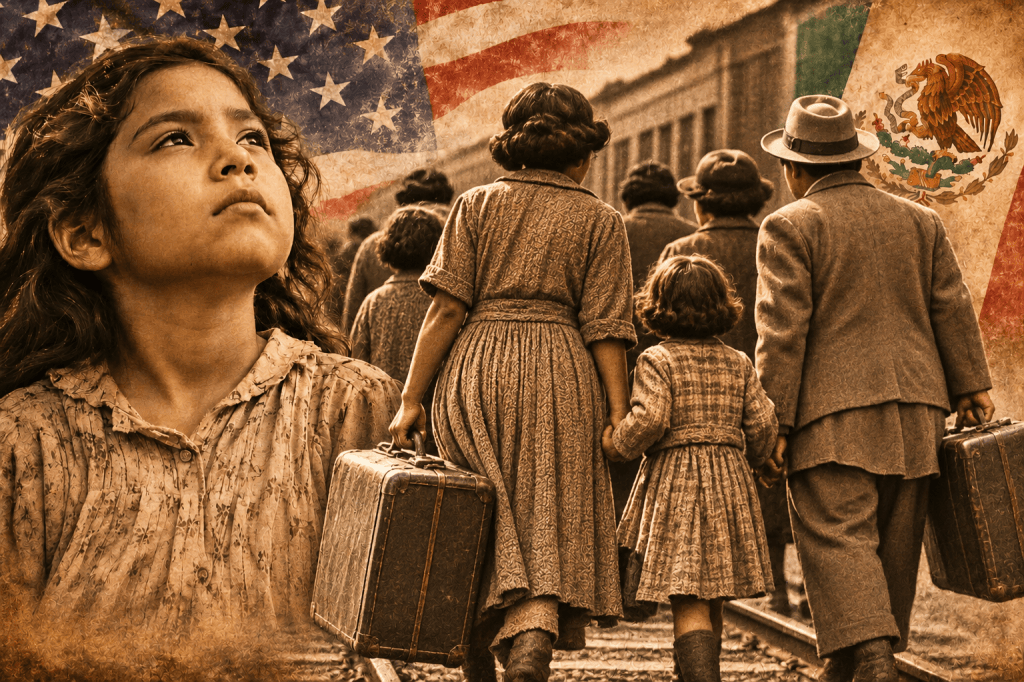
But it should.
Because during the 1930s, hundreds of thousands of people of Mexican descent left the United States amid deportations, intimidation, economic desperation, and government-organized repatriation campaigns.
Some were immigrants. Some were lawful residents. Some left voluntarily.
And some were American citizens who had never lived anywhere else.
To understand how that happened, we need to go back to an America that welcomed Mexican workers when their labor was needed, then treated many of those same families as expendable when the economy collapsed.
What We Were Taught
Most of us learned about the Great Depression through a familiar collection of images.
Breadlines. Soup kitchens. Men standing outside factories hoping for work. Families losing their farms. Dust Bowl refugees piling their belongings into automobiles and heading west.
We learned about the stock market crash of 1929, the collapse of banks, and the enormous suffering that followed. We learned about President Hoover, Franklin Roosevelt, and the New Deal.
And somewhere in all that hardship, we may have heard that Mexican workers returned to Mexico because there weren’t enough jobs in the United States.
Which sounds fairly straightforward, doesn’t it?
The economy collapsed. People couldn’t find work. Some immigrants went home.
Except that isn’t the whole story.
And that word home is doing an awful lot of work.
Because how do you send someone home to a country they’ve never lived in?
Before the Depression, America Wanted Their Labor
During the early twentieth century, Mexican workers became an important part of the American economy, particularly in agriculture, railroads, mining, construction, and manufacturing.
American employers recruited Mexican laborers to fill demanding jobs. Communities grew around those jobs, and families established lives in the United States.
People married, bought homes, opened businesses, attended churches, and raised children.
Those children went to American schools. They spoke English. They pledged allegiance to the American flag.
And under the Fourteenth Amendment, children born in the United States were generally American citizens, regardless of whether their parents had been born in Mexico.
Of course, that didn’t mean Mexican Americans enjoyed equal treatment. Segregation, employment discrimination, unequal schools, and racial prejudice were already part of their lives.
But they were building lives here, often in the very communities their labor had helped create.
Then came October 1929.
The stock market crashed, and the American economy began a devastating decline. Businesses closed, factories reduced production, and unemployment soared. Public assistance systems struggled to meet the growing need.
As Americans searched for explanations and solutions, Mexican communities became convenient targets.
Workers who had been welcomed when employers needed labor were suddenly portrayed as competition for jobs. Families who had contributed to their communities were accused of burdening public relief programs.
The economic crisis was real.
But blaming an entire population for it was a choice.
And that choice soon became something more than public resentment.
The Solution Was to Make Them Leave
The argument was simple enough to fit on a political slogan.
If Mexican workers left, there would be more jobs for other Americans. If Mexican families left, local governments would spend less money on public assistance.
And if enough people could be persuaded to go without formal deportation proceedings, the process would be faster and cheaper.
The word officials used was repatriation.
It’s a tidy little word, isn’t it?
It suggests returning people to their homeland, perhaps even helping them get there.
And some people did choose to return to Mexico. They had family connections there, and some believed they would find better opportunities.
But others faced threats, intimidation, or the prospect of losing the assistance their families needed to survive.
That is a very different kind of choice.
There was no single federal law ordering every person of Mexican ancestry to leave the country. Instead, federal immigration enforcement operated alongside state and local campaigns, county welfare departments, employers, charities, and Mexican consular officials.
Federal agents conducted immigration raids. Local welfare officials encouraged or pressured families receiving assistance to relocate. Some agencies arranged train transportation to Mexico, presenting departure as an alternative to continued public support.
Mexican consulates sometimes helped arrange transportation and assisted families who wished to return, but those arrangements could also facilitate departures made under considerable pressure.
And throughout the process, the public spectacle of immigration enforcement frightened people who had never been accused of violating any law.
You didn’t necessarily have to deport every person.
Sometimes you only had to make enough people afraid.
Los Angeles offers one particularly revealing example of how that worked.
Los Angeles, February 26, 1931
On February 26, 1931, immigration officers and local police converged on the city’s downtown plaza, a gathering place for Mexican and Mexican American residents.
Officers blocked exits and questioned people about their immigration status.
Contemporary accounts described hundreds of people being detained or prevented from leaving while officers conducted their investigation.
The precise number of arrests is less certain than the fact that hundreds were subjected to the raid. Its impact extended well beyond those taken into custody.
Imagine watching officers surround a public gathering place while people around you are questioned about whether they belong in the country.
Now imagine that you were born in Los Angeles.
Your parents might have come from Mexico. Your grandparents might have come from Mexico.
But you were born here.
What exactly were you supposed to prove?
And how quickly could you prove it while surrounded by officers?
The raid became a highly visible demonstration of federal immigration power. Its consequences reached far beyond those arrested, spreading fear among families who worried that they might be next.
That fear helped accomplish what formal deportation proceedings alone could not.
And while the raid made headlines, the consequences of repatriation were being experienced much more quietly in homes throughout the city.
One of those homes belonged to a little girl named Emilia.
A Little Girl Named Emilia
Emilia Castañeda was born in Los Angeles in 1926 and grew up in Boyle Heights.
Her father worked as a bricklayer and owned a duplex. Emilia attended elementary school, played with neighborhood friends, and recited the Pledge of Allegiance.
It was an American childhood.
Not a particularly wealthy one, especially as the Depression deepened, but it was hers.
Then her father lost work, and her mother died.
In 1935, when Emilia was nine years old, her father told the family they had to leave for Mexico.
In a 2003 interview with the Los Angeles Times, Emilia remembered the departure.
“We cried and cried,” she said.
She remembered leaving in the darkness, carrying what belongings the family could take.
And she remembered something else.
“I had never been to Mexico. We were leaving everything behind.”
That sentence should stop us in our tracks.
She wasn’t returning to a homeland she remembered. She was leaving the only home she’d ever known.
The family traveled by train through the Southwest and crossed into Mexico, eventually reaching Durango.
There, Emilia found herself struggling with poverty, unfamiliar living conditions, and the challenge of learning Spanish. She had attended an American school where speaking Spanish had been discouraged, only to find herself in a country where she needed it.
As the family’s circumstances worsened, she eventually left school to help support them.
A child lost her home, her education, her friends, and the familiar world of her childhood.
Not because she had committed a crime.
Not because she had entered the country illegally.
But because her family had become part of a population that officials wanted to leave.
Emilia finally returned to the United States in 1944, helped by her American birth certificate.
She was seventeen.
Nine years of her childhood had passed, and no government apology could ever give those years back.
Unfortunately, Emilia’s experience was far from unique. Similar stories were unfolding in industrial cities and agricultural communities across the country.
The Trains Didn’t Stop in California
Mexican communities across the United States experienced repatriation pressures, including in Michigan, Illinois, Texas, and other states.
In Detroit, Mexican workers had helped support the automobile industry and related businesses. When the Depression struck, those jobs disappeared, and families faced pressure to leave.
Oral historian Elena Herrada has documented what happened to her own family.
Her grandparents took their American-born children to Mexico in 1930. Eventually, the parents returned to Detroit to find work and send money, leaving their children with relatives in Mexico.
The children had to adjust to an unfamiliar language and environment, and their schooling was interrupted. When they returned to the United States two years later, they were placed in classes intended for foreign-born students, even though they were American citizens.
What began as a response to economic hardship became years of separation and educational disruption.
For other families, the journey itself marked the beginning of an entirely different struggle.
Hortencia Nieto was born in the United States. In 1932, when she was only two years old, her family was sent to Mexico.
In an oral history recorded with her son in 2008, she described what her older sister had told her about their arrival.
Their train brought them into the Mexican interior, where the group was left without an established settlement. They searched for water, cleaned out an old well, and constructed makeshift shelters.
Hortencia remembered a childhood of difficult agricultural labor, poverty, and uncertainty. She began working at ten years old and did not return to the United States until 1944.
It was only after returning that she began to understand the injustice of what had happened.
In her oral history, she recalled realizing that “it was wrong what United States did to us.”
Yet she also spoke with gratitude for the family and life she eventually built.
That complexity matters.
People who survive injustice are not defined solely by what was done to them. They have entire lives beyond it.
But their resilience doesn’t erase what happened.
And these individual stories help us understand what is otherwise an enormous and difficult-to-measure historical event.
How Many People Were Sent Away?
You may encounter claims that one million, or even two million, people were repatriated during the 1930s.
California’s 2005 apology legislation itself cited an estimate of two million people, including 1.2 million born in the United States.
But those figures are not universally accepted by historians and demographic researchers, some of whom arrive at considerably lower estimates.
A 2022 economic study, for example, examines the departure of at least 400,000 people between 1929 and 1934.
The precise total is difficult to establish because different records count different things.
Formal federal deportations were recorded separately from locally organized departures. Some families traveled on government-arranged trains, while others left independently. Some eventually returned to the United States.
And the surviving records do not always establish citizenship.
The proportion of American citizens among those who left is also disputed. Estimates vary by study, location, and method.
But here’s what we don’t have to dispute.
American citizens were among those displaced.
Children born in the United States were taken to a country they had never known. Families were separated, and government officials participated in campaigns that encouraged or coerced departures without providing the protections that formal legal proceedings should have offered.
We don’t need an inflated number to understand the seriousness of that history.
Hundreds of thousands of lives were affected.
And for many of those families, crossing the border was not the end of their ordeal. It was the beginning of another.
What Happened When They Got There?
For families boarding trains in Los Angeles, Detroit, Chicago, and elsewhere, Mexico could represent very different things. Some were returning to communities they remembered, where relatives might be waiting to welcome them. Others were traveling toward places they knew only through family stories. And for American-born children like Emilia and Hortencia, the journey meant leaving home for a country that was entirely unfamiliar.
Whatever expectations they carried, arrival did not necessarily bring relief.
Mexico was facing economic difficulties of its own, and the opportunities families hoped to find were often scarce. Some arrived with little money and few possessions, only to discover that promised work, land, or assistance was unavailable or insufficient. Families who had lived in American cities sometimes found themselves trying to survive in rural communities where they had neither established homes nor reliable employment.
The transition could be especially difficult for children. Those who had attended American schools were suddenly expected to navigate a different educational system, often in a language they did not speak fluently. Some were unable to continue their schooling at all, either because schools were inaccessible or because their families needed them to work.
For parents, the struggle to provide could lead to another painful decision. Some returned to the United States to seek employment, leaving children with relatives in Mexico until they could afford to reunite. Others remained together but endured years of poverty and uncertainty.
And then there were the families who tried to come back.
For American-born children, returning to the United States could require obtaining birth certificates or other documentation to establish citizenship they had possessed all along. The difficulty wasn’t necessarily that their legal status had changed. It was that proving their right to return could be complicated by lost records, limited resources, and years spent outside the country.
Not every family experienced the same hardships. Some found support, rebuilt their lives, or chose to remain in Mexico. Others eventually returned to the United States.
But for those who had been pressured to leave, the consequences could stretch across an entire childhood or generation.
A house sold or abandoned. A school year interrupted. A parent working hundreds of miles away. A child growing up without the familiar people and places that had once made the world feel secure.
Those losses rarely appeared in the official calculations of how much money repatriation supposedly saved.
And they were not losses that everyone accepted quietly.
Did Anyone Object?
Yes.
And this is important, because we sometimes tell historical stories as though everyone simply accepted the injustices of their time.
They didn’t.
Mexican American communities maintained mutual-aid organizations, social clubs, and advocacy networks. Families shared information and helped one another navigate unemployment, discrimination, and immigration enforcement.
The League of United Latin American Citizens, founded in Texas in 1929, worked to protect Mexican Americans’ civil rights and challenge discrimination.
Some social workers and observers criticized the pressure being placed on families. And as reports circulated about the difficult conditions awaiting repatriates in Mexico, families became increasingly reluctant to leave.
People recognized that something was wrong.
Some spoke against it. Some resisted.
But the people making these decisions had the power to control employment opportunities, public assistance, transportation, and immigration enforcement.
And a family worried about feeding its children was not negotiating from a position of strength.
Meanwhile, the economic justification for encouraging those families to leave deserves its own examination.
But Didn’t It Help American Workers?
That was one of the central promises.
Remove Mexican workers, and jobs would become available for other Americans.
It sounds simple. But economies don’t work quite that way.
Workers don’t merely occupy jobs. They also purchase goods, rent homes, support businesses, and help industries function. When large numbers of workers and families disappear from a community, their economic activity disappears with them.
Researchers Jongkwan Lee, Giovanni Peri, and Vasil Yasenov examined the effects of Mexican repatriation using historical census records.
Their 2022 study found that areas experiencing greater repatriation saw reduced employment and downward occupational mobility among U.S.-born workers who remained. The effects were particularly pronounced among lower-skilled workers and in urban areas.
In other words, the policy did not produce the promised employment benefits.
In some communities, it appears to have made economic conditions worse.
That doesn’t mean Depression-era officials understood every economic consequence in advance. But it does challenge the assumption that removing one group of workers automatically creates prosperity for everyone else.
And it raises an uncomfortable question about what was being counted as success.
Officials could calculate the cost of a train ticket or the amount of public assistance a county no longer had to provide. They could record the number of people who departed.
But how did they calculate the cost of a lost education, a separated family, or an American citizen spending years unable to return home?
For decades, those costs remained largely outside the nation’s public accounting.
Eventually, California acknowledged at least part of what had happened.
An Apology
In 2005, California passed legislation formally apologizing for its role in the Mexican Repatriation campaigns.
The state acknowledged that government authorities and private organizations had participated in the removal of people of Mexican ancestry, including American citizens and lawful residents.
The legislation recognized violations of civil liberties and constitutional rights, and required a commemorative plaque.
That acknowledgment mattered.
For decades, families had carried memories of what happened while the larger national story remained largely silent.
But the apology came more than seventy years after the events themselves. Many of the people who had been displaced were no longer alive to hear it.
And while California formally acknowledged the injustice, a separate proposal to establish a commission addressing the deportations and coerced departures was vetoed.
An apology is important, but it cannot return a childhood, restore a lost home, or reunite a family separated decades earlier.
Nor can it substitute for understanding how those violations became possible in the first place.
That is where this history begins to feel uncomfortably familiar.
That Was Then. What About Now?
It’s tempting to read about the 1930s and reassure ourselves that we’ve learned better.
That we understand citizenship more clearly. That we have stronger protections. That something like this couldn’t happen again.
But history doesn’t give us that reassurance automatically.
In October 2026, ProPublica published an investigation identifying 519 reported incidents involving American citizens detained by immigration agents between January 20, 2025, and October 21, 2026.
The journalists examined court records, local reporting, and other evidence, requiring at least two sources for each incident they included.
The cases involved different circumstances. Some citizens were questioned about their status. Others were detained while recording enforcement operations or during confrontations with agents. Some were held for extended periods.
The investigation also reported cases involving American citizens removed from the country, including children accompanying parents.
The Department of Homeland Security has repeatedly disputed allegations that it arrests U.S. citizens.
And it’s important to distinguish these incidents. A citizen detained during a protest is not necessarily in the same legal situation as a citizen mistakenly identified as a noncitizen. An American child accompanying a removed parent raises different legal questions from an adult citizen being deported.
But those distinctions do not make the underlying questions disappear.
What procedures are used to verify citizenship? What happens when someone is detained before that verification occurs? What legal process is available to challenge a mistake?
And what happens when a family is separated or removed before those questions are resolved?
The United States has the authority to enforce immigration law. But immigration enforcement does not erase constitutional protections.
American citizenship is not supposed to depend on whether someone looks, sounds, or has a surname that others associate with another country.
And a citizen cannot lawfully be deported as though they were a noncitizen.
The 1930s and the present are not identical. Their laws, enforcement systems, circumstances, and scale differ.
But the historical comparison raises a question worth examining.
What happens when the government’s determination of who belongs becomes more powerful, in practice, than the protections people are supposed to possess?
It’s a question that deserves an answer in our own time, not another seventy years from now.
A Final Thought from the Grove
I keep coming back to Emilia.
A little girl who went to school in Los Angeles, played with her friends, and recited the Pledge of Allegiance. A child who was told she had to leave for a country she’d never visited.
And I keep thinking about Hortencia, who spent much of her childhood in Mexico before returning to the country where she’d been born.
These weren’t abstract numbers on a government report.
They were children, parents, grandparents, workers, neighbors, students, and families.
Some were immigrants. Some were lawful residents. Some were American citizens. Their experiences were not all the same, but the history of Mexican Repatriation shows what can happen when economic fear, racial prejudice, and government power become entangled.
It shows how something described as voluntary can be anything but. It shows how an official policy can produce consequences far beyond its stated purpose.
And it shows how easily the rights of individuals can become secondary when a government decides that an entire population is a problem to be solved.
So I’m going to return to where we started.
I’m going to hold your hand when I say this.
Mass deportations of Americans is wrong.
It was wrong when American-born children were sent away during the Great Depression.
And the documented cases of citizens detained or removed in our own time demand serious scrutiny of the protections intended to prevent such outcomes.
We cannot change what happened to Emilia or Hortencia. But we can listen to their stories, learn the history, and ask difficult questions about what is happening in our own time.
We can refuse to let an uncomfortable chapter of our past disappear simply because it complicates the story we prefer to tell about ourselves.
Because history isn’t just about remembering what happened. It’s about understanding how it happened, why it happened, and what we can learn from it.
And sometimes, that means holding someone’s hand while telling them something they might not want to hear.
Y’all come sit a spell.
Sources and Further Reading
- Abraham Hoffman, Unwanted Mexican Americans in the Great Depression: Repatriation Pressures, 1929–1939. University of Arizona Press. https://open.uapress.arizona.edu/read/unwanted-mexican-americans-in-the-great-depression/section/a742c0de-9870-404d-bbd2-6fc32f66011f
- Gregg Jones, “Apology Sought for Latino ‘Repatriation’ Drive in ’30s,” Los Angeles Times, July 15, 2003. Includes Emilia Castañeda’s testimony. https://www.latimes.com/archives/la-xpm-2003-jul-15-me-repatriation15-story.html
- Antonio Olivo, “Ghosts of a 1931 Raid,” Los Angeles Times, February 25, 2001. https://www.latimes.com/archives/la-xpm-2001-feb-25-me-30223-story.html
- University of Michigan, Elena Herrada, Fronteras Norteñas Oral History Project. https://public.websites.umich.edu/~ac213/student_projects07/repatriados/about/elena.html
- Rancho Los Cerritos, Hortencia Nieto: A Story of Repatriation and Resilience, including the 2008 oral-history transcript. https://www.rancholoscerritos.org/hortencia-nieto-a-story-of-repatriation-and-resilience/
- Jongkwan Lee, Giovanni Peri, and Vasil Yasenov, “The Labor Market Effects of Mexican Repatriations: Longitudinal Evidence from the 1930s,” Journal of Public Economics, 2022. https://doi.org/10.1016/j.jpubeco.2021.104558
- California Senate Bill 670, Apology Act for the 1930s Mexican Repatriation Program, 2005. https://www.leginfo.ca.gov/pub/05-06/bill/sen/sb_0651-0700/sb_670_bill_20051007_chaptered.html
- California Assembly Judiciary Committee, 2005–2006 Bill Summaries, documenting the veto of SB 645 and enactment of SB 670. https://ajud.assembly.ca.gov/sites/ajud.assembly.ca.gov/files/publications/2005%2006%20bill%20sum.pdf
- Nicole Foy, Ruth Talbot, Cengiz Yar, and colleagues, “Search More Than 500 Cases of U.S. Citizens Detained by Immigration Agents,” ProPublica, October 29, 2026. https://projects.propublica.org/american-citizens-detained-dhs-civil-rights/list/


Leave a Reply