
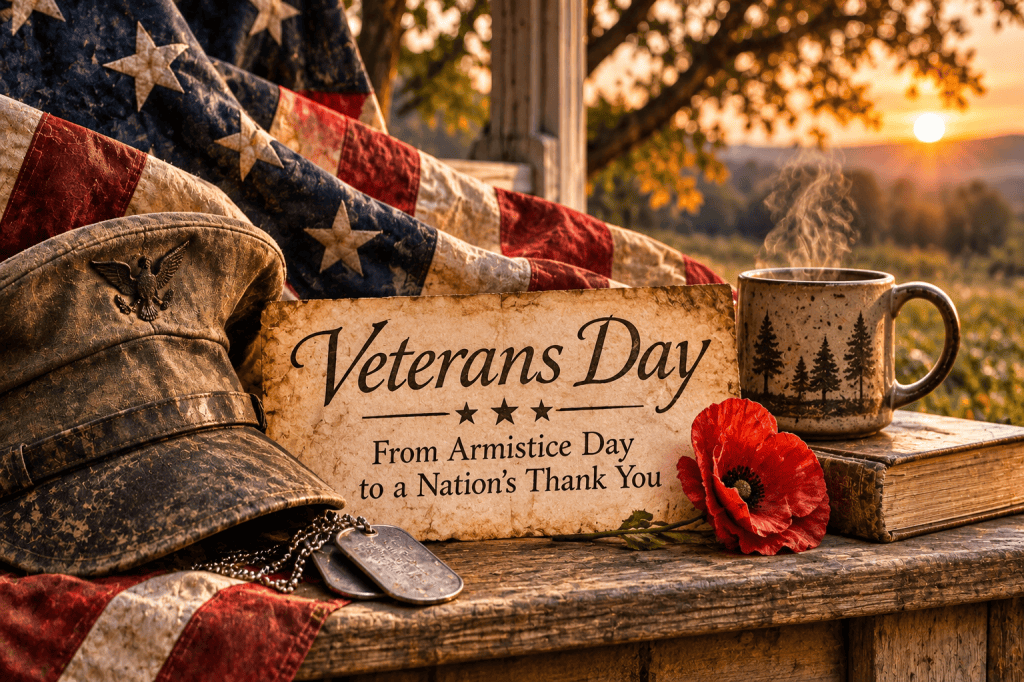
Good evening, and Happy Veterans Day!
Come on up to the porch, grab yourself a cup of coffee or something warm, and sit a spell. Today is a day for remembering, honoring, and saying thank you to the men and women who have served in our armed forces.
Across the country, there will be parades, ceremonies, flags flying, and people gathering to recognize our veterans. Some of us will visit cemeteries or memorials. Others will call a veteran we know, share a memory, or simply take a moment to reflect.
But here’s a little something you might not know.
Veterans Day wasn’t always Veterans Day.
It was originally called Armistice Day, and while that might sound like a simple name change, there’s a rather lovely story behind how it came to be.
So let’s turn back the calendar a little more than a century.
The Eleventh Hour
On November 11, 1918, at eleven o’clock in the morning, the guns fell silent along the Western Front in Europe.
After more than four years of devastating warfare, an armistice between Germany and the Allied powers brought the fighting to a halt.
An armistice, by the way, is an agreement to stop fighting. It isn’t necessarily the same thing as a formal peace treaty. That would come later, with the Treaty of Versailles in June 1919.
But on that November morning, the distinction probably mattered very little to the soldiers who could finally put down their weapons or the families who had spent years wondering whether their loved ones would ever come home.
The Great War, as World War I was then known, had left entire communities grieving. Millions of soldiers and civilians had died, and countless others were wounded, displaced, or forever changed.
Imagine the relief when the fighting finally stopped.
Church bells rang. Crowds gathered. People celebrated in the streets.
The world had endured something terrible, and there was a genuine hope that humanity had learned a lesson it would never forget.
They even called it the war to end all wars.
Oh, how we wish that had been true.
A Day Dedicated to Peace
One year later, in November 1919, President Woodrow Wilson proclaimed the first Armistice Day observance.
It was intended as a day to remember the service and sacrifice of those who had fought, but it also carried another important message.
Peace.
Wilson envisioned a day filled with gratitude for victory and reflection on America’s opportunity to work toward lasting peace among nations.
Early observances included parades, public gatherings, and moments of silence. The eleventh hour of the eleventh day of the eleventh month became a time to remember what had been lost and what people hoped had been gained.
In 1938, Congress made Armistice Day a legal federal holiday and specifically dedicated it to the cause of world peace.
I find that rather beautiful.
Not simply a celebration that the fighting had ended, but a reminder of why everyone hoped it would stay that way.
Unfortunately, history had other plans.
Another War, Another Generation
Just twenty-one years after the armistice, World War II began in Europe.
By the time it ended in 1945, another generation had experienced the destruction, loss, and sacrifice of a world war.
And only a few years later, Americans were fighting in Korea.
The hope that World War I might truly have been the last great war had long since faded.
But the meaning of November 11 hadn’t become less important. If anything, there were now more people whose service and sacrifice deserved recognition.
And that’s where a gentleman named Raymond Weeks enters our story.
One Man with an Idea
Raymond Weeks wasn’t a president or a famous general.
He was a World War II Navy veteran from Birmingham, Alabama, who came home believing that November 11 should honor veterans of all wars, not only those associated with World War I.
It was a simple idea, but one that would eventually change a national holiday.
In 1946, Weeks traveled to Washington, D.C., and presented his proposal to General Dwight D. Eisenhower, who was then the Army Chief of Staff.
Eisenhower supported the idea.
But Weeks didn’t sit around waiting for Congress to do something about it.
He went home and got to work.
On November 11, 1947, Birmingham held a celebration honoring veterans of all wars. It included a parade, ceremonies, and something I particularly love.
A World Peace Banquet.
Isn’t that wonderful?
Here was a man who had served through World War II, advocating for broader recognition of military veterans, and he still made peace part of the celebration.
Weeks understood something that we sometimes overlook.
Honoring those who served and hoping future generations won’t have to experience war are not opposing ideas.
They belong together.
And Weeks kept at it, organizing Birmingham’s annual observances and encouraging national recognition.
Seven years after that first celebration, his efforts helped bring about the change he had envisioned.
Armistice Day Becomes Veterans Day
On June 1, 1954, President Dwight D. Eisenhower signed legislation officially changing the name of Armistice Day to Veterans Day.
The holiday would now honor American veterans of all wars, recognizing the service of those who had worn the uniform across generations.
And here’s something worth remembering: the change wasn’t intended to erase the holiday’s original meaning.
The purpose was to expand it.
The ideals of remembrance and peace remained part of the observance, while the recognition of veterans grew to include those who had served in other conflicts.
Raymond Weeks continued organizing Veterans Day celebrations in Birmingham for decades.
In 1982, President Ronald Reagan presented him with the Presidential Citizens Medal, recognizing his role in establishing the holiday we know today.
Not bad for a fellow who came home from the war with an idea, is it?
And About That November 11 Date…
There’s one more little twist to this story.
For a few years, Veterans Day wasn’t even observed on November 11.
In 1968, Congress passed legislation moving several federal holidays to Mondays to create three-day weekends. Veterans Day was moved to the fourth Monday in October, with the change taking effect in 1971.
But veterans’ organizations and many Americans weren’t particularly happy about it.
November 11 wasn’t just a convenient date on the calendar. It was the date that connected the holiday to its beginnings, to that extraordinary moment in 1918 when the fighting stopped.
So Congress changed it back.
Beginning in 1978, Veterans Day returned to November 11, where it remains today.
Sometimes a date is more than a date.
Sometimes it carries the memory of an entire generation.
A Final Thought from the Grove
So there you have it.
Veterans Day began as Armistice Day, a commemoration of the end of World War I and a hopeful dedication to lasting peace.
Over time, as more Americans served through more conflicts, the holiday grew to recognize veterans from every generation.
And thanks in no small part to Raymond Weeks, a Navy veteran from Alabama who believed all veterans deserved a day of recognition, November 11 became the holiday we celebrate today.
I rather like knowing that story.
It doesn’t change how I feel about Veterans Day, but it does give me something else to think about when I see the flags flying and hear the speeches.
Because now I know that the day carries two messages.
One is gratitude for those who have served.
The other is hope for a world where fewer people will be called upon to make those sacrifices.
And I think there’s room in our hearts for both.
So today, to all our veterans, thank you for your service.
And to Raymond Weeks, thank you for helping make sure that service is remembered.
May we always honor those who have served, remember those who never came home, and keep working toward the peace that gave November 11 its original meaning.
Happy Veterans Day, y’all.
Sources and Further Reading
- U.S. Department of Veterans Affairs, History of Veterans Day. https://department.va.gov/veterans-day/history-of-veterans-day/
- U.S. Department of Veterans Affairs, Veterans Day Facts and Information. https://department.va.gov/veterans-day/
- Woodrow Wilson, Armistice Day Proclamation, November 11, 1919.
- Public Law 75-510, May 13, 1938, establishing Armistice Day as a federal holiday dedicated to world peace.
- Public Law 83-380, June 1, 1954, changing Armistice Day to Veterans Day.
- Ronald Reagan Presidential Library, Remarks on Presenting the Presidential Citizens Medal to Raymond Weeks, November 11, 1982. https://www.reaganlibrary.gov/archives/speech/remarks-presenting-presidential-citizens-medal-raymond-weeks-veterans-day-ceremony


Leave a Reply