
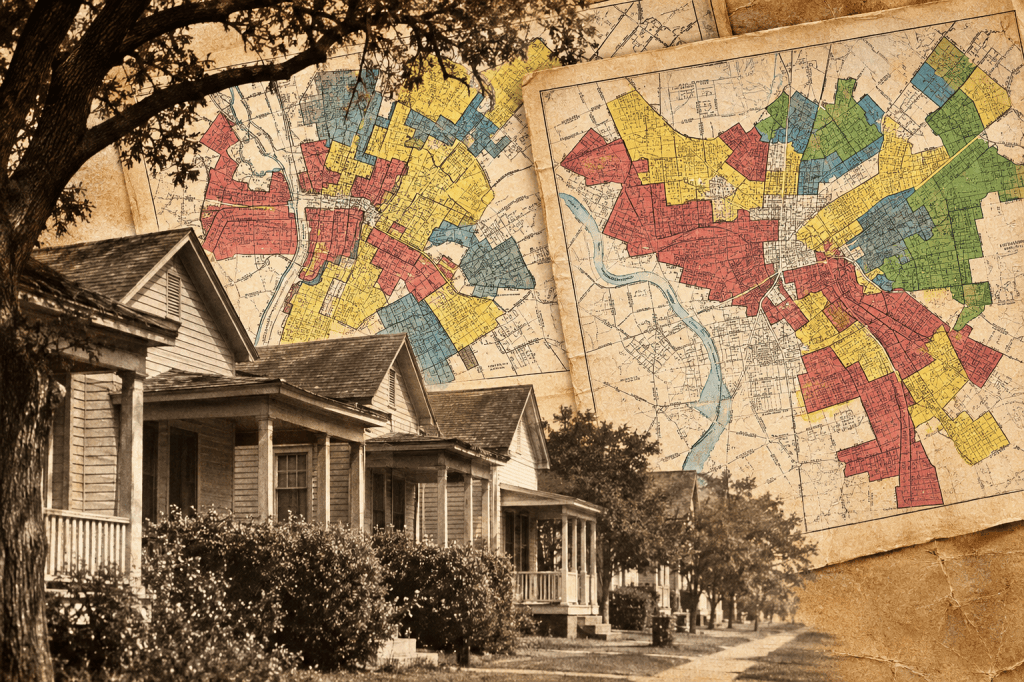
Good evening, y’all! We’ve got bevvies, there’s room on the porch, and I’ve got another little piece of American history I’d like to talk about. Come on up, grab yourself something to drink, and sit a spell.
My boyfriend and I have been looking at houses around Columbia, South Carolina. If you’ve ever gone house hunting, you know how it goes. You look at the house, the property, the neighborhood, and, of course, the price. You consider what you can afford, what you need, and whether you can imagine yourself living there.
But while researching the history of the places we’re considering calling home, I started thinking about something we don’t generally consider when we’re looking at houses.
What if the biggest obstacle to buying a home wasn’t your income, your credit, or the price of the house?
What if it was the neighborhood itself?
Not because the house was falling apart or because you couldn’t afford the mortgage, but because someone had decided that the people living in that neighborhood made it a bad investment.
And what if that decision affected not just whether you could buy a house, but what your children and grandchildren might eventually inherit?
Welcome to the history of redlining.
When a Neighborhood Got a Grade
During the Great Depression, the federal government created the Home Owners’ Loan Corporation, or HOLC, to help struggling homeowners refinance mortgages and avoid foreclosure.
Beginning in the mid-1930s, HOLC also undertook a project to evaluate residential neighborhoods in cities across the country.
Local real estate professionals, lenders, and other knowledgeable residents helped assess neighborhoods according to their perceived mortgage lending risk. The results appeared on color-coded maps.
Green meant best. Blue meant still desirable. Yellow meant definitely declining. And red meant hazardous.
At first glance, that might sound like a fairly ordinary system for evaluating real estate. Houses deteriorate. Neighborhoods change. Lenders consider risk.
But look a little closer at what those evaluators considered important.
Alongside information about housing conditions, transportation, property values, and neighborhood amenities, the assessments recorded residents’ race, ethnicity, and social class. The presence of Black families and certain immigrant groups could be treated as evidence that a neighborhood was becoming less desirable.
In other words, the people living in a neighborhood could be counted against it.
And in an era when homeownership was becoming one of the most important ways American families built financial security, that distinction mattered enormously.
There’s a historical wrinkle here, though, and it’s worth understanding before we go any further.
You’ve probably heard that the government drew red lines around Black neighborhoods and banks immediately stopped lending there. That’s a useful shorthand, but the actual history is more complicated.
Discriminatory lending existed before those maps. The Federal Housing Administration, established in 1934, promoted mortgage insurance standards that favored racially homogeneous neighborhoods and, for years, treated racial integration as a threat to property values.
The HOLC maps reflected many of those same prejudices, but historians continue to examine how directly the maps themselves influenced individual lending decisions. HOLC even refinanced mortgages for some Black homeowners.
So the maps weren’t the beginning of housing discrimination, and they weren’t the entire system.
They were, however, a remarkable written record of the assumptions that helped shape that system.
And if we want to see what those assumptions looked like in practice, we don’t have to travel very far.
Charlotte: A Neighborhood Called Brooklyn
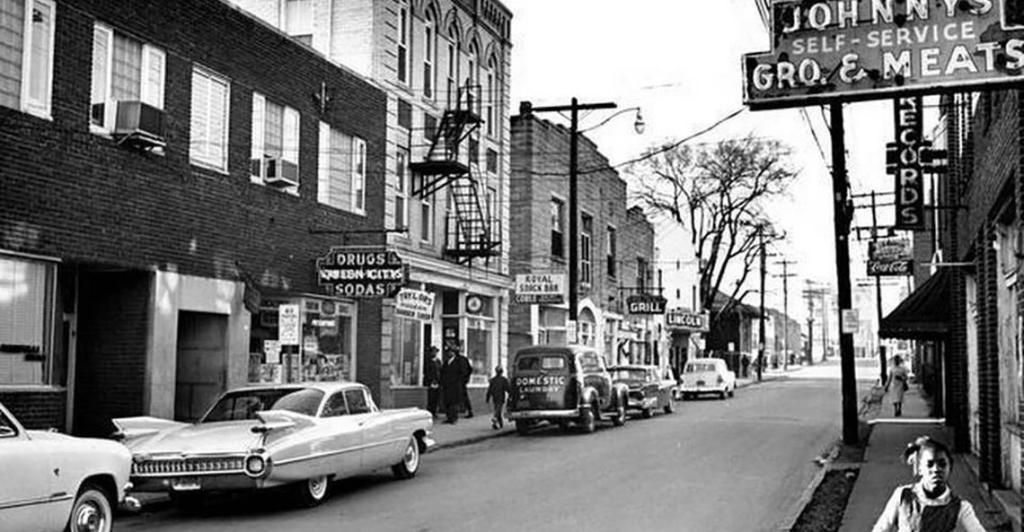
Right here in Charlotte, North Carolina, there’s a neighborhood history that deserves far more attention than it usually receives.
It was called Brooklyn, and it occupied much of the city’s Second Ward.
For generations, Brooklyn was a center of Black life in Charlotte. It had churches, schools, doctors, stores, restaurants, professional offices, and family businesses. Neighbors knew one another. Children grew up surrounded by people who helped create and sustain the community.
It wasn’t a wealthy neighborhood. Some housing was overcrowded or poorly maintained, and many residents faced economic hardship.
But Brooklyn was also a place of accomplishment, enterprise, and belonging.
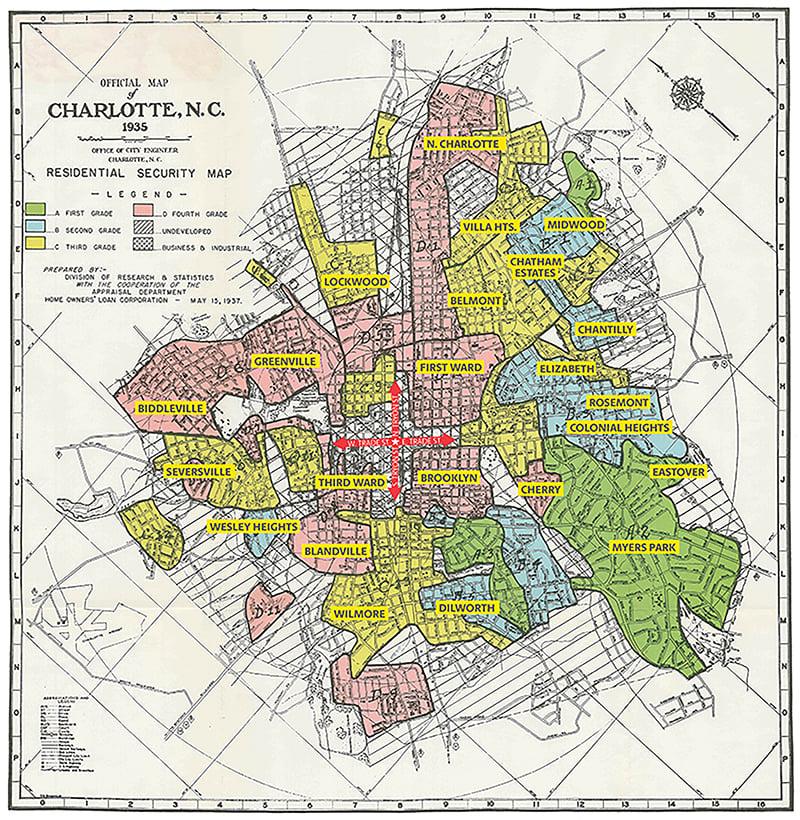
On Charlotte’s 1937 residential security map, areas of Brooklyn received the lowest grade.
To the evaluators, the neighborhood’s racial composition and housing conditions made it a poor investment risk.
To the people living there, it was home.
And few things illustrate that difference better than the memories of someone who actually lived there.
Barbara C. Steele grew up in Brooklyn. In an oral history preserved by UNC Charlotte, she remembered her family’s house and the improvements her parents had made to it.
They had installed electricity and a furnace, replaced the roof, and added a picture window.
Those weren’t merely repairs. They were investments in a home her family expected to enjoy.
But decades after the redlining maps were drawn, Charlotte undertook an urban renewal program that would transform Brooklyn. Steele’s family was among those forced to leave.
She recalled challenging the compensation offered for their property because it wasn’t enough to purchase a comparable home.
Her request was simple: “We left a decent place and we want to go to a decent place.”
Think about that for a moment.
Her parents had worked to improve their house. They had made it more comfortable, more valuable, and more suited to their needs. Then they were told they had to leave, and the compensation didn’t necessarily allow them to replace what they’d lost.
This wasn’t just a question of dollars and cents. It was a question of whether a family’s years of work and investment would be recognized.
And Steele’s family was far from alone.
According to UNC Charlotte’s historical research, Brooklyn’s principal demolition period between 1960 and 1967 displaced approximately 1,007 families and closed 216 businesses. Churches, schools, and other community institutions were also lost or relocated.
Now, here’s where we need to be careful with our history.
Redlining didn’t demolish Brooklyn. Urban renewal did.
Those were different policies, carried out at different times. But they belonged to a larger history in which Black neighborhoods were denied equal access to investment, judged as less valuable, and later targeted for redevelopment.
And there’s a bitter irony in that history.
A neighborhood that officials had long described as undesirable could suddenly become desirable for an entirely different purpose.
Just not necessarily for the people already living there.
Brooklyn wasn’t the only Southern community to experience that combination of discriminatory housing policies and redevelopment. A little farther south, in the city where we’ve been looking for our next home, the historical record tells a remarkably similar story.
Columbia: What the Paperwork Said
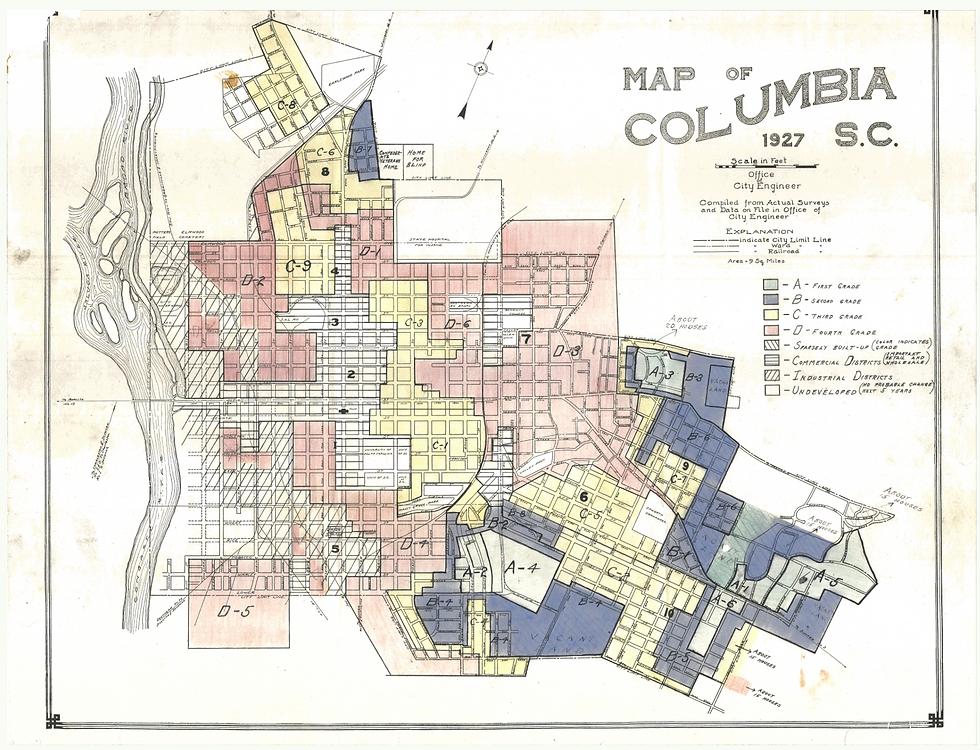
Columbia’s 1937 HOLC assessments offer a particularly revealing look at how neighborhoods were judged.
The city was divided into graded residential sections, with evaluators considering everything from the age and condition of houses to transportation, neighborhood amenities, and the people who lived there.
Predominantly white neighborhoods such as Forest Hills received favorable assessments. Evaluators praised attractive homes, orderly development, residential protections, and restrictions intended to preserve neighborhood character.
Those restrictions could include racially restrictive covenants, agreements written into property deeds that attempted to prevent homes from being sold or occupied by people of certain races.
Think about what that means.
A neighborhood could be praised for having measures that kept certain people out.
Meanwhile, predominantly Black neighborhoods such as Ward One and Waverly received unfavorable grades.
Their assessments pointed to deteriorating buildings, inadequate infrastructure, lower property values, and the racial and economic composition of their residents.
Some of those physical problems were real. There were homes in Columbia that lacked adequate plumbing, suffered from poor maintenance, or housed families in difficult conditions.
We shouldn’t pretend otherwise.
But there’s an enormous difference between recognizing that a neighborhood needs investment and deciding that the people who live there make it unworthy of investment.
And that difference can have consequences that reach far beyond a single property assessment.
When a community has difficulty obtaining affordable financing and other resources, improving its housing becomes harder. Buildings deteriorate, property values suffer, and those conditions can then be used as further evidence that the neighborhood is a poor investment.
It’s a cycle that can reinforce itself.
But the paperwork tells us only how officials evaluated these places. To understand what those judgments overlooked, we need to listen to the people who lived there.
Ward One: A Community Beyond the Map
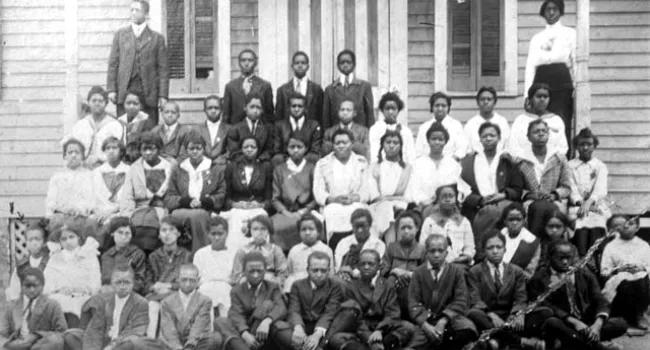
Columbia’s Ward One was a historically Black neighborhood near downtown.
Like Brooklyn, it had its share of hardship. But it also had churches, schools, businesses, friendships, and generations of families who considered it home.
Booker T. Washington High School opened in Ward One in 1916. Celia Saxon Elementary School followed in 1929.
Those schools were more than buildings. They were institutions around which families organized their lives and communities developed their identities.
And then there were the neighbors.
Agnes Harris David, who remembered life in Ward One, described the community this way:
“Everybody took care of each other. If one house didn’t have, another would give.”
I keep coming back to those words.
They don’t tell us that Ward One was prosperous or that everyone had an easy life. They tell us something the government’s neighborhood assessments couldn’t measure.
People looked after one another.
There was value in the relationships, the familiarity, and the sense that someone would notice if you needed help.
And that value didn’t appear in the property grades.
Unfortunately, the community’s own understanding of its worth wasn’t what determined its future.
As Columbia grew, Ward One became the focus of redevelopment and institutional expansion, including the growth of the University of South Carolina.
Homes were demolished. Businesses disappeared. Families relocated, sometimes with limited choices about where they could go.
By 1970, records from one Ward One redevelopment project indicated that 175 of 198 families and 21 of 33 businesses had been relocated.
As in Charlotte, urban renewal was not the same thing as redlining. But the two histories intersect in the way officials evaluated neighborhoods, decided what needed to change, and determined whose interests would shape that change.
Today, much of the old Ward One neighborhood is occupied by university facilities and other development.
The physical neighborhood has changed so dramatically that someone driving through the area might never realize what stood there before.
And that’s one of the reasons I think this history matters.
You can live in a city, drive its streets, visit its businesses, and never know what communities were once there.
But the losses weren’t limited to the buildings that disappeared. For many families, housing discrimination and displacement also meant losing financial opportunities that could have shaped their futures for generations.
The House Was Never Just a House
For many American families, a house is their largest financial asset.
It’s where they live, certainly. But it’s also something they can pay off, borrow against, sell, or leave to their children.
A home purchased for a manageable price can appreciate over decades. That accumulated equity can help pay for education, support retirement, provide a down payment for the next generation, or offer a cushion during difficult times.
Now imagine two families with similar incomes and similar ambitions.
One can purchase a home with an affordable, long-term mortgage in a neighborhood that receives steady investment.
The other faces discriminatory lending, limited housing choices, and less favorable financing. Perhaps that family rents for years instead of buying. Perhaps it purchases a home on difficult terms. Perhaps it eventually buys in a neighborhood where property values rise more slowly.
Those families may work equally hard.
But their financial opportunities aren’t equal.
And the differences can compound over generations.
This doesn’t mean every family that owned a home became wealthy, or that every family excluded from homeownership remained poor.
It means access to housing and financing helped shape which families had opportunities to accumulate and transfer wealth.
That is one of redlining’s most important legacies.
It wasn’t simply about where people lived.
It was also about what they could build for the future.
Of course, this raises another question. If these practices were so discriminatory, didn’t we eventually make them illegal?
Didn’t We Make This Illegal?
Yes. Important legal changes eventually challenged the practices that had shaped American housing.
In 1948, the Supreme Court ruled in Shelley v. Kraemer that courts could not enforce racially restrictive housing covenants.
That didn’t immediately remove those clauses from deeds or end private discrimination, but it changed their legal enforceability.
Then came the Fair Housing Act of 1968, which prohibited discrimination in housing transactions on the basis of race, color, religion, and national origin. Later amendments added other protected categories.
The Equal Credit Opportunity Act of 1974 prohibited discrimination in credit transactions on specified grounds, while the Community Reinvestment Act of 1977 sought to address how financial institutions served the credit needs of their communities, including low- and moderate-income neighborhoods.
Those laws mattered, and they still matter.
But changing a law doesn’t automatically undo decades of unequal opportunity.
A family that was prevented from purchasing a home in 1940 couldn’t go back in time and buy it at the 1940 price.
A business demolished during urban renewal couldn’t simply reopen in the same neighborhood once the policies changed.
A community scattered across a city couldn’t necessarily recreate the relationships and institutions it had lost.
And a generation denied the chance to build home equity couldn’t automatically recover those years of potential financial growth.
The laws could change the rules going forward.
They couldn’t restore everything that had already been lost.
Which brings me back to where this whole journey through housing history began: looking for a place to call home.
Looking at a Neighborhood Differently
So here I am, looking at houses around Columbia.
I’m still interested in the things most house hunters care about. I want enough room, a house that meets our needs, and a place where we can feel comfortable putting down roots.
I’m going to look at the property, the neighborhood, the price, and whether it feels like somewhere we could call home.
But I think I’ll also be looking at those neighborhoods a little differently.
Because now I know that some of the places we pass through have histories shaped by decisions made nearly ninety years ago.
I know that a neighborhood’s reputation may have roots in policies that had little to do with the character or aspirations of the people living there.
And I know that when a community disappears, we lose more than its buildings.
We lose the places where children played, where neighbors gathered, where businesses opened their doors, and where families imagined their futures.
Barbara Steele’s parents wanted a decent home to replace the one they’d worked so hard to improve.
Agnes Harris David remembered a community where neighbors helped one another.
Those stories tell us something the colored maps never could.
A neighborhood’s worth cannot be measured solely by its property values, the condition of its houses, or the judgments of people who may never have understood the lives being lived there.
And perhaps that’s the lesson I want to carry with me as we look for our next home.
A house has a price. A neighborhood has a history. And the people who make it a community give it a value that no map can fully capture.
You don’t know what you don’t know.
But when we learn a little more about the places around us, we begin to see them differently.
Thanks for sitting a spell with me, y’all. You are always welcome here at the Grove.
Sources and Further Reading
- Original Maps and Historical Records
- University of Richmond, Digital Scholarship Lab. Mapping Inequality: Redlining in New Deal America. Original Home Owners’ Loan Corporation maps and neighborhood assessments, including Charlotte, North Carolina, and Columbia, South Carolina.
https://dsl.richmond.edu/panorama/redlining/ - Mapping Inequality: Columbia, South Carolina. Historical context, original neighborhood classifications, and the histories of Ward One and Wheeler Hill.
https://dsl.richmond.edu/panorama/redlining/map/SC/Columbia/context - Charlotte: Brooklyn and Urban Renewal
- UNC Charlotte, Brooklyn Oral History Project. Barbara C. Steele. Oral history interview conducted April 1, 2004. Steele recalls growing up in Brooklyn, her family’s home improvements, and their displacement during urban renewal.
https://brooklyn-oral-history.charlotte.edu/barbara-c-steele/ - UNC Charlotte, J. Murrey Atkins Library. Historic Charlotte Neighborhoods: Brooklyn. Historical photographs and documentation of Brooklyn’s redevelopment, including the displacement of 1,007 families and closure of 216 businesses.
https://guides.library.charlotte.edu/c.php?g=621704&p=4626874 - Andrew Whittemore, Xijing Li, and Yan Song. The Home Owners’ Loan Corporation City Survey Map and Neighborhood Change in Charlotte, North Carolina: 1940–1960. Social Science History, vol. 50, no. 1, Spring 2026, pp. 202–223. Research examining the relationship between HOLC classifications, discriminatory mortgage lending, and neighborhood change.
https://doi.org/10.1017/ssh.2025.10094 - Columbia: Ward One and Wheeler Hill
- Ward One Historical Research Project. Ward One. Historical maps, photographs, neighborhood assessments, redevelopment records, and Agnes Harris David’s recollections of community life.
https://storymaps.arcgis.com/stories/dbe13f1e08b345b1b4f02cba73d01fe4 - University of South Carolina. Remembering the Days: South by Southwest, the University’s Expansion into Ward 1, Wheeler Hill. October 2021. History of university expansion and the displacement of residents and businesses.
https://sc.edu/uofsc/posts/2021/10/remembering_the_days_south_by_southwest_episode_34.php - Federal Housing Policy and Fair Housing Law
- Price Fishback, Jonathan Rose, Kenneth Snowden, and Thomas Storrs. New Evidence on Redlining by Federal Housing Programs in the 1930s. Journal of Urban Economics, vol. 141, 2024. Examines differences between HOLC lending and FHA mortgage insurance practices.
https://doi.org/10.1016/j.jue.2022.103462 - U.S. Department of Housing and Urban Development. HUD History. Timeline of federal housing legislation, including the Fair Housing Act of 1968 and subsequent amendments.
https://www.hud.gov/aboutus/history - National Archives. Classification 177: Discrimination in Housing. Historical federal enforcement records relating to the Fair Housing Act and discriminatory housing practices.
https://www.archives.gov/research/investigations/fbi/classifications/177-housing-discrimination.html


Leave a Reply