
Y’all come on up, grab yourself something to sip on, and sit a spell. We have some history to talk about today, and I suspect I’m going to need another cup of coffee before we’re through.
Every so often, while researching these essays, I encounter something that stops me in my tracks. Something that makes me reread a sentence, shake my head, and wonder how on earth we managed to turn this particular piece of history into a story about progress.
This is one of those times.
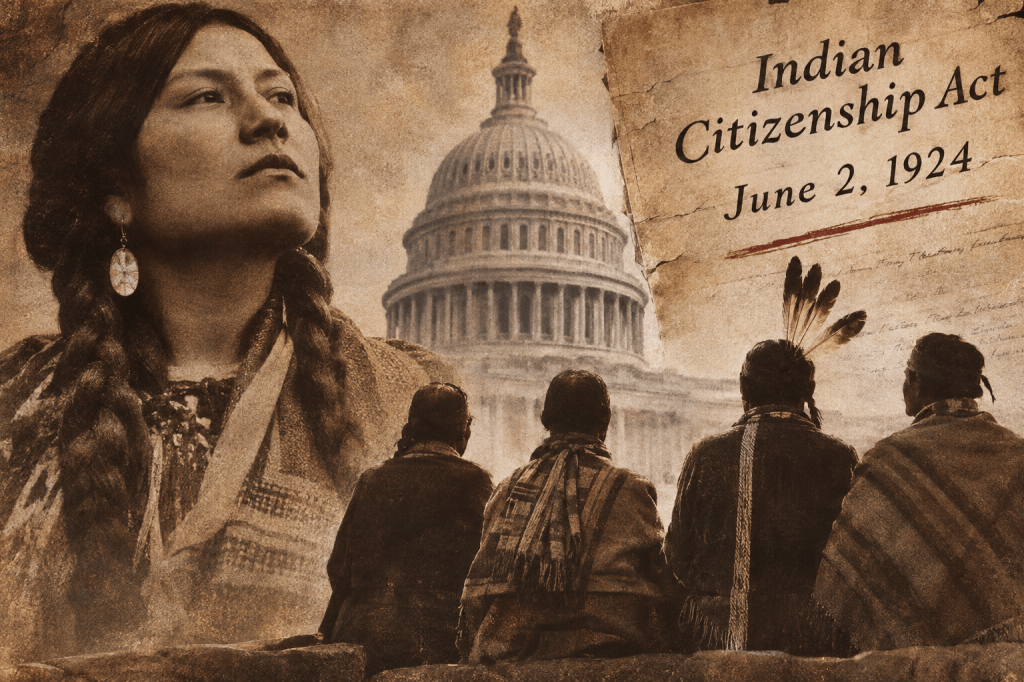
On June 2, 1924, the United States Congress passed the Indian Citizenship Act, extending American citizenship to Native Americans who had not previously been recognized as citizens.
Now, sit with that for a moment.
The United States, a country established upon lands that Indigenous peoples had inhabited, governed, cultivated, and defended for countless generations, decided to recognize those people as citizens.
Of the country built upon their ancestral homelands.
The sheer audacity of that arrangement is difficult for me to get past.
But as I began digging into the history, something became clear. My indignation, however justified I might believe it to be, wasn’t nearly as important as what Indigenous people themselves had to say.
And they had plenty to say.
Some advocated for American citizenship, recognizing the political power and legal protections it could provide. Others opposed it, arguing that Congress had no authority to impose citizenship upon members of sovereign nations.
Still others found themselves legally recognized as American citizens while state governments continued denying them the right to vote.
Their positions weren’t identical, and they shouldn’t be made to appear that way.
So today, rather than simply discussing what the United States decided to do about Indigenous citizenship, we’re going to listen to some of the people whose lives and nations were affected by those decisions.
Because this history belongs to them.
What We Were Taught
The familiar version of this story is straightforward.
In 1924, President Calvin Coolidge signed the Indian Citizenship Act into law, granting American citizenship to Native Americans.
Another milestone in the expansion of American democracy.
Another step toward equality.
And, certainly, the legislation mattered.
But the familiar telling leaves out some rather important details.
By 1924, approximately 175,000 Native Americans already possessed U.S. citizenship through various treaties, laws, marriages, military service provisions, or land-allotment policies.
Roughly 125,000 remained without it.
And citizenship wasn’t universally understood as a benefit.
For some Indigenous people, it meant access to a political system whose decisions profoundly affected their communities.
For others, it raised an entirely different question.
What happens when one government declares the citizens of another nation to be its own, without asking their permission?
To understand that question, we need to go back much further than 1924.
They Were Nations Before There Was a United States
Long before European colonization, North America was home to hundreds of distinct Indigenous nations.
Not one people. Not one government. Not one culture.
Nations.
They had political systems, laws, trade networks, diplomatic relationships, languages, spiritual traditions, and territories.
The Haudenosaunee Confederacy maintained sophisticated political and diplomatic institutions. Cherokee communities developed systems of government and law. Pueblo peoples sustained communities with enduring traditions of leadership and land stewardship.
Across the continent, Indigenous nations governed themselves according to their own histories and circumstances.
They weren’t waiting for European settlers to introduce the concept of government.
And when European powers arrived, they negotiated with Indigenous nations as political entities capable of making agreements and entering treaties.
The United States continued that practice.
Treaties were negotiated. Boundaries were established. Promises were made.
Many of those promises were subsequently broken.
Through warfare, forced removal, coercive agreements, settlement, and federal legislation, Indigenous nations lost enormous portions of their homelands.
But dispossession did not erase their identities or their political existence.
That distinction matters.
Because citizenship in an Indigenous nation and citizenship in the United States are not the same thing.
And the United States did not create Indigenous sovereignty by recognizing it.
The Constitution and the People It Excluded
In 1868, the Fourteenth Amendment established that people born or naturalized in the United States, and subject to its jurisdiction, were American citizens.
The amendment was enormously significant following the Civil War and the abolition of slavery.
But federal interpretations excluded many Indigenous people born into tribal nations.
The reasoning rested upon their distinct political relationship with the United States.
In 1884, that question reached the Supreme Court.
John Elk, an Indigenous man born into a tribal community, had moved to Omaha, Nebraska, and sought to register to vote.
He was denied.
Elk argued that his birth within United States territory entitled him to citizenship under the Fourteenth Amendment.
The Supreme Court disagreed.
In Elk v. Wilkins, the majority ruled that birth within U.S. territory did not automatically confer citizenship upon someone born into a tribal nation outside the jurisdiction contemplated by the amendment.
Simply leaving his tribal community and living among white Americans did not establish citizenship.
Here was a man attempting to participate in the political system governing the place where he lived, only to be told that he did not qualify as a citizen.
The federal government recognized Indigenous nations as politically distinct when doing so supported the exclusion of their members from citizenship.
Yet it simultaneously asserted extraordinary authority over Indigenous lands, governments, and daily lives.
That contradiction would become increasingly difficult to ignore.
Citizenship and the Price of Assimilation
Three years later, Congress passed the Dawes Act of 1887.
The law authorized the division of certain tribal reservation lands into individual allotments.
Land that had been held collectively could be divided among individual Native Americans and families. Land deemed surplus after allotment could be opened to non-Native settlement.
Federal officials promoted the policy as a means of encouraging individual property ownership, agriculture, and assimilation into American society.
Citizenship was part of that framework.
Under the original act, qualifying recipients of allotments and certain other Native Americans who adopted what lawmakers called the habits of civilized life could be declared citizens.
Consider what that language reveals.
Indigenous cultures and political systems were measured against white American expectations, and conformity was treated as progress.
The consequences were devastating.
The allotment system fractured communal landholdings and facilitated the transfer of millions of acres out of Indigenous ownership.
Different nations faced different laws and circumstances, but the larger federal objective was unmistakable.
Indigenous societies were expected to change.
Their landholding systems were to be reorganized.
Their political and cultural identities were to become less distinct.
And citizenship was sometimes offered as part of that process.
The boarding-school system pursued similar assimilationist objectives through the lives of Indigenous children.
Children were separated from their families, sometimes by force or coercion, and sent to institutions where many were punished for speaking their languages or practicing their traditions.
We explored that history in an earlier Grove essay, and it deserves far more attention than we can give it here.
But its relationship to citizenship matters.
The same federal government that sought to suppress Indigenous identities was also deciding when Indigenous people could be recognized as American citizens.
Yet Indigenous people themselves did not universally accept the premise that citizenship required surrendering who they were.
One woman made that argument particularly powerfully.
Zitkála-Šá: Demanding a Political Voice
Zitkála-Šá, also known as Gertrude Simmons Bonnin, was a Yankton Dakota writer, musician, educator, and political activist.
She knew the consequences of assimilation policies firsthand.
As a child, she attended a boarding school, and her later writing described the pain of separation from family, language, and cultural identity.
She became an outspoken critic of federal assimilation practices.
But she also believed Indigenous people should have American citizenship and voting rights.
She understood that the United States government exercised enormous power over Indigenous communities.
And she wanted Indigenous people to have a voice in that government.
In advocating for enfranchisement, she wrote of the Native American:
“In the land that was once his own – America…”
The words are striking.
Not because she was asking the United States to establish Indigenous belonging, but because she was reminding Americans whose homeland they were discussing.
She argued that Indigenous people should have the opportunity to participate in the political decisions affecting their lives.
Her position was not an abandonment of Indigenous identity.
It was an insistence that Indigenous identity and political participation in the United States need not be mutually exclusive.
She worked with the Society of American Indians, advocated for reforms, and challenged federal policies that harmed Native communities.
In 1924, she organized voter-registration efforts among Native Americans who were eligible to vote.
Two years later, she and her husband helped establish the National Council of American Indians.
Her advocacy continued until her death in 1938.
Zitkála-Šá did not regard American citizenship as a substitute for Indigenous identity.
She saw political participation as one means of defending Indigenous interests.
But not every Indigenous leader agreed that American citizenship was desirable.
And some rejected the very idea that Congress could impose it.
The Onondaga Nation: We Did Not Consent
The Onondaga Nation is one of the nations of the Haudenosaunee Confederacy.
Its relationship with the United States includes treaties negotiated between political communities, including the 1794 Treaty of Canandaigua.
Those treaties are central to the Onondaga understanding of its sovereignty.
And when Congress considered the Indian Citizenship Act, Haudenosaunee opposition was already known.
According to the Onondaga Nation’s published historical account, Representative Homer P. Snyder, the bill’s sponsor, acknowledged that Native people in New York opposed the measure.
He nevertheless expressed his willingness to proceed.
The original proposal had contemplated citizenship for those who applied.
Congress ultimately enacted a blanket declaration of citizenship for those not already recognized as citizens.
That distinction is significant.
Application involves a choice.
Imposition does not.
On December 30, 1924, the Onondaga Council of Chiefs sent President Calvin Coolidge a formal protest.
They called the Snyder Bill:
“a destructive and an injurious weapon”
They argued that the law threatened their treaty relationship and the political rights they understood those treaties to protect.
And they made their position unmistakable:
“We, the Indians have not as yet tired of the free use and enjoyment of our rights as Indians living on reservations.”
The council called for the legislation’s abandonment and repeal.
Those weren’t the words of people who failed to understand the supposed benefits of American citizenship.
They were the words of leaders defending a political relationship they believed the United States had an obligation to respect.
The Onondaga Council was not asking whether Congress would kindly permit its people to belong.
It was challenging Congress’s authority to redefine their citizenship without consent.
In 1925, Chief Jesse Lyons traveled to Washington with wampum belts to reinforce the nation’s position.
In Haudenosaunee diplomacy, wampum belts preserve and communicate important agreements and relationships.
Their presence was a reminder of treaties and obligations that predated the citizenship legislation.
The Onondaga Nation has continued to reject the claim that the United States can unilaterally impose citizenship upon its people.
In a 2018 statement published by the Nation, its general counsel, Joseph Heath, wrote that the Haudenosaunee had never accepted federal authority to transform their nations’ citizens into U.S. citizens.
This is not simply an old disagreement preserved in an archive.
It is part of an ongoing assertion of sovereignty.
And it requires us to reconsider the familiar story.
If some Indigenous people actively sought American citizenship while others explicitly rejected it, how can we describe the 1924 act as an uncomplicated gift?
Whose understanding of citizenship are we using?
And whose consent mattered?
The Law Passed Anyway
On June 2, 1924, President Calvin Coolidge signed the Indian Citizenship Act.
The legislation was remarkably brief.
It declared that all noncitizen Native Americans born within the territorial limits of the United States were citizens.
It also specified that the law would not impair their rights to tribal or other property.
That provision mattered because Indigenous leaders had legitimate concerns about the relationship between citizenship, property, and tribal rights.
But it did not resolve every question about sovereignty or consent.
Nor did it guarantee access to the ballot.
The Onondaga Nation’s historical account preserves another revealing exchange from the congressional debate.
When asked whether the bill would allow Native Americans to vote, Snyder replied:
“It is not the intention of this law to have any effect upon suffrage qualifications in any State.”
Read that again.
Congress was declaring people American citizens while acknowledging that the law would not necessarily change their ability to vote.
The distinction was not accidental or discovered years later.
It was discussed before the legislation passed.
And Indigenous citizens would spend decades challenging the consequences.
Those Who Served, and Those Who Couldn’t Vote
Long before the Indian Citizenship Act, Indigenous men had served in the United States military, including during World War I.
For some, military service was an expression of duty, patriotism, or a commitment to defend their homelands and communities. Motivations varied, just as Indigenous perspectives on citizenship varied.
But service did not guarantee equal treatment.
Joe High Elk, a Cheyenne River Sioux veteran, reflected upon his military experience in a questionnaire collected around 1919–1920.
He wrote:
“I am an Indian and never had any Experience in a war before, but I realize that I was doing my duty as a patriot”
He went on to express his hope that Indigenous people might someday enjoy the freedom they had been denied.
That testimony deserves a moment of consideration.
A man who had served in war was asking for freedom.
Not special treatment.
Not a privilege unavailable to others.
Freedom.
And two decades later, Indigenous servicemen were still confronting the same contradiction.
In 1943, Private Ralph Anderson wrote on behalf of Navajo soldiers seeking the right to vote.
His question was painfully direct:
“we do not understand what kind of citizenship you would call that.”
He was referring to the fact that Congress had granted citizenship in 1924, yet Indigenous people in his community still lacked access to the ballot.
It is difficult to imagine a more concise explanation of the problem.
A person could serve the United States, be recognized as an American citizen, and still be denied a voice in choosing its government.
Anderson’s words were not merely a complaint.
They were a demand that the country reconcile its promises with its practices.
Citizens Without a Vote
In 1928, just four years after the Indian Citizenship Act, the Arizona Supreme Court ruled in Porter v. Hall that Native Americans living on reservations could be excluded from voting under the state’s constitutional guardianship provision.
Federal supervision of certain Indigenous affairs became the basis for denying political participation.
The same government relationship used to regulate Indigenous lives could be invoked to restrict the rights of those now recognized as citizens.
For twenty years, that interpretation remained in place.
Then two Indigenous men challenged it.
Frank Harrison and Harry Austin, identified in the court’s decision as members of the Mohave-Apache Indian Tribe residing on the Fort McDowell Reservation, attempted to register to vote.
They were refused.
Rather than accept the exclusion, they took their case to court.
In July 1948, the Arizona Supreme Court reversed its earlier interpretation in Harrison v. Laveen.
The court concluded that Native Americans could not be excluded from voting simply because of the federal government’s relationship with their communities.
It was a significant victory.
The following month, another Indigenous veteran won a voting-rights challenge in New Mexico.
Miguel Trujillo, a member of Isleta Pueblo who had served in World War II, challenged the state’s exclusion of Indigenous people who were not taxed.
In Trujillo v. Garley, a federal court ruled against that restriction.
But neither victory ended every barrier to Indigenous voting.
Other states maintained exclusions, and discriminatory practices continued.
Literacy tests, administrative obstacles, and unequal access to registration and polling places could still interfere with political participation.
The Voting Rights Act of 1965 provided important federal protections against racial discrimination in voting, but the struggle did not end there.
The chronology tells its own story.
In 1924, Congress declared Native Americans citizens.
In 1928, Arizona upheld an interpretation denying many of them the vote.
In 1943, Indigenous soldiers were still demanding the right to participate in the democracy they served.
In 1948, Indigenous plaintiffs successfully challenged voting exclusions in Arizona and New Mexico.
And even afterward, additional barriers remained.
Citizenship was established by federal law.
Meaningful access to the rights associated with it required continued Indigenous advocacy, organization, and litigation.
That distinction deserves to be remembered.
The Voices We Need to Hear
There is a temptation, when looking back on this history, to divide everyone neatly into categories.
Those who supported citizenship.
Those who opposed it.
Those who fought for voting rights.
Those who defended tribal sovereignty.
But Indigenous political positions were never that simple.
Zitkála-Šá wanted Native Americans to have political influence within the United States.
The Onondaga Council of Chiefs rejected citizenship imposed without consent.
Joe High Elk hoped military service might be followed by greater freedom.
Ralph Anderson questioned the meaning of citizenship without voting rights.
Frank Harrison, Harry Austin, and Miguel Trujillo challenged governments that denied Indigenous people the ballot.
Their circumstances, priorities, and arguments were different.
Yet all were asserting the ability of Indigenous people to speak and act for themselves.
And that may be the most important correction to the familiar history.
Native Americans were not passive figures waiting for Congress to decide their futures.
They negotiated treaties.
They organized political movements.
They wrote letters and published arguments.
They challenged legislation.
They served in the military.
They went to court.
They defended their nations, cultures, lands, and rights.
And they did not always agree with one another.
We should not expect them to.
Hundreds of distinct Indigenous nations, with different histories and political relationships, cannot be reduced to one opinion about American citizenship.
Respecting their history means allowing that complexity to remain.
Sovereignty Didn’t End in 1924
Today, many Native Americans are citizens of both the United States and their respective tribal nations.
Those relationships are distinct.
Tribal nations maintain governments, citizenship requirements, institutions, and political responsibilities.
Their sovereignty is not merely a historical tradition or a cultural identity.
It remains a living political and legal reality, although federal law has long imposed substantial limitations on its exercise.
And the Onondaga Nation’s continuing objection reminds us that not every Indigenous nation accepts the same understanding of dual citizenship.
That is precisely why we must be careful with our language.
The United States did not give Indigenous peoples their nations.
It did not give them their ancestors, their histories, their languages, or their homelands.
The Indian Citizenship Act established a particular legal relationship under United States law.
For some, that relationship was something they had actively sought.
For others, it represented an unwanted assertion of federal authority.
For many, the rights associated with citizenship remained difficult to exercise.
All of those truths belong in the story.
The Audacity of It All
I keep returning to the question that started this research.
How did we reach a point where the government of a country established upon Indigenous homelands could decide whether the descendants of the people who were here first qualified as its citizens?
Legally, governments define citizenship. That is part of how modern states operate.
But legality does not resolve every moral question.
And the history of the United States’ relationship with Indigenous nations makes this question particularly uncomfortable.
The federal government that extended citizenship in 1924 had also participated in forced removals, broken treaties, land dispossession, and assimilation policies.
It asserted extraordinary authority over Indigenous lives while frequently denying Indigenous communities meaningful control over decisions affecting them.
And after citizenship was extended, state governments continued denying many Indigenous citizens the vote.
I find the presumption of authority troubling.
I find the denial of rights that followed even more disturbing.
But the voices we’ve heard today remind me that my reaction is not the center of this history.
Their actions and arguments tell us far more than my indignation ever could.
Indigenous history is not simply a record of what the United States did.
It is also the history of people who continued governing, negotiating, resisting, advocating, and determining their own futures despite enormous obstacles.
Their sovereignty did not begin with American recognition.
Their identities did not depend upon congressional approval.
And their voices did not begin speaking in 1924.
What We Don’t Know
When I first encountered the Indian Citizenship Act, I saw a story about the audacity of a government deciding whether Indigenous peoples belonged in a country built upon their ancestral lands.
I still see that.
But now I also see something more complicated, and far more important.
I see a Yankton Dakota woman insisting that Indigenous people deserved political representation in the government exercising power over their lives.
And Onondaga leaders reminding the President of treaties and rejecting citizenship imposed without their consent.
I see Indigenous veterans asking why service and citizenship had not brought equal rights.
I see Indigenous men challenging state laws that denied them the ballot.
And I see nations continuing to assert their sovereignty long after Congress declared the citizenship question settled.
We often tell history as though progress arrives when a government passes a law.
Sometimes a law matters enormously.
But a law is not the entire story.
The people who fought for it, opposed it, challenged its limitations, or defended their rights despite it deserve to be heard.
So the next time we encounter the statement that America granted citizenship to Native Americans in 1924, perhaps we should ask a few more questions.
Citizenship in whose country?
On whose land?
Under whose authority?
And according to whose understanding of belonging?
Then perhaps we should do something that history lessons haven’t always encouraged us to do.
Listen to the people whose lives we’re discussing.
They have been telling us their stories all along.
Y’all come sit a spell.
Sources
1. Onondaga Nation — The Citizenship Act of 1924 (2018)
Joseph Heath, General Counsel of the Onondaga Nation. Includes the Council’s 1924 protest, the congressional debates, treaty history, and the Nation’s position on imposed citizenship.Read the Onondaga Nation’s account
2. National Archives — Indian Citizenship Act, June 2, 1924
Original legislation, including the citizenship declaration and the provision protecting tribal and other property rights.View the original act
3. U.S. Capitol Visitor Center — Granting Citizenship to American Indians
Historical background, the 1924 population estimates, and firsthand testimony from World War I veteran Joe High Elk.Read the Capitol’s historical account
4. National Park Service — Zitkála-Šá (Red Bird / Gertrude Simmons Bonnin)
Biography covering her boarding-school experience, writing, political activism, and advocacy for Indigenous citizenship and voting rights.Read the Zitkála-Šá biography
5. U.S. Supreme Court — Elk v. Wilkins, 112 U.S. 94 (1884)
Original Supreme Court decision addressing Indigenous citizenship under the Fourteenth Amendment.Read the Supreme Court decision
6. Arizona Supreme Court — Harrison v. Laveen, 67 Ariz. 337 (1948)
Court decision concerning Frank Harrison, Harry Austin, and the reversal of Arizona’s exclusion of reservation residents from voting.Read Harrison v. Laveen
7. National Archives — The War after the War: The American Indian Fight for the Vote after WWII (2019)
Archival research by Cody White documenting Private Ralph Anderson’s 1943 letter, the Arizona and New Mexico cases, and continued voting exclusions.Read the National Archives research
8. National Archives — Dawes Records
Background on the allotment system, the Dawes Commission, and the federal government’s role in determining tribal enrollment and dividing communal lands.Explore the Dawes records


Leave a Reply