
Y’all come on up, grab something to sip on, and sit a spell. We’ve got some history to talk about today.
And I have a feeling we’re going to need to refill our cups.
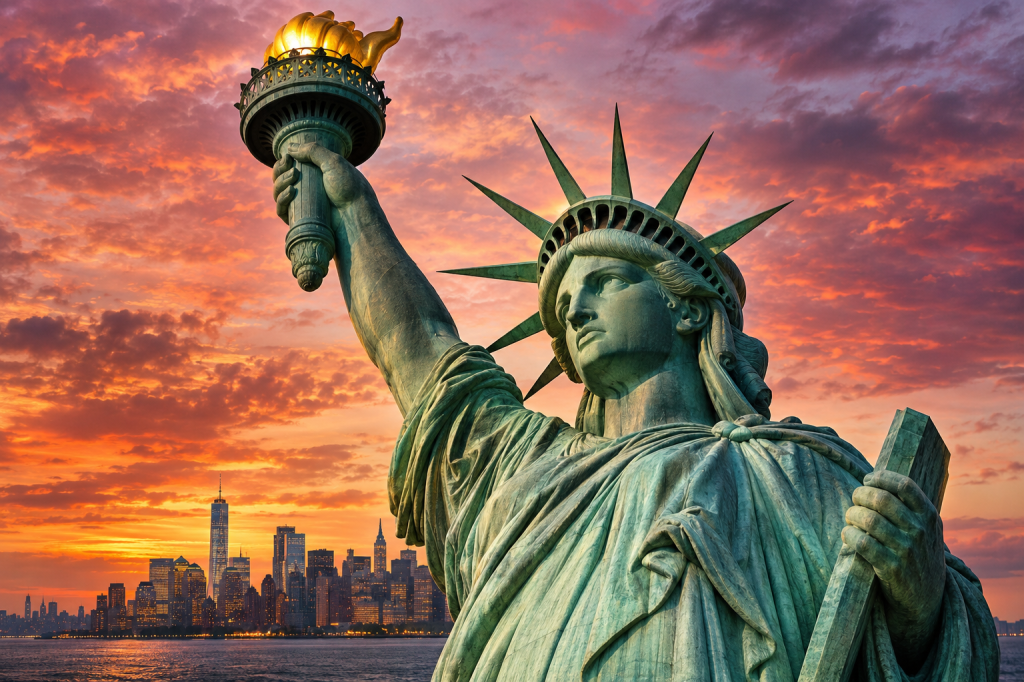
There’s a lady standing in New York Harbor who has been holding a torch above her head for 140 years.
She’s one of the most recognizable figures in the world. Her crown, her torch, her solemn expression. We know her before we ever learn her name.
Lady Liberty.
For generations, she has represented freedom, opportunity, hope, and the promise of a better life.
She’s appeared in photographs, textbooks, movies, political cartoons, and countless family stories. For immigrants arriving by ship, she was often among the first sights of their new country.
And in 2026, we marked the 140th anniversary of her dedication.
But I’ve been thinking about something.
What was she supposed to represent when she was created?
What did she come to represent?
And how closely has America lived up to either promise?
Because, as it turns out, people were questioning that last part before the dedication ceremony was even over.
A Woman Named Liberty, in a Country Where Women Couldn’t Vote
On October 28, 1886, New York Harbor was filled with celebration.
President Grover Cleveland presided over the dedication of an enormous copper statue gifted by the people of France.
There were speeches, flags, music, and a parade. It was a grand occasion, celebrating liberty and the friendship between two republics.
But not everyone was celebrating.
Members of the New York State Woman Suffrage Association were protesting.
Women were largely excluded from the official ceremonies on Bedloe’s Island, despite the fact that the monument being unveiled was a woman representing freedom.
The suffragists chartered their own boat to join the harbor festivities.
Their president, Lillie Devereux Blake, described the celebration as “a gigantic lie.”
She pointed out the contradiction of erecting a female figure representing liberty in a country where women had no equal political liberty.
Well.
That’s one way to introduce yourself to the festivities.
But she had a point.
The United States was celebrating liberty in the form of a woman while denying women the right to participate equally in its democracy.
The Nineteenth Amendment, ratified in 1920, would prohibit denying voting rights on account of sex.
Thirty-four years after Lady Liberty raised her torch.
And even then, discriminatory laws and practices continued preventing many women of color from voting.
So from the very beginning, there was a difference between the freedom the statue represented and the freedom people actually experienced.
That wasn’t something historians discovered a century later.
People standing in New York Harbor knew it in 1886.
What Was She Supposed to Be?
The Statue of Liberty’s official name is Liberty Enlightening the World.
Her story began in France.
Édouard de Laboulaye was a French legal scholar, political thinker, and outspoken opponent of slavery. He admired the American republic and supported the Union during the Civil War.
He is traditionally credited with proposing a monument in 1865, following the Union victory and the abolition of slavery, to celebrate liberty and the relationship between France and the United States.
The idea eventually took shape through the work of sculptor Frédéric Auguste Bartholdi.
The statue would commemorate American independence, republican ideals, and freedom from oppression. Abolition was an important part of the political context in which the project emerged.
France would provide the statue, while Americans would raise the money for its pedestal.
And the finished monument would stand at the entrance to New York Harbor.
There is a detail about the statue that I suspect many of us have never noticed.
At Liberty’s feet lie a broken shackle and chain.
Part of the chain disappears beneath her robes, emerging again near her raised right foot.
It’s easy to miss from the ground.
But it was deliberately included.
Those broken restraints symbolize liberation from slavery and oppression.
The statue wasn’t originally conceived primarily as a welcoming figure for immigrants. That interpretation would become prominent later.
Her original symbolism was connected to American independence, republican government, abolition, and the broader ideal of liberty.
Which makes the timing rather remarkable.
Because while the monument was being conceived, constructed, and celebrated, the United States was already retreating from many of the promises of emancipation.
Freedom, With Conditions
The Thirteenth Amendment abolished slavery in 1865, except as punishment for a crime.
The Fourteenth Amendment established birthright citizenship and equal protection under the law.
The Fifteenth Amendment prohibited denying voting rights on account of race, color, or previous condition of servitude.
These were extraordinary constitutional changes.
They transformed the legal foundations of the country.
During Reconstruction, formerly enslaved people established schools, built communities, organized politically, and held public office.
There was real progress.
But there was also fierce resistance.
White supremacist violence, political intimidation, and discriminatory laws undermined Black political participation and civil rights.
Federal Reconstruction ended in 1877, nine years before the statue’s dedication.
Across the South, segregation and disenfranchisement would become increasingly entrenched.
So when Lady Liberty was unveiled in 1886, the broken chain at her feet celebrated a freedom that had been won at enormous cost.
Yet the struggle to make that freedom meaningful was far from over.
Black Americans understood the contradiction.
Historical research by the National Park Service documents how the Black press challenged romantic portrayals of the statue and the country’s claims about universal freedom.
For people confronting discrimination, racial violence, and political exclusion, the monument could be a painful reminder of promises left unfulfilled.
I find myself wondering how different that dedication ceremony must have looked depending upon where you stood in American society.
For some, it was a celebration of what the country had achieved.
For others, it was a reminder of what remained denied.
And both groups were looking at the same statue.
The Mother of Exiles
Now, here’s something I didn’t fully appreciate before researching this essay.
The words most closely associated with the Statue of Liberty weren’t part of the original design.
They came from a poet.
Emma Lazarus was a Jewish American writer born in New York City in 1849.
She became deeply concerned about the plight of Jewish refugees fleeing persecution in Eastern Europe.
She worked with immigrants and refugees and advocated for their welfare.
In 1883, she was asked to contribute a poem to an auction raising money for the statue’s pedestal.
At first, she was reluctant.
But she eventually wrote a sonnet called The New Colossus.
Rather than imagining Liberty as a triumphant figure celebrating national achievement, Lazarus gave her a different identity.
She called her the Mother of Exiles.
And she imagined the statue speaking to the world:
“Give me your tired, your poor,
Your huddled masses yearning to breathe free”
Those words would change the way generations of people understood the monument.
Lazarus wasn’t describing an America that had already welcomed everyone.
She was expressing a vision of what America could be.
A refuge.
A place where people fleeing persecution, poverty, and oppression might begin again.
But there is another important detail.
Her poem was not prominently displayed at the statue’s dedication in 1886.
Lazarus died the following year.
It wasn’t until 1903 that a plaque bearing her poem was installed inside the pedestal.
By then, the statue’s meaning was already evolving.
Ellis Island had opened in 1892, and millions of immigrants would pass through its facilities.
They saw the enormous figure standing above the water.
They saw her torch.
And many gave her a meaning that was deeply personal.
Welcome.
Hope.
A new beginning.
For countless families, that promise became reality.
They found safety, established homes, built businesses, and created new lives.
Their descendants became part of the extraordinary cultural fabric of the United States.
We shouldn’t minimize those experiences.
But we also shouldn’t mistake the promise of welcome for a guarantee that everyone was welcome.
Because while Emma Lazarus was writing about the Mother of Exiles, Congress was writing something very different into American law.
The Golden Door Wasn’t Open to Everyone
In 1882, one year before Lazarus wrote The New Colossus, Congress passed the Chinese Exclusion Act.
The law prohibited the immigration of Chinese laborers for ten years and imposed significant restrictions on Chinese immigrants. It also reinforced barriers to naturalization.
The law was later extended and strengthened.
Think about that juxtaposition.
In 1883, a poet was imagining America as a refuge for the world’s displaced and desperate.
At the same time, the United States was enforcing a federal law excluding people on the basis of nationality and ethnicity.
Chinese immigrants had helped build American railroads, worked in mines, established businesses, and contributed to communities across the country.
Yet they faced organized hostility, discriminatory laws, and violence.
The Chinese Exclusion Act was not repealed until 1943, and even then, restrictive immigration quotas remained.
And Chinese exclusion was only one chapter in a much larger history.
In 1924, Congress passed the Immigration Act commonly known as the Johnson-Reed Act.
It established national-origins quotas designed to sharply limit immigration, particularly from Southern and Eastern Europe.
It also barred immigration by many people from Asia who were ineligible for naturalization.
The system favored certain national origins over others.
And it remained a defining feature of American immigration law for decades.
So there stood Lady Liberty, holding her torch beside the harbor.
Her pedestal carried the words of a Jewish American woman who had imagined refuge for the persecuted.
And the government of the country she represented was deciding which nationalities were desirable enough to enter.
The contradiction is difficult to overlook.
But the promise was never meaningless simply because the country failed to honor it consistently.
For countless immigrants, America genuinely did provide refuge and opportunity.
For others, the door was closed.
For still others, entry was possible, but acceptance and equality remained elusive.
The statue represented an aspiration.
The law determined who could approach it.
And those two things were not always in agreement.
Whose Liberty?
There is another question we need to consider.
When we speak about American liberty, whose experience are we describing?
For Indigenous nations, the United States’ expansion often meant the loss of ancestral homelands, forced removal, broken treaties, and restrictions on self-government.
While the Statue of Liberty celebrated freedom, federal policies continued attempting to assimilate Indigenous peoples and transform their relationships with their lands and nations.
In 1887, only a year after the statue’s dedication, Congress passed the Dawes Act.
As we discussed in our essay about the Indian Citizenship Act of 1924, the allotment system helped transfer enormous amounts of Indigenous land out of tribal ownership.
That is another uncomfortable juxtaposition.
A nation celebrating liberty was simultaneously imposing policies that limited the freedom and sovereignty of peoples whose nations existed long before the United States.
And the contradictions extended beyond race and nationality.
Women were fighting for the vote.
Workers were organizing for safer conditions and fairer treatment.
People with disabilities faced exclusion and institutionalization.
Religious and ethnic minorities encountered discrimination.
The ideals represented by Liberty’s torch were broad.
The rights and opportunities available to people living beneath that torch were not.
But there is something else we should notice.
People didn’t simply accept those limitations.
They organized.
They protested.
They challenged laws.
They went to court.
They wrote, marched, taught, and demanded change.
And again and again, they invoked the very principles America claimed to represent.
When Citizenship Wasn’t Enough
And then came World War II.
Following Japan’s attack on Pearl Harbor in December 1941, fear and suspicion spread across the United States.
But for Japanese Americans, that fear became something much more than suspicion.
It became government policy.
On February 19, 1942, President Franklin D. Roosevelt signed Executive Order 9066, authorizing military commanders to designate areas from which people could be excluded.
The order did not specifically name Japanese Americans. But it became the basis for the mass removal and incarceration of people of Japanese ancestry, primarily from the West Coast.
More than 120,000 people were uprooted and confined.
Approximately two-thirds were American citizens.
Let that sink in for a moment.
These weren’t simply people seeking admission to the United States.
They were Americans.
They had homes, businesses, jobs, neighbors, and communities.
Children attended American schools.
Parents paid American taxes.
Families had built their lives here.
And suddenly, their ancestry was treated as grounds for removing them from those lives.
Families received orders to leave their homes, often with very little time to prepare.
They could take only what they could carry.
Homes and businesses were sold under pressure, abandoned, or entrusted to others. Property and livelihoods were lost.
People were initially confined in temporary assembly centers, some located at fairgrounds and racetracks, before being transferred to more permanent camps.
Families lived in crowded barracks.
Privacy was scarce.
Armed guards and fences marked the boundaries of their confinement.
And they were subjected to this treatment without individual trials establishing that they had committed crimes.
The government justified the mass exclusion as a wartime security measure.
But decades later, a federal commission concluded that the policy had not been justified by military necessity. It identified racial prejudice, wartime hysteria, and failures of political leadership as the principal causes.
And there was another contradiction.
Japanese American men served in the United States military during World War II, including in the highly decorated 442nd Regimental Combat Team.
Some fought for a country that had confined their families.
Think about what that means.
While the United States was fighting overseas against governments that denied fundamental freedoms, it was denying freedom to many of its own citizens at home.
And Lady Liberty was still standing in New York Harbor.
Her broken chains still represented liberation from oppression.
Her torch still represented freedom.
But for more than 120,000 people of Japanese ancestry, those ideals offered little protection.
The story didn’t end when the camps closed.
Survivors returned to communities where they sometimes encountered hostility and discrimination. Many had lost property, income, educational opportunities, and years of their lives.
It took decades of organizing, testimony, and advocacy before the federal government formally acknowledged the injustice.
In 1988, President Ronald Reagan signed the Civil Liberties Act, providing an official apology and monetary reparations to eligible survivors.
That acknowledgment mattered.
It recognized that the government had violated the civil liberties of people it was obligated to protect.
But an apology could not return the years spent behind fences.
It could not restore every lost business, every family home, or every opportunity that had disappeared.
And it could not erase the fear of discovering that citizenship itself might not be enough to protect you from your own government.
What does liberty mean if citizenship itself cannot protect you from losing it?
And what responsibility do we have to recognize when fear is being used to justify taking freedom away?
The Promise Was Worth Fighting For
I don’t want this essay to become a list of everything America has done wrong.
Not because those things should be ignored.
Quite the opposite.
We need to understand them if we’re going to understand the distance between the country’s ideals and its actions.
But we also need to recognize the people who worked to close that distance.
The abolitionists who fought slavery.
The formerly enslaved people who built institutions and demanded full citizenship.
The suffragists who challenged political exclusion.
The Indigenous advocates who defended sovereignty and voting rights.
The immigrants who organized against discrimination.
The Japanese Americans who challenged their incarceration and later fought for acknowledgment and redress.
The civil rights activists who confronted segregation and unequal treatment.
Their work mattered.
The Nineteenth Amendment mattered.
The civil rights legislation of the twentieth century mattered.
The Immigration and Nationality Act of 1965, which dismantled the national-origins quota system, mattered.
The Civil Liberties Act of 1988 mattered.
These changes didn’t solve every problem.
But they changed lives.
They expanded opportunities.
They moved the country closer to some of the ideals represented by that enormous copper figure in the harbor.
And many of those changes happened because people refused to accept that the promises of liberty were reserved for someone else.
That is worth celebrating.
It is also worth remembering that progress is not automatic.
Rights can be expanded, restricted, defended, or challenged.
Laws can change.
Public attitudes can change.
The distance between what a country promises and what it delivers can narrow.
Or widen.
Which means the story of liberty is not finished.
Liberty Doesn’t End at the Detention Center Door
And that brings us to the present.
One hundred and forty years after the Statue of Liberty’s dedication, we’re still confronting questions about who deserves protection, what limits should exist on government authority, and how people should be treated when their freedom is taken away.
Today, those questions are particularly visible in immigration enforcement.
Immigration and Customs Enforcement, commonly known as ICE, is a federal agency responsible for enforcing immigration laws, including the arrest, detention, and removal of certain noncitizens.
A country has the authority to establish and enforce immigration laws.
But the existence of that authority doesn’t answer every question about how it should be exercised.
And that’s where I find myself returning to Lady Liberty.
Because my concern isn’t simply whether immigration laws exist.
It’s what happens to human beings when those laws are enforced.
What happens during an arrest?
What happens when someone is separated from family members?
What happens when someone is placed in detention?
Are people treated with dignity?
Are their medical needs addressed?
Can they communicate with their families and legal representatives?
Are they protected from unnecessary force, abuse, and degrading treatment?
And when something goes wrong, who is held accountable?
These aren’t abstract questions.
They are questions raised by investigations, court cases, oversight reports, and the accounts of people who have experienced immigration detention.
In July 2026, Human Rights Watch and the American Civil Liberties Union published an investigation of conditions at Camp East Montana, a large immigration detention facility at Fort Bliss in Texas.
The organizations reported allegations of physical abuse, inadequate medical treatment, obstacles to legal representation, and other serious mistreatment.
Those accounts warrant careful investigation and accountability. They should not be treated as established facts about every detention facility or every officer.
But neither should they be dismissed simply because the people making them are in immigration custody.
In November 2026, the U.S. Government Accountability Office issued a report examining changes in immigration detention oversight.
It found that the detained population and number of facilities had increased while some inspection programs had been reduced, changed, or discontinued.
The GAO also raised concerns about whether ICE had adequately assessed how those changes affected its ability to identify problems.
This matters because oversight is one of the mechanisms intended to protect people who cannot simply leave.
Medical care, food, access to legal services, and the ability to report mistreatment are not luxuries.
They are essential responsibilities when the government holds people in custody.
And ICE’s own detention standards recognize an obligation to provide humane treatment.
There is another distinction worth understanding.
Immigration detention is generally a civil administrative process, not a criminal sentence.
Some people in immigration custody have criminal convictions. Others do not. Some are seeking asylum or contesting removal. Their legal circumstances vary considerably.
But regardless of those circumstances, being detained does not mean a person has forfeited the right to humane treatment.
The government can exercise its legal authority without treating people as though their humanity is negotiable.
And I think we need to be willing to examine the conduct of officers and agencies, not merely the legal status of the people they arrest.
Were proper procedures followed?
Was the use of force justified?
Were people given the protections required by law?
Were complaints investigated?
Was anyone held responsible when standards were violated?
These questions should matter regardless of which political party controls the government.
Because the principles involved are larger than any administration.
And because the way a nation exercises power over vulnerable people tells us something about how seriously it takes its own ideals.
The Statue of Liberty doesn’t promise that no one will ever be arrested.
She doesn’t establish immigration policy or determine who qualifies for admission.
But she does represent a country that claims liberty, dignity, and freedom as fundamental values.
Surely those values should inform how we treat people, especially when they are powerless in the face of government authority.
The measure of a nation’s commitment to liberty isn’t how it treats people who have power. It’s how it treats people who are powerless in the face of its authority.
I don’t think we have to abandon the rule of law to insist upon humane treatment.
I think humane treatment should be part of what the rule of law means.
And I think Lady Liberty’s torch gives us a very good reason to keep asking whether we’re meeting that standard.
A Torch, Not a Trophy
I’ve been thinking about the symbolism of that torch.
The statue’s official name is Liberty Enlightening the World.
Not Liberty Has Finished Her Work.
Not Liberty Has Achieved Perfection.
Enlightening.
There’s movement in that word.
An ongoing responsibility to bring light where it is needed.
And perhaps that’s a useful way to understand the statue today.
Not as proof that America has fulfilled every promise.
Not as evidence that the country’s ideals are meaningless because it has failed to meet them.
But as a visible reminder of what those ideals require.
The broken chains at her feet remind us that freedom has been fought for and won.
The tablet in her hand bears the date of American independence.
Her torch represents enlightenment and liberty.
And Emma Lazarus’s words invite us to consider what it means to welcome those who need refuge.
Together, those symbols ask something of us.
Are we willing to examine the contradictions in our history?
Are we willing to acknowledge whose freedoms were restricted while others celebrated?
Are we willing to recognize progress without pretending the work is complete?
And are we willing to extend to others the rights and opportunities we value for ourselves?
Those are not questions the statue can answer.
They’re questions for the people who stand beneath her.
One Hundred and Forty Years Later
On October 28, 2026, the Statue of Liberty marked 140 years since her dedication.
One hundred and forty years.
Imagine what she has witnessed.
Ships carrying immigrants from around the world.
Two world wars.
The Great Depression.
The civil rights movement.
Changes in immigration law.
Generations of families arriving, settling, struggling, and building lives.
She has watched the country grow and change.
She has stood through extraordinary achievements and terrible failures.
And through it all, the torch has remained raised.
I think that’s why the statue still matters.
Not because America has always lived up to the ideals she represents.
It hasn’t.
Not because those ideals are hopelessly out of reach.
They aren’t.
But because she reminds us of a promise that is larger than any single generation.
The promise that liberty matters.
That freedom matters.
That human dignity matters.
That people should not have to surrender their humanity to be treated as worthy of respect.
And that a country claiming those principles has a responsibility to make them meaningful.
I don’t expect perfection.
I do expect us to keep trying.
Because every generation inherits both the progress made before it and the work left unfinished.
And this generation is no exception.
What We Don’t Know
When I began researching the Statue of Liberty, I thought I knew her story.
A gift from France.
A symbol of freedom.
A welcome to immigrants.
A torch raised above New York Harbor.
And all of those things are true.
But they’re not the whole story.
I didn’t fully appreciate how closely her origins were connected to abolition.
I hadn’t given much thought to the broken chains at her feet.
I hadn’t considered that women protested her dedication because they were excluded from the very political liberty she represented.
Or that Emma Lazarus’s words became central to the statue’s meaning years after her death.
Or how sharply those words contrasted with immigration laws already being enacted.
And when we follow the history forward, we find still more questions.
How could a nation celebrating liberty incarcerate tens of thousands of its own citizens because of their ancestry?
How do we reconcile the promise of human dignity with documented failures in the treatment of people held in government custody?
How do we recognize the progress we’ve made without allowing that progress to become an excuse for ignoring what remains unfinished?
The more I learned, the more I realized that the statue’s history isn’t simply about a monument.
It’s about the ongoing argument over what liberty means and who gets to enjoy it.
And maybe that’s why she has endured.
Because the promise is still worth pursuing.
Because progress is possible.
And because we aren’t finished.
Lady Liberty has been holding that torch for 140 years.
Imma hold your hand when I say this…
We got work to do.
It’s about time we helped her carry it.
Y’all come sit a spell.
Research and Further Reading
- National Park Service — Statue of Liberty Facts. The statue’s origins, Édouard de Laboulaye, the abolition of slavery, broken shackles, and Emma Lazarus’s poem.
- National Park Service — Black Statue of Liberty: Summary Report. Historical research into the statue’s original symbolism and its later association with immigration.
- National Archives — Executive Order 9066. The wartime order leading to Japanese American incarceration and the subsequent Civil Liberties Act of 1988.
- National Archives — Japanese American Incarceration: Justice Denied. Historical documentation and the findings of the Commission on Wartime Relocation and Internment of Civilians.
- U.S. Government Accountability Office — Immigration Detention: Changes in Inspections of ICE Facilities Raise Questions About Oversight. November 5, 2026 report examining detention facility inspections and federal oversight.
- Human Rights Watch and Physicians for Human Rights — Dying in Detention. June 25, 2026 research on deaths in immigration custody, medical care, and oversight.


Leave a Reply