
Hey y’all, come on up. Grab yourself something to sip on and come sit a spell. We have some things to talk about.

You might want to bring the whole pot of coffee for this one.
We’re going to talk about the Civil War. More specifically, we’re going to talk about what caused it, what I remember being taught about it, and what happens when you start reading the words of the people who actually established the Confederacy.
I grew up in South Carolina, where Civil War history isn’t exactly something you can avoid. It’s in the names of roads, the buildings, the family stories, and the things people say without necessarily stopping to think about what those words mean.
I remember being taught that slavery was one of the causes of the war, certainly, but that the bigger issue was states’ rights.
States’ rights. Southern independence. Northern aggression. A proud people defending their way of life.
And somewhere in my childhood, there was a little Southern girl enthusiastically hollering, “The South will rise again! YeeHaw!”
That little girl was me.
Lord have mercy.
I cringe thinking about it now.
But I don’t tell you that story to pretend I was an unusually terrible child. I tell you because children repeat things. They absorb the language, traditions, and assumptions of the world around them, often long before they understand what any of it means.
I knew I was supposed to be proud of my Southern heritage.
I didn’t necessarily understand what I was being asked to be proud of.
And that brings us to November’s recurring theme here at the Grove:
You don’t know what you don’t know.
Sometimes you don’t know because nobody told you. Sometimes because the story was simplified. Sometimes because the people telling it believed it themselves.
And sometimes because the complete story is a whole lot harder to live with.
So today, we’re going to get our hands dirty. We’ll look at the historical documents, examine some familiar explanations, and ask questions that may make us uncomfortable.
I’ll hold your hand if you need it.
But we’re going to look.
States’ Rights. All Right. Which Rights?
Let’s begin with the explanation I remember most clearly.
The Civil War was about states’ rights.
Now, there’s a reason that explanation has survived for so long. States’ rights really were part of the political arguments surrounding secession.
The relationship between state governments and the federal government had been contentious since the founding of the country. Americans disagreed about federal power, taxation, economic policy, and who should have the authority to make particular decisions.
Those arguments were real.
But saying that the Civil War was about states’ rights without explaining which rights is rather like saying two neighbors are fighting over property without mentioning that one of them claims to own the other one’s children.
It leaves out a fairly important detail.
So here’s the question we need to ask:
States’ rights to do what?
Fortunately, we don’t have to guess.
Several seceding states left us documents explaining their decisions.
And since I’m a South Carolina girl, let’s start at home.
South Carolina Told Us Why
On December 20, 1860, South Carolina became the first state to secede from the United States.
Four days later, its secession convention adopted a declaration explaining the reasons for that decision.
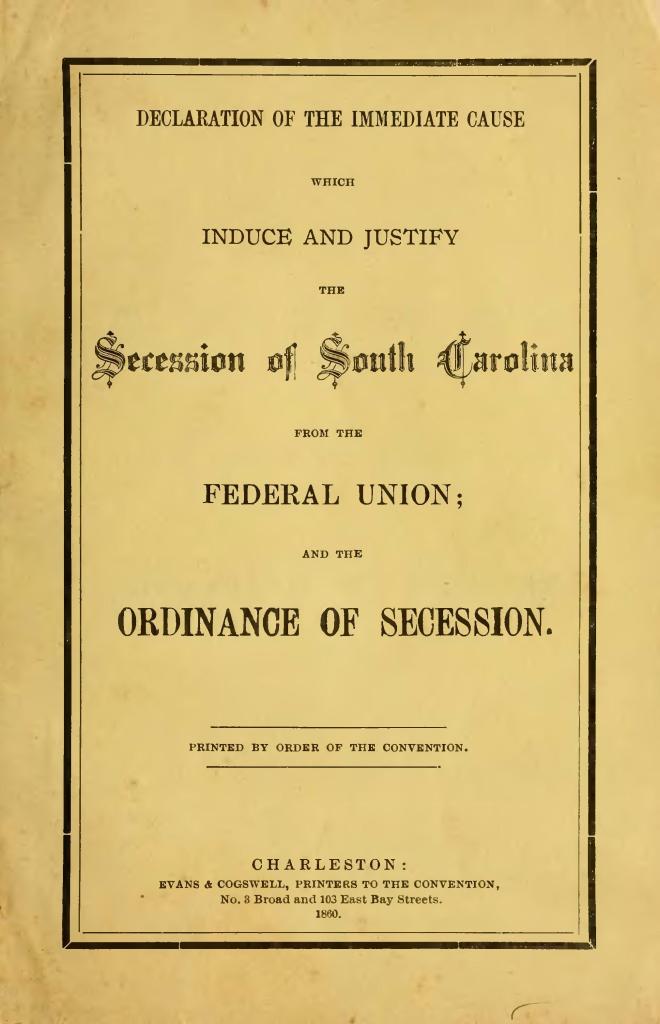
It’s a remarkable document, especially when you compare it with the explanation many of us grew up hearing.
The declaration discusses the Constitution, the sovereignty of states, and the obligations of the federal government.
But when it identifies the grievances that brought South Carolina to secession, slavery is at the center of the argument.
South Carolina’s leaders complained that Northern states were refusing to fulfill constitutional obligations concerning people who escaped enslavement.
They objected to Northern criticism of slavery.
They objected to antislavery organizations.
They objected to the election of Abraham Lincoln and the growing political power of people opposed to slavery’s expansion.
In other words, South Carolina’s leaders believed their slaveholding system was threatened.
They said so.
And here’s something especially interesting about that states’ rights argument.
South Carolina was angry, in part, because Northern states weren’t doing enough to help enforce the rights claimed by Southern enslavers.
Think about that for a moment.
The state demanding freedom from federal interference was also demanding that other states cooperate in returning human beings to bondage.
That isn’t a consistent argument for every state being free to decide its own policies.
It’s an argument for protecting slavery, including when doing so required overriding the wishes of other states.
And South Carolina wasn’t alone.
Mississippi’s declaration was even more direct:
“Our position is thoroughly identified with the institution of slavery.”
Not tariffs. Not an abstract disagreement about government structure.
Slavery.
Mississippi’s leaders described it as an enormous economic interest and argued that attacks on slavery threatened commerce and civilization itself.
Those aren’t accusations made by later historians.
Those are the reasons secessionists gave in their own words.
The Federal Government They Wanted to Use
To understand the contradiction in the states’ rights explanation, we need to visit 1850.
That year, Congress passed a new Fugitive Slave Act as part of a larger political compromise intended to ease tensions between free and slaveholding states.
The law strengthened the machinery for capturing and returning people accused of escaping enslavement.
Federal commissioners could decide whether an accused person would be sent into slavery without providing a jury trial. The accused could not testify on their own behalf.
Federal officials were required to assist in enforcement, and people who helped freedom seekers faced serious penalties.
Imagine being a free Black person in a Northern state and knowing that an accusation could put your liberty in jeopardy.
Imagine having no meaningful opportunity to tell your own story before the government decided your fate.
Now imagine being a Northern resident who believed slavery was wrong and being told that federal law required cooperation with this system.
Some Northern states attempted to protect their residents through personal liberty laws. Southern slaveholders objected.
Here we have a striking reversal of the story many of us were taught.
Slaveholding interests weren’t consistently arguing that federal power should stay out of state affairs.
They wanted federal power used to protect slavery.
They objected when Northern states resisted.
So when we say states’ rights were involved, we need to finish the sentence.
The dispute was deeply concerned with the claimed right to own human beings and the power to preserve that claim.
How Did We Get to the Breaking Point?
The Civil War didn’t materialize out of thin air in 1861.
For decades, the United States had struggled with the expansion of slavery.
As the country grew westward, an increasingly urgent question followed it:
Would slavery be permitted in new territories and states?
The Missouri Compromise of 1820 attempted to maintain a political balance between free and slaveholding states.
The Compromise of 1850 addressed another set of disputes, including the status of territories acquired after the Mexican-American War.
Then came the Kansas–Nebraska Act of 1854, which allowed settlers in those territories to decide the slavery question under the principle of popular sovereignty.
Rather than settling the argument, it helped produce violent conflict in Kansas.
People were fighting over whether slavery would expand.
In 1857, the Supreme Court’s Dred Scott decision further inflamed the crisis by ruling that people of African descent could not be citizens of the United States under its interpretation of the Constitution and that Congress could not prohibit slavery in federal territories.
And then came the election of 1860.
Abraham Lincoln won the presidency on a Republican platform opposed to the expansion of slavery into the territories.
That distinction matters.
Lincoln was not elected on a promise to immediately abolish slavery everywhere it already existed. His initial position was considerably more limited.
But Southern secessionists saw the election of a president opposed to slavery’s expansion as a threat to their political power and the future of the institution.
South Carolina seceded before Lincoln even took office.
Six other Deep South states followed.
They were not responding to a federal army marching through their communities. They were responding to a political development they believed endangered slavery’s future.
The Confederacy was established before the first shots at Fort Sumter.
And that sequence is important when we examine the claim that the South was simply defending itself against an invasion.
The war began after Confederate forces fired on the United States garrison at Fort Sumter in Charleston Harbor in April 1861.
Lincoln then called for troops, and four additional slaveholding states joined the Confederacy.
The decisions of those later-seceding states involved additional concerns, including resistance to being called upon to fight fellow Southerners.
But we need to distinguish the immediate events that brought additional states into the war from the underlying political crisis that had already produced secession.
That crisis centered on slavery.
They Even Put It in Their Constitution
Now, if the secession declarations aren’t enough, there’s another document we should examine.
The Confederate Constitution.
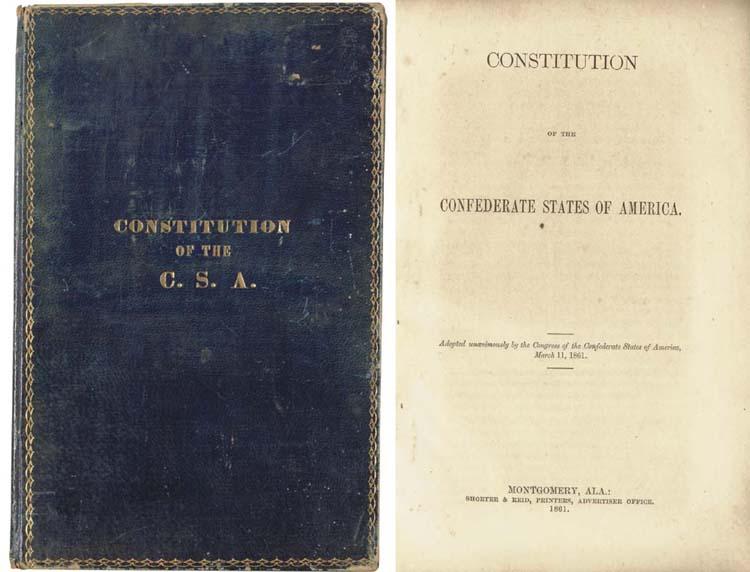
Adopted in March 1861, it borrowed much of its structure and language from the United States Constitution.
There were differences involving taxation, government spending, the presidency, and other matters.
But one difference is particularly revealing.
The Confederate Constitution explicitly protected slavery.
Article I prohibited the Confederate Congress from passing laws denying or impairing property rights in enslaved Black people.
Article IV protected slaveholders traveling or temporarily residing in other Confederate states with enslaved people.
It also required the return of people who escaped enslavement.
And in Confederate territories, the constitution required slavery to be recognized and protected.
Let’s consider what that means.
If the Confederacy had been established primarily to allow individual states to decide for themselves whether to permit slavery, why would its national constitution contain such protections?
Why would it restrict the ability of its own government to interfere with slaveholding property claims?
Why would it require protection for slavery in its territories?
Because preserving slavery wasn’t an incidental feature of the new government.
It was built into the structure.
The constitution did prohibit most overseas importation of enslaved Africans. But that should not be confused with opposition to slavery itself. The domestic institution and the claims of existing enslavers remained firmly protected.
The Confederate leaders who drafted this document knew how to write constitutional protections.
And they chose to protect slavery.
Then the Vice President Explained It
If you’re still wondering whether we’re reading too much into those documents, allow me to introduce Alexander H. Stephens.
Stephens was the vice president of the Confederacy.
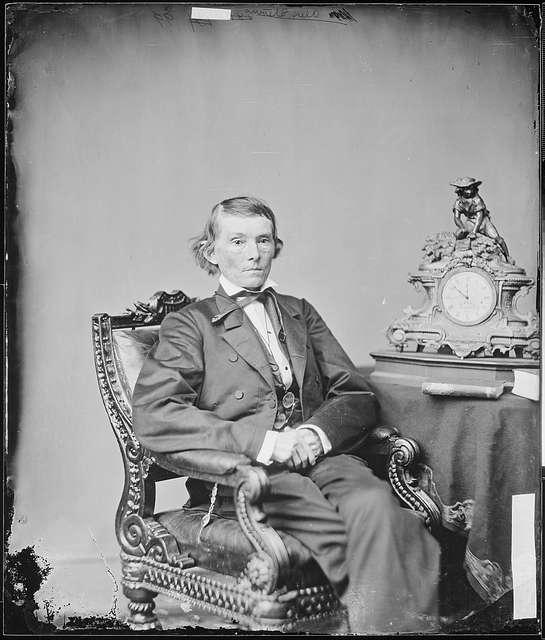
In March 1861, he delivered a speech in Savannah, Georgia, commonly known as the Cornerstone Speech.
The surviving text comes from contemporary newspaper reporting, so we should be careful about treating every word as a verified verbatim transcript.
Nevertheless, the reported speech is unusually explicit about the political ideas Stephens was defending.
He described the dispute over slavery as the immediate cause of the rupture between North and South.
He also argued that the new Confederate government rested upon the belief that Black people were inherently unequal to white people and that slavery was their proper condition.
I want you to sit with that for a moment.
This wasn’t a modern historian imposing an interpretation on the Confederacy.
This was its vice president, publicly explaining the principles of the new government.
Stephens had initially opposed Georgia’s secession. That fact makes his eventual defense of the Confederacy more complicated, but it doesn’t make his words disappear.
And those words are profoundly difficult to reconcile with the claim that slavery was merely a minor issue.
The secession declarations tell us what leaders feared losing.
The constitution tells us what they wanted protected.
The vice president tells us how he understood the foundations of the government.
Those three pieces of evidence point in the same direction.
But Wasn’t Slavery Already Dying?
Here’s another explanation I remember hearing.
Slavery was on its way out anyway.
It was supposedly becoming obsolete, and within a few decades it would have disappeared without a war.
Now, I can’t tell you what would have happened in an alternate version of American history.
Nobody can.
But we can examine what was actually happening in the years before the Civil War.
And the numbers are not consistent with an institution quietly fading away.
According to historical United States census figures:
| Year | People recorded as enslaved |
|---|---|
| 1790 | 697,624 |
| 1820 | 1,538,022 |
| 1850 | 3,204,313 |
| 1860 | 3,953,760 |
Nearly four million human beings were enslaved in the United States in 1860.
That’s an increase of roughly 749,000 people in just ten years.
Meanwhile, cotton had become central to the American export economy, and enslaved labor was essential to the plantation system that produced it.
The expansion of cotton cultivation into the Deep South had increased demand for enslaved workers.
Human beings were bought, sold, mortgaged, inherited, and separated from their families.
The domestic slave trade moved enormous numbers of people, often by force, from older slaveholding regions into expanding plantation areas.
The financial interests tied to slavery extended beyond plantation owners. Merchants, insurers, lenders, manufacturers, and shipping businesses could all benefit from an economy built in part on enslaved labor.
And let’s remember that economic value was being measured in the forced labor and stolen freedom of actual people.
People with names.
People with families.
People who loved their children and feared losing them.
People whose lives were treated as entries in somebody else’s ledger.
So no, the historical evidence doesn’t support the comfortable claim that slavery was obviously about to disappear on its own.
Abolition movements were growing. Other countries had abolished slavery. Political opposition was real.
But slavery in the United States remained economically powerful and politically defended.
We cannot know exactly how long it might have survived without the Civil War.
We can say that its imminent, peaceful disappearance was not a demonstrated fact.
And the people who established the Confederacy certainly weren’t behaving as though slavery was something they expected to surrender quietly.
Not Every Southerner Agreed
Now we need to be careful.
When I say Confederate leaders established a government designed to protect slavery, I’m talking about the documented goals of a political movement and its government.
I’m not claiming every person living in the South shared the same beliefs.
Because they didn’t.
There were Southern Unionists who opposed secession.
In places such as eastern Tennessee, significant numbers of white residents remained loyal to the United States.
Some opposed the political power of wealthy slaveholders. Some believed secession was disastrous. Some were loyal to the Union for reasons that had little to do with racial equality.
And that distinction matters, too.
A white Southerner could oppose secession without opposing slavery.
History doesn’t always provide us with tidy heroes and villains.
But there’s another group whose voices are too often pushed to the margins of this story.
Enslaved Southerners.
They were Southerners, too.
They lived and worked in Southern communities. Their families had histories there. Their labor helped build the region’s wealth.
Yet they were denied any meaningful say in whether their states would leave the Union.
And when the war began, many took extraordinary risks to claim freedom for themselves and their families.
In 1861, three enslaved men escaped to Union-held Fort Monroe in Virginia. Their arrival helped create a major legal and military dilemma over the treatment of people fleeing slavery.
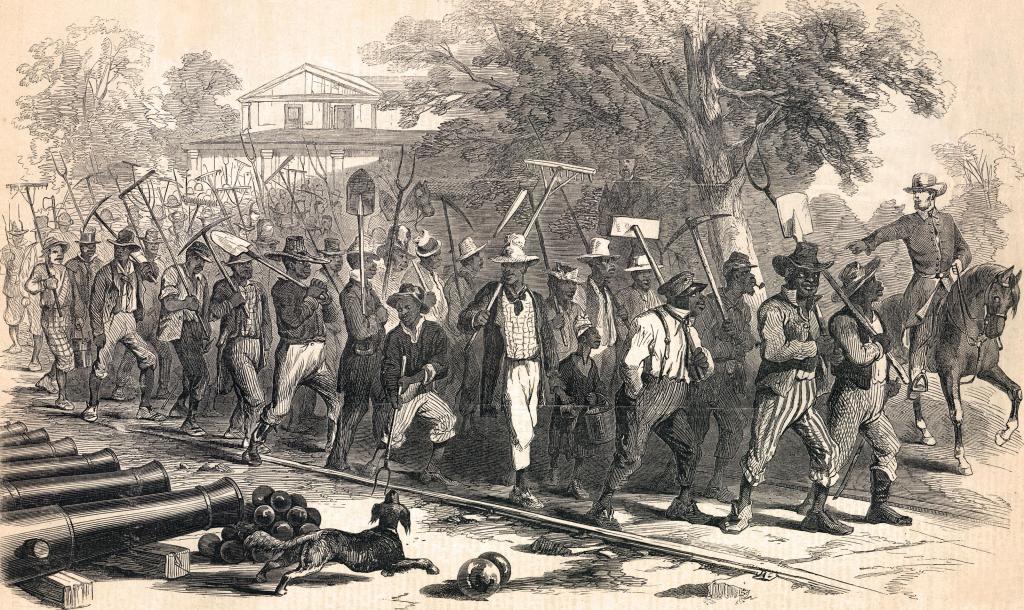
As the war continued, many thousands more made their way to Union lines.
They weren’t simply waiting for someone to announce that they were free.
They acted.
They escaped.
They provided information, labor, and assistance to Union forces.
Black men also served in the Union Army, fighting in a war whose meaning increasingly included emancipation.
The destruction of slavery wasn’t solely the work of presidents, generals, or legislators.
Enslaved people themselves helped force the issue.
And if we’re going to talk about the Southern experience of the Civil War, their experience belongs in the story.
What About the Men Who Fought?
This is where the conversation becomes personal for me.
I have Confederate ancestors.
My grandmother belonged to the United Daughters of the Confederacy, an organization whose membership is tied to Confederate ancestry.
My sister and I had the opportunity to continue that family tradition.
We declined.
There was a general discomfort with the whole business of fighting a war over owning people.
And I want to be very clear about something.
I don’t know why my individual ancestors fought.
I don’t know what they believed. I don’t know what pressures they faced or what conversations happened around their family tables.
I don’t have their letters sitting in front of me.
And I am not going to invent their motives just to make a point.
The reasons individual Confederate soldiers fought were varied.
Some believed they were defending their homes and families.
Some felt loyalty to their states.
Some believed in slavery and the racial hierarchy on which Southern society was built.
Some enlisted because their friends and neighbors did.
Some were influenced by expectations of honor and duty.
Some were eventually compelled into military service through conscription.
And as the war continued, some fought primarily out of loyalty to the men beside them.
A soldier’s personal motivation and the political purpose of the government he served were not necessarily identical.
We should be capable of understanding that distinction.
A man could sincerely believe he was protecting his family while fighting for a government created to protect slavery.
Those things could both be true.
But here’s the other side of that distinction.
The fact that a particular soldier may have fought for his home doesn’t change what the Confederate government was established to defend.
And the fact that we don’t know an ancestor’s personal motives doesn’t mean we don’t know the Confederacy’s stated objectives.
Those are two separate historical questions.
We have evidence for one.
For the other, we may have to admit that we simply don’t know.
They made their choices, and I’m making mine.
A Rich Man’s War?
There’s another wrinkle worth examining before we leave the soldiers behind.
The Confederacy introduced conscription in 1862.
It also created exemptions, including a provision commonly called the Twenty Negro Law, which benefited certain men responsible for supervising plantations with twenty or more enslaved people.
Imagine being a poor white Southern family watching sons and husbands leave for war while some men connected to large slaveholding operations could remain home.
You can probably understand why resentment developed.
The phrase “a rich man’s war and a poor man’s fight” captured a real source of anger.
But even here, we need to avoid turning a complicated society into a simple story.
Many white Southerners who did not own enslaved people nevertheless supported slavery.
Some believed in white supremacy. Some hoped to become slaveholders themselves. Some feared what emancipation might mean for the racial and social order they knew.
Others questioned the influence of wealthy planters or resisted Confederate authority.
The South was not one unified community with one unified set of beliefs.
And that is precisely why we should avoid confusing the experiences of individual Southerners with the documented goals of secessionist leaders.
So How Did the Story Become Something Else?
If the secession declarations, Confederate Constitution, and public statements of Confederate leaders are so clear, how did generations of Americans come to believe slavery was only a secondary cause?
That’s where we begin to encounter something historians call the Lost Cause.
After the war, former Confederates and their supporters developed interpretations that emphasized Southern honor, states’ rights, military bravery, and the defense of home.
Slavery was often minimized, romanticized, or pushed out of the center of the story.
The United Daughters of the Confederacy, founded in 1894, became one of the organizations involved in preserving and promoting Confederate memory.
Its activities included caring for veterans and their families, but also influencing how history was taught and commemorated.
That last part is especially important.
History isn’t shaped only by the people who lived through an event.
It’s also shaped by the people who write the textbooks, select the stories, and decide which interpretations become familiar.
I can’t tell you that a particular textbook from my childhood was influenced by a particular organization without examining that textbook.
But we do know that organized efforts to promote the Lost Cause helped shape generations of historical memory.
And that gives me something to think about.
My grandmother belonged to an organization associated with that tradition.
I grew up hearing that states’ rights were the bigger issue.
I remember the idea that slavery was already dying.
I absorbed language about Southern pride without fully understanding the history beneath it.
Those things don’t prove exactly how every belief reached me.
But they do make me wonder about the path those beliefs traveled.
And that is a question worth asking.
We’ll explore more of that history later this week when we examine the Confederate flag and Confederate monuments.
For today, I want to stay with the causes of the war itself.
Because before we can examine how something was remembered, we need to understand what happened.
The History We Inherit Is Not the History We Have to Keep
I loved my grandmother.
I also know she held racist beliefs and made choices that I cannot defend.
My parents worked to teach us something different. They taught us that Black children were no different from us, even when some of the older attitudes around us said otherwise.
Families are complicated that way.
Love doesn’t make every belief right.
And recognizing that someone you love was wrong about something important doesn’t erase every good memory you have of that person.
I don’t have to pretend my grandmother was perfect to love her.
I don’t have to defend every choice my ancestors made to acknowledge that they are part of my family.
And I don’t have to accept the version of history I inherited simply because it was familiar.
That’s the part I wish more of us understood.
Learning something new about our history doesn’t require us to despise where we came from.
It does require us to be willing to reconsider what we’ve been told.
Sometimes that means looking at an old family tradition and deciding not to continue it.
Sometimes it means reading a historical document that makes us uncomfortable.
Sometimes it means acknowledging that the story we learned left out people whose lives mattered every bit as much as the people whose names appeared in our textbooks.
And sometimes it means admitting that something we repeated with great enthusiasm as children was something we didn’t understand.
YeeHaw and all.
I can’t tell you when I first understood that owning another human being was wrong.
Maybe I always knew it.
Maybe the understanding was there long before I had the words or the historical knowledge to explain it.
I don’t remember a particular moment when the light came on.
But I know where I stand now.
I can acknowledge that individual soldiers had different reasons for fighting.
I can recognize that political, economic, and constitutional disagreements existed alongside the slavery crisis.
I can admit that I don’t know every detail of my ancestors’ lives.
And I can still read the documents left by Confederate leaders and recognize what they tell us.
Slavery was not a footnote to secession.
It was central to it.
That isn’t an attack on every person who calls the South home.
It’s an acknowledgment of the historical record.
I love the South. I love its landscapes, its food, its music, its storytelling, and the particular warmth that can make a stranger feel welcome at the table.
But loving a place doesn’t require defending everything that happened there.
In fact, I think loving a place ought to make us care enough to tell its history fully.
Even the hard parts.
Especially the hard parts.
On Tuesday, we’re going to examine the Confederate flag and how its meanings developed over time. On Saturday, we’ll look at Confederate monuments and the choices people made about what to commemorate.
Those conversations will bring their own questions.
But today’s question was what caused the Civil War.
And the people who established the Confederacy left us an answer.
So keep asking questions. Keep learning. And remember that discovering you were taught an incomplete story isn’t the end of the conversation.
It might just be the beginning.
And if you want to know where I stand after all of this, I can say it now with my full chest:
Owning people is wrong.
Y’all come sit a spell.
Sources & Further Reading
- South Carolina’s Declaration of the Immediate Causes of Secession, December 24, 1860 — Yale Law School, Avalon Project.
- Mississippi’s Declaration of Secession, January 1861 — Yale Law School, Avalon Project.
- Constitution of the Confederate States of America, March 11, 1861 — Yale Law School, Avalon Project.
- Alexander H. Stephens’s Cornerstone Speech, March 21, 1861 — Encyclopedia Virginia.
- Causes of the Civil War — National Park Service.
- Civil War Timeline — Gettysburg National Military Park.
- A Century of Population Growth: Historical Census Data — U.S. Census Bureau.
- Why Confederate Soldiers Fought — National Park Service.
- The United Daughters of the Confederacy — Encyclopedia Virginia.
- The Lost Cause — Encyclopedia Virginia.


Leave a Reply