
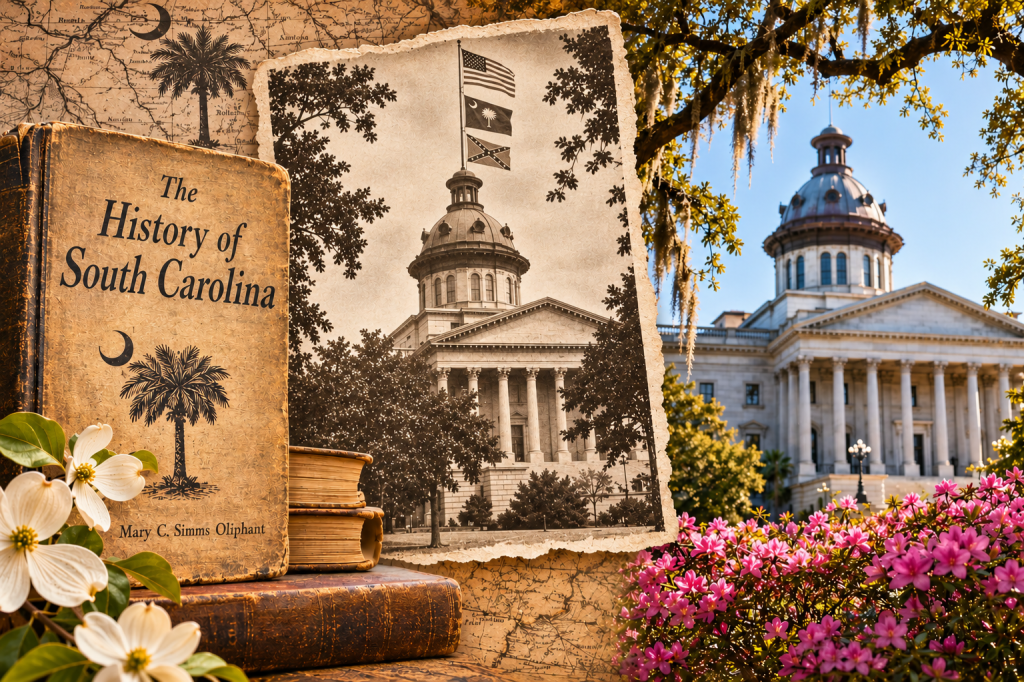
Hey y’all. Come on up, grab something warm to drink, and sit a spell.
We’re going to talk about something that may make some folks uncomfortable. Truthfully, parts of it make me uncomfortable, too. But that’s all right. Sometimes the things worth talking about are the very things we’d rather leave alone.
I want to tell you about a flag.
More specifically, a flag I once believed in, the history I thought I understood, and how I came to realize that loving my home didn’t require defending everything about its past.
Because once upon a time, I was a South Carolina teenager who was proud of the Confederate battle flag.
And today, I’m not.
That change didn’t happen overnight. There was no dramatic confrontation or single revelation that overturned everything I believed.
It was a process.
And it began, of all places, with Shakespeare.
The Pride I Grew Up With
I grew up in a small South Carolina town during the latter part of the twentieth century. South Carolina wasn’t simply where I lived. It was home, and I loved it.
I still do.
Growing up, the Confederate battle flag was part of the landscape. You saw it on bumper stickers, T-shirts, and other things celebrating Southern identity. It flew above our State House, where it had been raised in 1962, years before I was old enough to understand what it represented.
To me, it was a symbol of Rebel Pride.
We were Southerners. We stood up for what we believed in. We’d fought a war, we’d lost, and we weren’t going to pretend otherwise or apologize for having fought.
There was a certain teenage defiance wrapped up in that understanding. Being a rebel has particular appeal when you’re young enough to believe refusing to back down is practically a virtue.
But I didn’t invent those ideas.
They were part of the culture around me, reinforced by what I heard, what I saw, and the history I’d been taught.
My parents weren’t particularly invested in defending the Confederate flag. This wasn’t some sacred family tradition passed down around the dinner table.
It was something I absorbed.
And here’s an important distinction: I knew slavery was part of the Civil War.
I wasn’t taught that slavery didn’t exist. I knew people had been enslaved in the South, and I knew slavery had something to do with the war.
But I also learned about states’ rights, economic disagreements, Southern independence, and people defending their homes and way of life.
Those explanations sat alongside one another in my understanding of the conflict.
What I didn’t understand was how much weight each deserved.
I knew slavery was part of the story. What I didn’t understand was how much of the story it was.
And that difference matters.
What Shakespeare Had to Do With It
When I got to college, I took English classes that introduced me to a rather different Shakespeare than the one I’d encountered in high school.
Did y’all know how much bawdy humor Shakespeare managed to sneak into those plays?
Well, I didn’t.
There were jokes, innuendos, and layers of meaning that had sailed right past us. Suddenly, these works I’d known as serious, important literature were full of wit and irreverence.
And I was indignant.
Not because Shakespeare was naughty. Quite the opposite. I wanted to know why nobody had told us!
I even went back and questioned some of my former teachers. Couldn’t they at least have given us a wink and a nod? Some indication that there was more going on than what appeared on the page?
Those conversations weren’t confrontations. I respected my teachers and remained friends with some of them for years.
They explained that teachers worked within the materials and guidelines available to them. Textbooks and supplementary materials weren’t always theirs to choose. They hoped students would continue reading and eventually discover those additional layers for themselves.
I understood that.
But the experience left me with a question much bigger than Shakespeare.
If there was that much more to something I’d already studied, what else didn’t I know?
What else had been simplified, left out, or presented from only one perspective?
I didn’t suddenly decide everything I’d learned was wrong.
I began to understand that what I’d learned might not be everything.
And once that possibility gets into your head, it has a way of staying there.
What the Confederacy Actually Said
Eventually, those questions led me back to the Civil War.
This time, instead of relying on the explanations I remembered, I began looking at what the people who supported secession had said themselves.
We can spend generations debating what people meant or what their descendants believe they were fighting for.
But sometimes the people involved left us their own words.
South Carolina adopted its Declaration of the Immediate Causes Which Induce and Justify the Secession of South Carolina from the Federal Union on December 24, 1860.
The declaration discusses constitutional obligations and states’ rights. But when you read the grievances South Carolina actually identified, slavery is impossible to separate from the argument.
The document objects to Northern states’ resistance to the return of people who had escaped enslavement. It condemns growing opposition to slavery and points to the election of a president whose views were considered hostile to the institution.
The state’s rights being defended weren’t abstract principles unrelated to slavery.
Protecting slavery was central to the dispute.
Mississippi was even more explicit in its declaration of secession:
“Our position is thoroughly identified with the institution of slavery.”
There isn’t much ambiguity in that sentence.
In March 1861, Confederate Vice President Alexander H. Stephens delivered what became known as the Cornerstone Speech, defending the new Confederacy’s foundation on racial inequality and the enslavement of Black people.
The Confederate Constitution itself provided explicit protections for slavery.
These weren’t later interpretations imposed on the past. They were statements and laws produced by the people establishing the Confederacy.
That doesn’t mean every Confederate soldier understood the war in exactly the same way. Individuals enlisted for different reasons. Some believed they were protecting their homes. Some were conscripted. Others embraced the Confederacy’s political objectives.
But the reasons individual soldiers fought and the reasons Confederate states seceded are two different historical questions.
We can acknowledge one without obscuring the other.
Once I understood that distinction, the familiar explanation of the war as primarily a fight over states’ rights looked very different.
Because the next question was unavoidable.
States’ rights to do what?
The History That Came After the War
The Confederacy lost the Civil War in 1865.
But the struggle over how the war would be remembered was only beginning.
In the decades that followed, an interpretation of the conflict developed that historians call the Lost Cause.
It emphasized Confederate honor, military courage, Southern suffering, and resistance to Northern aggression. It celebrated figures such as Robert E. Lee while minimizing slavery’s central role in secession.
It also portrayed Reconstruction through a distorted lens, frequently depicting formerly enslaved people as unprepared for freedom and Reconstruction governments as corrupt or illegitimate.
This went beyond families remembering loved ones who had died.
Organizations, writers, veterans’ groups, and memorial associations worked to shape public understanding of the war.
Among them were the United Daughters of the Confederacy, whose activities included promoting monuments, commemorations, and particular interpretations of history in schools.
In the early twentieth century, Mildred Lewis Rutherford, a prominent UDC historian, produced guidance for evaluating textbooks according to whether they presented Southern history in ways the organization approved.
Think about that for a moment.
The effort wasn’t limited to preserving memories of the past.
It included influencing what children would learn about it.
And that brings us back to South Carolina classrooms.
The Textbooks We Grew Up With
While researching this essay, I went looking for the South Carolina history textbooks used when I was growing up.
Like many South Carolina students, I had a dedicated state history class in eighth grade.
One name kept appearing: Mary C. Simms Oliphant.
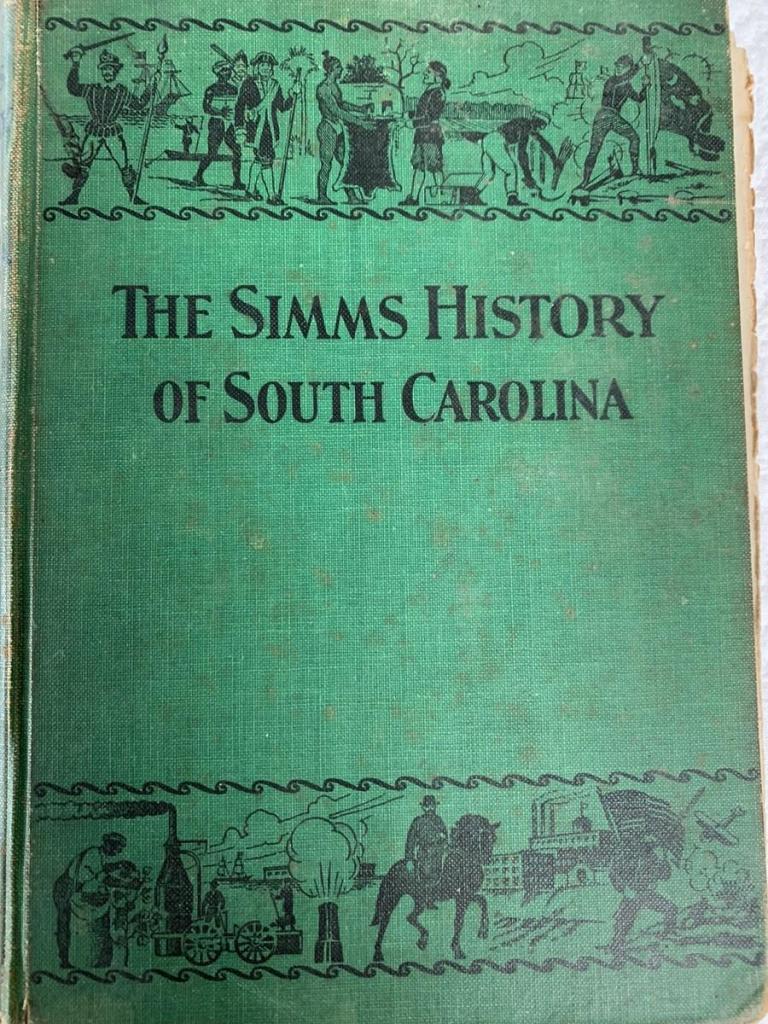
Her The History of South Carolina appeared in multiple editions and was used by South Carolina students well into the 1980s.
When I saw the cover of one edition, something about it was familiar. I couldn’t swear it was the exact book that sat on my desk, but I recognized it, or something very much like it.
And the more I researched, the more interested I became.
Historians have documented how earlier editions of Oliphant’s work reflected Lost Cause interpretations, particularly in their treatment of the Civil War, slavery, and Reconstruction.
A digitized 1958 edition, for example, calls its Civil War chapter “The War for Southern Independence.”
That title tells you something about the perspective from which the story is introduced.
The text emphasizes the courage and sacrifices of white Southerners, while its treatment of enslaved people and Reconstruction reflects assumptions historians have since challenged.
There was also a 1977 edition, published around the era of my school years. I haven’t verified which textbook or edition my class used, and I don’t intend to claim something I can’t establish.
But the larger history of the textbook series is documented.
And it raises a question that feels very personal.
How much of my understanding of Southern pride came from the way history had been organized and presented to me?
I don’t ask that to blame my teachers.
I had teachers who cared deeply about their students and encouraged us to learn. They worked within an educational system with its own requirements, approved materials, and inherited assumptions.
Nor do I believe every lesson I received was false.
The problem with an incomplete account of history is that it can contain plenty of accurate facts.
What matters is which facts receive emphasis, whose experiences are treated as central, and which explanations students are encouraged to accept.
You can learn about slavery without understanding its central place in secession.
You can study Reconstruction and still come away with a distorted impression of what freedom meant for formerly enslaved people.
And you can admire the courage of Confederate soldiers without examining the political cause their government was defending.
That was the understanding I had to reconsider.
The Flag’s Second Life
There’s another part of this history I didn’t appreciate when I was younger.
The Confederate battle flag didn’t simply remain an unchanged symbol from the 1860s until my childhood.
Its public meaning and political uses evolved.
First, let’s clear up something that often gets confused.
The familiar flag with the diagonal blue cross and white stars on a red field was associated with Confederate military forces, particularly the Army of Northern Virginia. It wasn’t the Confederacy’s original national flag.
After the war, battle flags remained important in veterans’ commemorations and memorial traditions.
But they acquired new prominence during the twentieth century.
In 1948, Southern Democrats opposed to their national party’s civil rights direction formed the States’ Rights Democratic Party, commonly called the Dixiecrats.
Their presidential candidate was South Carolina’s Strom Thurmond.
The Dixiecrats defended racial segregation and opposed federal civil rights measures. Confederate battle flags appeared prominently at their political gatherings.
That wasn’t the flag’s only postwar use. It also appeared in popular culture and was embraced by some people as a symbol of rebelliousness or regional identity.
But its association with organized resistance to racial equality was part of its modern history.
This is where intention and history become complicated.
I know what that flag meant to me when I was young.
I didn’t wave it because I wanted to defend slavery or segregation. I understood it as a symbol of Southern identity and defiance.
But my intentions couldn’t erase its history.
Nor could they determine what it meant to someone else.
That was something I had to learn.
The Flag Above Our State House
South Carolina raised the Confederate battle flag above its State House dome in 1962, during the Civil War centennial.
The decision also occurred during the civil rights era, when South Carolina and other Southern states were resisting desegregation.
Historians continue to examine the specific motives behind the display, and we should distinguish the documented centennial explanation from the broader political context.
But whatever individual lawmakers intended, the result was unmistakable.
The Confederate battle flag became a prominent feature of South Carolina’s seat of government.
Growing up, it was simply there.
For years, I spent time around the State House. The flag was part of the familiar scenery, something I’d seen so often it barely required conscious attention.
But familiarity isn’t understanding.
As I continued reading, questioning, and listening, I began thinking more seriously about what it meant to display that particular flag over a building belonging to every South Carolinian.
Not just the white South Carolinians who saw it as a symbol of heritage.
Every South Carolinian.
I began paying closer attention to what Black South Carolinians said about it.
For some, the flag was inseparable from slavery, segregation, and political movements that had fought to preserve racial inequality.
Their ancestors had lived through the Civil War, too.
But their experiences of that war, and what its outcome meant for them, were very different.
I couldn’t keep treating my interpretation of the flag as though it were the only one that mattered.
Eventually, I reached a simple conclusion.
If the flag’s presence on the State House caused that much pain to fellow South Carolinians, it didn’t belong there.
I could still love my state, value its history, and cherish its traditions.
I didn’t need that flag flying over our government to prove any of those things.
Postponing the Inevitable
By the time South Carolina reached its flag compromise in 2000, my thinking had already changed.
The state removed the flag from the State House dome and legislative chambers, but a Confederate battle flag remained on the grounds beside the Confederate Soldier Monument.
I wasn’t satisfied.
To me, moving the flag wasn’t resolving the controversy. It was postponing the inevitable.
I wanted the Band-Aid ripped off.
The question of whether that flag belonged on the grounds of our State House wasn’t going to disappear because we’d moved it.
We were going to have to confront it eventually.
But what do you do?
The legislature made its decision, the flag moved, and South Carolina carried on.
For another fifteen years.
And then came Charleston.
When the Flag Finally Came Down
On June 17, 2015, nine Black worshippers were murdered at Mother Emanuel African Methodist Episcopal Church in Charleston.
They had gathered for Bible study.
The killings were an act of racist violence, and the grief reached far beyond Charleston.
I was appalled.
I was hurt.
And when the Confederate battle flag finally came down from the State House grounds on July 10, 2015, I didn’t feel as though we’d won something.
I had wanted that flag removed for years.
But now nine people were dead.
The removal felt nearly hollow.
Yes, the flag was finally gone from the grounds. Yes, it was a decision I believed should have been made long before.
But I kept coming back to a question.
Where was the work that actually needed to be done?
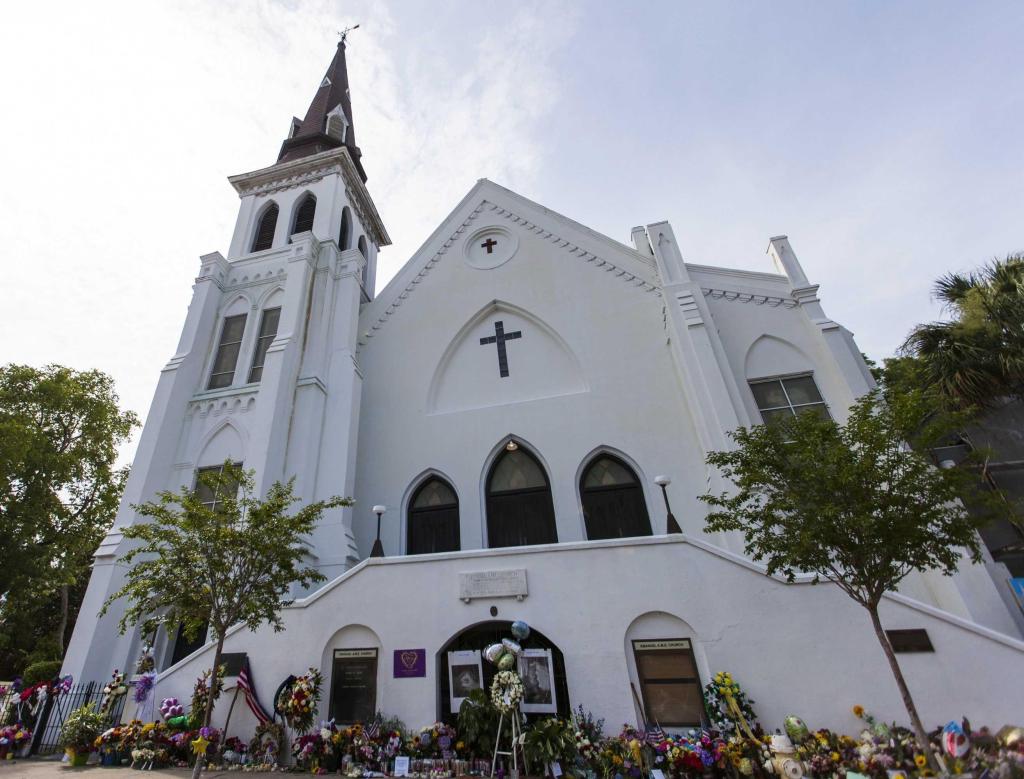
Removing a flag is a visible act. You can photograph it, watch it happen, and point to a before and an after.
But changing what people understand about history, how they treat one another, and whether they recognize experiences different from their own doesn’t happen in a single ceremony.
What were we doing about that?
What were we doing to make sure the next generation understood more than the last?
Taking down the flag mattered.
But taking down the flag wasn’t enough.
Back to the Classroom
And that question brought me, rather unexpectedly, back to eighth grade.
While researching this essay, I decided to look at South Carolina’s current educational standards.
What are children being taught now?
Are they still receiving the explanations I remember, or has the state changed what it expects students to understand?
The answer, at least in the written standards, gives me reason for hope.
South Carolina’s 2019 social studies standards, together with subsequent instructional guidance, require eighth-grade students to examine slavery, secession, the Civil War, Reconstruction, segregation, and the Civil Rights Movement.
Students are expected to work with historical evidence, consider multiple perspectives, and examine the experiences of people whose stories were too often marginalized in older accounts.
State instructional guidance also addresses the Lost Cause as a historical narrative to be examined critically.
Think about that.
The very interpretation of history that helped shape generations of Southern identity is now something students can be taught to investigate.
That’s progress.
It doesn’t guarantee that every classroom gets it right, every teacher has the same resources, or every difficult question receives the attention it deserves.
And it certainly doesn’t mean the work is finished.
But the expectations have changed.
That matters to me.

Because somewhere in South Carolina, another eighth grader is sitting in a classroom learning about the state I love.
Maybe that student is in a small town like the one where I grew up.
Maybe they’re reading South Carolina’s declaration of secession and discovering that the people who made those decisions explained their reasons in their own words.
Maybe they’re studying Reconstruction through the experiences of newly freed people rather than only through the grievances of former Confederates.
And maybe, just maybe, they’re learning to ask questions that didn’t occur to me until years later.
I hope so.
Loving a Place Enough to Question It
I’ve thought a great deal about what it means to change your mind about something you once believed.
Sometimes we treat changing our minds as a weakness, as though consistency matters more than understanding.
But I don’t see it that way anymore.
I was a teenager who took pride in being Southern. I accepted an interpretation of the Confederate flag that was familiar to me and reinforced by the culture around me.
Then I learned more.
I asked questions.
I listened.
I encountered evidence that didn’t fit comfortably with what I’d believed.
And my understanding changed.
I don’t think that means I was foolish for believing what I believed as a child.
I was working with what I knew.
What matters is what I chose to do when I knew more.
I don’t believe every person who sees the Confederate flag as a symbol of heritage is consciously endorsing everything in its history. I know firsthand how sincerely someone can hold an incomplete understanding.
But sincerity doesn’t make that understanding complete.
At some point, we have to examine the things we’ve inherited. We have to ask whether the stories we tell about ourselves leave other people out, and recognize that the meaning we attach to a symbol isn’t the only meaning it carries.
I haven’t stopped loving South Carolina.
I love its landscapes, its people, its history, and the peculiar mixture of stubbornness, hospitality, humor, and contradiction that makes it home.
But loving a place doesn’t require pretending its past was something it wasn’t.
Sometimes loving a place means being willing to tell the truth about it.
Sometimes it means listening when someone tells you that something you’ve always regarded with pride has caused them pain.
And sometimes it means deciding that what once felt worth defending no longer does.
The Confederate flag didn’t change.
What I understood about it did.
I’m still a proud South Carolinian. I’m a proud South Carolinian who understands her history.
And that brings me back to the lesson that has followed me through so much of my adult life.
You don’t know what you don’t know.
That’s not an excuse to stop learning. It’s a reminder that there’s always something beyond the limits of our own experience.
We do the best we can with what we know.
And when we know better, we have an opportunity to do better.
The real question is whether we’re willing.
Y’all come sit a spell.
Sources and Further Reading
Primary Historical Documents
- South Carolina Secession Convention. Declaration of the Immediate Causes Which Induce and Justify the Secession of South Carolina from the Federal Union. December 24, 1860. Yale Law School, Avalon Project. https://avalon.law.yale.edu/19th_century/csa_scarsec.asp
- Mississippi. A Declaration of the Immediate Causes Which Induce and Justify the Secession of the State of Mississippi from the Federal Union. January 1861.
- Confederate States of America. Constitution of the Confederate States of America. March 11, 1861. Yale Law School, Avalon Project. https://avalon.law.yale.edu/19th_century/csa_csa.asp
- Alexander H. Stephens. Cornerstone Speech. March 21, 1861. Contemporary newspaper accounts.
Historical Interpretation and Education
- Mildred Lewis Rutherford. A Measuring Rod to Test Text Books, and Reference Books in Schools, Colleges and Libraries. United Daughters of the Confederacy, 1919–1920. Digital Library of Georgia. https://dlg.usg.edu/record/dlg_zlgb_gb5126
- Mary C. Simms Oliphant. The History of South Carolina. Various editions, including 1958 and 1977. https://openlibrary.org/books/OL4278612M/The_history_of_South_Carolina
- Jeffrey Allan Bird Jr. The Lost Cause, Reconciliation, and White Supremacy in South Carolina’s Education System, 1920–1940. 2021. Indiana University Indianapolis ScholarWorks. https://scholarworks.indianapolis.iu.edu/items/b6c9d032-6142-42fd-be2d-ba70be9087b2
- John M. Coski. The Confederate Battle Flag: America’s Most Embattled Emblem. Harvard University Press, 2005.
South Carolina Flag and Educational History
- South Carolina General Assembly records and attorney general opinions concerning the 1962 State House flag resolution.
- South Carolina General Assembly. Legislation concerning the Confederate flag, 2000 and 2015.
- South Carolina Department of Education. 2019 South Carolina Social Studies College- and Career-Ready Standards, eighth-grade South Carolina history, and subsequent instructional alignment guides. https://ed.sc.gov/instruction/standards/social-studies/standards/2019-south-carolina-social-studies-college-and-career-ready-standards/
- South Carolina Department of Education. Social studies instructional resources and African American history guidance. https://www.ed.sc.gov/instruction/standards/social-studies/instructional-resources/


Leave a Reply