• Who is your favorite cartoon character?

    View all responses

    My favorite cartoon character has always been Tinker Bell.

    But I feel like I need to clarify something.

    Not the nice one.

    I mean the original Tinker Bell. The tiny blonde in the green dress from Peter Pan. The jealous one. The petty one. The one with the temper. The one who could communicate an entire profanity-laced paragraph with nothing more than a facial expression and the furious jingle of a bell.

    That Tinker Bell.

    My Tink had teeth.

    Years ago, when Peter Pan came out on DVD, a partner and I sat down to watch it again. Somewhere along the way, they looked at me with genuine surprise.

    “Tink isn’t nice.”

    I grinned.

    “No. No, she isn’t.”

    Apparently, somewhere between childhood and adulthood, people remembered the wings. They remembered the green dress and the blonde bun. They remembered the pixie dust.

    They remembered the sparkle.

    But they had forgotten the teeth.

    I hadn’t.

    Original Tink was a girl with wings.

    That was the magic of her.

    We understood exactly what was happening when Wendy showed up. Here comes this girl, this interloper, waltzing into Neverland and suddenly occupying Peter’s attention.

    Tink was jealous.

    Of course she was.

    We were jealous with her.

    We wanted Wendy gone too.

    Granted, most of us probably would have stopped somewhere before attempted murder.

    Tink had commitment.

    She was petty. Possessive. Impulsive. Selfish. Vindictive. She didn’t even want to share her pixie dust. Peter had to make her.

    And she was also fiercely loyal, brave, loving and ultimately willing to sacrifice herself.

    She was complicated.

    She wasn’t a role model.

    She was a character.

    Then Disney discovered something else about Tinker Bell.

    She was marketable.

    Very, very marketable.

    There were movies to make. Dolls to sell. Books and clothes and toys and an entire fairy universe waiting to be built around one of the most recognizable little blondes in the world.

    I understand the business decision.

    They made their money.

    But somewhere along the way, they Stepford-wifed a fairy.

    They kept the recognizable parts. The wings stayed. The green stayed. The blonde bun stayed. Certainly the sparkle stayed.

    But those troublesome little personality defects?

    Those needed some work.

    The jealousy was softened. The temper became more manageable. The selfishness lost its bite. The dangerous little creature who could make spectacularly bad decisions because she was overwhelmed by an ugly emotion became considerably more agreeable.

    And apparently, while they were working on her personality, somebody decided she needed a little plastic surgery too.

    Exhibit A: original Tink.

    Exhibit B: the newer version.

    Your Honor, I have no further questions.

    But what bothers me most isn’t that they changed her.

    It’s that they squandered her.

    Because original Tinker Bell already had everything a storyteller could possibly want for a series of stories about growth.

    She had actual flaws.

    Not adorable flaws manufactured so that a character can encounter a conveniently constructed crisis, learn the appropriate lesson and be better by the closing credits.

    Tink had problems.

    Tink was sometimes the problem.

    What an extraordinary place to begin.

    Let her jealousy cost her something.

    Let her selfishness hurt somebody she loves.

    Let her temper create consequences she can’t simply jingle her way out of.

    Let her discover that loving someone doesn’t mean possessing them.

    Let her learn to share her pixie dust and still be a little pissed about it.

    Let her screw up. Let her apologize badly. Let her screw up again, but perhaps a little less spectacularly the next time.

    Let her grow.

    Let her mature.

    Let her learn what to do with those teeth.

    Instead, they sanded her down first and then manufactured crises for the polished version to navigate.

    That’s the tragedy of it.

    Tinker Bell didn’t need to become nicer before she could grow.

    She needed the opportunity to grow because she wasn’t nice.

    And I can’t help wondering what those meetings looked like.

    Was there somebody sitting at that conference table defending her?

    Did anybody say, “Wait. These aren’t defects in the product. These are the character”?

    Did anybody argue that little girls didn’t need another perfectly agreeable heroine?

    Did anyone suggest trusting Tink with her own future?

    Because we had already trusted her once.

    Children watched the original Peter Pan and understood her.

    We didn’t need her jealousy explained away. We knew jealousy.

    We didn’t need her anger softened. We knew anger.

    We didn’t need somebody to assure us that underneath everything she was really sweet.

    Sometimes she wasn’t.

    So what?

    Children have ugly emotions too.

    Maybe there’s value in seeing a character feel something ugly without deciding that the character herself must therefore be ugly.

    Maybe there’s value in watching someone make a terrible decision because of jealousy and then face what that decision caused.

    Maybe little girls can handle a female character who isn’t always pleasant.

    Maybe grown women can too.

    We have an odd habit of celebrating women with strong personalities right up until those personalities become inconvenient.

    We like spunky.

    We like feisty.

    We like independent.

    But only while they’re charming.

    Once those qualities acquire sharp edges, we start reaching for the sandpaper.

    And perhaps that’s why I still feel protective of that original little fairy.

    I don’t need to rehabilitate Tinker Bell.

    I don’t need to explain away the jealousy, selfishness, temper or the occasional willingness to have Wendy knocked out of the sky.

    Some of it was awful.

    I know.

    I was paying attention.

    That’s my Tink.

    The little girl with wings who loved enormously, hated enormously, made terrible decisions, redeemed herself, and never needed to be perfect for me to love her.

    I don’t love Tinker Bell despite her teeth.

    I love her with full respect for the teeth.

    Disney kept the sparkle.

    I just wish they’d trusted her enough to let her keep the rest of herself too.
  • Come sit a spell.

    I have recently encountered some information that has caused me to question everything we’ve been taught about prehistoric civilization.

    It started with dinner.

    More specifically, it started with the fact that I wasn’t cooking it.

    This was apparently unexpected news to the man in my house.

    Now, before anyone becomes concerned, there was food in the house. There was an entire kitchen. It contained appliances, ingredients, utensils and, presumably, everything necessary to sustain human life for one evening.

    I had even offered to make a fried egg sandwich earlier.

    My offer had gone unanswered.

    And yet, as evening progressed and it became increasingly apparent that dinner was not going to spontaneously manifest itself through my efforts, there was a certain amount of…discontent.

    Eventually, there was some muttering about peanut butter and jelly.

    And that’s when it hit me.

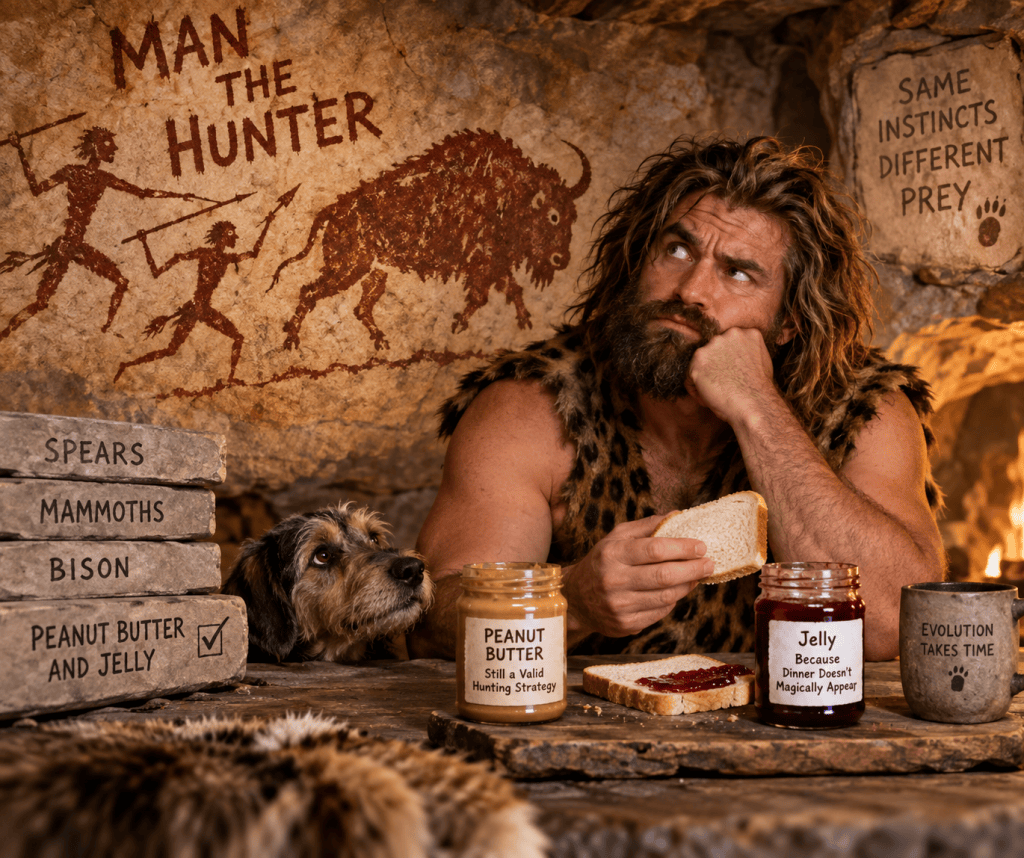
    We used to send these people out to hunt mammoths.

    Or so we’ve been told.

    For thousands of years, we’ve accepted a fairly straightforward account of prehistoric life.

    The men went hunting.

    The women gathered things, tended children, maintained the camp, prepared food and presumably spent a considerable amount of time waiting for somebody to come home with a mastodon.

    But standing there in my kitchen, observing a perfectly capable adult man confronting the possibility that he might have to assemble his own sandwich, I began to have questions.

    Who exactly told us the men were doing all the hunting?

    Because I’m starting to think we need to examine our sources.

    Apparently, much of what we know about prehistoric people comes from archaeological evidence.

    Fair enough.

    But we also have cave paintings.

    And have we considered the possibility that cave paintings were simply prehistoric social media?

    Think about it.

    There’s always some magnificent hunting scene.

    Men with spears.

    Massive animals.

    Action.

    Danger.

    Heroism.

    Very impressive.

    But where are the cave paintings of what happened twenty minutes earlier?

    “Where’s my spear?”

    “I don’t know. Where did you leave it?”

    “Have you seen my good hunting hide?”

    “It’s exactly where you dropped it yesterday.”

    “Is there anything to eat before we go?”

    “There are berries.”

    “I don’t want berries.”

    And then, six hours later, the man returns from hunting, sits down beside the fire and announces that he’s starving.

    Sir.

    There is an entire cave.

    Avail yourself.

    The more I thought about it, the more suspicious I became.

    What if prehistoric men weren’t actually the primary hunters?

    What if they just had better public relations?

    Maybe women were out there doing all sorts of essential things that didn’t make the cave-wall highlight reel because nobody thought gathering roots looked sufficiently dramatic.

    Meanwhile, one guy successfully pokes a bison with a stick and immediately commissions a mural.

    “Make sure you get my good side.”

    Twenty thousand years later, we’re standing in museums admiring it and saying:

    Ah yes. Man the Hunter.

    Are we sure?

    Because I’m looking at the modern evidence and I would like the historical record reopened.

    To be fair, the man in my house did eventually locate the peanut butter and jelly.

    So perhaps the ancient instincts remain.

    The terrain has changed.

    The prey is different.

    But somewhere deep within the male genetic memory, there apparently remains the ability to venture bravely into unfamiliar territory, locate necessary provisions and return alive.

    Granted, the unfamiliar territory was the kitchen.

    And the provisions were in jars.

    But evolution takes time.

    The investigation continues.

  • This morning, WordPress asked me a question.
    If your pet could talk, what would be the first thing it says?
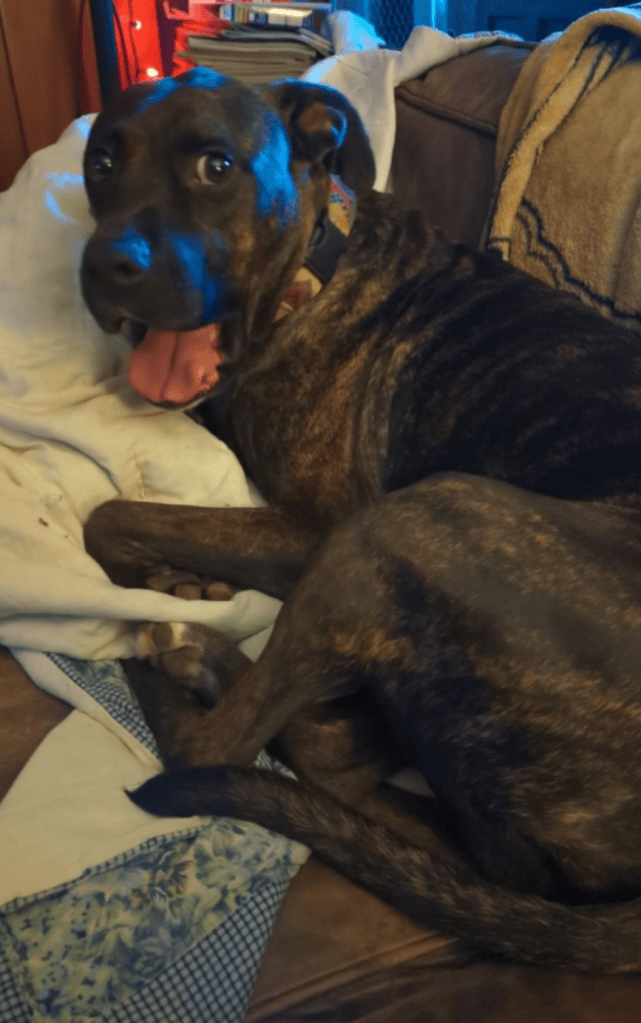
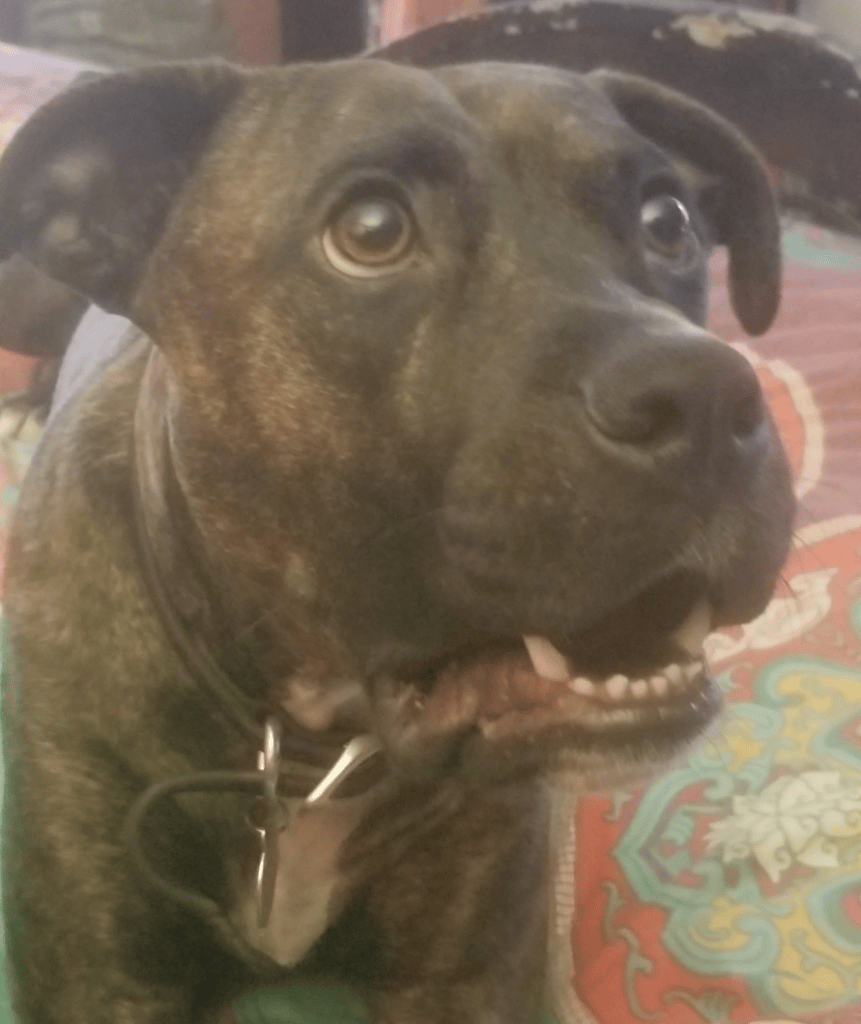
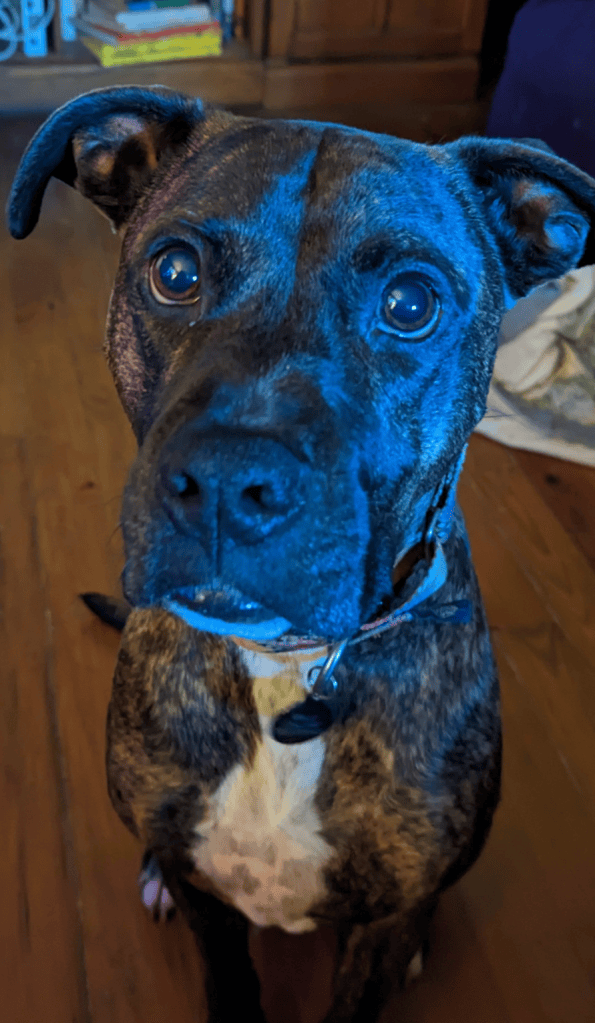
    I looked at Rowdy.
    Rowdy looked at me

    There is no if.

    The only question in this house is: Are you listening?

    Rowdy talks. He has always talked. He talks when he wants something. He talks when he thinks I should be doing something. He talks when I am doing something incorrectly. He has opinions, complaints, requests, rebuttals, and occasionally what I can only assume is commentary on my general performance.

    He especially likes to talk when I’m on the phone.

    Apparently, hearing me engaged in conversation with someone who isn’t him reminds Rowdy that he, too, has something to contribute.

    And before anyone asks, no. He is not a Husky.

    His name is Rowdy, though, and he takes that as a personal challenge.

    I didn’t name him. He came with the name.

    Actually, Rowdy came with a whole backstory.

    My brother originally got him for my nephew. My nephew didn’t want him. My sister had him for a while. And then, in early 2020, Rowdy came to live with me.

    That makes it sound much more orderly than it probably was.

    The important part is that eventually, Rowdy got here.

    And, well…

    He’s just the best.

    Not the best-behaved. Let’s not get carried away.

    The best.

    Over the years, Rowdy and I have developed a language that requires absolutely no English on his part. There are sounds. There are looks. There are very specific expressions. There is positioning. There is staring. There is the occasional escalation when I have clearly failed to understand the first communication.

    And I know what they mean.

    That’s the part that’s hard to explain to someone who hasn’t lived with a dog long enough to become fluent in that particular dog.

    I don’t understand dogs.

    I understand Rowdy.

    Rowdy doesn’t begin by barking. Barking would be rude.

    He starts with the rumbles.

    They’re soft at first, a general airing of the grievance. He’s brought a matter to my attention and, presumably, expects management to address it.

    If management fails to respond appropriately, we move to the aroos.

    The aroos are not a suggestion. By this point, Rowdy has explained himself perfectly clearly and cannot understand why corrective action has not been taken.

    Only if I continue to ignore him does he bark.

    A bark is escalation. A bark means all previous attempts at diplomacy have failed and Rowdy would now like to speak to a supervisor.

    Unfortunately for Rowdy, I am the supervisor.

    This disappoints him regularly.

    Rowdy also knows what time it is.

    I don’t mean he recognizes that morning follows nighttime or that dinner generally happens sometime after afternoon. Rowdy knows when it is time for breakfast and when it is time for dinner.

    And if I have somehow failed to notice the hour, he is happy to bring the matter to my attention.

    Politely, at first.

    There will be a rumble.

    I may choose to pretend I don’t understand the rumble.

    This is foolish, because we both know perfectly well that I understand the rumble.

    Then comes the aroo.

    Ma’am. I believe you will find that dinner is late.

    Continue ignoring him and eventually we arrive at the bark, which is essentially Rowdy filing a formal complaint with management.

    He also asks to go to daycare.

    Not because he needs daycare. Because his friends are there.

    Rowdy has a social life.

    He knows the place. He knows what happens there. And sometimes he would like me to stop whatever nonsense I have planned for the day and take him to see his friends.

    He especially likes to talk when I’m on the phone.

    And I don’t mean he makes noise because I’m paying attention to someone else. Rowdy understands perfectly well what a phone is. There is a person in there, I am talking to that person, and he sees absolutely no reason he should be excluded from the conversation.

    He will aroo while I’m talking until I put the phone on speaker.

    He particularly likes talking to my mom and my sister.

    Once they’re on speaker, he listens. He responds. He participates.

    This is not separation anxiety.

    This is a conference call.

    Rowdy also pouts.

    He ignores me when I’ve displeased him. Deliberately. Demonstratively. There is a significant difference between a dog who happens not to be paying attention to you and a dog who wants you to know that he has heard you and has elected not to respond.

    Rowdy has mastered the latter.

    His entire body can communicate disappointment. His face can communicate disgust. He can lie three feet away from me and somehow make the distance feel personal.

    Again, I return to the WordPress question:

    If your pet could talk…

    What exactly do you people think talking is?

    So when WordPress asks me what Rowdy would say if he could talk, I don’t have to imagine an answer.

    I already know.

    Breakfast.

    Dinner.

    I would like to see my friends.

    Put Grandma on speaker.

    You’re ignoring me.

    I know you heard me.

    And, eventually:

    AROO.

  • Come sit a spell.

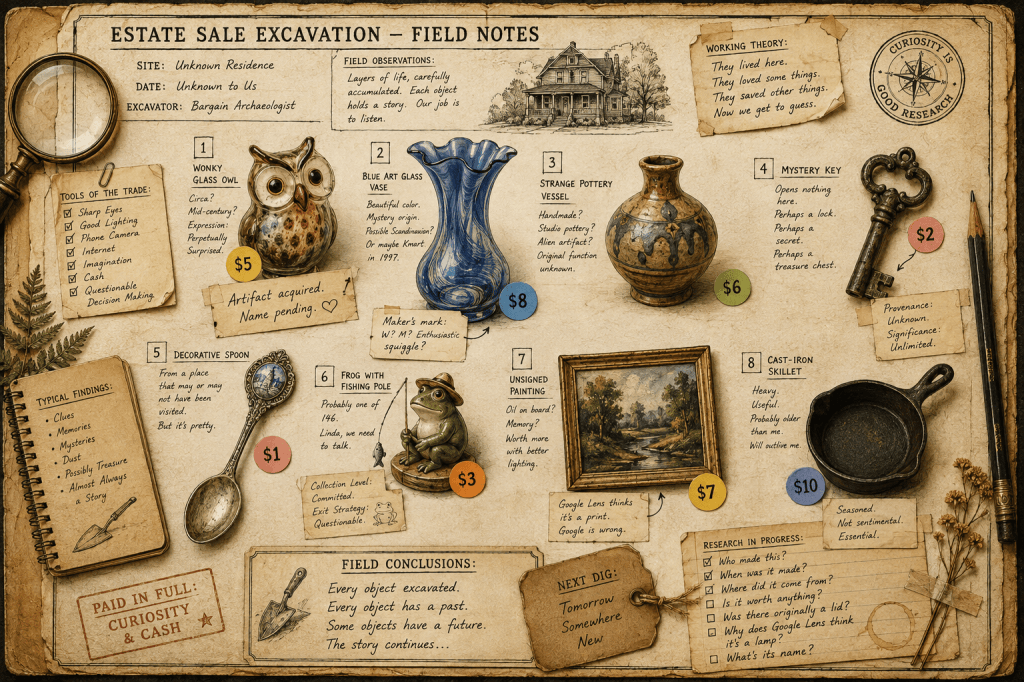
    I love an estate sale.

    Not just because there might be a fabulous piece of glass sitting unnoticed on a back shelf for eight dollars.

    Although let’s not pretend that isn’t a factor.

    I love estate sales because they are essentially archaeology with price tags.

    You walk through the front door of a house belonging to someone you’ve never met and, within fifteen minutes, you have developed an entire theory about their life.

    You don’t mean to.

    It just happens.

    There are three sets of china in the dining room.

    She entertained.

    The garage contains every tool known to mankind, including seventeen screwdrivers that appear to be exactly the same.

    He didn’t trust anybody to put his tools back.

    There’s a sewing room with fabric stacked to the ceiling.

    She had plans.

    There is a cabinet containing approximately four hundred plastic grocery bags.

    Depression-era parents. Those bags were never going to be wasted.

    You know these people now.

    Or at least you think you do.

    That’s part of the fun.

    Estate sales are different from antique stores.

    An antique store has already edited the story.

    Someone has selected the interesting things, cleaned them up, researched them, arranged them attractively and attached a little tag that says:

    Mid-Century Italian Art Glass — $185

    An estate sale says:

    Blue Vase — $8

    Now we’re talking.

    Because that blue vase is sitting exactly where somebody left it.

    Maybe it spent forty years on that mantel.

    Maybe it was a wedding gift.

    Maybe Aunt Margaret brought it back from Italy in 1963.

    Maybe somebody bought it at Kmart in 1997.

    We don’t know.

    But suddenly I need to know.

    So I pick it up.

    Turn it over.

    Look for a signature.

    Hold it toward the light.

    Squint at the bottom.

    Take a picture.

    Google something vague like blue glass vase weird bottom possibly Scandinavian.

    This is research.

    Do not question my methods.

    Meanwhile, the house continues telling its story.

    You learn which holidays mattered.

    Christmas people are easy to identify.

    There are bins.

    So many bins.

    Entire closets devoted to ornaments.

    Possibly a ceramic village extensive enough to require municipal zoning.

    Sometimes you encounter a person who clearly had a thing.

    Owls.

    Roosters.

    Elephants.

    Lighthouses.

    Precious Moments figurines.

    At some point this person casually mentioned liking frogs and made the catastrophic mistake of doing so within earshot of friends and family.

    For the next thirty-seven years, every gift-giving occasion produced another frog.

    Birthday?

    Frog.

    Christmas?

    Frog.

    Retirement?

    Congratulations. Here is a frog holding a fishing pole.

    Eventually the house contains 146 frogs and everyone attending the estate sale assumes the deceased had a lifelong passion for amphibians.

    Maybe.

    Or maybe Linda bought one frog in 1984 and lost control of the situation.

    We will never know.

    Then there are the collections nobody understands.

    A drawer containing twenty-seven bottle openers.

    Nine decorative spoons from places the owners may or may not have visited.

    A basket of keys that open absolutely nothing currently located on the property.

    Every estate sale has keys.

    No one knows what they unlock.

    No one is willing to throw them away.

    They have simply been passed down through generations like tiny metal family secrets.

    And then you find the good stuff.

    Not necessarily the valuable stuff.

    The interesting stuff.

    A strange little piece of pottery.

    An unsigned painting.

    A wonderfully wonky glass owl.

    Something handmade by somebody who clearly had a vision, although what that vision was remains open to interpretation.

    That’s the moment I love.

    Because everyone else has walked past it.

    And something about it makes me stop.

    Sometimes I know immediately what it is.

    Sometimes I haven’t got a clue.

    Sometimes I buy it specifically because I haven’t got a clue.

    Those are dangerous words at an estate sale:

    “What the hell is that?”

    That’s how things come home with me.

    Then the investigation begins.

    Who made it?

    When?

    Where?

    Is that signature a W?

    An M?

    Possibly a very enthusiastic squiggle?

    Is this worth anything?

    Was there originally a lid?

    Why does Google Lens think it’s a lamp?

    And, most importantly:

    What’s its name?

    Because apparently archaeology eventually becomes adoption around here.

    But there’s another part of estate sales that sneaks up on you.

    Every once in a while, you stop looking at the objects individually and see the whole house.

    A life is being dismantled.

    The dishes people ate from.

    The chair somebody sat in every evening.

    The Christmas decorations they unpacked year after year.

    The tools.

    The cookbooks.

    The half-used box of birthday candles.

    The good towels.

    The ridiculous frog collection.

    All the ordinary things that accumulate around a person simply because they were busy living.

    It’s strangely intimate.

    And strangely humbling.

    Eventually, most of our possessions become things somebody else has to decide what to do with.

    Keep.

    Sell.

    Donate.

    Throw away.

    Eight dollars for the blue vase.

    Three dollars for the frog.

    Free box by the driveway.

    That could make estate sales unbearably sad.

    But I don’t usually find them sad.

    There’s something hopeful about them, too.

    Because the story doesn’t necessarily end when the house is emptied.

    Somebody walks in and notices the blue vase.

    Someone else takes home the old cast-iron skillet.

    A granddaughter keeps the Christmas ornaments.

    A woodworker buys the tools.

    And some woman who absolutely does not need another piece of glass spots a weird little owl on a table and says:

    “Well, look at you.”

    Five dollars later, he has a new house.

    Probably a name.

    Possibly an entire backstory.

    And another chapter begins.

    So yes, I go to estate sales looking for treasures.

    Sometimes I even find something valuable.

    But that’s not really why I keep going.

    I like the hunt.

    I like the mystery.

    I like objects with history.

    And I like walking into a house full of seemingly ordinary things and trying to figure out what they tell me about the people who lived among them.

    It’s archaeology.

    Except the artifacts have little round stickers on them.

    And occasionally the archaeologist gets to take one home.

  • I have tossed plenty of books in my life. In frustration, in anger, in absurdity…. But only two stand out in my memory as books I threw. Not casually tossed aside. Thrown.

    My Sister’s Keeper went flying because I was furious. I had invested myself in those characters, in that impossible family, in all that emotional damage, and then came the ending. I couldn’t stand it. I couldn’t understand why anyone would end a book that way. I was mad at the book. I was mad at Jodi Picoult. I was probably mad at literature as a concept.  How – or Why – anyone would do that was simply beyond my comprehension.

    Swan Song was different. Robert McCammon scared the absolute shit out of me. That book gave me nightmares. Actual, sleeping-in-my-bed nightmares. More than one, on multiple days.  It, too, was thrown.

    Both were eventually retrieved when cooler heads prevailed.

    And here’s the problem with calling either one a book I regret reading: they’re magnificent books.

    Isn’t that what a writer wants? To make us feel something? To create people and worlds that follow us after we’ve closed the cover? To make us angry or frightened or devastated enough that decades later, when someone asks whether we’ve ever regretted reading a book, we know exactly which one, or two?

    So yes. I regret reading them.

    And I’m very glad I did.


    View all responses

  • We need to talk about it.  Come sit a spell.

    I have paid the bills.

    Not a bill.

    The bills.

    Electricity. Water. Gas. Insurance. Car. House.

    Money has been electronically dispatched in every direction necessary to maintain my continued participation in modern civilization.

    And I would like some recognition.

    Not a parade.

    That would be excessive.

    But perhaps a small certificate.

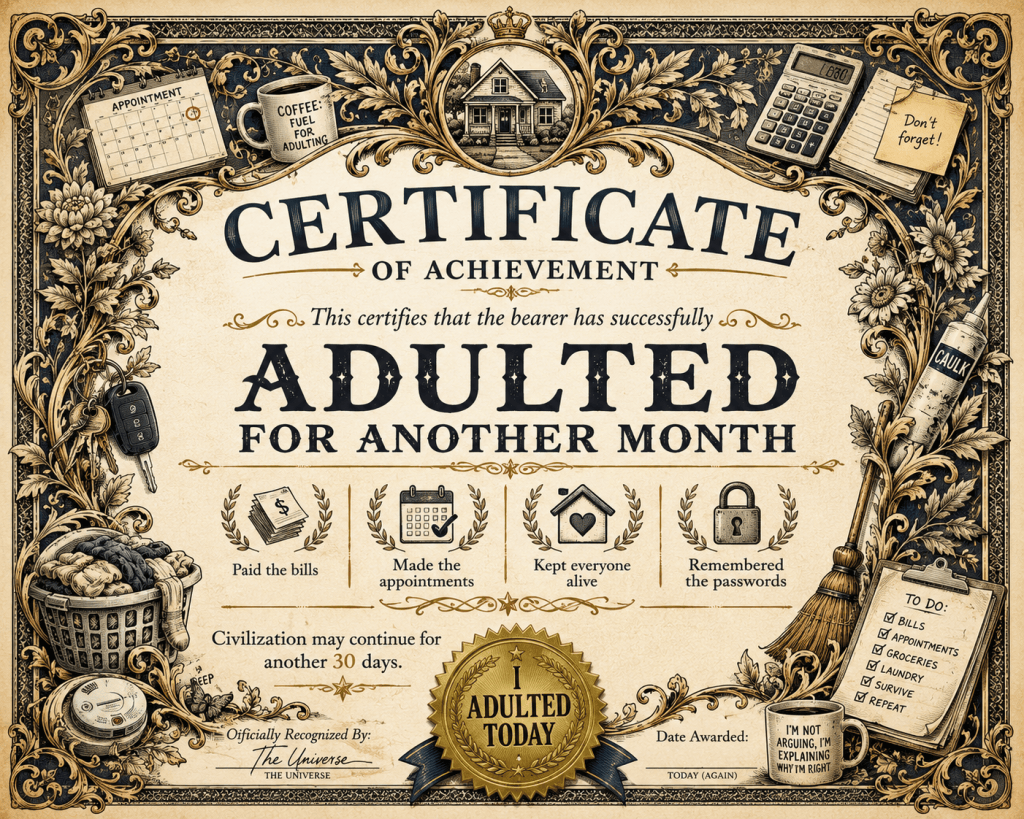
    Congratulations. You Have Successfully Adulted for Another Month.

    Maybe a sticker.

    I would wear the sticker.

    Because here’s the thing nobody adequately explained when we were children:

    Adulting is stupid.

    We were sold an entirely different version.

    When you’re ten, adulthood looks fantastic.

    Adults can stay up as late as they want.

    Adults can eat cookies before dinner.

    Adults can buy things without asking permission.

    Adults can get in the car and just GO SOMEWHERE.

    Nobody stops them.

    There are no permission slips.

    No bedtimes.

    No one standing over them saying, “You can’t have ice cream. You haven’t eaten your vegetables.”

    It looked like freedom.

    And technically, I suppose, it is.

    I can absolutely eat ice cream for dinner.

    But apparently I have to buy the ice cream.

    Which means I have to have money.

    Which means I have to work.

    Which means there are taxes.

    And insurance.

    And retirement accounts.

    And passwords.

    So many passwords.

    Why do I need seventeen passwords simply to exist?

    And every single institution has different requirements.

    One needs twelve characters, a number, a symbol and the blood of a virgin.

    Another doesn’t allow symbols.

    A third says I can’t use any of my previous twelve passwords.

    Sir.

    I am trying to pay you.

    Why are you making this difficult?

    Then there are appointments.

    The dentist would like to see you.

    The eye doctor would like to see you.

    The doctor would like to see you.

    Your car would like an oil change.

    Your insurance company would like to discuss your policy.

    Your bank has an important message.

    Your credit card company wants you to review a statement.

    Your utility company has updated its terms of service.

    I do not care.

    I have never once awakened in the morning and thought:

    You know what would really complete this day? Reviewing Duke Energy’s updated terms of service.

    But adulthood isn’t finished with you yet.

    Because once you’ve paid everybody and made the appointments and changed the passwords and signed the forms, you discover that your house has needs.

    Apparently houses require maintenance.

    This feels like something that should have been disclosed earlier.

    Air filters need changing.

    Gutters need cleaning.

    Smoke detectors start chirping at 2:17 in the morning.

    Appliances develop opinions.

    Trees occasionally attempt entry.

    And there is always something somewhere in the house that needs caulk.

    Nobody tells children about caulk.

    They should.

    Forget algebra.

    Sit those kids down and say:

    “One day you will own property, and you are going to need to know what this tube of goo does.”

    That is practical education.

    And adulthood never ends.

    There is no point where someone comes by, checks your work and says:

    “Excellent. You’ve completed everything. You’re free to go play now.”

    No.

    You finish the laundry and people immediately begin wearing clothes again.

    You buy groceries and people eat them.

    You clean the kitchen and someone requires a glass.

    You pay the electric bill and thirty days later those greedy bastards want more money for more electricity.

    I just paid you.

    What did you do with it?

    And perhaps the greatest betrayal of all is that there isn’t actually an adultier adult coming.

    Remember being young and something went wrong?

    There was always an adult.

    Somebody knew what to do.

    Pipe leaking?

    Get an adult.

    Car making a weird noise?

    Get an adult.

    Strange letter from the government?

    Definitely get an adult.

    Now something happens and you look around for the responsible person.

    And eventually you realize:

    Oh, shit. It’s me.

    I am the adult.

    This seems like a serious oversight in the system.

    I don’t remember applying for the position.

    I certainly wasn’t interviewed.

    And yet here I am, apparently authorized to make decisions involving property, money and other living creatures.

    So yes.

    I paid the bills.

    I handled the paperwork.

    I did the things.

    Civilization may continue for another thirty days because I have fulfilled my administrative obligations.

    And now I would like my sticker.

    Preferably one that says:

    I ADULTED TODAY.

    Because tomorrow somebody is going to need something else.

    And adulting is stupid.

  • LinkedIn Put on a Tie and Called It Networking

    Come sit a spell.

    I deactivated my LinkedIn account.

    Nothing happened.

    My career did not immediately collapse.

    No one arrived to confiscate my résumé.

    A recruiter did not appear on the porch and demand that I surrender my professional credentials.

    I just wasn’t on LinkedIn anymore.

    And I felt better about it almost immediately.

    I’d been thinking about it for a while.

    We have spent years talking about the effects of social media on our mental health.

    We know the drill.

    People post the vacation, not the credit card bill.

    They post the anniversary dinner, not the argument in the car on the way there.

    They post the beautifully renovated kitchen, not the six months they spent washing dishes in the bathtub while threatening divorce over cabinet hardware.

    We know we’re looking at curated versions of people’s lives.

    At least we’re starting to know.

    We’ve had conversations about Instagram and unrealistic expectations. About Facebook and comparison. About TikTok and body image. About filters, influencers, doomscrolling, FOMO, screen time and the strange psychological consequences of knowing what someone you went to high school with in 1987 had for brunch.

    We know social media can mess with our heads.

    But apparently LinkedIn put on a tie, combed its hair on picture day and got a pass.

    Because LinkedIn isn’t social media.

    It’s professional networking.

    Sure, Jan.

    Scroll through LinkedIn for ten minutes.

    Someone has been promoted.

    Someone is thrilled to announce a new position.

    Someone is humbled and honored to receive an award.

    Someone just completed a certification.

    Someone has launched a business.

    Someone has joined an incredible team.

    Someone is celebrating twenty years of professional excellence.

    And someone has written seven paragraphs about leadership because the barista spelled his name wrong.

    Everyone is thriving.

    Everyone is growing.

    Everyone is incredibly excited about what comes next.

    Nobody ever seems to post:

    I applied for thirty-seven jobs and four of them bothered to respond.

    Nobody announces:

    I was passed over for a promotion and spent twenty minutes crying in my car at lunch.

    There aren’t a lot of celebratory graphics for:

    I’ve been doing this for fifteen years and I’m beginning to suspect I have no idea what the hell I’m doing.

    That’s not a criticism of the people posting their accomplishments.

    People should celebrate good things.

    Getting the job matters.

    Earning the degree matters.

    Building the business matters.

    Surviving the project that nearly killed you and getting the little plaque at the end absolutely matters.

    The problem isn’t that people post the good things.

    The problem is what happens when almost everybody posts almost exclusively the good things.

    Especially when you aren’t having a good thing.

    Maybe you’ve lost a job.

    Maybe you’re trying to change careers.

    Maybe you’ve been looking for work longer than you expected.

    Maybe you’re working somewhere that makes you miserable.

    Maybe you’re underpaid.

    Maybe you’re burned out.

    Maybe nothing terrible has happened at all.

    Maybe you’re simply in a rut.

    Then you open LinkedIn.

    Promotion.

    New job.

    Award.

    Certification.

    Promotion.

    Successful launch.

    New business.

    Thrilled.

    Honored.

    Humbled.

    Excited.

    And somewhere between thrilled and humbled, a little voice in your head starts talking.

    Everybody is moving except you.

    Nobody on LinkedIn said that to you.

    That’s important.

    There doesn’t have to be any bullying.

    There doesn’t have to be targeted harassment.

    There doesn’t have to be misinformation or some stranger calling you an idiot in the comments.

    Everybody can be perfectly pleasant.

    The damage can happen entirely inside your own head.

    Because you’re comparing the full, unedited version of your professional life to everybody else’s announcements.

    And then, because apparently we haven’t made this interesting enough, let’s throw imposter syndrome into the mix.

    Now we’re having a party.

    Because if you’re already wondering whether you’re as competent as people think you are, LinkedIn has brought approximately 900 people to provide supporting documentation.

    Look what they accomplished.

    Look what they know.

    Look where they work.

    Look at all those letters after their names.

    Look how confidently they have opinions about synergy.

    Meanwhile, you’re sitting there wondering whether the fact that you had to Google something you’ve supposedly known for twelve years means your entire career has been an elaborate clerical error.

    That’s a hell of an environment for an internal dialogue.

    And here’s the really ridiculous part.

    The person whose post just made you feel inadequate may be sitting at home feeling exactly the same way.

    Maybe she got the promotion and is terrified she can’t do the job.

    Maybe he got the award and still thinks somebody is eventually going to discover he isn’t nearly as good as everyone thinks.

    Maybe she applied for sixty jobs before she got the one she’s thrilled to announce.

    Maybe his marriage is hanging by a thread because of the hours required to become the successful professional you’re currently comparing yourself to.

    Maybe she cried in the bathroom Tuesday morning.

    We don’t know.

    That’s not the part we’re shown.

    So we end up with a digital room full of ordinary, complicated, insecure human beings presenting polished versions of their professional lives to one another.

    And potentially walking away thinking:

    Why does everybody else have their shit together?

    That seems worth talking about.

    Especially because work isn’t some insignificant little corner of our lives.

    For many of us, our profession gets tangled up with identity.

    It affects our income, our security, our confidence, our sense of competence and sometimes our sense of worth.

    There are already professions where burnout, anxiety, depression, substance misuse, perfectionism and suicide are serious problems.

    Maybe adding a constantly updating scoreboard of everybody else’s apparent success deserves a little more scrutiny than we’ve given it.

    Not because LinkedIn is evil.

    It isn’t.

    Not because people should stop celebrating accomplishments.

    They shouldn’t.

    And not because everyone needs to deactivate their account.

    They don’t.

    LinkedIn can be useful.

    People find jobs there.

    People make connections there.

    Businesses find clients there.

    Professionals learn things from one another there.

    All of that can be true.

    And it can also be true that something useful isn’t necessarily good for every person all of the time.

    That’s the part I finally landed on.

    I thought about what being there was doing for me.

    Then I thought about what being there was doing to me.

    I didn’t particularly like the answer.

    So I left.

    Maybe I’ll reactivate it someday.

    Maybe there will be a time when I need what it offers more than I dislike what comes with it.

    But for now, I think I’ll pass.

    Because social media doesn’t stop being social media just because we replace vacation pictures with promotions and selfies with headshots.

    And the effect social media can have on our mental health doesn’t disappear because you put it in a tie and comb its hair on picture day.

    Sometimes comparison is still comparison.

    Even when we call it networking.

  • Come sit a spell.
    It’s quieter on the porch today.
    We’ve lost some people recently who made the world feel a little more colorful, and I’ve been trying to figure out why certain losses seem to hit differently.
    We lose talented people all the time.
    Actors. Musicians. Artists. Writers. People whose work has been woven into our lives for so long that we don’t remember when we first knew their names.
    Their deaths are sad, certainly.
    But every once in a while, we lose someone and it feels like we’ve lost more than their talent.
    We’ve lost a little joy.
    You know the people I mean.
    The ones who seemed genuinely delighted to be here.
    They weren’t necessarily the loudest people in the room, although sometimes they absolutely were. They weren’t perfect. They didn’t need to be.
    There was just something about them that said:
    This is who I am. I rather like being me. And I’m going to enjoy the hell out of this while I’m here.
    There is something wonderfully rebellious about that.
    Because somewhere along the way, most of us learn to edit ourselves.
    Don’t laugh quite that loudly.
    Don’t wear that.
    Don’t be too excited.
    Don’t care too much.
    Don’t be silly.
    Don’t be sentimental.
    Don’t take up too much room.
    Don’t let people see how much you love something because, God forbid, they might think you’re ridiculous.
    So we sand down our edges a little.
    We become more appropriate.
    More measured.
    More careful.
    And perhaps a little less interesting.
    That’s why people who refuse to do that are so damn refreshing.
    They remind us that enthusiasm isn’t embarrassing.
    That delight isn’t childish.
    That being completely, unmistakably yourself can be its own kind of generosity.
    You don’t have to know someone personally to receive that gift from them.
    Maybe they made you laugh.
    Maybe they sang something that lived with you for thirty years.
    Maybe they were gloriously eccentric.
    Maybe they walked into a room wearing something nobody else on Earth would have considered wearing and somehow made you wonder why the rest of us were dressed so boringly.
    Maybe they simply seemed to wake up every morning thinking being alive was a pretty interesting proposition.
    And then they’re gone.
    The world continues, of course.
    It always does.
    But it feels just a little less sparkly.
    I think that’s what I’ve been mourning.
    Not celebrity.
    Not nostalgia.
    Joy.
    The particular kind that comes from people who were unapologetically themselves and seemed genuinely enthusiastic about the business of living.
    We need those people.
    Maybe more than we realize.
    And perhaps the best thing we can do when one of them leaves is resist the temptation to simply admire what made them special.
    Maybe we borrow a little of it.
    Wear the ridiculous earrings.
    Sing too loudly.
    Order dessert.
    Plant the flowers.
    Take the trip.
    Make the thing.
    Tell somebody you love them.
    Laugh until you snort.
    Get excited about something that absolutely nobody else understands.
    Be interested.
    Be curious.
    Be delighted.
    Take up a little room.
    Because there will always be enough seriousness in the world.
    There will always be enough careful.
    There will always be enough people reminding us to behave appropriately.
    What seems to be in shorter supply are people who make the rest of us remember that being alive can be fun.
    And when we lose one of those people, the world really does lose a little joy.
    So maybe today, we make some of our own.

  • Have I introduced…?

    Come sit a spell.

    I have a confession.

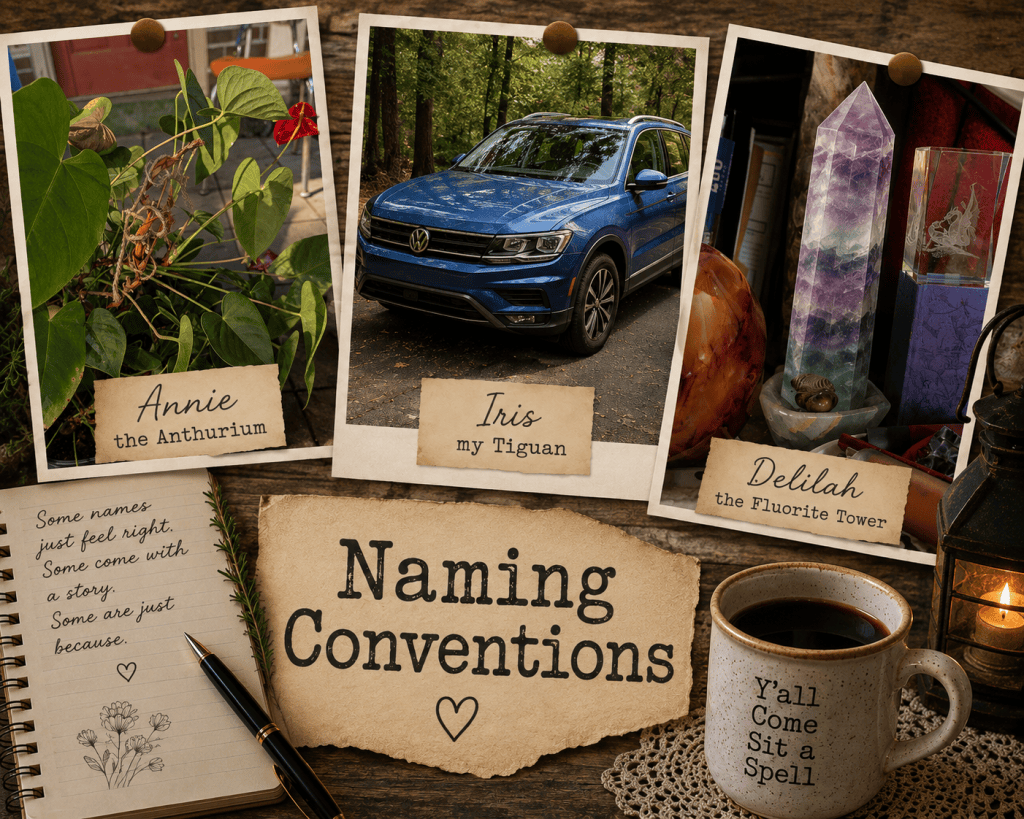
    I name things.

    Not just pets.

    That would be normal.

    I name plants.

    I name pieces of glass.

    I name pottery.

    I name particularly troublesome book projects.

    Anything that spends enough time in my house is at risk of acquiring both a name and an unnecessarily detailed personality.

    I don’t intentionally do this.

    I’ve never brought home an estate-sale vase and thought:

    Excellent. My first order of business will be to establish your identity.

    It just happens.

    I’ll be walking through the house one day, glance at something and think:

    Well, hello, Gloria.

    And that’s it.

    She’s Gloria now.

    I don’t make the rules.

    Occasionally the system is less reliable.

    I will name something, forget what I named it, and give it another name three days later.

    This does not concern me.

    Apparently the object simply wasn’t committed enough to its original identity.

    It happens.

    But then there are the names that arrive fully formed.

    Those are different.

    You don’t choose them.

    You recognize them.

    Bertha.

    Bertha was never going to be an Emily.

    Absolutely not.

    You could look at Bertha from across the room and know that woman has never been an Emily a day in her life.

    Eventually she became Bertha LouEllen.

    Because apparently Bertha alone was insufficient to contain the personality involved.

    BertieLou if she’s being sweet.

    But fundamentally?

    Bertha.

    Forever.

    And this is where people who don’t name inanimate objects begin looking at me strangely.

    I understand.

    From the outside, perhaps it seems unnecessary.

    It’s a vase.

    It’s a plant.

    It’s a rock.

    It’s a book file.

    It does not need a name.

    Counterpoint:

    Have you met it?

    Because that vase may have opinions.

    The plant is unquestionably dramatic.

    The rock has been sitting there looking smug for six months.

    And the book file has caused enough emotional distress to qualify as an immediate family member.

    These aren’t anonymous objects anymore.

    We’ve been through things together.

    Plants are particularly susceptible to naming because plants are already ridiculous.

    Anyone who tells you plants don’t have personalities has never owned a peace lily.

    A peace lily will look perfectly healthy at breakfast and by lunch be collapsed across the pot like a Victorian woman who has just received news from the front.

    You rush over.

    “OH MY GOD. WHAT HAPPENED?”

    Water.

    It wanted water.

    That’s it.

    Forty-five minutes later it’s standing upright again pretending the entire incident never occurred.

    You cannot live with that level of drama and continue referring to it as the plant.

    It needs a name.

    Possibly a middle name.

    The vintage things are different.

    Maybe I name them because they’ve already had lives before they came to me.

    An old piece of pottery sitting on an estate-sale table isn’t just an object.

    Somebody chose it.

    Somebody brought it home.

    It sat on somebody else’s shelf.

    It survived moves and holidays and redecorating and children and grandchildren and decades of people saying, “What are we going to do with that?”

    And somehow it ended up here.

    I don’t necessarily know who made it.

    I don’t know who owned it.

    I don’t know where it spent the last fifty years.

    But I know one thing.

    Her name is Hilda.

    Don’t ask me how I know.

    I just do.

    Then there are the rocks.

    Rocks probably don’t need names.

    In my defense, most of them don’t have them.

    That would be excessive.

    I have standards.

    But every collection eventually contains a few specimens that cross some invisible line from interesting mineral to little dude who lives over there.

    Once that happens, there’s no going back.

    The strange part is that naming something changes the way you talk about it.

    Nobody says:

    “The large peace lily is drooping.”

    No.

    They say:

    “Rita is being dramatic again.”

    And everyone in the household knows exactly what that means.

    Nobody asks:

    “What large, extremely complicated publishing project are you working on?”

    They ask:

    “How’s Bert?”

    And the answer might be:

    “She’s being an asshole.”

    Perfectly normal conversation.

    Maybe that’s really why I do it.

    Names turn objects into stories.

    And I like stories.

    I like wondering where old things came from.

    I like imagining personalities for objects that absolutely do not have them.

    I like having a house full of things that were chosen because they made me stop and look twice, not because they matched the sofa.

    So perhaps it was inevitable that eventually they’d all start introducing themselves.

    Some stay.

    Some get sold.

    Some get propagated.

    Some get revised to 539 pages and sent to Amazon while I whisper threats at them.

    But while they’re here, they’re part of the cast.

    And cast members need names.

    So if you ever come to my house and I say:

    “Careful, Gloria’s behind you,”

    don’t panic.

    There’s probably not another person in the room.

    Probably.

    Just move slowly and ask me who Gloria is.

    I’ll introduce you.


  • Pull up a chair. We need to discuss Smokey the Bear.

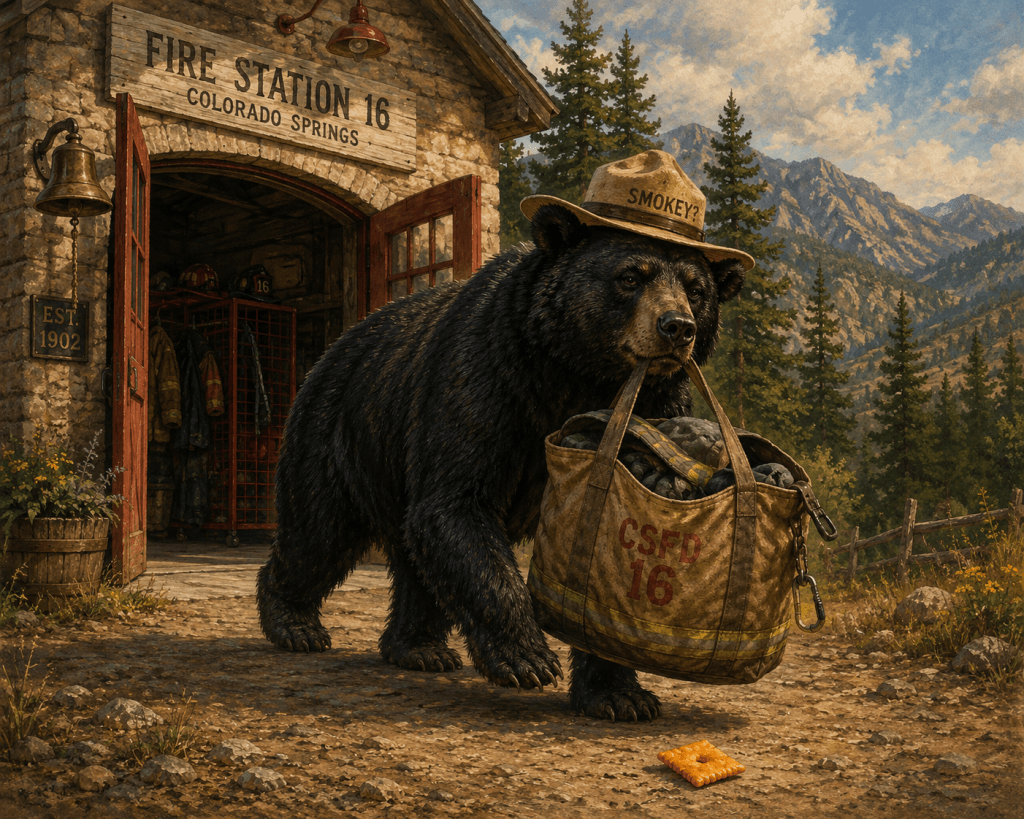
    Apparently, a black bear recently wandered into Colorado Springs Fire Station 16, helped himself to a bag of firefighting gear, and left.

    There is video.

    The Colorado Springs Fire Department, showing precisely the kind of attitude we appreciate around here, suggested that the culprit may have been Smokey himself, apparently ready to take matters into his own paws.

    The official version of events is fairly straightforward: Bear enters fire station. Bear takes gear bag. Bear leaves.

    But I have questions.

    First of all, we’re throwing the word stealing around pretty freely.

    How do we know this bear intended to steal firefighting equipment?

    Have we considered snacks?

    To be perfectly clear, I have absolutely no evidence that there were snacks in that bag. I made that part up.

    But stay with me.

    Colorado Parks and Wildlife describes black bears at this time of year as basically a stomach with a nose. They’re in hyperphagia, the late-summer eating frenzy when they’re trying to pack on weight before winter.

    So I’m supposed to believe that a bear, currently operating primarily as an ambulatory digestive system equipped with an extraordinary sense of smell, wandered into a fire station and thought:

    You know what I need? A gear bag.

    No.

    I submit that somewhere in that bag was a cracker.

    Maybe several crackers.

    Perhaps a granola bar.

    We cannot rule out Cheez-Its.

    And if there was so much as a crumb of anything delicious in that bag, I believe we need to turn our attention to the firefighter who left it unattended.

    Sir.

    You work in Colorado.

    You know there are bears.

    You cannot wander around with a pocketful of delicious crackers and then act surprised when the local wildlife expresses an interest.

    That isn’t theft.

    That’s poor snack management.

    Which brings us to Smokey.

    For generations, we’ve been told that Smokey the Bear simply appeared as a responsible woodland authority figure in a ranger hat, deeply committed to preventing forest fires.

    But what if we’ve been missing the origin story?

    What if Smokey had roguish beginnings?

    Robin Hood didn’t start with a pension plan.

    Perhaps one young bear followed the scent of an irresponsibly stored snack into a fire station, accidentally absconded with some equipment and, upon examining his haul, realized he had found his calling.

    “Well, shit. Guess I work here now.”

    Next thing you know, he’s wearing a hat, educating the public and fronting one of the longest-running public-service campaigns in American history.

    That’s not criminal behavior.

    That’s a redemption arc.

    And frankly, I’m troubled by how quickly everyone has been willing to condemn this bear without investigating the alleged cracker situation.

    The defense therefore requests that all charges be dismissed pending a complete forensic inventory of the gear bag, including testing for cracker crumbs, granola residue and the unmistakable orange dust of a Cheez-It.

    Until then, my client maintains his innocence.

    The defense rests.

    Editor’s note: There is no evidence whatsoever that the bear is actually Smokey, that the bag contained crackers, or that Smokey began his distinguished career in public service following a petty theft. We just think it makes a better story.