
LinkedIn Put on a Tie and Called It Networking
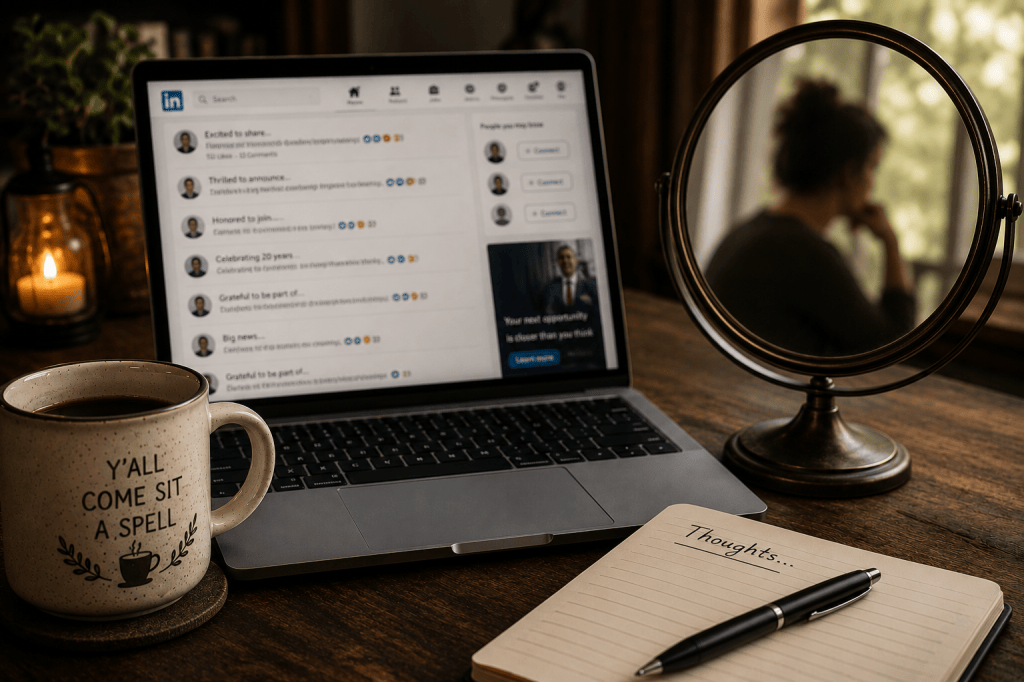
Come sit a spell.
I deactivated my LinkedIn account.
Nothing happened.
My career did not immediately collapse.
No one arrived to confiscate my résumé.
A recruiter did not appear on the porch and demand that I surrender my professional credentials.
I just wasn’t on LinkedIn anymore.
And I felt better about it almost immediately.
I’d been thinking about it for a while.
We have spent years talking about the effects of social media on our mental health.
We know the drill.
People post the vacation, not the credit card bill.
They post the anniversary dinner, not the argument in the car on the way there.
They post the beautifully renovated kitchen, not the six months they spent washing dishes in the bathtub while threatening divorce over cabinet hardware.
We know we’re looking at curated versions of people’s lives.
At least we’re starting to know.
We’ve had conversations about Instagram and unrealistic expectations. About Facebook and comparison. About TikTok and body image. About filters, influencers, doomscrolling, FOMO, screen time and the strange psychological consequences of knowing what someone you went to high school with in 1987 had for brunch.
We know social media can mess with our heads.
But apparently LinkedIn put on a tie, combed its hair on picture day and got a pass.
Because LinkedIn isn’t social media.
It’s professional networking.
Sure, Jan.
Scroll through LinkedIn for ten minutes.
Someone has been promoted.
Someone is thrilled to announce a new position.
Someone is humbled and honored to receive an award.
Someone just completed a certification.
Someone has launched a business.
Someone has joined an incredible team.
Someone is celebrating twenty years of professional excellence.
And someone has written seven paragraphs about leadership because the barista spelled his name wrong.
Everyone is thriving.
Everyone is growing.
Everyone is incredibly excited about what comes next.
Nobody ever seems to post:
I applied for thirty-seven jobs and four of them bothered to respond.
Nobody announces:
I was passed over for a promotion and spent twenty minutes crying in my car at lunch.
There aren’t a lot of celebratory graphics for:
I’ve been doing this for fifteen years and I’m beginning to suspect I have no idea what the hell I’m doing.
That’s not a criticism of the people posting their accomplishments.
People should celebrate good things.
Getting the job matters.
Earning the degree matters.
Building the business matters.
Surviving the project that nearly killed you and getting the little plaque at the end absolutely matters.
The problem isn’t that people post the good things.
The problem is what happens when almost everybody posts almost exclusively the good things.
Especially when you aren’t having a good thing.
Maybe you’ve lost a job.
Maybe you’re trying to change careers.
Maybe you’ve been looking for work longer than you expected.
Maybe you’re working somewhere that makes you miserable.
Maybe you’re underpaid.
Maybe you’re burned out.
Maybe nothing terrible has happened at all.
Maybe you’re simply in a rut.
Then you open LinkedIn.
Promotion.
New job.
Award.
Certification.
Promotion.
Successful launch.
New business.
Thrilled.
Honored.
Humbled.
Excited.
And somewhere between thrilled and humbled, a little voice in your head starts talking.
Everybody is moving except you.
Nobody on LinkedIn said that to you.
That’s important.
There doesn’t have to be any bullying.
There doesn’t have to be targeted harassment.
There doesn’t have to be misinformation or some stranger calling you an idiot in the comments.
Everybody can be perfectly pleasant.
The damage can happen entirely inside your own head.
Because you’re comparing the full, unedited version of your professional life to everybody else’s announcements.
And then, because apparently we haven’t made this interesting enough, let’s throw imposter syndrome into the mix.
Now we’re having a party.
Because if you’re already wondering whether you’re as competent as people think you are, LinkedIn has brought approximately 900 people to provide supporting documentation.
Look what they accomplished.
Look what they know.
Look where they work.
Look at all those letters after their names.
Look how confidently they have opinions about synergy.
Meanwhile, you’re sitting there wondering whether the fact that you had to Google something you’ve supposedly known for twelve years means your entire career has been an elaborate clerical error.
That’s a hell of an environment for an internal dialogue.
And here’s the really ridiculous part.
The person whose post just made you feel inadequate may be sitting at home feeling exactly the same way.
Maybe she got the promotion and is terrified she can’t do the job.
Maybe he got the award and still thinks somebody is eventually going to discover he isn’t nearly as good as everyone thinks.
Maybe she applied for sixty jobs before she got the one she’s thrilled to announce.
Maybe his marriage is hanging by a thread because of the hours required to become the successful professional you’re currently comparing yourself to.
Maybe she cried in the bathroom Tuesday morning.
We don’t know.
That’s not the part we’re shown.
So we end up with a digital room full of ordinary, complicated, insecure human beings presenting polished versions of their professional lives to one another.
And potentially walking away thinking:
Why does everybody else have their shit together?
That seems worth talking about.
Especially because work isn’t some insignificant little corner of our lives.
For many of us, our profession gets tangled up with identity.
It affects our income, our security, our confidence, our sense of competence and sometimes our sense of worth.
There are already professions where burnout, anxiety, depression, substance misuse, perfectionism and suicide are serious problems.
Maybe adding a constantly updating scoreboard of everybody else’s apparent success deserves a little more scrutiny than we’ve given it.
Not because LinkedIn is evil.
It isn’t.
Not because people should stop celebrating accomplishments.
They shouldn’t.
And not because everyone needs to deactivate their account.
They don’t.
LinkedIn can be useful.
People find jobs there.
People make connections there.
Businesses find clients there.
Professionals learn things from one another there.
All of that can be true.
And it can also be true that something useful isn’t necessarily good for every person all of the time.
That’s the part I finally landed on.
I thought about what being there was doing for me.
Then I thought about what being there was doing to me.
I didn’t particularly like the answer.
So I left.
Maybe I’ll reactivate it someday.
Maybe there will be a time when I need what it offers more than I dislike what comes with it.
But for now, I think I’ll pass.
Because social media doesn’t stop being social media just because we replace vacation pictures with promotions and selfies with headshots.
And the effect social media can have on our mental health doesn’t disappear because you put it in a tie and comb its hair on picture day.
Sometimes comparison is still comparison.
Even when we call it networking.


Leave a Reply