• Have you ever liked a villain more than the hero? Who and why?
    Have I ever liked a villain more than the hero?

    Of course I have.

    Heroes are admirable. Heroes are brave. Heroes arrive at the appropriate moment, make the difficult choice, save the day, and usually stand around looking noble while the music swells.

    But then Loki walks into the room.

    Suddenly, I’m considerably less interested in who is supposed to win.

    Villains often get the better entrance, the better clothes, the better dialogue, and the freedom to be complicated in ways heroes rarely are. Heroes are expected to be good. Villains are allowed to be brilliant, wounded, charming, petty, theatrical, terrifying, and funny, sometimes within the same five minutes.

    They are also allowed to ask uncomfortable questions.

    Medusa has been called a monster for centuries, but which version of her story are we telling? In the version most of us recognize, she is punished after being violated in Athena’s temple. Her hair becomes snakes. Her gaze turns men to stone. Eventually, Perseus kills her and carries her severed head around as a weapon.

    He becomes the hero.

    She becomes the monster.

    Funny how often history works that way.

    Maleficent was the evil fairy who cursed a baby because she wasn’t invited to a party. That is certainly one way to tell it. Later versions asked what might exist beneath all that fury. What if she had been betrayed? What if something precious had been taken from her? What if the woman labeled evil had a story that began long before she entered the room?

    Understanding the villain does not automatically make her innocent. It does, however, make the hero’s version of events feel a little less complete.

    The Wicked Witch had her sister killed when a house dropped out of the sky. Before the body was even cold, a stranger took the dead woman’s shoes.

    Yes, I know there was more going on.

    Still. It is worth mentioning.

    Sometimes the villain is simply the person who did not get to tell the story first.

    Then we have characters like the Joker.

    There is no single definitive Joker. He changes depending on who is writing him and, perhaps more importantly, who is playing him. Sometimes he is a criminal mastermind. Sometimes he is chaos in face paint. Sometimes he is the product of cruelty, isolation, mental illness, and a society that failed to notice him until he became dangerous.

    Learning how someone became monstrous is not the same as excusing the monster.

    That distinction matters.

    But the Joker remains compelling because he forces us to look at the thin, uncomfortable line between explanation and absolution. We can recognize someone’s pain without approving of what they do with it. We can understand the road without agreeing to follow it.

    And then there are the villains we love because an actor picked up what was on the page and transformed it into something unforgettable.

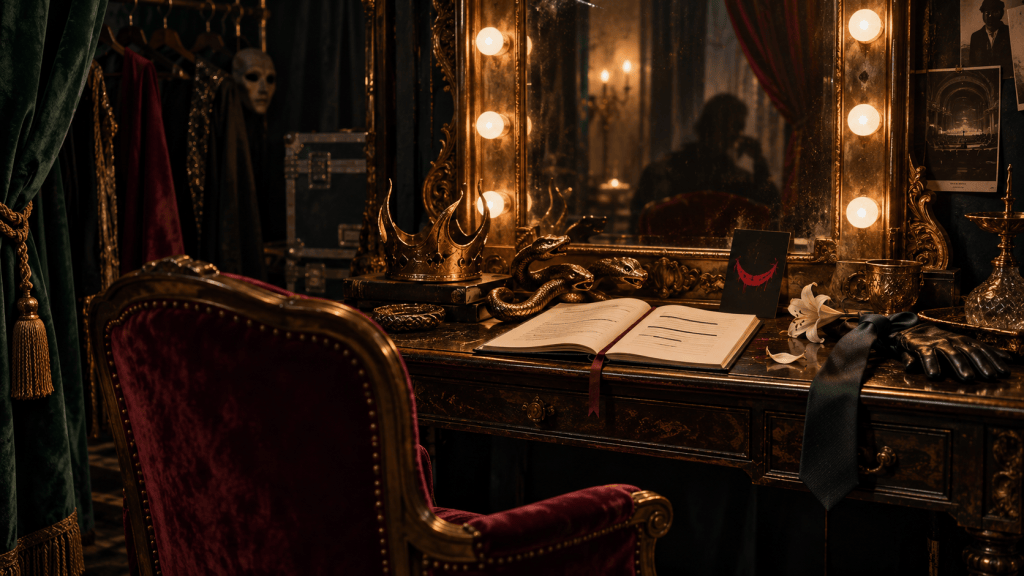
    Loki could have been a standard jealous brother with excellent cheekbones and a questionable relationship with planetary domination. Tom Hiddleston gave him something more. His Loki is arrogant, wounded, dangerous, lonely, ridiculous, elegant, and always performing. Beneath every threat is a child who still wants someone to tell him he was enough.

    Someone else may eventually wear the horns, and I feel deeply sorry for that person.

    They will not simply be playing Loki. They will be standing in Hiddleston’s beautifully tailored shadow while millions of people examine every smirk, pause, head tilt, and emotionally compromised syllable.

    Anthony Hopkins appears in The Silence of the Lambs for only a small portion of the film, yet Hannibal Lecter haunts every minute of it. He is cultured, articulate, observant, and utterly horrifying. Hopkins did not need elaborate violence to make him frightening. He used stillness. He made courtesy feel threatening. He turned a quiet conversation into something that crawled under your skin and stayed there.

    Then there is Hans Gruber.

    John McClane may be the hero of Die Hard, but Hans Gruber owns the building long before he falls from it. Alan Rickman gave what could have been a standard action-movie terrorist elegance, intelligence, impatience, humor, and impeccable timing.

    Hans Gruber does not merely enter Nakatomi Plaza.

    He arrives.

    That is what a great actor can do for a villain. They find the crack in the character and let us glimpse what lives inside. Sometimes it is pain. Sometimes it is vanity. Sometimes it is rage, charm, loneliness, or the quiet certainty that everyone else in the room is beneath them.

    The actor gives us something the character may not have possessed on the page.

    Flavor.

    Nuance.

    Humanity, even when the human in question is doing spectacularly inhuman things.

    Perhaps villains interest us because they are allowed the contradictions we recognize in ourselves. Most of us are not entirely noble. We have been hurt. We have been angry. We have imagined the devastating speech we would deliver if anyone ever gave us the microphone and proper lighting.

    We do not necessarily want the villain to win.

    We may not forgive them, defend them, or believe they were right.

    But we want to know why.

    We want to understand who they were before the horns, the snakes, the scars, or the perfectly tailored suit. We want to know whether they were born monstrous, made monstrous, or simply called a monster by someone who benefited from the label.

    The hero may save the day.

    But the villain is usually the one we are still discussing afterward.

    After all, the devil gets the better lines.
  • There is something about a cauldron.

    You can call it a pot. You can point out that, historically speaking, people cooked in the damn things. You can remind me that most modern “cauldrons” have never simmered anything more dangerous than potpourri.

    I do not care.

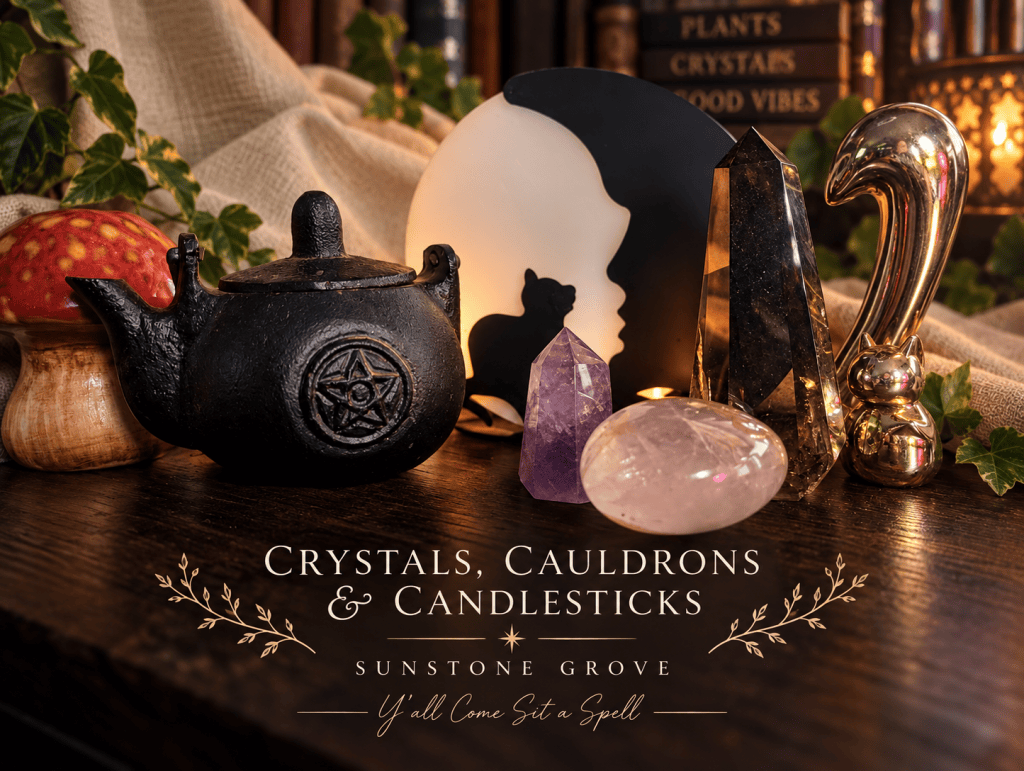
    Put a heavy black cauldron in the corner of a room, add a few old candlesticks, scatter some interesting rocks nearby, and suddenly the place has possibilities.

    Not necessarily supernatural possibilities.

    Although I’m not ruling anything out.

    I have always been drawn to things that feel as though they have a story. Old glass. Tarnished silver. Stones that look like somebody picked them up beside a river seventy years ago and couldn’t quite bring themselves to throw them away. Bowls with worn edges. Candlesticks with wax still clinging to them. Things made by somebody’s hands.

    And, apparently, things that make other people ask:

    “What are you going to do with that?”

    Listen.

    If I knew what I was going to do with everything I brought home, half the fun would be gone.

    The Crystal Situation

    Crystals are particularly entertaining because people tend to fall into camps.

    There are the people who can tell you exactly which stone belongs with which chakra, moon phase, planetary alignment, emotional crisis and Tuesday afternoon.

    There are the people who think all of that is complete nonsense.

    And then there are people like me, standing somewhere in the middle, holding a particularly pretty piece of labradorite up to the light and saying:

    “Well, whatever else it does, LOOK AT THAT.”

    Because perhaps rose quartz attracts love.

    Perhaps amethyst brings calm.

    Perhaps black tourmaline protects your energy.

    Or perhaps human beings have been picking up beautiful rocks since the beginning of human beings because beautiful things make us happy.

    Those ideas are not mutually exclusive.

    I don’t need a crystal to pass a peer-reviewed double-blind study before I allow it to sit on my windowsill and make me feel better about the state of the world.

    We give meaning to things constantly.

    Wedding rings.

    Grandmother’s china.

    A shell picked up on vacation.

    A concert ticket tucked into a drawer for twenty years.

    A coffee mug nobody else in the house is allowed to use.

    Nobody demands scientific proof that those things hold something for us.

    They simply do.

    And Then There’s the Cauldron

    The cauldron has suffered terribly from public relations.

    Thanks to several centuries of witches being depicted hunched over bubbling green goo, you cannot put one anywhere without somebody assuming eye of newt is imminent.

    Which is unfortunate, because the cauldron might be one of the most practical symbols we have.

    You put things in.

    They change.

    That’s it.

    Soup does it.

    Stew does it.

    Herbs steep in water.

    Wax melts.

    Plants become dye.

    One thing goes in and something different comes out.

    If you want a metaphor for transformation, humanity has been using the same cookware for thousands of years.

    There is nothing particularly silly about that.

    Besides, I find it deeply comforting that one of the great symbols of witchcraft is basically a sturdy piece of kitchen equipment.

    Of course it is.

    Women have been doing astonishing things with whatever was within reach forever.

    Candlesticks Are Where We Get Fancy

    Candles may be my favorite because they require almost no explanation.

    We understand candles.

    We put them on birthday cakes and make wishes.

    We light them in churches.

    We light them when someone dies.

    We light them at dinner because apparently pasta becomes 37 percent more sophisticated in low lighting.

    We light them when the power goes out.

    We light them because they smell like apples and cinnamon and somebody at Target convinced us September had arrived six weeks early.

    Flame marks things.

    Beginnings. Endings. Celebration. Mourning. Hope. Memory.

    You can call lighting a candle a ritual or you can call it Tuesday night.

    Again, the line is thinner than we pretend.

    Maybe That’s What I Like About All of It

    The older I get, the less interested I am in arguing about what counts as magic.

    There is enough mystery in ordinary life.

    Seeds know when to break open underground.

    Trees spend an entire season appearing dead and then casually return.

    The moon moves oceans.

    A smell can put you back in a kitchen that no longer exists with a person who has been gone for years.

    Tell me again how thoroughly we have everything figured out.

    I am comfortable leaving a few question marks lying around.

    I don’t need every old practice to be sacred.

    I don’t need every superstition to be true.

    I don’t need every crystal to vibrate at precisely the correct frequency or every herb hanging by a doorway to be protecting the house from anything more sinister than an enthusiastic mosquito.

    Sometimes a thing can simply remind us of what we want.

    Peace.

    Protection.

    Courage.

    Abundance.

    Rest.

    A little more beauty.

    A little less bullshit.

    That seems useful enough.

    The Women Who Came Before Us Knew Something

    Not necessarily spells.

    Not necessarily secrets whispered beneath a full moon.

    Just things.

    Which plant soothed a cough.

    What weather was coming by the smell of the air.

    When to plant.

    When to preserve.

    How to feed six people with almost nothing.

    What tea settled a stomach.

    What neighbor could be trusted.

    When somebody walking up the road meant trouble.

    Some of it was passed down. Some of it was learned the hard way. And a whole lot of it came from simply paying attention.

    Knowledge gets romanticized once enough generations pass.

    What we now call folklore was often simply somebody paying very close attention.

    And I think there is something worth reclaiming in that.

    Not some fantasy version of the past where every grandmother was secretly brewing potions in the holler.

    They weren’t.

    But generations of women carried knowledge, habits, rituals and instincts through ordinary life. Much of it never made its way into official histories because it happened in kitchens, gardens, sickrooms, fields and conversations between one generation and the next.

    It didn’t have to be mystical to matter.

    They knew things because they watched. They listened. They remembered. And then they taught somebody else.

    That is plenty magical for me.

    So Yes, There Will Be Crystals

    There will probably be candlesticks.

    There may very well be a cauldron sitting somewhere with flowers growing out of it because I contain multitudes and apparently one of them is a slightly feral garden witch.

    There will be herbs.

    There will be old things whose original purpose I do not know.

    There will be things collected purely because they are beautiful.

    And there will always be room for a little mystery.

    Somewhere along the way, all of that acquired a name.

    Crystals, Cauldrons & Candlesticks.

    Of course it did.

    It wasn’t really a brand when the name appeared. It was more of a shorthand for this particular corner of the Grove. The curious things. The beautiful things. The things with stories, and the things that make us wonder whether they might have stories even when we don’t know what they are.

    Apparently, once you give something a name, it has a tendency to grow.

    We’ll see where it goes.

    In the meantime, you are welcome to believe every crystal has a purpose.

    You are welcome to believe it is just a rock.

    Either way, hand me that smoky quartz.

    It would look fantastic beside the cauldron.


  • What’s the longest book you’ve ever read?

    I don’t know.

    I have read The Priory of the Orange Tree. I have read Atlas Shrugged. Both are books sturdy enough to serve as emergency furniture. I am sure there have been other beasts along the way, but I couldn’t tell you which one was the longest without looking up the page counts.

    I have never once measured a book before deciding whether it deserved my time.

    The question feels like it expects a contest. Name your largest literary conquest. Present the enormous book you successfully defeated. Collect your medal at the library desk.

    But reading is not a winner-takes-all situation.

    Finishing a thousand-page novel does not make someone a better reader than the person who spent an afternoon delighted by a two-hundred-page mystery. Page count is not a measure of intelligence, commitment, or literary worth. It only tells us how much room the author used.

    Sometimes reading is a vacation for the brain. We check into someone else’s world, unpack our imagination, and stay awhile.

    Sometimes it is a laboratory. We experiment with uncomfortable ideas, examine human behavior, and safely ask what might happen if the rules changed.

    Sometimes it is a classroom. We meet people we would never otherwise know. We walk through histories we did not live and places we may never see.

    And sometimes we simply need to escape our own lives for a few hours.

    None of those experiences becomes more valuable because the book is heavier.

    Still, when an author asks me to remain for eight hundred or a thousand pages, world-building matters. You had better build me somewhere worth living.

    The world has to feel larger than the chapter I am standing in. I need to understand its rules, believe its history, recognize its people, and trust that something exists beyond the edge of the page. I want texture. I want details that suggest lives are continuing even when the characters are not directly in front of me.

    A long book cannot merely contain more events. More things happening is not the same as depth.

    Give me a world capable of holding me.

    That is what makes a massive book disappear. I do not notice how many pages remain because I am not dragging myself toward the finish line. I am living there. I know the roads. I understand the grudges. I have opinions about people who do not exist. I am worried about a kingdom, a family, a dragon, or an ideological argument that has absolutely no bearing on whether I remembered to move the laundry.

    The book becomes not a challenge to complete, but a place I am reluctant to leave.

    That is why large books should be normalized instead of treated as either terrifying obstacles or trophies of intellectual endurance. Some stories require more room. Some worlds need hundreds of pages before we can fully understand them. If the author has done the work, staying for all of them is not a hardship.

    It is a privilege.

    The better question was never, “What’s the longest book you’ve ever read?”

    Ask me what kind of world made me willing to stay that long.

    Ask me which characters continued living in my head after I closed the cover. Ask me which ideas followed me home. Ask me which book changed the way I understood something, or gave me somewhere to hide when my own world became too loud.

    Those answers tell you something about a reader.

    A page count does not.

    Nine hundred pages in a fully realized world can feel like leaving too soon.

    Fifty pages in a hollow one can feel like a hostage situation.

  • What’s the best advice you’d give to someone younger than you?

    I could tell you to save money. Wear sunscreen. Take the pictures, even when you don’t like how you look in them. All solid advice. None of it is the thing I most wish I’d understood earlier.

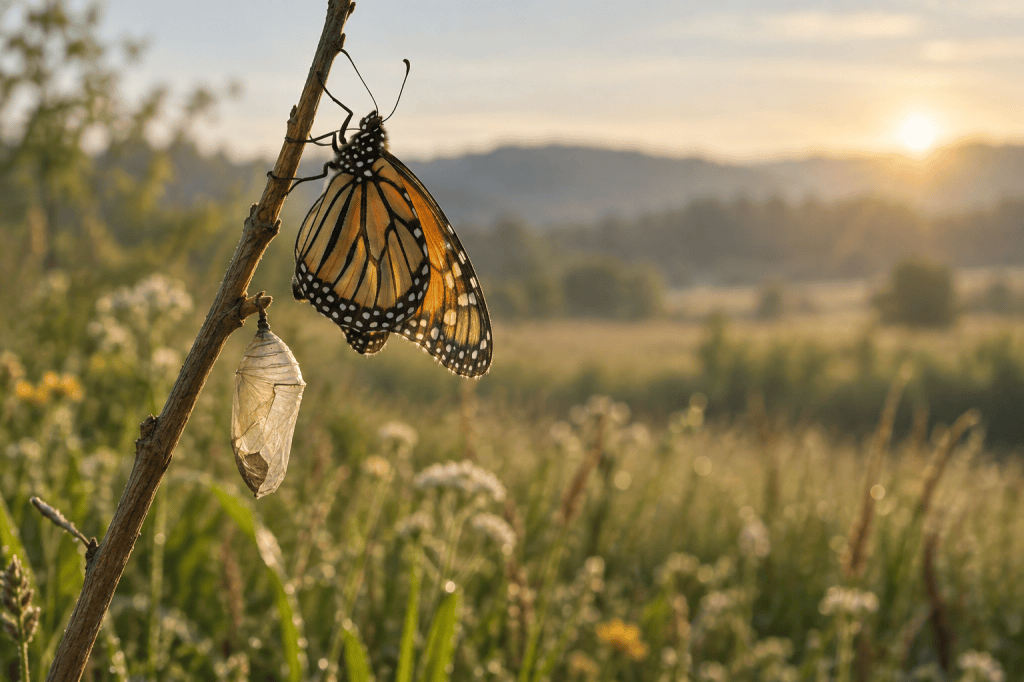
    I would tell you that the life you imagine is allowed to change.

    That sounds simple until you’ve spent years building yourself around a particular version of the future. You know where you’re going, who will be beside you, what you’ll do when you get there. You may not have every detail worked out, but you can see enough of it to believe you’re headed somewhere.

    Then something happens. Sometimes it’s catastrophic. Sometimes it’s a slow accumulation of smaller things. Sometimes nothing terrible happens at all, and you simply realize that the person you’ve become no longer wants the life the person you used to be planned.

    Any one of those can leave you standing there with a map that doesn’t match the road.

    People are quick to tell you to move on. They may mean well. They may be uncomfortable watching you grieve a future they can’t see. But you’re allowed to grieve it. A life doesn’t have to have happened for its loss to hurt. You can miss the plans you made, the person you expected to become, and all the ordinary Tuesdays you thought you’d get to live.

    What I wish someone had told me is that grieving one future doesn’t mean you’ve given up on having another.

    This morning I watched Michael J. Fox speak about living with Parkinson’s. He talked about accepting his diagnosis without surrendering to it. I keep turning that distinction over in my mind. Acceptance asks you to see what is true. Surrender tells you there’s nothing left to do. Those are very different places to stand.

    He couldn’t keep the future he’d imagined before his diagnosis. That loss was real. So was the life and the work he built afterward. It would be cruel to point to everything he accomplished and suggest the disease was somehow a gift. He did those things while carrying something hard. His courage lies partly in refusing to let that hardship be the only thing his life could mean.

    I remember a story about a woman whose husband was a firefighter killed on 9/11. The story told of their love, their family, and the life they had together. At the end, it mentioned that she had healed and found love again.

    That ending stayed with me. She didn’t get their life back. Loving someone else didn’t make the loss smaller, or replace the man she’d loved. There was simply more life ahead of her than she could have seen in the worst moment of it.

    We tend to talk about healing as though it finishes a job. As though one day you put the old life away and step neatly into the new one. I don’t think people work that way. You can carry a love forward and make room for another. You can ache for what was supposed to happen and still be glad for what did. You can have a good day without declaring all the bad days over.

    Perspective isn’t pretending things turned out fine. It’s being able to see more than one truth at once.

    Perseverance isn’t always a dramatic speech or a heroic decision, either. Sometimes it looks like getting up and making coffee. Sometimes it’s taking care of the people who are still here. Sometimes it’s laughing at something you didn’t expect to find funny and feeling a little guilty, until you realize laughter was never the enemy of love.

    And sometimes perseverance means admitting that the vision itself needs to change.

    That part can be frightening even when no catastrophe caused it. We talk about following a dream as though a dream arrives fully formed and waits patiently for us to execute it. In my experience, dreams are considerably less organized. Mine have left notes in odd places, vanished for a while, then shown up years later and acted as if we had an appointment.

    I almost started a blog a long time ago. I say “almost” because the bones were there. I had things to say. I had thoughts I’d return to, little scraps of stories, arguments, observations, and the occasional line that made me laugh at my own cleverness. I could picture a place for them. I just didn’t take the steps that would make that place real.

    I’ve thought about those earlier attempts several times this month. It would be easy to look backward and scold myself. Why didn’t I start then? Why did I let fear of what people might think get between me and something I wanted to do? Imagine what I could have built by now if I’d just gone ahead.

    That last one is particularly seductive. The imaginary blog I started years ago has had years to grow. Of course she looks impressive from here. She never had to survive an actual Tuesday.

    The truth is, I wasn’t ready then. The ideas were real, and so was the fear. Both belonged to the person I was at the time. I can wish I’d begun sooner without treating that version of me as a failure.

    Here I am now. The blog exists. The words have somewhere to go. People are reading them, including people I’ve never met. Some names keep appearing. New ones show up, too. After all those years wondering whether anyone would like what I had to say, I’m finally giving them the chance to decide for themselves.

    I don’t think I could have forced this version of the porch into existence twenty years ago. I could have started something, certainly. Maybe it would have lasted. Maybe it would have taught me what I needed to know. But this place, with this voice and this life behind it, could only be built by the woman who is here now.

    The time had to come to me.

    I know that can sound like an excuse when you’re young and impatient, or older and angry about the years you think you wasted. I’m not suggesting you sit around waiting for a sign. Take the step you can take. Write the paragraph. Buy the notebook. Tell someone what you’re dreaming about. Try, if you’re able to try.

    I am saying that an idea doesn’t expire because it hasn’t become a finished thing yet. You can come back to it with more experience, a different voice, or a better understanding of why it matters to you. The bones may still be there. They may be waiting for you to see what they can hold now.

    This applies to plans that fall apart, too. The new vision isn’t always visible on the day the old one breaks. You may have no interest in hearing that something else could be beautiful. You may need to sit with what happened, and nobody gets to set a deadline for when you’re done.

    But someday you might notice a door you didn’t know was there. You might walk through it because you’re curious, or because you have no idea what else to do. You might find people on the other side. Work that matters to you. A laugh you thought you’d lost. Love you hadn’t expected.

    You can be grateful for those things without being grateful for the circumstances that led you to them.

    That’s an important distinction. I don’t want to turn someone’s devastating loss into a tidy lesson about how everything happens for a reason. Some things happen and they are awful. People make what they can of the life afterward because they are still alive and that life belongs to them.

    Sometimes what they make is beautiful. Sometimes it is better than what they could have imagined before. That doesn’t mean the loss was necessary. It means the human capacity to keep loving and creating is bigger than the first map we drew.

    So if I were sitting across from someone younger than me, I’d tell them this:

    Make plans. Want things. Give yourself the pleasure of imagining a future. When you can take a step toward it, take one.

    And if the road changes, let yourself be upset. Grieve what you have to grieve. Then, when you’re able, look around. You may need a new vision. You may need to return to an old one with different eyes. You may discover that a dream you thought you missed has been quietly keeping a chair for you.

    You haven’t failed because your life looks different from the one you pictured.

    And you haven’t missed your chance just because it hasn’t come yet.

  • Come sit a spell.

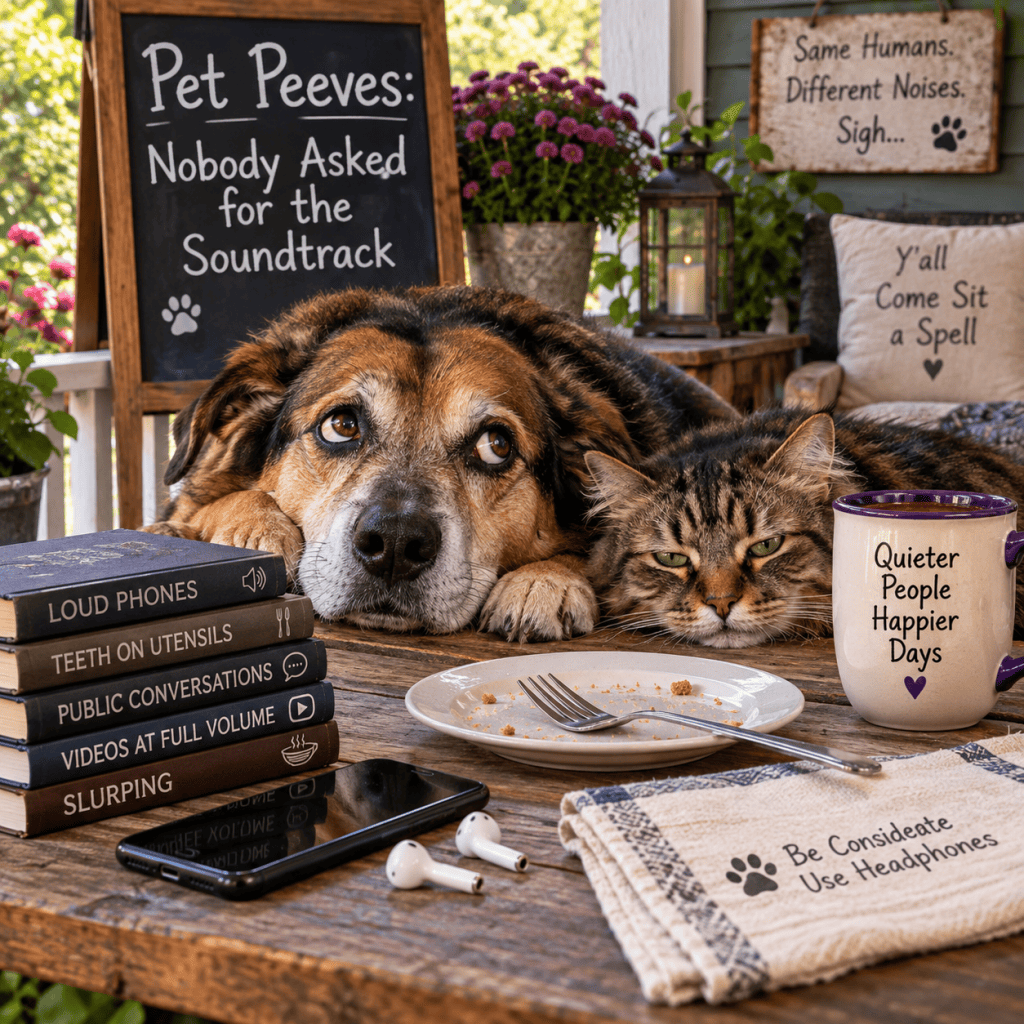
    We need to talk about pet peeves.

    Not the important things.

    There are plenty of genuinely terrible things happening in the world, and I am capable of having proportionate, adult reactions to those.

    This is not about those things.

    This is about the tiny, relatively harmless behaviors that cause an entirely disproportionate reaction somewhere deep within my soul.

    I know they’re petty.

    I know nobody is actually being harmed.

    I know I should probably just let them go.

    I will not.

    Let’s begin with teeth on utensils.

    Why?

    Why are your teeth involved?

    The fork has completed its assignment.

    It successfully transported the food from the plate to your mouth.

    At this point, the fork’s work is done.

    Close your lips.

    Remove the fork.

    There is absolutely no reason for your teeth to scrape down the tines on its way out.

    SCRRRRAPE.

    I felt that in my spine just typing it.

    I don’t know what evolutionary response this activates in me, but it is immediate and profound.

    Every muscle in my body tightens.

    My shoulders rise.

    My teeth hurt in sympathy.

    Some primitive part of my brain begins evaluating exits.

    And the person doing it?

    Completely unbothered.

    Just sitting there.

    Eating.

    Possibly preparing to do it again.

    I am watching the fork now.

    I cannot participate in the conversation because all available resources have been redirected to fork surveillance.

    Please don’t.

    Please don’t.

    Please don’t.

    SCRRRRAPE.

    I have to leave.

    Which brings us naturally to slurping.

    Soup.

    Coffee.

    Noodles.

    I don’t care what we’re consuming.

    Unless the food is actively attempting to escape your mouth, I see no reason suction should be involved.

    There are cultures where slurping is completely normal and even appreciative.

    I understand this intellectually.

    I respect cultural differences.

    I also know that if I am sitting beside you while you repeatedly SHHHHLLLLURP something into your mouth, I may need to excuse myself before international relations deteriorate.

    This is my issue.

    I accept that.

    But I cannot fix it.

    Then we arrive at one of the great technological scourges of modern civilization:

    The person using a phone in public without headphones.

    Oh, Lacey.

    Come here.

    We need to talk.

    I don’t know Lacey.

    There may not even be a Lacey.

    But somewhere, right now, a Lacey is sitting in a waiting room having a full-volume conversation with her BFF.

    And now we’re all in it.

    We know where she went Friday night.

    We know what Trevor said.

    We know what she said Trevor said.

    We know what her mother thinks about Trevor.

    We know Trevor’s ex has apparently been “doing too much.”

    I didn’t ask for this.

    None of us asked for this.

    Yet here we sit, involuntary members of Lacey’s inner circle.

    And speakerphone somehow makes it worse.

    Because now I don’t just know Lacey’s business.

    I know Brittany’s business, too.

    Brittany sounds tired.

    Frankly, I don’t blame her.

    Then there are videos.

    TikTok.

    YouTube.

    Reels.

    Whatever we’re watching today.

    At full volume.

    In public.

    Without headphones.

    Why?

    Headphones exist.

    Earbuds exist.

    Some of them cost less than the coffee you’re currently drinking.

    Yet apparently twelve people sitting in an airport gate should all listen to a forty-seven-second video of a man shouting about a life hack involving aluminum foil.

    And because the algorithm has apparently decided that one wasn’t enough, we’re going to hear another.

    And another.

    And another.

    I don’t even know what you’re watching.

    All I hear is:

    “OH MY GOD YOU GUYS—”

    Swipe.

    Music.

    Swipe.

    Someone screaming.

    Swipe.

    “HERE ARE FIVE THINGS—”

    Please.

    I am begging you.

    There was once a social contract.

    We all understood that being in public meant making tiny accommodations for the fact that other humans were also occupying the space.

    You didn’t need to become invisible.

    You could talk.

    You could laugh.

    You could exist at full human size.

    You just maintained a vague awareness that nobody else had agreed to participate in your personal audio experience.

    Somewhere along the way, we lost that.

    Now everyone’s phone is a tiny portable television, radio station, movie theater and conference room, and apparently the rest of us have been automatically subscribed.

    No.

    I would like to unsubscribe.

    Immediately.

    And here’s the thing about pet peeves.

    I don’t actually think people who scrape forks across their teeth are bad people.

    I’m sure some of them volunteer.

    They probably remember birthdays.

    They may be excellent tippers.

    Lacey could be delightful.

    She may rescue senior dogs and make an outstanding pound cake.

    I don’t wish any of these people harm.

    I simply wish them silence.

    Beautiful, glorious silence.

    Eat your soup quietly.

    Remove the fork without involving your incisors.

    Put in your earbuds.

    Text Brittany.

    Please.

    Because I am trying very hard to be a reasonable person.

    And you are making noises.

  • What’s one thing that would instantly improve your city?

    Population reduction, Thanos style.
    There. I said it.
    I hate to sound like the old lady sitting on her porch, shaking her fist at traffic, but there are too damn many people around here.
    Before anyone becomes alarmed, I am not actually advocating for the Infinity Gauntlet. I don’t dislike people individually. Some of my favorite people are people.
    Collectively, however, you become traffic.
    You become another SUV trying to turn across three lanes during rush hour. You become a line wrapped around the Harris Teeter parking lot. You become 400 new townhomes feeding onto a two-lane road that was already begging for mercy ten years ago.
    And every one of those townhomes will be advertised as part of a peaceful, wooded community with a name like The Preserve at Whispering Oaks.
    The oaks, of course, were bulldozed to build it.
    That is the part I cannot laugh away.
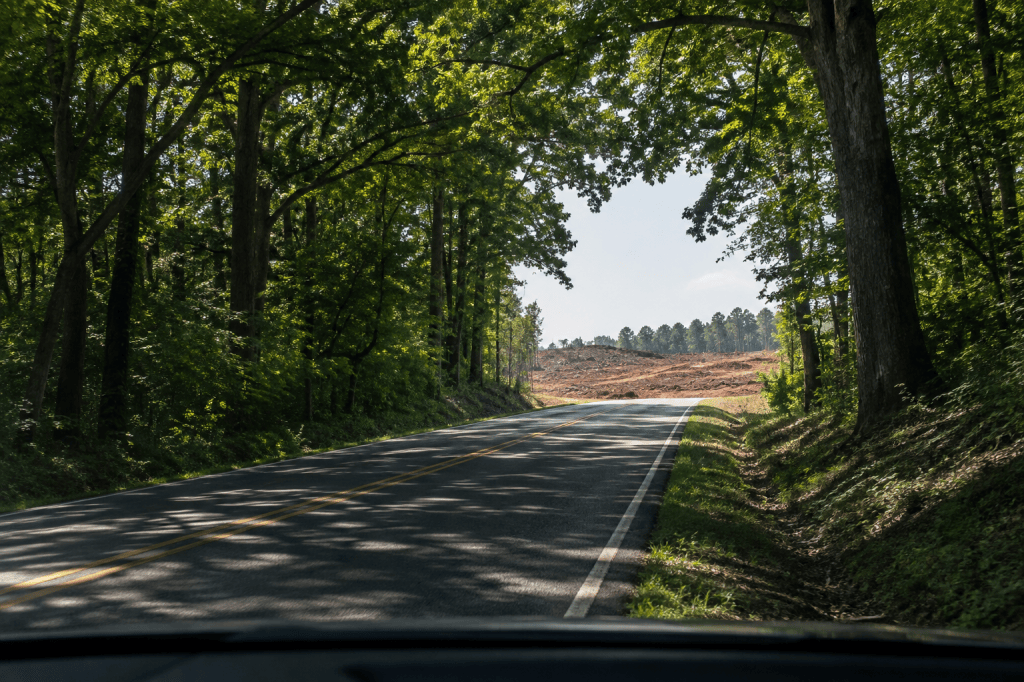
    I have driven down roads that were once gorgeously shaded sanctuaries and barely recognized them. Roads where trees met overhead and the temperature seemed to drop as soon as you entered. Roads that offered a few quiet minutes between wherever you had been and whatever waited for you at home.
    Then one day, the trees were gone.
    Not trimmed. Not thinned.
    Gone.
    I have pulled over and cried.
    That probably sounds ridiculous to some people. They were only trees. The land had been sold. The owner had every legal right to clear it. People need places to live. Communities grow. Progress requires change.
    Those are all tidy, reasonable words.
    But none of them describe what it feels like to see a living place stripped down to raw dirt.
    “Development” is such a pretty word for something so violent.
    We say the land was cleared, not destroyed. We say it was improved, as though the forest were deficient. We call it undeveloped, as though nothing was happening there before we arrived with survey flags and bulldozers.
    But the land was never empty.
    Those trees were cleaning our air. Their roots were holding the soil and drinking the rain. Their branches sheltered birds, insects, and animals whose homes apparently mattered less than ours. They softened the heat, absorbed noise, and turned an ordinary road into a place that could settle something inside a person.
    Science tells us that trees communicate. They send chemical warnings when they are threatened. They respond to injury. Through their roots and the fungal networks beneath the soil, they exchange resources and information.
    Science has not established that trees feel pain in the way animals do. They have no brains, nerves, or pain receptors like ours.
    Still, they recognize damage. They respond to danger. They warn one another.
    I do not know what a forest experiences when the machines arrive.
    I only know what I experience afterward.
    Grief.
    We are very good at measuring what development adds. Houses. Businesses. Tax revenue. Jobs. Convenience.
    We are much less interested in measuring what it takes.
    How do you put shade on a balance sheet? What is the market value of birdsong? Where does an environmental impact report record the human need to drive beneath a canopy of trees and feel, for three minutes, that the world is still gentle?
    What do you offer of value in exchange for the trees that were cleaning my air?
    What do you offer my soul in exchange for the place that soothed it?
    Another grocery store? Another storage facility? Another subdivision named for the natural feature destroyed during its construction?
    We keep treating growth as inherently good, as though becoming larger automatically means becoming better. We celebrate every new development without asking whether the thing being built is worth the thing being erased.
    It is not that nobody else should be allowed to come here. I came from somewhere else too. Most of us did.
    The problem is the belief that wanting to occupy a place gives us the right to consume all of it.
    We could build with restraint. We could preserve mature trees and meaningful stretches of habitat. We could stop approving enormous developments before the roads, schools, and infrastructure can support the people already here. We could require developers to treat the land as something more than an obstacle between them and profit.
    We could begin with the radical idea that a forest is already doing something valuable.
    Instead, we scrape the earth clean, crowd it with roofs, plant three decorative saplings beside the entrance sign, and call the result The Woodlands.
    Perhaps the old lady on the porch has a point.
    Perhaps she remembers when the road was cooler, quieter, and alive. Perhaps she is not resistant to change simply because she understands that some changes cannot be undone.
    Perhaps she is angry because everyone keeps calling it progress and expecting her to be grateful.
    So yes, my first answer was population reduction, Thanos style.
    It was funny because it was outrageous.
    The truth beneath it is quieter and much harder to dismiss.
    I do not want fewer people because I hate people.
    I want us to stop behaving as though we are the only living things whose needs count.

  • What’s the longest trip you’ve ever taken?

    Today’s writing prompt seemed easy enough.
    What’s the longest trip you’ve ever taken?
    Alaska.
    Six months.
    Done.
    Except six months is long enough that I’m not entirely sure Alaska qualifies as a trip. At some point, when you know where to buy groceries and have developed opinions about local roads, you may have crossed the line from visiting to living there.
    Although Alaska never really became ordinary.
    I was there long enough for it to.
    It just didn’t.
    I’ve traveled a fair bit since then. I’ve seen places that still live vividly in my memory. I’ve traveled through the Panama Canal, which deserves special recognition because there is something wonderfully audacious about getting on a ship in one ocean and getting off in another because humans looked at a whole-ass continent and said, You know what would make this easier? A hole.
    And in a few weeks, I’ll fly to Barcelona, board another ship, visit Morocco and the Canary Islands, and then spend seven days crossing the Atlantic before eventually washing up in Miami.
    I have traveled.
    I have stories.
    So Alaska should have been an easy answer.
    But I got stuck on two words.
    Longest.
    Are we measuring distance?
    Or time?
    And then:
    Trip.
    Does a trip require us to physically go somewhere?
    Because if it doesn’t, Alaska isn’t even close.
    The longest trip I’ve ever taken is toward accepting myself.
    And I’m still on it.
    For a long time, I thought self-acceptance was somewhere I was supposed to arrive.
    A destination.
    There was some version of me out there who had figured everything out. She knew who she was. She understood why she did the things she did. She had dealt with all her baggage, presumably using one of those very efficient packing-cube systems.
    She did not overthink.
    She did not second-guess herself.
    She certainly did not lie awake at three in the morning replaying something she said to a stranger in 1997.
    She had her shit together.
    I was going to become her eventually.
    I spent a lot of years trying.
    There were maps, although most of them had been drawn by other people.
    Maps for what a successful woman should look like.
    What adulthood should look like.
    What a career should look like.
    What productivity should look like.
    What my body should look like.
    How much space I should take up.
    How loudly I should speak.
    Which parts of myself were charming and which ones needed to be toned down a little.
    Or a lot.
    I followed some of those maps for miles.
    Turns out, a surprising number of them weren’t going anywhere I wanted to go.
    Somewhere along the way, I started throwing them out.
    Not all at once.
    There was no dramatic bonfire where I burned society’s expectations while dancing naked beneath the full moon.
    Although now that I’ve written that sentence, I admit there are possibilities.
    It happened more quietly.
    I started noticing when something didn’t fit.
    I started asking why I was trying so hard to make it fit anyway.
    I started realizing that some of the things I had spent years trying to fix weren’t necessarily broken.
    Some were simply mine.
    I started getting curious.
    And curiosity changed everything.
    Instead of asking, What the hell is wrong with me?
    I started asking, Why do I do that?
    Instead of, Why can’t I be more like everyone else?
    I started wondering whether I actually wanted to be.
    Instead of trying to become the woman I thought I was supposed to be, I started paying attention to the woman who was already here.
    She’s interesting.
    She is also exhausting.
    We’re working on it.
    She gets wildly excited about things. She collects interests like other people collect refrigerator magnets. She can lose an afternoon researching something she did not know existed that morning. She has opinions.
    So many opinions.
    Occasionally a stranger says something within earshot and her head whips around because Actually…
    Someone usually intervenes.
    Usually.
    For years, I thought maturity would eventually sand down some of those edges.
    Instead, I’m discovering I rather like them.
    And lately, something else has happened.
    I’ve started meeting parts of myself I didn’t know were still there.
    The woman who writes because she has something to say.
    The woman who makes things simply because the idea delighted her.
    The woman who will try something without first demanding proof that she’ll succeed.
    The woman who gets excited and follows the excitement just to see where it goes.
    The woman who has spent enough of her life worrying about whether she was too much and has finally begun to wonder whether too much for whom?
    I like her.
    Not every day.
    Let’s not get carried away.
    Self-acceptance is not waking up every morning, gazing lovingly into the mirror, and whispering affirmations to your reflection while sunlight streams through gauzy curtains.
    Some mornings you look in the mirror and think, Jesus Christ, woman.
    That counts too.
    Because maybe self-acceptance isn’t loving every single thing about yourself.
    Maybe it’s simply no longer treating yourself like a problem you are obligated to solve.
    Maybe it’s being able to look at the whole messy collection and say:
    Okay. This is who we’re traveling with.
    Pack snacks.
    I used to think there would be an arrival.
    That one day I would finally understand myself, forgive myself, love myself properly, and plant a little flag that said:
    MADE IT.
    I don’t think that anymore.
    And I’m glad.
    I’ve been to Alaska.
    I’ve crossed the Panama Canal.
    I’ve traveled thousands of miles to see what was on the other side of the horizon.
    But this?
    This is the longest trip I’ve ever taken.
    And for the first time in my life, I don’t want the trip to end.
    There are still parts of me I haven’t met yet.
    I’d like to see where she takes me.

  • I don’t care what people think of me.

    I mean that.

    Mostly.

    I have reached an age where I can leave the house without makeup, wear what I want, say what I think, and generally allow other people’s opinions of me to remain their problem. It took me a long time to get here, and I rather like it.

    Then I started putting things on the internet.

    Apparently, I care very much what people think of me there.

    Except that’s not quite right either.

    I don’t need you to like it.

    I need you to look at it.

    There is a difference.

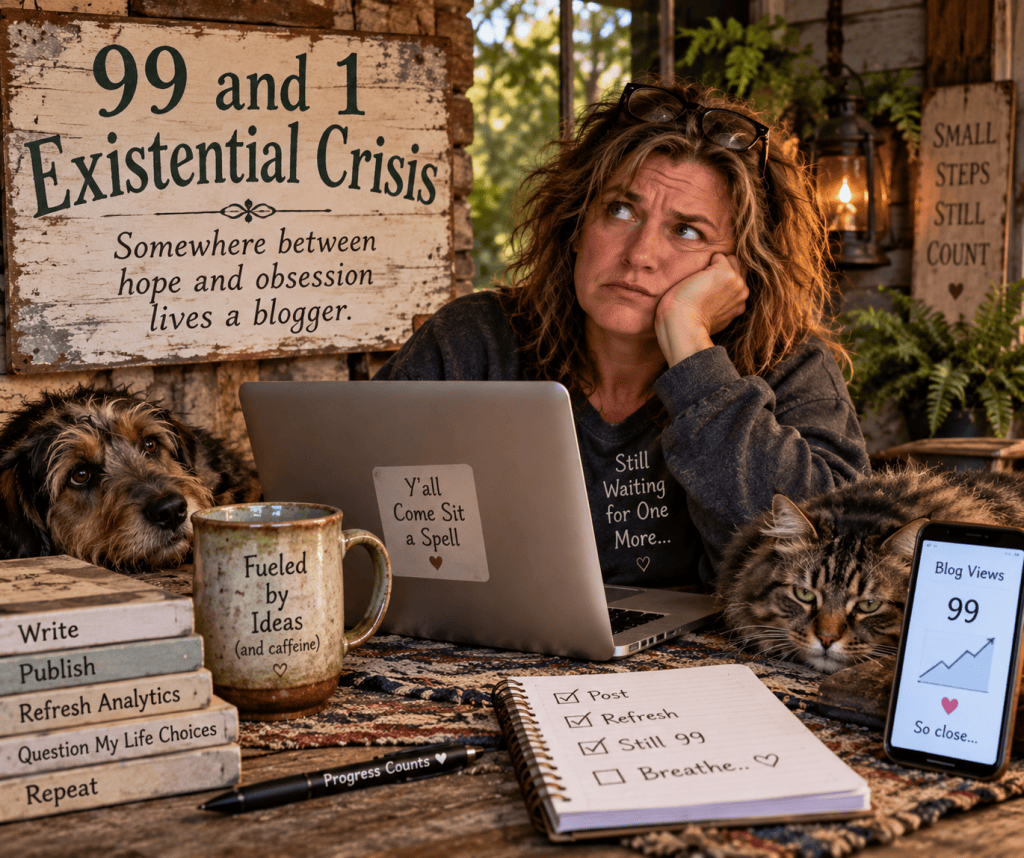
    I discovered this recently while staring at the number 99.

    Ninety-nine views.

    A perfectly respectable number for something I’d tossed onto the internet, particularly considering I’d only recently started tossing things onto the internet at all.

    But it was 99.

    One hundred was sitting right there.

    One more person. That was all I needed. One more random human being needed to stumble across my little contribution to the endless stream of things being flung into the digital universe.

    I refreshed.

    Still 99.

    I went and did something else.

    I came back.

    Still 99.

    At some point, this became personal.

    Which is ridiculous, because I didn’t need the hundredth person to like it. I didn’t need them to comment. I didn’t need them to follow me, buy anything, pledge their eternal devotion, or nominate me for an award.

    I just needed the little counter to roll over.

    Someone see the damn thing.

    And that’s when I realized I may have a somewhat complicated relationship with putting myself out there.

    Because I will apparently publish my thoughts on the World Wide Web, where billions of complete strangers could theoretically encounter them.

    But tell people I actually know that I’ve done it?

    Absolutely the fuck not.

    Don’t judge me.

    Seriously.

    A stranger can read something I’ve written and decide I’m ridiculous. That’s fine. We had no relationship before they arrived, and we’ll have no relationship after they leave. They can wander off into the internet thinking, Well, that woman is a lot.

    Fair assessment.

    But someone I know?

    That’s different.

    They already know me. Or at least they know a version of me.

    And suddenly saying, Hey, I made this thing. Come look at it, feels far more exposing than quietly putting the same thing somewhere millions of strangers could potentially find it.

    Make that make sense.

    I want people to find my writing.

    I want people to see the things I make.

    I want the views.

    I want the 99 to become 100.

    But apparently I would also prefer that everyone discover these things through an elaborate series of breadcrumbs so I never have to actually announce:

    LOOK! I MADE A THING AND I WOULD LIKE YOU TO LOOK AT MY THING.

    Because that sounds suspiciously like asking for attention.

    And God forbid.

    So I compromise.

    I put things out there.

    I make the books. I write the essays. I post the videos. I pin the pins.

    And then I stand approximately six feet away pretending I don’t give a shit whether anybody notices while checking the statistics often enough to qualify as a minor behavioral disorder.

    Today, I put the link to this blog on my Facebook profile.

    I did not make a post.

    Let’s not get carried away.

    I also changed my cover photo to the porch—the same porch you see here—but there are no words on it. No logo. No blog name. Nothing announcing what it is.

    Just the porch.

    The link is there if somebody happens to look.

    The door is open if somebody happens to wander through it.

    Apparently that’s as brave as we’re getting today.

    And you know what?

    I’ll take it.

    I don’t need to stop caring entirely.

    Maybe I just need to keep putting the things I care about where somebody might find them.

    Even if I can’t quite bring myself to knock on their door and tell them they’re there.

    But if you happen to be number 100?

    For the love of God, don’t just stand there. The counter is waiting.

  • Know Your Limits, Know Your People, and Go

    There is nothing cheap about travel.

    There. I said it.

    You can watch airfare like it owes you money. You can compare hotels across six different websites, travel during the off-season, pack snacks, use points, skip the overpriced airport cocktail, and spend three hours trying to save twenty-three dollars on a rental car.

    I have done some version of all of these things.

    Travel still costs money.

    So when WordPress asked for my best tip for budget travel, my first thought wasn’t about airfare or hotels or credit card points.

    It was this:

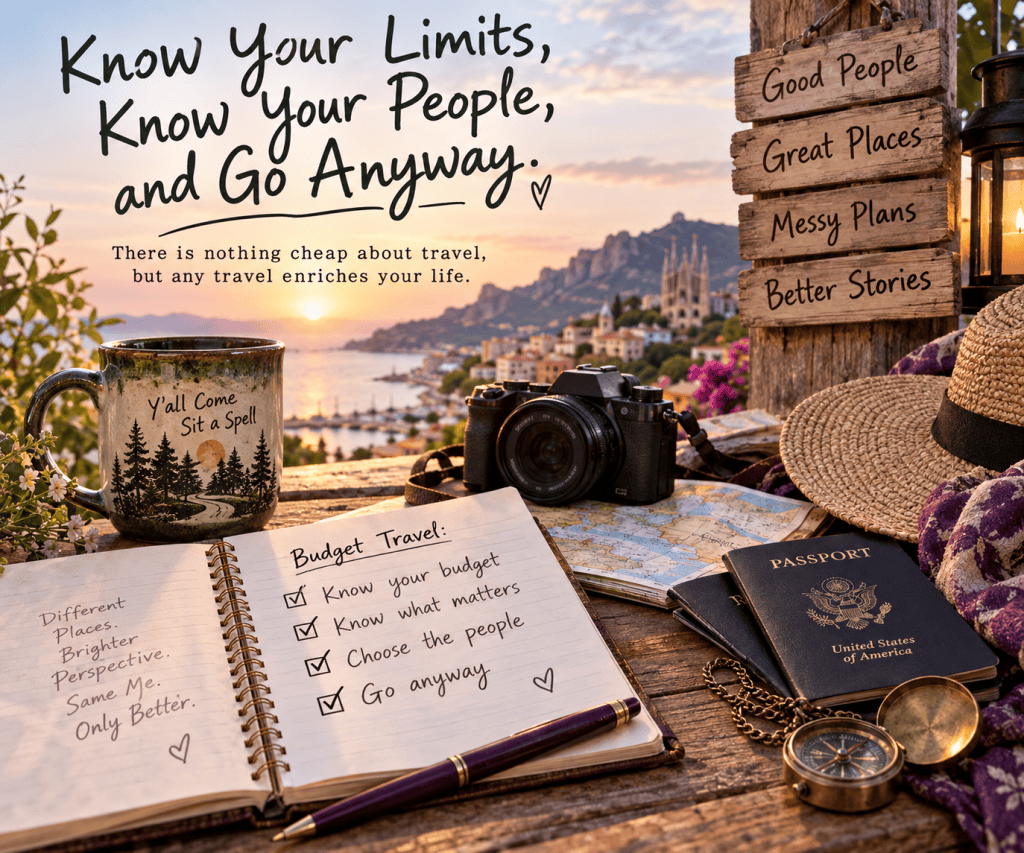
    Know your budget. Know what matters to you. Choose your people carefully. And go.

    Know Your Budget

    A budget isn’t punishment. It’s information.

    Know what you can spend before you start planning. Not what you wish you could spend. Not what your friend can spend. Not what some travel influencer assures you is completely reasonable for seven days in Italy.

    Your money. Your limits.

    Then work from there.

    Maybe your budget gets you across an ocean. Maybe it gets you three hours down the road and two nights in a motel.

    Both count.

    Because budget travel isn’t about taking the cheapest trip possible. It’s about taking the trip you can afford without coming home and wondering whether you now need to sell a kidney.

    Know What Matters

    This is where I think people sometimes get budget travel wrong.

    You don’t have to save money on everything.

    You have to figure out what doesn’t matter very much to you.

    I don’t need the fanciest hotel in town if I’m only going to be there long enough to sleep and shower. Someone else may consider a beautiful hotel part of the experience and happily spend more there.

    Neither of us is wrong.

    Maybe food is your thing. Maybe it’s excursions. Maybe you couldn’t care less about a balcony but you’ve dreamed your entire life about seeing one particular painting hanging in one particular museum.

    Spend accordingly.

    Save on the things you won’t remember.

    Spend on the things you will.

    That’s not being cheap. That’s having priorities.

    Know Your People

    This one may matter more than everything else.

    Who you travel with is as important as where you go.

    Maybe more important.

    The right people can make a delayed flight, pouring rain, a questionable meal, a closed attraction, or a spectacularly bad navigational decision into a story you’ll still be laughing about ten years later.

    The wrong people can make paradise miserable.

    Good travel companions don’t necessarily want to do everything together. In fact, some of the best ones don’t.

    They can say, “You go do that. I’m going to sit here with my coffee,” and nobody gets offended.

    They understand the budget. They can roll with a change of plans. They don’t need everybody to be having fun in exactly the same way at exactly the same moment.

    And, perhaps most importantly, when something inevitably goes sideways, they don’t make it worse.

    Choose those people.

    And Go

    This might actually be my best travel advice.

    Go anyway.

    Don’t wait for the perfect trip.

    Don’t wait until you have enough money to travel the way somebody on Instagram says you should travel.

    Don’t wait until everyone can come.

    Don’t wait until you’re the right age, the right size, have the right luggage, or can afford the room with the better view.

    Go across the ocean if you can.

    Go across the state if you can’t.

    Take the cruise. Take the road trip. Spend the weekend somewhere you’ve never been. Drive to the little town you’ve passed a hundred times and always wondered about.

    Travel doesn’t have to be grand to matter.

    There is something about leaving the familiar, even briefly, that changes the way you see things. You meet people you wouldn’t have met. Eat things you wouldn’t have tried. Learn things you didn’t know you didn’t know.

    And you come home carrying something you didn’t leave with.

    A story. A memory. A different perspective. Sometimes just a really good photograph and an inside joke nobody else understands.

    All of it counts.

    So no, I don’t have a secret for traveling cheaply.

    Know your budget.
    Know what matters.
    Know your people.
    Know your limits.

    And then, whenever and however you can,

    go. 

    View all responses
  • Who is your favorite cartoon character?

    View all responses

    My favorite cartoon character has always been Tinker Bell.

    But I feel like I need to clarify something.

    Not the nice one.

    I mean the original Tinker Bell. The tiny blonde in the green dress from Peter Pan. The jealous one. The petty one. The one with the temper. The one who could communicate an entire profanity-laced paragraph with nothing more than a facial expression and the furious jingle of a bell.

    That Tinker Bell.

    My Tink had teeth.

    Years ago, when Peter Pan came out on DVD, a partner and I sat down to watch it again. Somewhere along the way, they looked at me with genuine surprise.

    “Tink isn’t nice.”

    I grinned.

    “No. No, she isn’t.”

    Apparently, somewhere between childhood and adulthood, people remembered the wings. They remembered the green dress and the blonde bun. They remembered the pixie dust.

    They remembered the sparkle.

    But they had forgotten the teeth.

    I hadn’t.

    Original Tink was a girl with wings.

    That was the magic of her.

    We understood exactly what was happening when Wendy showed up. Here comes this girl, this interloper, waltzing into Neverland and suddenly occupying Peter’s attention.

    Tink was jealous.

    Of course she was.

    We were jealous with her.

    We wanted Wendy gone too.

    Granted, most of us probably would have stopped somewhere before attempted murder.

    Tink had commitment.

    She was petty. Possessive. Impulsive. Selfish. Vindictive. She didn’t even want to share her pixie dust. Peter had to make her.

    And she was also fiercely loyal, brave, loving and ultimately willing to sacrifice herself.

    She was complicated.

    She wasn’t a role model.

    She was a character.

    Then Disney discovered something else about Tinker Bell.

    She was marketable.

    Very, very marketable.

    There were movies to make. Dolls to sell. Books and clothes and toys and an entire fairy universe waiting to be built around one of the most recognizable little blondes in the world.

    I understand the business decision.

    They made their money.

    But somewhere along the way, they Stepford-wifed a fairy.

    They kept the recognizable parts. The wings stayed. The green stayed. The blonde bun stayed. Certainly the sparkle stayed.

    But those troublesome little personality defects?

    Those needed some work.

    The jealousy was softened. The temper became more manageable. The selfishness lost its bite. The dangerous little creature who could make spectacularly bad decisions because she was overwhelmed by an ugly emotion became considerably more agreeable.

    And apparently, while they were working on her personality, somebody decided she needed a little plastic surgery too.

    Exhibit A: original Tink.

    Exhibit B: the newer version.

    Your Honor, I have no further questions.

    But what bothers me most isn’t that they changed her.

    It’s that they squandered her.

    Because original Tinker Bell already had everything a storyteller could possibly want for a series of stories about growth.

    She had actual flaws.

    Not adorable flaws manufactured so that a character can encounter a conveniently constructed crisis, learn the appropriate lesson and be better by the closing credits.

    Tink had problems.

    Tink was sometimes the problem.

    What an extraordinary place to begin.

    Let her jealousy cost her something.

    Let her selfishness hurt somebody she loves.

    Let her temper create consequences she can’t simply jingle her way out of.

    Let her discover that loving someone doesn’t mean possessing them.

    Let her learn to share her pixie dust and still be a little pissed about it.

    Let her screw up. Let her apologize badly. Let her screw up again, but perhaps a little less spectacularly the next time.

    Let her grow.

    Let her mature.

    Let her learn what to do with those teeth.

    Instead, they sanded her down first and then manufactured crises for the polished version to navigate.

    That’s the tragedy of it.

    Tinker Bell didn’t need to become nicer before she could grow.

    She needed the opportunity to grow because she wasn’t nice.

    And I can’t help wondering what those meetings looked like.

    Was there somebody sitting at that conference table defending her?

    Did anybody say, “Wait. These aren’t defects in the product. These are the character”?

    Did anybody argue that little girls didn’t need another perfectly agreeable heroine?

    Did anyone suggest trusting Tink with her own future?

    Because we had already trusted her once.

    Children watched the original Peter Pan and understood her.

    We didn’t need her jealousy explained away. We knew jealousy.

    We didn’t need her anger softened. We knew anger.

    We didn’t need somebody to assure us that underneath everything she was really sweet.

    Sometimes she wasn’t.

    So what?

    Children have ugly emotions too.

    Maybe there’s value in seeing a character feel something ugly without deciding that the character herself must therefore be ugly.

    Maybe there’s value in watching someone make a terrible decision because of jealousy and then face what that decision caused.

    Maybe little girls can handle a female character who isn’t always pleasant.

    Maybe grown women can too.

    We have an odd habit of celebrating women with strong personalities right up until those personalities become inconvenient.

    We like spunky.

    We like feisty.

    We like independent.

    But only while they’re charming.

    Once those qualities acquire sharp edges, we start reaching for the sandpaper.

    And perhaps that’s why I still feel protective of that original little fairy.

    I don’t need to rehabilitate Tinker Bell.

    I don’t need to explain away the jealousy, selfishness, temper or the occasional willingness to have Wendy knocked out of the sky.

    Some of it was awful.

    I know.

    I was paying attention.

    That’s my Tink.

    The little girl with wings who loved enormously, hated enormously, made terrible decisions, redeemed herself, and never needed to be perfect for me to love her.

    I don’t love Tinker Bell despite her teeth.

    I love her with full respect for the teeth.

    Disney kept the sparkle.

    I just wish they’d trusted her enough to let her keep the rest of herself too.