Hey, it’s me, Vivie! I’m the inner five-year-old, and I’m here to tell you what’s happening around the Grove. A lot of our ideas started with me saying, “Hey, let’s…” so the Grown Up decided I could tell you what we did, what’s going on now, and what we might do next.
Before I tell you what we did, I should probably tell you who “we” are. Sunstone Grove has a lot of branches. Seasoned Saves was the first, our flipping shop for vintage glass and pottery. Then came Never Ending Coffee Press and Pet Care Made Simple Press, each with its own books and voice, along with the blog, the socials, and the witchy wares shop.
The Grown Up is a middle-aged pagan witch in the southern United States, a Hu-mom to three pups, and an adult-diagnosed ADHDer whose ADHD affects her significantly. She found a way to harness some of her creativity with a purple pen and a Remarkable notebook. She says it may be the best medicine she could have given herself.
Now the Grove has three published coloring books, one published Guinea Pig care book, a Beardie care book in the works, a blog, and a witchy wares shop. That is a lot of branches. I like branches.
What We Did
September was when Y’all Come Sit a Spell opened its front door. The Grown Up has been filling the blog with essays, and people have started stopping by to read. I like having company on the porch.
The witchy wares shop opened, and the Grove started showing up in more places online. Facebook and Tumblr joined the mix, and the Grown Up kept making things for TikTok. There are a lot of doors on the internet. We are still learning which ones lead to friendly people.
The glass menagerie had new adventures, and Annie the Anthurium bloomed. There is always something happening around here. Sometimes it is a very pretty piece of glass. Sometimes it is a plant. Sometimes it is me saying, “Hey, let’s…”
What’s Going On Now
October is We Don’t Know What We Don’t Know: Cryptid Edition. The October cryptids are all researched, written, and loaded to be released one a day, every day. Starting tomorrow, you’ll meet a new one each day. I’m excited to introduce you to my new friends. Some of them are very strange. I like that.
The Grown Up is still working on the Beardie care book and building the 2027 Cozy Witchy Grove Planner. She has a very large pile of herb research, and there are crystals and animals in the mix, too. The purple pen has been busy.
What We Might Do
November might be “We Don’t Know What We Don’t Know: American History.” December might be “We Don’t Know What We Don’t Know: Holiday Traditions.” The Grown Up has started mapping both, and I think there is a lot we still need to learn.
After that, there’s the Wheel of the Year. We have to decide if we want to do that whole thing, or go in another direction. I have ideas, obviously. The Grown Up says we’ll talk about it later.
Vivie’s Junction
Things that went well: The purple pen and the Remarkable notebook. A lot of ideas turned into real things because we had a place to catch them.
Things we’re looking forward to: Introducing you all to my new friends, the Cryptids. One every day in October!
Things we need to do better: Posting consistently on socials and updating the sales posts. I have brought this to management’s attention. The purple pen is right there.
Welcome to our new friends, and welcome back to the folks who have been sitting with us since the beginning. There’s room on the porch for everyone. Pull up a chair and stay awhile. October’s bringing cryptids, and I can’t wait for you to meet them.
In the remote ravines of Tenerife, there once lived an enormous eel with hair on her head and malice in her eyes.
At least, that is what the story says.
The people nearby reportedly believed she was a demon in disguise. An exorcism was performed, after which the creature either died or disappeared.
This is the official folklore.
The Grove has reviewed the available evidence and reached a different conclusion.
Someone disturbed an elderly eel while she was soaking her itchy skin in the mud, took one look at her unfortunate visage, and created a legend.
That is usually what happens.
The Creature in the Pool
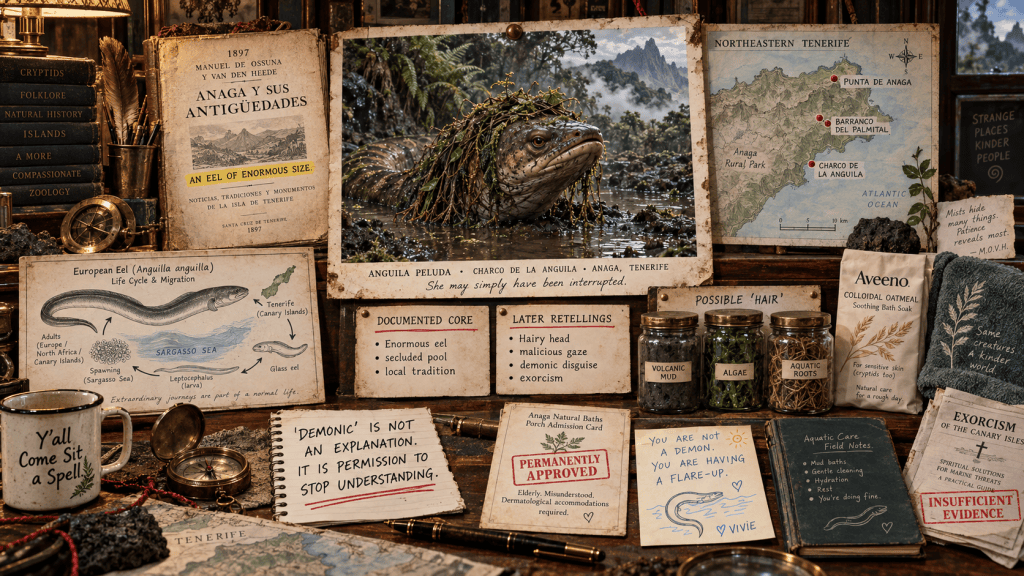
The Anguila Peluda, or Hairy Eel, belongs to the folklore of the Anaga massif in northeastern Tenerife.
Anaga is precisely the sort of landscape that produces stories. Volcanic mountains rise into clouds. Ancient laurel forests cover steep slopes. Water cuts through deep ravines before reaching the Atlantic, forming isolated pools where light and common sense arrive only occasionally.
In his 1897 book Anaga y sus antigüedades, Tenerife historian Manuel de Ossuna y Van den Heede recorded a local tradition about an enormous eel living in a secluded gorge.
Among the residents of Punta de Anaga, he wrote, it was commonly said that many years earlier an eel of tremendous size had inhabited the Barranco de los Infiernos.
That translates to the Ravine of the Hells.
Nobody gave this animal a fair chance from the beginning.
The gorge is generally identified with the modern Barranco del Palmital, where the name Charco de la Anguila, or Eel Pool, preserves the creature’s connection to the landscape.
That is our firmest historical core.
There was a local tradition.
There was an unusually large eel.
It lived in a remote pool.
The pool remembered her.
And Then She Grew Hair
Later retellings add more detail.
The eel became monstrous. Her head was covered in hair. Her eyes held a threatening or malicious expression. Local farmers believed she was not an animal at all but a demon wearing an eel costume for reasons known only to the demon.
She was reportedly exorcised.
Afterward, she died or vanished.
These details may preserve genuine parts of the oral tradition, but they are not all documented as securely as Ossuna’s enormous eel. Stories accumulate features as they travel.
A large eel becomes a monstrous eel.
Something stringy on her head becomes hair.
An irritated expression becomes malice.
Then religion arrives with paperwork.
We should also consider the eel’s perspective.
If you have ever disturbed an elderly woman while she was bathing, you may understand why the resulting expression was interpreted as hostile.
The Eels Were Real
The most important detail in this story is that eels actually lived in Tenerife’s ravines.
European eels, Anguilla anguilla, historically occurred throughout the Canary Islands, including waterways in Anaga. They have been recorded in ravines around Afur, Igueste de San Andrés, Roque Bermejo, Anosma, Ijuana, and other parts of northeastern Tenerife.
This was not a landscape where villagers invented an eel because they had never seen one.
The animal was real.
Only the size, hair, temperament, and demonic affiliations remain disputed.
European eels also possess one of the strangest life cycles on Earth.
They begin their lives far out in the Atlantic, in the region of the Sargasso Sea. Their transparent larvae drift with ocean currents toward Europe and North Africa. As they approach the coast, they transform into glass eels, develop pigment, and enter rivers, streams, estuaries, and pools.
There they may remain for years or even decades.
Eventually, they transform again and begin the long migration back toward their Atlantic spawning grounds.
Scientists have studied this journey for generations, but parts of the eel’s reproductive life remain remarkably elusive. Humans have raised cities, split atoms, and sent machines beyond the solar system, yet the European eel still retains some privacy.
Honestly, good for her.
“Demonic” Is Not an Explanation
Perhaps the Anguila Peluda was not lurking in the pool.
Perhaps she was using it.
Imagine an old animal with irritated or damaged skin settling into cool mud because it offers relief. The mud coats her body. Algae and vegetation cling to her head. She remains there quietly until someone approaches the water and disturbs her.
She rises.
She is enormous. She is covered in muck. Her skin is inflamed, and she looks directly at the person who has interrupted the first comfortable moment she has experienced all day.
The witness sees hair and malice.
The eel sees another human being who cannot mind his own business.
We cannot know that this happened. It is no more documented than the hair, the malicious gaze, or the exorcism. But it asks us to imagine the eel as a living creature responding to discomfort instead of a symbol waiting to frighten us.
That matters because “demonic” is not an explanation.
It is permission to stop understanding.
Once a creature is called demonic, nobody has to ask whether she is sick, injured, frightened, displaced, or defending herself. Nobody has to consider what she needs or why she behaves as she does.
Curiosity becomes unnecessary.
Compassion becomes dangerous.
Violence becomes righteous.
The label does not tell us anything about the eel.
It tells us what the humans wanted permission to do.
How Does an Eel Become Hairy?
Eels do not naturally grow hair.
This is an important scientific statement and an unfortunate limitation of the name.
But an eel living in a secluded pool could acquire an unusual appearance through several earthly mechanisms.
Algae or aquatic vegetation might cling to her head. Fungal growth or skin disease could produce pale, fuzzy patches. Scarring might distort her features. Debris could catch against her body. Poor water quality might contribute to lesions or abnormal growth.
An unusually old eel could also become quite large compared with the specimens local people encountered regularly.
Then add murky water, reflected light, fear, and a brief glimpse.
A weathered head rises from the pool. Mud coats her skin. Vegetation trails from her body. She looks directly at the person who has disturbed her.
The witness does not think:
“How fascinating. This may be an elderly European eel with an epiphytic algae problem.”
The witness thinks:
“That demon has hair.”
The problem is not that the witness was frightened. Fear is natural.
The problem is what happens when fear is treated as evidence.
About the Exorcism
The exorcism is the saddest part of the story.
It is also one of the least secure details historically, so we should not pretend to know exactly what occurred. Perhaps a religious ritual was performed at the pool. Perhaps someone killed the eel. Perhaps she disappeared naturally and the ritual received credit. Perhaps the entire episode was added later because stories about demons require conclusions.
Whatever happened, the alleged exorcism reflects a familiar human impulse.
When we meet an animal that looks sick, old, unusually large, or simply unfamiliar, we often turn difference into danger.
When we cannot explain something, we may decide it is evil.
Once evil has been declared, cruelty can masquerade as protection.
The eel does not have to be supernatural for the story to matter. She only has to be strange enough that nobody asks what might have happened to her.
The Grove Take
I do not think a hairy demon eel lived in a Tenerife ravine.
I do think someone may have seen an extraordinary eel.
Perhaps she was unusually old. Perhaps she was larger than expected. Perhaps algae, vegetation, disease, or injury gave her head a strange appearance.
Perhaps she had found a muddy pool that soothed her damaged skin.
Perhaps someone interrupted her.
Or perhaps several people saw different eels over many years, and the stories gradually merged into one creature.
The natural explanation is not disappointing.
A creature born in the ocean travels across immense distances, enters a volcanic island’s freshwater system, lives quietly in a remote pool for decades, then feels some ancient biological signal and attempts to return to the sea.
That is not less wondrous than a demon.
It is more wondrous because it actually happens.
The tragedy is that European eels are now critically endangered. The ordinary animal beneath the monster story is disappearing while we remain fascinated by the monster.
The legendary eel survived in a place-name.
The real eels need more than stories.
Maybe the Anguila Peluda was a supernatural creature.
Maybe she was an enormous elderly eel treating her irritated skin in the mud when someone interrupted her bath.
The historical record cannot settle the question.
But only one explanation required people to stop asking questions, and it was the one that called her demonic.
Porch Policy
The Anguila Peluda is permanently approved.
We have installed a temperature-controlled rehabilitation pool beside the porch. The water is clean, the lighting is gentle, and absolutely nobody is permitted to perform an exorcism.
An oatmeal soak is waiting.
If the hair turns out to be algae, we will remove it carefully.
If it is a skin condition, we will contact an aquatic veterinarian.
If it is actual hair, we will respect her privacy and purchase an appropriate conditioner.
Maybe work has been relentless. Maybe money is tight. Maybe they are worried about someone they love. Maybe they have answered seventeen questions, solved four problems, and discovered that the eighteenth question is already waiting.
Then you ask something perfectly reasonable.
Their answer comes back sharper than expected.
It lands on you.
And because it landed on you, your brain immediately concludes that it must have been thrown at you.
Now you are hurt. Or angry. Or defensive. You replay their tone. You search their face for evidence. You begin constructing an explanation for why they spoke to you that way.
What did I do?
Why are they mad at me?
What is their problem?
Sometimes, of course, the answer is that they are mad at you. People do occasionally direct their feelings toward the correct address.
But sometimes you were simply standing where the emotion spilled.
There is a difference between being affected by something and something being about you.
Someone can be frustrated, angry, overwhelmed, scared, grieving, exhausted, or completely out of bandwidth. What comes out of them may have far more to do with what they are processing than with the person standing in front of them.
That does not mean the impact disappears.
A dropped plate can still cut you even if nobody threw it.
But understanding how it reached the floor may keep you from building an entire story about why someone wanted you wounded.
The Story We Build
Human beings are remarkably efficient meaning-making machines.
We notice a change in someone’s tone and begin interpreting it. We see a shorter text message, a delayed response, a tense expression, or a sigh that arrives at the wrong moment. We do not simply register the information.
We explain it.
Unfortunately, the explanation is often assembled from our own fears.
If we already worry that we are too much, their exhaustion becomes rejection.
If we fear we have disappointed them, their distraction becomes judgment.
If we have learned to watch other people’s moods for danger, their frustration becomes an alarm sounding inside our own bodies.
The feeling lands first. The story follows.
By the time we consider the possibility that they are hungry, frightened, tired, preoccupied, or having a terrible day, we may have already written three chapters about their secret resentment of us.
The story feels convincing because the impact was real.
Their tone did hurt.
Their distance did feel cold.
Their frustration did change the room.
But real impact does not automatically prove deliberate intent.
Not everything that lands on us was thrown at us.
When Frustration Meets Frustration
Then comes the feedback loop.
Someone else’s frustration hits our low frustration tolerance. We take it personally. We respond with our own sharpness.
They hear our reaction and feel attacked.
Now they are reacting to our reaction.
We react to that.
Within minutes, two people are arguing about tone, attitude, respect, facial expressions, and who started what.
Meanwhile:
The original problem is sitting quietly in the corner wondering what the fuck happened.
The appointment still needs to be made.
The bill still needs to be paid.
The directions are still unclear.
The dog still needs to go outside.
But the simple problem has acquired an entire emotional support cast.
This is how a five-minute inconvenience becomes a two-hour conflict.
No one necessarily entered the room wanting a fight. One person was already carrying too much. The other person felt the weight when some of it fell. Both began protecting themselves before either paused long enough to identify what had actually happened.
Sometimes the most useful question in that moment is not, “Why are you doing this to me?”
It is:
“Is this actually about me?”
That question does not demand immediate forgiveness. It does not deny what happened. It simply creates enough space for another explanation to exist.
Maybe the emotion was aimed at you.
Maybe it was not.
Knowing the difference matters.
Understanding Is Not Permission
There is a danger in taking this idea too far.
Some people have been trained to explain everyone else’s behavior while abandoning themselves.
They can identify the childhood wound behind someone’s cruelty, the pressure behind their anger, the fear behind their control, and the exhaustion behind their neglect.
They understand everything.
Then they use that understanding to excuse what continues to hurt them.
He is under a lot of stress.
She has been through so much.
They did not mean it that way.
That is just how they communicate.
Understanding why someone behaves badly does not require us to volunteer as the surface where they unload it.
We can recognize that another person’s anger did not begin with us and still say:
You do not get to speak to me that way.
We can understand that someone is overwhelmed and still refuse to become their emotional punching bag.
We can offer compassion without offering unrestricted access.
We can say, “I know this is not about me, but it is affecting me.”
That is not selfish.
That is clarity.
The boundary is not punishment. It is not a declaration that the other person’s feelings do not matter. It is a refusal to let those feelings become our fault, our identity, or our burden to carry indefinitely.
Your pain may explain why you dropped this in the room.
It does not obligate me to pick it up.
Leaving It on the Floor
This is difficult for those of us who notice every emotional shift.
We feel tension and want to resolve it. We hear frustration and search for our role in creating it. We sense discomfort and begin adjusting ourselves before anyone has asked us to move.
We pick up emotions automatically.
We carry them away, examine them, name them, and attempt to repair them. Sometimes we apologize for them even when they never belonged to us.
By the end of the day, we are exhausted from managing weather systems we did not create.
What if we stopped?
What if someone could be disappointed without our becoming a disappointment?
What if someone could be angry without our immediately accepting guilt?
What if someone could have a bad day without our turning it into evidence that we are difficult to love?
What if we noticed the emotion, acknowledged its presence, and left it where it fell?
That does not mean becoming cold or indifferent. It means allowing other adults to own their internal lives.
We can care without absorbing.
We can listen without accepting blame.
We can remain present without becoming responsible for making every uncomfortable feeling disappear.
Sometimes the kindest thing we can do for ourselves is refuse to pick up every emotion someone drops in the room.
Let it sit there for a moment.
Look at it before claiming it.
Ask whether it has your name on it.
If it does, then address it honestly.
If it does not, leave it with the person who brought it.
Not everything that lands on you was thrown at you.
And not everything that falls near your feet belongs in your hands.
Good morning from La Laguna/Tenerife – it’s a gorgeous day and there are many sights to see. The coffee has been amazing, as is the wine and cheese.
When I try to think of the best online class I’ve taken, nothing comes to mind. Online classes have traditionally been difficult for me because I learn much more efficiently in person. It is easier for me to focus and pay attention when I am in the room with other people. Online, it is easier to drift off or lose focus, even when I want to learn. I prefer face-to-face interaction and the feeling of being present with the class. So I do not have a favorite online class to name. The honest answer is that online learning has never been the format that works best for me. I learn better in person, where I can focus, participate, and connect with the people around me.
I hope you have found the method that works best for you. Until tomorrow – I’m off to enjoy the rest of this amazing island.
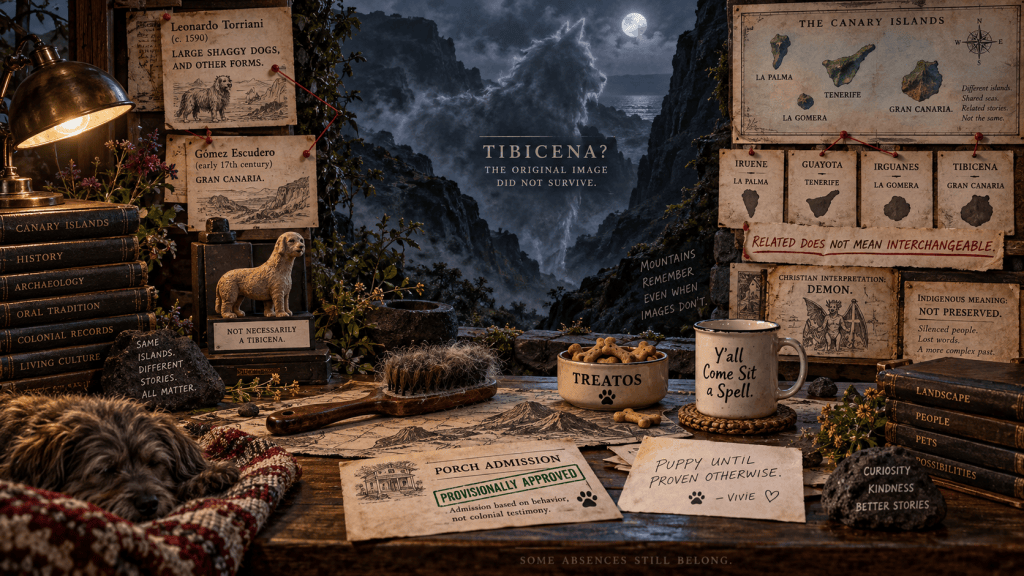
The Tibicena is described as an enormous, shaggy, supernatural dog from the Indigenous traditions of Gran Canaria.
European chroniclers called it a demon.
Vivie has requested that we postpone judgment until someone brushes it, offers it a treato, and asks for its side of the story.
Honestly, that may be the sounder research method.
Something Large and Shaggy This Way Comes
The surviving accounts describe Tibicenas as supernatural beings that appeared most often in the form of very large, shaggy dogs.
They could appear at night or during the day. Some accounts suggest they could assume other shapes, which means “giant dog” may not have been a permanent biological description. It may have been one form taken by something less easily defined.
They frightened people. They appeared along dangerous paths and in wild places. In one account, the beings seem to lure or frighten people toward steep drops.
This is not ideal puppy behavior.
It is, however, important to remember who wrote the surviving descriptions.
The Devil Arrived With the Chroniclers
The Indigenous people of the Canary Islands did not leave written accounts of the Tibicena. Most of what survives was recorded after the Spanish conquest by European Christian writers.
Those writers described Tibicenas as manifestations of the devil.
That tells us exactly how the chroniclers understood them.
It does not necessarily tell us how the Indigenous Canarians did.
This distinction matters because European Christians displayed a remarkable talent for encountering another culture’s spirits, deities, ancestors, guardians, rituals, sacred places, powerful women, medicinal practices, seasonal celebrations, and inconvenient opinions, then placing all of them into a box labeled DEMONIC.
It was an efficient filing system.
It was not an accurate one.
Around 1590, the engineer and chronicler Leonardo Torriani wrote that the being appeared to the Canarians as large, shaggy dogs and in other forms. He interpreted the figure as the devil and described it as frightening or deceiving people.
Another chronicler, Gómez Escudero, similarly recorded a belief in beings appearing as very large, shaggy dogs called Tibicenas.
Both accounts preserve something valuable.
Both accounts also pass that something through an aggressively Christian filter.
A Small Island Correction
The Tibicena belongs most specifically to Gran Canaria.
People often use “Guanche” as a general term for all the Indigenous inhabitants of the Canary Islands, but the name properly refers to the Indigenous people of Tenerife. Gran Canaria’s Indigenous population is more accurately called the Canarians, or ancient Canarians.
This becomes important because the islands had related but distinct cultures and traditions.
Gran Canaria had the Tibicena.
La Palma had a large shaggy supernatural being called Iruene.
La Gomera had beings called Irguanes, described in one colonial account as enormous, woolly figures capable of standing upright and terrifying adults and children.
Tenerife had its own spiritual landscape, including Guayota, the powerful being associated with Mount Teide.
Modern retellings often gather these traditions together, add caves, glowing red eyes, volcanic fire, the underworld, and a generous scoop of hellhound imagery, then introduce the result as the Tibicena.
It makes a magnificent monster.
It may not make good history.
Was It a Dog?
The Canary Islands have a long and complicated relationship with dogs.
Ancient writers connected the islands themselves with large dogs, although the origin of the name Canary remains debated. Dogs lived alongside the Indigenous islanders and could serve practical, social, and symbolic roles.
They could also become dangerous.
A large feral dog threatening livestock would not be a trivial problem in a community whose survival depended heavily on goats and sheep. An animal moving through a ravine at night could become both an immediate danger and the physical language used to describe a spiritual one.
Perhaps the Tibicena began with real dogs.
Perhaps it represented the danger of traveling alone through steep terrain.
Perhaps it was a guardian, an ancestral presence, a hostile spirit, or something that did not fit neatly into any of those categories.
Perhaps its meaning changed from one community to another.
We do not know.
That is not a failure of the story.
It is evidence of what conquest destroys.
When a culture’s people are killed, displaced, converted, enslaved, or forced to abandon their language, their stories may survive only in fragments recorded by the people dismantling them.
The creature remains.
Its explanation does not.
About Those Figurines
Small clay figures found at archaeological sites on Gran Canaria are sometimes presented online as images of Tibicenas.
Some are animal-like. Others are human or difficult to classify. A few possess exactly the sort of wonderfully strange appearance that encourages modern viewers to assign them supernatural identities.
But archaeology does not permit us to point at an unusual figurine and confidently announce, “Demon dog.”
We do not know that the figures represent Tibicenas. We do not know whether they were offerings, sacred objects, toys, symbols of identity, representations of people or animals, or objects with purposes we have not recovered.
Calling every mysterious object a Tibicena creates a satisfying answer.
It may also repeat the original mistake by forcing Indigenous material into a story we have already decided to tell.
Sometimes responsible scholarship must say, “This object mattered, but we do not know what it meant.”
Vivie dislikes this answer because she would like to name it, feed it, and build it a small bed.
Vivie must cope.
The Grove Take
I suspect the Tibicena was never simply a monster.
The surviving figure may contain pieces of animal encounters, dangerous landscapes, spiritual beliefs, practical warnings, and cultural meanings that colonial writers neither understood nor cared to preserve.
The chroniclers saw a large supernatural dog and reached immediately for the devil.
That conclusion feels less like evidence and more like habit.
If an Indigenous community recognized power in a place, Christianity called it haunted.
If they respected a spirit, Christianity called it worship.
If the spirit inspired fear, Christianity called it evil.
If it appeared as an enormous shaggy dog, Christianity apparently called animal control on behalf of Satan.
Vivie has now looked at the long historical record of European Christians mangling, tangling, mutilating, and misappropriating Indigenous stories.
She has considered the available evidence.
She is brushing the Tibicena.
The Tibicena, for its part, has not pushed anyone into a ravine. It appears to have had several centuries of compacted undercoat and some understandable trust issues.
Porch Policy
The Tibicena is approved for a provisional porch seat.
This ruling is contingent upon its behavior, not the accusations of men who arrived carrying crosses, swords, and a prewritten explanation for everything they did not understand.
The Tibicena will receive water, treatos, and a thorough brushing.
It may tell us what it guarded.
It may tell us why people feared it.
It may tell us whether it ever wanted worship, or whether it simply wanted travelers to stop wandering carelessly through dangerous ravines after dark.
If it turns out to be an actual malevolent spirit intent on driving us over a cliff, porch privileges will be reconsidered.
Until then, the Tibicena stays.
Vivie has finished brushing one side and would like someone to locate the detangling spray.
Which celebrity would you love to meet, and what would you talk about?
Greetings from Gran Canaria, I have my coffee and a relaxing day planned. Las Palmas looks enticing, and I look forward to discovering what’s out there.
If I could meet one celebrity, I think I would choose Ruth Bader Ginsburg. I’ve had the opportunity to meet a few celebrities. Some were wonderful, and some were asshats. Both kinds of experiences stay with you. You can build a picture of someone in your mind, then meet the real person and find out they don’t match your expectations. There are a few people I’d be happy to meet. Jason Momoa and Tom Hanks seem warm and down to earth. I’d enjoy talking with authors like Nora Roberts or Gloria Naylor. But being famous isn’t what makes someone interesting to me. I really enjoy meeting an Average Joe and discovering who they are without any expectations getting in the way. Ruth Bader Ginsburg would be different. I’d want to hear about her experiences and the cases she heard, especially those involving women, children, BIPOC, and others whose rights are too often overlooked. I’d ask what she thought about the state of the courts and our political climate. I’d want to hear what concerned her, what gave her hope, and which cases stayed with her long after they were over. More than anything, I’d want to listen. I think she would have been a wonderful person to sit with and talk to, not because she was a celebrity, but because of the life she lived, the work she did, and the way she thought about justice.
Now, I’m off to meet some Average Joes and see what the island has to offer.
Rome Brought an Army. The Snake Required Artillery.
I would like to begin by stating that I do not enjoy this.
I have agreed to investigate Bigfoot, Dogman, lake monsters, flying creatures, seductive spirits, and several fishes that may or may not have existed outside William Beebe’s bathysphere window.
Giant snakes are different.
A giant snake is not an imaginative combination of animals. It has no wings, antlers, glowing eyes, or mysterious human face. It is simply a snake after somebody has removed the size restriction.
That is enough.
Childhood Vivie understood this perfectly. Adult Vivie may now approach the subject with scholarship, skepticism, and several decades of emotional regulation.
Childhood Vivie is already standing on the furniture.
The Roman Army Versus One Extremely Large Snake
Our story begins during the First Punic War, when Rome and Carthage were fighting for control of the western Mediterranean.
Around 256 BCE, the Roman consul Marcus Atilius Regulus led an army into North Africa. Somewhere near the Bagradas River, now called the Medjerda River in Tunisia, his soldiers reportedly encountered a serpent of astonishing size.
Not a soldier who glimpsed something moving through the reeds.
Not a shepherd who found an unusually wide trail.
An entire Roman military force.
According to later Roman accounts, the creature attacked soldiers who approached the river for water. Spears and javelins allegedly bounced from its scales. It crushed men, bit others, and disrupted the camp so thoroughly that ordinary weapons proved insufficient.
Regulus responded as military commanders do when nature refuses to cooperate.
He brought in a ballista.
Yes.
According to the story, Rome deployed siege artillery against a snake.
A large stone struck the serpent’s spine and disabled it. The soldiers then killed it, removed its skin, and sent the hide to Rome, where it was supposedly displayed for decades.
The reported length varies, but the number that survived most enthusiastically is 120 Roman feet.
That is somewhere around 115 modern feet.
No.
I reject it.
Not because I possess evidence that the story is false, although we will get to the evidence problem shortly. I reject it because 115 feet is not a snake. It is a municipal infrastructure project.
The Evidence Problem
The oldest detailed versions of the serpent story were written long after the alleged encounter.
That matters.
Polybius, our most important surviving historian of the First Punic War, describes Regulus’s North African campaign without mentioning the occasion when his army supposedly fought a snake with artillery.
You would think that might have made the report.
The tale appears in later Roman writers, including Valerius Maximus, Pliny the Elder, Aulus Gellius, and Orosius. Some of them may have drawn from earlier sources now lost to us, but we cannot independently verify what those sources said or how the account changed as it traveled.
The missing skin is another difficulty.
Writers claimed it had been displayed in Rome, but it did not survive, and we have no physical evidence demonstrating that a 115-foot serpent ever inconvenienced the Roman military.
What we have is a story repeated across centuries.
That does not make it worthless.
It does make it slippery.
Much like the subject.
Could It Have Been a Python?
The African rock python is real, formidable, and entirely capable of inspiring panic.
Large individuals can exceed fifteen feet, with exceptional specimens reported at greater lengths. A snake of that size appearing suddenly at a riverbank could kill a human being and terrify a group of soldiers unfamiliar with the animal.
Snake skins can also stretch significantly when removed and prepared. Fear stretches measurements even more efficiently.
A very large python could therefore sit beneath the legend.
The creature attacks. Men panic. The animal is killed. Its skin is stretched, displayed, described, and retold. Each generation adds a few feet because nobody ever improved a military story by announcing that the snake was somewhat above average.
Eventually, Rome has fought a serpent longer than a basketball court.
This is plausible as folklore formation.
It is not comforting.
“It may only have been a twenty-foot python” is a sentence scientists can say because scientists have confused explanation with reassurance.
Unfortunately, North Africa Really Did Have Giant Snakes
Here is where the story becomes rude.
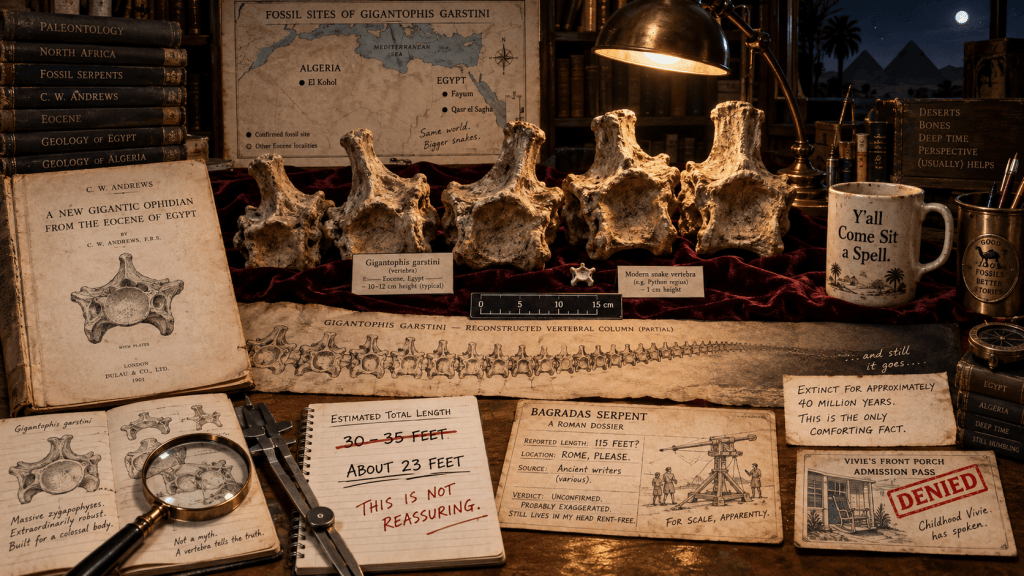
In 1901, paleontologist Charles William Andrews described fossil vertebrae from Egypt belonging to an enormous extinct snake. He named it Gigantophis garstini.
The name essentially means Garstin’s giant snake, because paleontologists occasionally abandon subtlety in the presence of an appropriately terrifying spine.
Gigantophis lived roughly 35 to 40 million years ago in what is now North Africa. Early estimates placed it between about thirty and thirty-five feet long. A later study revised that estimate downward to roughly twenty-three feet, although reconstructing the total length of an extinct snake from a limited collection of vertebrae is not an exact business.
Twenty-three feet is still unacceptable.
More importantly, the fossils establish that North Africa once supported snakes much larger than most living species.
This does not prove that Regulus met one.
Forty million years separate Gigantophis from the Roman army, which is a fairly substantial scheduling conflict.
Still, the ground beneath the legend once held exactly the kind of animal the legend describes.
That feels unnecessarily provocative.
The Grove Take
I do not believe a 115-foot snake attacked Regulus’s army.
There is no physical evidence, the surviving written accounts are late, and the measurements are biologically extravagant. The most reasonable explanation is that an encounter with a large python became increasingly enormous as it passed through Roman literature.
But I understand why the story lived.
A soldier goes to the river for water and something erupts from the reeds. It has no legs to announce its approach. It moves with an efficiency that seems to violate the expected terms of anatomy. Weapons strike it and fail. Men who crossed the Mediterranean to fight Carthage suddenly discover that North Africa has entered the war independently.
Then someone sends for the artillery.
That is not merely an animal encounter. It is the moment human confidence meets a landscape that does not recognize human authority.
Rome could conquer cities.
The river still had opinions.
Porch Policy
No.
Absolutely not.
The Bagradas serpent is not being offered a chair on the porch.
The porch has load-bearing limits, and I have emotional limits. Both have been exceeded.
We will acknowledge the snake respectfully from a considerable distance. We will preserve its habitat. We will refrain from firing siege weapons unless the situation becomes genuinely unmanageable.
I would like to know what the sweet potato did to deserve this level of revulsion and contempt.
It is called a sweet potato. The name practically introduces it as a kind neighbor. It has never demanded anything of you beyond a little heat and perhaps some butter.
Yet every time sweet potatoes come up, someone announces that they hate them. Not a particular recipe. Not the way their aunt made them one Thanksgiving. The entire sweet potato.
I’m going to need an explanation.
The sweet potato has range. Bake it and give it butter. Roast it. Mash it. Make fries. Put it in a pie. Invite it to Thanksgiving and let it arrive under a blanket of marshmallows. I may have preferences about what I’m in the mood for, but I have yet to meet a preparation that made me turn against the sweet potato itself.
And have you introduced cinnamon to it?
Come on.
A warm sweet potato and cinnamon understand each other immediately. You barely have to arrange the meeting. If you’ve been avoiding sweet potatoes all these years, I’d start there before making any final declarations.
I know taste is personal. You are allowed to dislike a food, even one I consider charming and remarkably cooperative. I’m not going to chase you down the street with a forkful of casserole.
I am going to ask what happened.
Was it the texture? The sweetness? Were you served one that had been sitting around too long, and the sweet potato took the blame? Did somebody tell you that you had to like them, causing you to resist on principle? I respect resisting on principle. I simply think we should make sure the principle has identified the correct party.
Because the sweet potato keeps offering alternatives. Don’t want dessert-level sweetness at dinner? Roast it. Don’t want it mashed? Make fries. Don’t want fries? Bake one and bring out the cinnamon.
If none of those appeals to you, fine. More for me. But please stop speaking of this pleasant orange food as though it personally wronged you.
The sweet potato has shown up in good faith. I think we owe it at least a fair hearing.
Good morning from the Grove, where the coffee is steaming and the ocean stretches out in front of me. On this beautiful sea day, I’m sitting with a big question: What does it mean to be a good person? For me, a good person is someone who doesn’t automatically put their own needs above everyone else’s. They try to balance the needs of all. That includes caring for themselves, because their needs matter too. Self-care, rest, and boundaries belong in a good life. The heart of it is taking care of yourself without making others bear the cost. And “others” means more than people. Animals and the environment belong in this conversation, too. We share this world with creatures who cannot always tell us what they need, and with a living planet that cannot simply walk away when we treat it carelessly. Our choices ripple outward. A good person tries to notice those ripples and consider who, or what, might be affected. Of course, needs can conflict. There may not be a perfect answer that makes everyone happy. Balance means pausing long enough to consider the lives touched by a choice, then doing the best we can with what we know. It means listening when someone tells us we missed something, taking responsibility when we cause harm, and being willing to change course. I don’t think goodness is something we prove once and then keep forever. It shows up in the choices we make again and again: how we treat the people around us, how we care for animals, how we use the resources we share, and whether we leave room for others to have needs of their own. Maybe being a good person means living with the understanding that we are part of a much larger circle of life. We can care for ourselves while making room for others. We can meet our own needs with thoughtfulness, and try to leave people, animals, and the world around us a little better for having shared this day. What does being a good person mean to you?
There are several things a man traveling alone at night in Morocco is advised not to do.
Do not linger beside isolated water.
Do not follow a beautiful stranger into the darkness.
Do not assume the woman asking for a ride is exactly what she appears to be.
And if you happen to look down and discover that she has the legs of a camel or goat, understand that the evening has taken a significant turn.
Her name is Aisha Qandisha.
Probably.
She has many names, several histories, multiple forms, and no particular obligation to explain herself to us.
Who Is Aisha Qandisha?
Aisha Qandisha is one of the best-known female spirits in Moroccan folklore.
Her name appears in several spellings, including Aicha Kandicha, Aïcha Qandisha, and Aisha Qandisa. She is also known by regional names and titles, including Lalla Aisha, a respectful form meaning Lady Aisha.
Descriptions vary across Morocco.
She is often portrayed as a strikingly beautiful woman with long dark hair and alluring clothing. She appears near rivers, springs, marshes, drainage canals, wells, or the sea.
She may approach men traveling alone after dark.
At first, everything seems promising.
Then they notice her feet.
Beneath the beautiful human form are the legs or hooves of a camel, goat, donkey, or other animal.
This is generally the point at which the evening ceases to feel promising.
Aisha may seduce the man, possess him, drive him mad, render him helpless, or kill him.
In some modern road stories, she asks a lone driver for a ride. He does not realize who she is until he sees the hooves.
Because apparently checking the passenger’s feet before allowing an unknown woman into the car is one more safety procedure men must learn through folklore.
She Belongs to the Water
Although the details change from region to region, Aisha Qandisha is consistently associated with water.
Near Tangier, she may belong to the sea.
Near Tétouan, she is connected to the Martil River.
In Fez, stories place her near canals.
Other traditions associate her with the Sebou River, springs, marshes, wells, and wet places where the ordinary world feels slightly less secure.
Water is a natural home for stories like hers.
It conceals.
It reflects.
It changes shape without losing itself.
A person standing beside dark water cannot see what waits beneath the surface, and reflections are perfectly capable of showing a familiar face attached to something else entirely.
Aisha is sometimes said to control water or alter it.
She may be called Aisha of the Sea or Lady of the Marsh.
But there may not be one single Aisha.
In some Moroccan spiritual traditions, several female spirits carry the name. They have different temperaments, colors, preferences, and relationships with the people who encounter or invoke them.
Trying to compress them into one standardized monster profile may say more about our need for tidy categories than it does about Aisha.
She is not interested in fitting neatly onto a cryptid identification card.
Jinn, Spirit, Woman, or Something Older?
Aisha Qandisha is often described as a jinniya, a female jinn.
That translation is useful, but incomplete.
In Morocco, traditions surrounding jinn are diverse and deeply woven into religion, place, family stories, healing practices, music, and everyday caution.
Aisha is not merely a spooky creature parents mention to keep children away from dangerous water.
For some communities, she is a meaningful spiritual presence connected to possession and healing rites.
The Hamadsha, Moroccan religious fraternities associated with music, trance, and therapeutic ritual, have traditions involving Aisha. She may be invoked, negotiated with, honored, appeased, or understood through possession.
Music, rhythm, incense, color, movement, and ritual can become part of the relationship between the spirit and the person affected by her.
This is considerably more complex than calling her a demon and moving along.
Aisha may harm.
She may possess.
She may also reveal an illness, create a role for the afflicted person, or participate in a process through which suffering becomes understandable and manageable.
In other words, this is living cultural and spiritual territory.
We should remove our muddy cryptid boots before entering.
Where Did She Come From?
Nobody knows.
That has not prevented people from offering theories.
One suggestion connects Qandisha to the Portuguese word condessa, meaning countess. Portuguese forces occupied several Moroccan coastal cities beginning in the fifteenth and sixteenth centuries, and later stories sometimes identify Aisha as a Portuguese noblewoman.
Another theory reaches much farther back, connecting her to ancient Mediterranean or North African goddesses associated with sexuality, war, and water.
Names such as Astarte and Qetesh appear in these discussions.
The similarities are interesting.
They are not proof of an unbroken historical line.
Folklore rarely travels through history carrying identification papers.
Stories merge. Names shift. Older beliefs settle inside newer religious traditions. Foreign words are reshaped by local speech. A frightening tale in one region becomes a sacred story in another.
Then there is the resistance fighter.
The Woman Who Fought the Portuguese
One popular modern version says Aisha Qandisha began as a real Moroccan woman during the Portuguese occupation.
In some tellings, soldiers attacked her village or killed members of her family. Aisha responded by using her beauty to lure Portuguese soldiers away from their camps.
Once they followed her into the woods or darkness, she killed them.
The colonizers began warning one another about the dangerous woman.
Over time, the resistance fighter became something supernatural.
Her ability to move unseen became magic.
Her beauty became enchantment.
Her courage became predation.
Her successful ambushes became the work of a demon.
It is a powerful story.
It is also difficult to verify historically.
There is no firm evidence establishing one documented resistance fighter as the origin of Aisha Qandisha.
The story may be old oral history.
It may be a later attempt to reclaim a frightening female spirit as an anti-colonial heroine.
It may be both.
Folklore does not become meaningless because it cannot be confirmed.
Sometimes the way a story changes tells us what people need it to mean.
The Beautiful Woman Is Dangerous Again
We have just left the sirens sitting comfortably on the Grove porch.
Now another beautiful woman waits near the water while men insist that she is responsible for what happens when they follow her.
There appears to be a pattern.
Aisha is beautiful, but her beauty is treated as a weapon.
Men desire her.
Men approach her.
Men follow her.
Men lose control.
The story concludes that she must be monstrous.
Her animal legs reveal the danger supposedly hidden beneath female beauty.
But they also expose the man’s failure to look beyond the part of her he wanted.
He saw a beautiful woman alone at night and built the rest of the story himself.
Then the hooves arrived.
Perhaps Aisha is a warning about lust.
Perhaps she is a warning against wandering near dangerous water after dark.
Perhaps she protects places where men are not welcome.
Perhaps she remembers colonizers who thought a beautiful woman could not also be a threat.
Perhaps the monster is what happens when a culture tries to explain female desire, rage, power, illness, or independence without allowing any of those things to belong fully to a woman.
Or perhaps she is a jinniya with camel feet who will absolutely ruin your evening.
Multiple interpretations remain available.
What Evidence Do We Actually Have?
Centuries of oral tradition.
Regional stories from across Morocco.
Accounts of possession.
Rituals, music, and healing practices associated with Aisha and related spirits.
Modern encounter stories.
Films, songs, books, and art.
Possible historical and linguistic connections.
No body.
No hoofprints scientifically connected to a supernatural woman.
No verified photograph.
No confirmed Portuguese countess transforming into a jinn.
No historical record proving that one resistance fighter became the Aisha Qandisha known today.
But unlike many cryptids, Aisha does not depend on zoological proof.
She does not need to be an undiscovered animal hiding beside a river.
She exists as folklore, spiritual presence, cultural memory, warning, explanation, fear, and rebellion.
Those are not lesser forms of existence.
They are simply harder to pin beneath museum glass.
The Grove Take
I do not think there is one correct Aisha Qandisha.
I think she has carried too many meanings for too many people to be reduced to a beautiful predator with camel feet.
She may contain memories of older water spirits.
She may carry traces of goddesses whose names were nearly lost.
She may express the terror of possession and mental illness.
She may offer a language through which suffering can be recognized and treated.
She may warn children away from water and men away from strangers.
She may preserve the story of a woman who resisted foreign occupation.
She may also represent something we keep encountering in folklore.
When a woman cannot be controlled, she becomes supernatural.
When she uses beauty deliberately, she becomes dangerous.
When men desire her and suffer for it, she becomes responsible.
When she fights back, history calls her a monster.
I cannot prove that Aisha Qandisha began as a resistance fighter.
But I understand why people want that version remembered.
A beautiful woman lured armed occupiers away from their camps and killed them.
The soldiers called her a demon.
Her people called her Lalla.
Lady Aisha.
Perhaps both names tell us exactly who feared her and who did not.
Does She Get a Chair on the Porch?
Aisha Qandisha does not need our permission to sit on the porch.
Her chair is already there.
It will be placed near the water, but not so near that anyone can claim we failed to establish reasonable safety precautions.
We will greet her respectfully as Lalla Aisha.
We will not demand that she choose one origin story, one body, one name, or one explanation for herself.
We will not ask to inspect her feet.
That seems rude.
The sirens are nearby, so she will have company familiar with being blamed when men follow beautiful women toward water.
There will be no attempts to summon, control, test, provoke, or photograph her.
There will be music if she requests it.
There will be silence if she does not.
Men traveling alone after dark are responsible for their own decisions.
What’s a country that’s at the top of your bucket list?
Good afternoon from Casablanca, where I’m visiting a winery and the birds are abundant. Today’s prompt asks which country is at the top of my bucket list and I can’t pick just one. Iceland and Greenland are tied. The northern lights, volcanoes, glaciers, and hot springs all sound like my kind of adventure. I love places where the landscape feels wild and alive, where nature is part of the experience rather than just the view. Alaska gave me a taste for that kind of travel, and I’d love to see what Iceland and Greenland have waiting for me. The good news is I don’t have to choose between them. There are cruises that visit both, which sounds like the perfect way to take in two dream destinations in one trip. Northern lights overhead, glaciers stretching toward the sea, and the chance to soak in a hot spring after a day of exploring? Sign me up.
For now, I’m grateful to be here in Morocco, enjoying the scenery, the winery, and another day of seeing the world.