• Most cryptid stories begin with someone walking alone through the woods.

    This one begins with two scientists sealing themselves inside a steel ball and asking to be lowered half a mile into the Atlantic Ocean.

    There was no steering system.

    There was no way to collect anything they saw.

    There was no quick exit.

    There was one cable connecting the sphere to the ship above, an oxygen system, a telephone line, and a small quartz window looking into a part of the world no human being had ever seen alive.

    Then something enormous moved through the light.

    Welcome to the case of William Beebe and the fishes nobody has found again.

    Meet the Bathysphere

    In the early 1930s, naturalist William Beebe wanted to see deep-sea animals where they actually lived.

    Scientists already knew strange creatures existed below the reach of sunlight. Nets dragged through deep water returned with animals that seemed assembled from spare parts.

    Huge mouths.

    Transparent bodies.

    Eyes mounted on stalks.

    Teeth too large for the face containing them.

    Lights growing directly from flesh.

    But a net could only show what survived being caught, hauled through changing pressure, and dragged hundreds or thousands of feet to the surface.

    Beebe wanted to watch these animals alive.

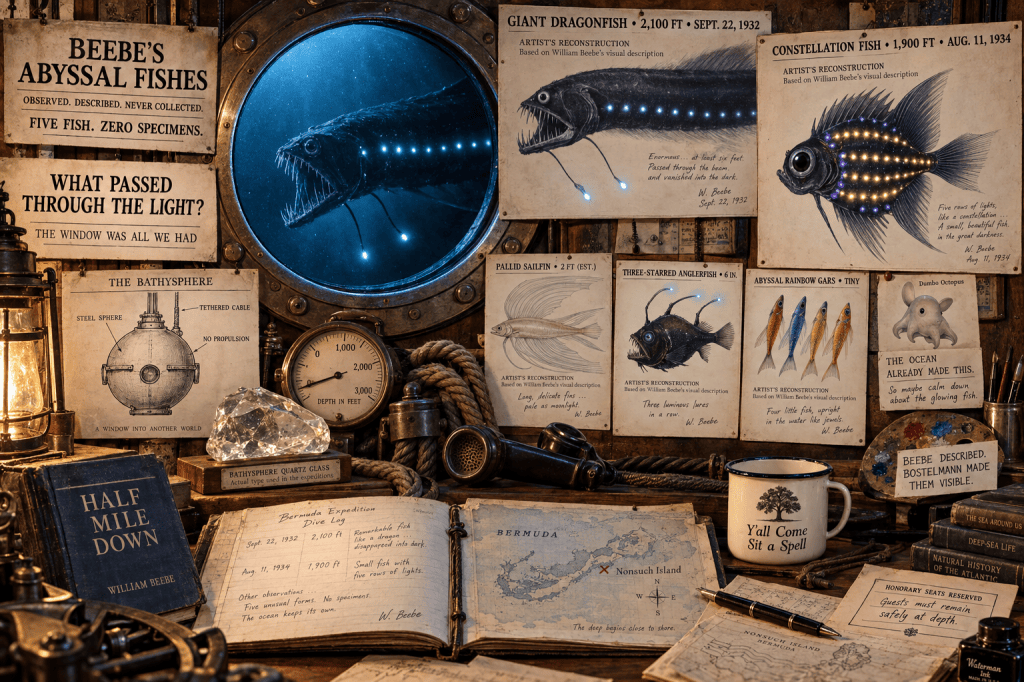
    Engineer Otis Barton designed the Bathysphere, a hollow steel ball large enough for two men to sit inside if neither valued personal space.

    It had no independent propulsion. The Bathysphere was lowered from a ship by a steel cable and hung beneath it like the world’s most scientifically important wrecking ball.

    In 1930, Beebe and Barton began diving off Nonsuch Island in Bermuda.

    On August 15, 1934, they reached 3,028 feet.

    At the time, no human beings had ever descended so deeply into the ocean and returned alive.

    Inside the sphere, Beebe looked through the window and described what he saw over a telephone line to Gloria Hollister aboard the ship.

    Scientific artist Else Bostelmann later worked with his descriptions to paint the animals.

    This detail matters.

    The famous images of Beebe’s abyssal fishes are not photographs.

    They are reconstructions based on what Beebe reported seeing through a small window, in darkness, while suspended thousands of feet beneath the Atlantic Ocean.

    That does not make them worthless.

    It does make them complicated.

    The Giant Dragonfish

    On September 22, 1932, at approximately 2,100 feet, Beebe saw two large creatures pass through the Bathysphere’s light.

    He estimated that each was at least six feet long.

    They had short heads, open jaws, and long dark bodies lined with pale blue lights. Two luminous-tipped appendages appeared to hang beneath each fish.

    Beebe believed they resembled dragonfish, a real group of deep-sea predators known for sharp teeth, dark bodies, and bioluminescence.

    There was one significant problem.

    Known dragonfish were nowhere near six feet long.

    Beebe gave the creature the scientific name Bathysphaera intacta.

    The name has been interpreted as the “untouchable Bathysphere fish.”

    That is painfully appropriate.

    He could see it.

    He could describe it.

    He could not reach it.

    No six-foot dragonfish has ever been collected.

    The Pallid Sailfin

    During a 1934 descent, Beebe saw a very different fish.

    He encountered it twice, at depths between approximately 1,500 and 2,500 feet.

    The creature was at least two feet long and shaped somewhat like a cigar. It had a small eye, a moderate mouth, broad filament-like pectoral fins, dramatically extended upper and lower fins, and a tiny tail that Beebe compared to a button.

    It did not glow.

    Its color was pale, sickly olive.

    Beebe described it as resembling water-soaked flesh.

    Charming.

    He named it Bathyembryx istiophasma, the pallid sailfin.

    The scientific name poetically suggests something from the deep abyss swimming with ghostly sails.

    No specimen was collected.

    Nobody has positively identified one since.

    The Five-Lined Constellation Fish

    At roughly 1,900 feet on August 11, 1934, Beebe saw one of the loveliest creatures he encountered during the Bathysphere dives.

    It was a small, disc-shaped fish, perhaps five inches high and six inches long, with large eyes and vertical fins.

    Along its body were five rows of pale yellow lights. Each larger light appeared to be surrounded by tiny purple photophores.

    Against the absolute darkness, the fish looked like a living constellation.

    Beebe named it Bathysidus pentagrammus, the five-lined constellation fish.

    He wrote that it remained in his memory as one of the most beautiful things he had ever seen.

    Other scientists were less enchanted.

    Ichthyologist Carl Hubbs suggested that Beebe might have seen a comb jelly distorted through the Bathysphere window. Light, curved glass, movement, and an unfamiliar transparent body could have combined to create the appearance of a fish lined with impossible stars.

    Or Beebe saw exactly what he said he saw.

    Nature does not appear to have been consulted for a follow-up.

    The Three-Starred Anglerfish

    During the same August 1934 descent, at approximately 2,470 feet, another small black fish entered the light.

    It was about six inches long and shaped like an anglerfish.

    Anglerfish are already real creatures that appear to have been designed during a meeting nobody adequately supervised.

    Many species possess a modified fin ray called an illicium, tipped with a glowing lure used to attract prey in the darkness.

    Beebe’s fish had three.

    Each one ended in a pale yellow light.

    He called it Bathyceratias trilychnus, the three-starred anglerfish.

    More than two hundred species of anglerfish are now known, and the deep ocean continues producing forms that look unreasonable even when they are lying directly on a laboratory table.

    A species with three lures does not feel impossible.

    It has simply never been confirmed.

    The Abyssal Rainbow Gar

    Then came the little show-off.

    At approximately 2,500 feet, Beebe switched on the Bathysphere’s powerful light and saw four slender fish hanging almost vertically in the water.

    They were only about four inches long.

    Their pointed heads and jaws were bright red. Their bodies were blue. Their tails were yellow.

    They remained stiffly upright before swimming away into the darkness.

    Beebe called them abyssal rainbow gars, although he readily admitted they might not have been gars at all.

    Unlike four of his other mystery fishes, he did not assign this one a formal scientific name.

    Perhaps they were an unknown species.

    Perhaps they were squid or another familiar animal seen at an unfamiliar angle.

    Perhaps red, blue, and yellow simply seemed like the appropriate uniform for a group of tiny fish determined to make an entrance.

    They have never been identified.

    Five Fish or Four?

    You will sometimes see references to five formally described Bathysphere fishes.

    That is not quite accurate.

    Beebe described five memorable mystery forms associated with the dives, but he gave formal scientific names to four of them.

    The abyssal rainbow gar remained an informal name.

    None of the five is currently recognized as a confirmed species.

    That does not mean Beebe was an amateur inventing monsters for attention.

    He was a respected naturalist whose work helped identify dozens of legitimate species. His Bermuda research involved years of deep-water sampling and produced a substantial body of scientific work.

    It also does not mean he could not be mistaken.

    Beebe was trying to identify moving animals through a small window in darkness. He could not pursue them, photograph them clearly, capture them, examine their anatomy, or compare a specimen against known species.

    Sometimes he had seconds to observe them.

    That is not how scientists usually describe a new species.

    A formal species description generally requires a physical specimen that other researchers can examine. Measurements can be repeated. Bones, fins, scales, teeth, organs, and tissues can be compared.

    Beebe had his eyes, his experience, his memory, Barton beside him, a telephone connection to the surface, and Bostelmann’s extraordinary ability to translate language into images.

    It was groundbreaking.

    It was also not enough to prove that the fishes existed exactly as described.

    Did Beebe Invent Them?

    There is no compelling reason to believe he did.

    Beebe did not need five fictional fish to make his expedition interesting.

    He and Barton had already survived a descent no human beings had made before. They were observing living deep-sea animals in their natural environment decades before modern remotely operated vehicles made such footage familiar.

    The truth around them was already extraordinary.

    Barton also supported Beebe’s observations, although the confined viewing position and brief encounters limited what either man could verify independently.

    The more reasonable possibilities are less dramatic.

    Beebe may have seen known animals from strange angles.

    The quartz window and artificial light may have distorted proportions and colors.

    Several animals may have overlapped in the beam.

    A transparent squid, comb jelly, or other invertebrate might have looked like a fish.

    He may have correctly observed species that remain unidentified because the deep ocean is enormous, sparsely explored, and profoundly indifferent to our desire for confirmation.

    More than one explanation may be true.

    Perhaps the constellation fish was a comb jelly.

    Perhaps the pallid sailfin was a distorted view of a known deep-sea species.

    Perhaps somewhere below Bermuda, a six-foot dragonfish remains deeply committed to avoiding scientists.

    What Evidence Do We Actually Have?

    Beebe’s written descriptions.

    His telephone reports during the dives.

    Otis Barton’s supporting observations.

    Else Bostelmann’s reconstructions.

    Beebe’s scientific publications and his 1934 book, Half Mile Down.

    No specimens.

    No bones.

    No preserved tissue.

    No definitive photographs.

    No later confirmed sightings.

    The evidence is stronger than a campfire story told by one frightened hiker.

    It is weaker than the evidence required to establish a species.

    That puts Beebe’s fishes in a particularly delicious cryptid category.

    They were reported by a trained scientist conducting serious research in the exact environment where unknown animals are most likely to exist.

    And we still cannot prove he saw what he believed he saw.

    The Grove Take

    I believe William Beebe saw something.

    More accurately, I believe he saw several somethings.

    I do not believe every detail of every reconstruction must be correct for the encounters to matter.

    Imagine sitting inside a steel sphere almost half a mile beneath the ocean.

    Above you are thousands of feet of black water.

    Outside the window is a world humans have never directly entered.

    Your light reaches only a short distance before the darkness swallows it.

    Then a living shape passes through the beam.

    You have seconds.

    Describe it.

    Measure it.

    Remember every fin, color, light, movement, and proportion.

    Do it while knowing it may disappear before anyone else can see it.

    Beebe tried.

    Perhaps he named the fishes too quickly. Perhaps some of his confidence exceeded what the evidence could support.

    But I understand why he did it.

    He had traveled farther into their world than any human before him. For a few seconds, the darkness opened and showed him something.

    Then it closed again.

    Nearly a century later, we have better cameras, stronger submersibles, remotely operated vehicles, and entire institutions devoted to deep-sea exploration.

    We are still discovering animals that look impossible.

    We have documented the Dumbo octopus, a soft-bodied little creature that drifts through the abyss by flapping two ear-like fins and looks as though the ocean designed an animated character during lunch.

    That animal is real.

    So I am reluctant to declare a glowing constellation fish implausible merely because nobody has brought one upstairs yet.

    Also I am not prepared to tell William Beebe that all five of his fishes were mistakes.

    The ocean has hidden stranger things.

    Do They Get a Chair on the Porch?

    Every one of them.

    The giant dragonfish will require the reinforced section.

    The pallid sailfin may have the chaise because anyone described as swimming with ghostly sails deserves room to drape.

    The constellation fish will be seated where we can properly admire the lights.

    The three-starred anglerfish must keep all lures away from the other guests.

    The rainbow gars can share. They are four inches long and apparently travel as a committee.

    There is, unfortunately, a practical problem.

    These fishes belong thousands of feet beneath the surface. Bringing them onto the porch would be inhospitable, scientifically irresponsible, and probably explosive.

    So their chairs will remain symbolically reserved.

    William Beebe and Otis Barton may sit in them and tell us what passed outside that window.

    Else Bostelmann gets a chair too. Someone had to turn voices from the darkness into pictures the rest of the world could see.

    The fishes may remain safely in the abyss.

    If they are still there, they already know we are talking about them.

  • Come sit a spell.

    When my grandmother died, my mother asked me if there was anything of hers I wanted.

    I didn’t have to think about it.

    Her brown pottery tea pitcher.

    What I didn’t know was that my mother had already put it aside for me.

    We had never discussed the pitcher.

    We had never had a conversation about my grandparents’ brown ware or what it meant to me. I had never told her, “If anything ever happens to Grandma, that’s what I want.”

    But somehow, when my mother began sorting through her mother’s things, she looked at that chipped everyday tea pitcher and thought:

    Elizabeth will want this.

    She was right.

    There were probably plenty of things I could have chosen.

    Jewelry.

    A purse.

    Something tucked away for special occasions.

    Something valuable.

    But the only thing I wanted was the pitcher.

    It wasn’t a valuable piece of pottery.

    It wasn’t a name brand.

    It wasn’t pristine.

    In fact, it was chipped.

    But it had been part of the background of my grandparents’ home for as long as I could remember.

    It wasn’t displayed carefully behind glass.

    Nobody took it down twice a year and told us to be careful with it.

    It was used.

    It held tea.

    It sat on the table.

    It was part of ordinary days.

    And somehow my mother understood, before I ever said a word, that the ordinary thing was the important thing.

    I still have it.

    I also collect Hull brown ware now.

    My grandparents had brown pottery dishes when I was growing up. Their set wasn’t Hull, but Hull’s brown ware reminds me of it.

    So when I see those warm brown dishes, something in my brain recognizes them.

    Not as antiques.

    As home.

    That’s an interesting thing about the objects we keep.

    Their monetary value and their actual value frequently have almost nothing to do with each other.

    We understand this perfectly well, and yet we still use the same word for both.

    Value.

    An appraiser can tell you what something is worth.

    Twenty dollars.

    Two hundred dollars.

    Two thousand dollars.

    But an appraiser can’t tell you its value.

    Those are different things entirely.

    Sometimes the least expensive thing in the house is the one you’d grab first.

    A chipped bowl.

    An old pocketknife.

    A recipe card.

    A Christmas ornament made from construction paper and enough glue to survive a direct nuclear strike.

    A rock picked up on a trip.

    A coffee mug nobody else is allowed to use.

    None of these things would cause a bidding war at Sotheby’s.

    But try throwing one away.

    Absolutely not.

    Because objects collect things other than dust.

    They collect associations.

    That pitcher doesn’t contain tea anymore.

    It contains my grandmother’s kitchen.

    It contains family meals.

    It contains the particular shade of brown pottery that my brain apparently filed decades ago under This Is What Home Looks Like.

    You can’t put a price on that because nobody else can buy it.

    Someone else could own the exact same pitcher.

    Same manufacturer.

    Same shape.

    Same glaze.

    Same age.

    Maybe theirs wouldn’t even have a chip.

    It still wouldn’t be mine.

    Because mine was hers.

    I think that’s also why some inherited things don’t resonate with us the way we’re told they should.

    We’re expected to want the jewelry.

    The china.

    The silver.

    The things traditionally considered valuable enough to pass down.

    Sometimes we do.

    But sometimes Grandma’s diamond ring isn’t the thing that makes you think of Grandma.

    Maybe it’s the dented aluminum measuring cup she used every Sunday.

    Maybe it’s the ugly lamp beside her chair.

    Maybe it’s the wooden spoon she stirred gravy with.

    Maybe it’s the chipped pitcher that held the tea.

    Those are the things we actually saw them use.

    They’re connected not to the ceremonial parts of someone’s life, but to the ordinary ones.

    And perhaps ordinary is where most of our memories actually live.

    We remember holidays and weddings and big occasions, certainly.

    But a life isn’t mostly made of big occasions.

    It’s made of Tuesday afternoons.

    It’s made of dinner.

    It’s made of coffee in the morning and tea on the table and somebody sitting in the same chair every night.

    It’s made of thousands of tiny moments nobody thinks to photograph because nobody realizes they’re going to miss them someday.

    The objects were just there.

    Until the person wasn’t.

    Then suddenly that old pitcher isn’t just a pitcher anymore.

    It’s evidence.

    She was here.

    She held this.

    She poured tea from this.

    This ordinary thing was part of her ordinary life.

    And I got to be part of that life, too.

    Maybe that’s why I love old things now.

    Maybe that’s part of why I can walk through an estate sale and become fascinated by something another person has walked right past.

    Objects have stories.

    Sometimes we know them.

    Usually we don’t.

    And sometimes we bring an object home and let it start another one.

    My grandmother’s pitcher won’t ever be particularly valuable.

    It’s still chipped.

    It’s still anonymous brown pottery.

    And I wouldn’t trade it for a pristine piece of Hull.

    Because I can buy Hull.

    I can’t buy another pitcher that sat on my grandmother’s table.

    So when my mother asked what I wanted, I didn’t choose the thing that was worth the most.

    I chose the thing that was worth the most to me.

    There’s a difference.

    And sometimes the difference is everything.

  • Today we are leaving Barcelona and heading out to sea.

    This means it is time to discuss one of the oldest pieces of maritime safety advice ever recorded:

    If a beautiful disembodied voice begins singing to you from somewhere beyond the railing, do not investigate.

    Do not lean over for a better look.

    Do not assume Virgin has added surprise nighttime entertainment.

    Go inside.

    The sirens are singing.

    You Already Know the Story

    Most of us were introduced to sirens through some version of the story of Odysseus.

    The sorceress Circe warns him that his ship will pass the island of the Sirens, whose irresistible song lures sailors to their deaths.

    Anyone who hears them will forget home, family, duty, and apparently every useful instinct required to remain alive.

    Odysseus wants to hear the song.

    Of course he does.

    This is a man who has already survived a war, a Cyclops, angry gods, cannibals, enchantresses, shipwrecks, and his own repeated inability to leave well enough alone.

    His solution is surprisingly responsible by Odysseus standards.

    He orders his crew to plug their ears with beeswax. Then he has them tie him upright to the ship’s mast. No matter how desperately he begs, threatens, or commands them to release him, they must ignore him and tighten the ropes.

    The plan works.

    As the ship passes the island, the Sirens sing directly to Odysseus.

    They promise knowledge. They claim to know what happened at Troy and everything that occurs across the earth.

    That is important.

    Their song is not merely beautiful.

    It offers him exactly what he wants most.

    Odysseus struggles against the ropes and begs to be freed. His crew cannot hear him. They bind him tighter and keep rowing.

    Once the ship passes beyond the reach of the song, Odysseus returns to himself.

    The sailors remove the wax.

    Everyone survives.

    This remains the gold standard for knowing in advance that you are going to make a terrible decision and arranging responsible supervision.

    Homer Forgot to Describe Them

    Here is where the story becomes strange.

    Homer tells us what the Sirens do.

    He tells us where they live.

    He tells us about their voices, their knowledge, and the bodies of dead sailors decaying around them.

    He does not tell us what they look like.

    No feathers.

    No wings.

    No scales.

    No tails.

    Not even an official number.

    He leaves an enormous visual blank in one of the most famous monster stories ever written.

    Artists promptly filled it.

    Ancient Greek art usually portrayed sirens as birds with women’s heads. Later versions gave them more of a woman’s upper body while retaining wings, talons, or a bird’s lower half.

    They were not glamorous women reclining on rocks and combing waist-length hair.

    They were bird-women.

    Some traditions connected them to Persephone. They may have been her companions before Hades carried her into the Underworld. In one version, they asked for wings so they could search for her across land and sea. In another, Demeter transformed them as punishment for failing to protect her daughter.

    Either way, the wings made sense.

    For centuries, if someone told you to picture a siren, you were supposed to imagine something closer to a beautiful harpy than Ariel’s homicidal cousin.

    So how in the hell did we get a fish tail?

    Medieval People Got Involved

    By the early Middle Ages, writers and artists had inherited several overlapping traditions about dangerous women connected to water.

    They had the Greek sirens with their fatal song.

    They had mermaids and other fish-tailed water beings from European folklore.

    They had translations moving between Greek, Latin, and regional languages.

    They had bestiaries that mixed natural history, religion, morality, folklore, and animals somebody’s cousin had supposedly seen beyond the edge of the known world.

    Precision was not always the main objective.

    An early medieval work called the Liber Monstrorum described sirens as sea maidens with the upper bodies of women and scaled fish tails below.

    Other manuscripts continued to show bird-like sirens.

    Some showed fish-like sirens.

    Some apparently looked at the disagreement and gave them wings, clawed feet, and fish tails.

    Why choose?

    Across medieval Europe, the fish-tailed version became increasingly common. The siren’s irresistible voice and murderous intentions blended with the mermaid’s aquatic body.

    Language helped the confusion along. In several European languages, the same word came to be used for both siren and mermaid.

    The merger became so complete that modern audiences often assume the ancient Greek sirens always had fish tails.

    They did not.

    Homer gave us a voice.

    Greek artists gave it wings.

    Medieval writers gave it a tail.

    Popular culture decided the tail photographed better and quietly retired the bird parts.

    Sirens and Mermaids Are Not Quite the Same Thing

    Traditionally, a mermaid is defined by her body.

    She is part woman and part fish.

    What she does depends on the culture telling the story.

    Mermaids may warn of storms, cause shipwrecks, grant wishes, fall in love with humans, protect waterways, steal children, predict death, or simply sit on a rock being mysteriously well groomed despite constant exposure to saltwater.

    A siren is defined by her weapon.

    The song is the point.

    A siren does not need a fish tail. She does not technically need wings. She needs a voice capable of overriding judgment and drawing people toward destruction.

    The difference is useful.

    A mermaid is something you see.

    A siren is something you hear too late.

    They Returned to the Big Screen

    Sirens received a particularly effective modern reappearance in Black Panther: Wakanda Forever.

    During an attack on an ocean mining platform, the Talokanil use an eerie song to hypnotize people aboard the ship. One after another, the crew members calmly walk toward the edge and step into the sea.

    Nobody chases them.

    Nobody needs to drag them overboard.

    The victims hear the call and go willingly.

    It is one of the most unsettling scenes in the film because it restores what centuries of beautiful mermaid paintings often softened.

    The siren’s power is not that she is attractive.

    Her power is that she reaches inside your mind, finds the thing capable of moving you, and makes destruction feel like your own idea.

    The filmmakers did not need Odysseus, an island, feathers, or a mast.

    They kept the essential element.

    Someone sings.

    Everyone who hears it is lost.

    Were Sirens Ever Cryptids?

    Not really.

    There is no biological case for bird-women or fish-tailed singers operating an organized maritime murder program.

    Sirens belong to mythology and folklore.

    But by Day 11, we have already welcomed a possible alien owl, a woolly swamp torpedo with a propeller for a tail, and whatever Barcelona thought was flying over Les Corts in 1990.

    The admission standards have become flexible.

    Sirens also belong here because they influenced centuries of alleged mermaid encounters.

    Sailors reported seeing humanlike figures in the water. Maps placed strange sea people alongside whales and monsters. Manatees, dugongs, seals, distance, exhaustion, loneliness, and expectation likely explained many sightings.

    But expectation matters.

    People do not see the unknown with empty minds.

    They see it through the stories they already carry.

    A sailor who grew up hearing about mermaids and sirens was prepared to recognize one.

    A shadow rose from the water.

    A strange cry moved across the waves.

    A marine animal surfaced at dusk.

    The story supplied the rest.

    What Evidence Do We Actually Have?

    Ancient literature.

    Greek pottery and sculpture.

    Roman mosaics.

    Medieval manuscripts and bestiaries.

    Centuries of folklore.

    Sailors’ stories.

    Reported mermaid sightings.

    An extraordinary number of shipwrecks that almost certainly had more to do with reefs, weather, navigation, and human judgment than supernatural women singing from nearby rocks.

    No bones.

    No feathers attached to a human torso.

    No biologically verified fish-tailed woman.

    No recording of a song capable of overriding human will.

    We have no evidence that sirens exist as physical creatures.

    We have overwhelming evidence that the idea of them refuses to die.

    The Grove Take

    Sirens have survived for nearly three thousand years because the monster was never really the body.

    That part could change.

    Bird.

    Woman.

    Fish.

    Wings.

    Tail.

    The danger remained intact.

    The siren represents the terrifying possibility that desire can become stronger than reason. That something might know exactly what we want to hear and use it to lead us somewhere we would never willingly go.

    The ancient version offered Odysseus knowledge and glory.

    Later stories offered sailors beauty, love, escape, or the promise of something waiting beyond the horizon.

    Modern sirens do not require an island.

    They live in movements, leaders, advertisements, algorithms, relationships, and every voice that promises to give us exactly what we want if we will only stop asking where it is taking us.

    Maybe that is why the siren survived while her body kept changing.

    We were never truly afraid of the feathers or the tail.

    We were afraid we might hear the song and follow.

    Do They Get a Chair on the Porch?

    Absolutely.

    Who gets the opportunity to sit down with a mythological creature and says no?

    Pull up a chair. Bring the whole flock, school, choir, or whatever collective noun the current version of sirens prefers.

    I have questions.

    What did they actually sing to Odysseus? Did they know their appearance would be debated for three thousand years? How did they feel about the transition from wings to tails? Was there a meeting? Were they consulted, or did one medieval illustrator simply make an executive decision that everybody else copied?

    Or perhaps was the first siren simply a woman who wanted to be left the fuck alone on her island and understood that men respect danger more reliably than boundaries. She spread a few conflicting descriptions, sang something unsettling from the rocks, and let frightened sailors handle the publicity. Bird legs? Certainly. Fish tail? Obviously. Eats men? Constantly. Visitors welcome? Absolutely not.

    The sirens are welcome at the Grove.

    If they arrive with fish tails, we will provide chaises. If they arrive with bird legs, they may perch beside the Barcelona Big Bird. If they arrive with wings and tails because a medieval artist refused to commit, we will admire their versatility and make room.  If they walk up, have a seat.

    They will not, however, be invited to karaoke night.

    They are also excluded from bonfire sing-alongs, porch concerts, humming near open water, and any activity involving the phrase, “You have to hear this.”

    We love them.

    We want to know them.

    We also recognize that healthy relationships require boundaries, and “Please do not enchant our guests and lure them to their deaths” is a perfectly reasonable one.

    The chairs are ready.

    Nobody sing.

  • What’s one thing you know now that would have saved your younger self a lot of pain?

    Worked for 13s

    Good morning from Barcelona, where the coffee is hot, I don’t hear any birds, and today I’m getting on a boat. This morning’s prompt asks what I know now that could have saved my younger self a lot of pain.

    I don’t have to search long for my answer. I wish someone had taught me financial awareness and planning. Of all the things I wish I had known earlier, this is the biggest piece.

    Money decisions can feel like separate moments: paying a bill, using credit, borrowing, saving, handling an emergency. But they connect to one another, and they shape the choices available later. I wish I had understood sooner how planning, interest, debt, and savings could affect my options over time. I wish I had known what questions to ask before I was already facing the consequences.

    Financial literacy is more than knowing how to add numbers or make a budget. It means understanding the tools in front of you and being able to make choices with a clearer view of what may come next. Those are skills people need, and they shouldn’t be left to chance.

    There’s a lot of life in the words what could have been different. I can’t know exactly how things might have unfolded with better guidance. I do know that learning financial literacy at any point could have changed many of my choices and spared me some pain.

    That is the lesson I wish I could give my younger self: learn how money works, ask questions, and make a plan. It’s the biggest thing I wish someone had taught me.

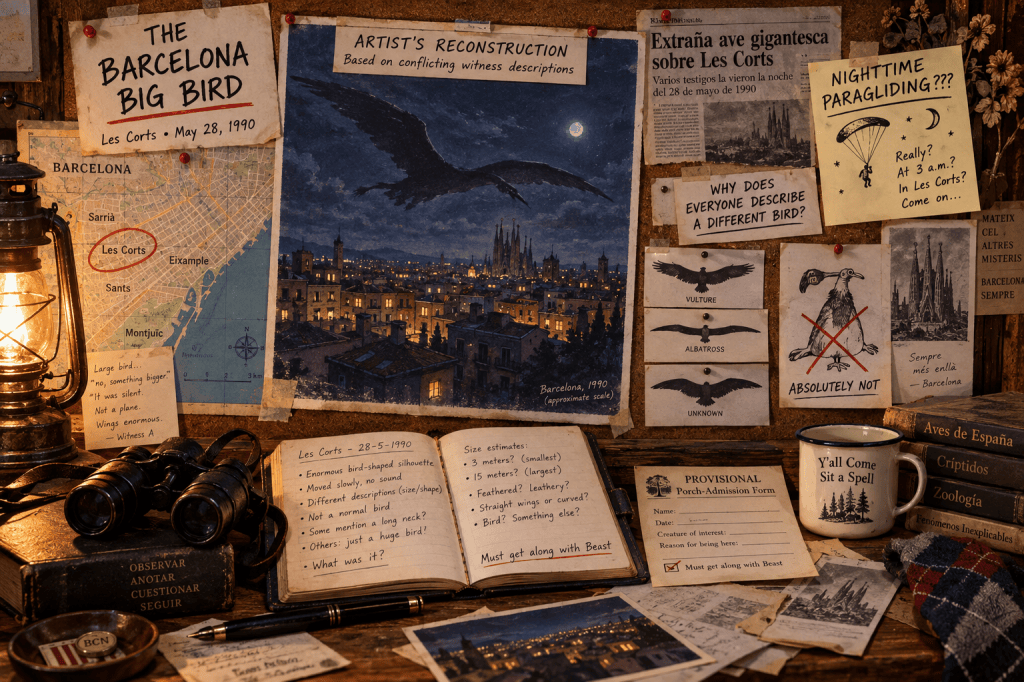
  • In the summer of 1990, something enormous may have flown over Barcelona.

    It was dark.

    It was loud.

    It may have had feathers.

    It may have had leathery wings.

    It may have been a vulture, an albatross, a mutant pigeon, a mechanical bird, a prehistoric survivor, or the wandering spirit of someone who had angered the gods.

    Or it may never have existed at all.

    Whatever it was, Barcelona spent three glorious months discussing it in the newspaper.

    Welcome to the Barcelona Big Bird Incident.

    It Began in Les Corts

    On June 10, 1990, La Vanguardia published a letter from a Barcelona resident named Pere Carbó.

    Carbó described something that had allegedly happened on the night of May 28 in Les Corts, a district on the western side of the city.

    Residents had been awakened by unbearable screeching or cawing. When they stepped onto their balconies, they saw the black silhouette of an enormous bird.

    Carbó estimated that it measured somewhere between three and five meters across.

    That is roughly ten to sixteen feet.

    This was not a slightly oversized seagull that had been eating particularly well.

    According to Carbó, numerous neighbors saw it and discussed it the following day. He wanted to know what the creature was and why nobody had mentioned it in the press.

    The press had now mentioned it.

    Barcelona responded.

    Everyone Had Seen the Bird

    Letters began arriving from other readers.

    Some claimed they had seen the same enormous creature in Barcelona. Others placed it in nearby communities, including Gavà, Sant Joan Despí, Salou, Bellvei del Penedès, and the Empordà region.

    Reports came during the day and at night.

    The bird was usually described as black or gray, but that was about where agreement ended.

    Its estimated wingspan ranged from three meters to fifteen.

    Some witnesses saw an enormous crow.

    Others saw a pigeon.

    One described something resembling a chicken or ostrich.

    Several thought it looked prehistoric, with membranous wings like a pterodactyl.

    The creature reportedly produced loud, unpleasant cries in three different tones. Other witnesses said it was completely silent.

    It flapped its wings.

    It glided without moving them.

    It had thick legs.

    It may have had a long neck.

    It may have eaten Barcelona’s missing cats.

    By this point, the Big Bird had acquired nearly every possible characteristic except consistency.

    The Original Social Network

    It is important to remember that this happened in 1990.

    There was no Facebook neighborhood group.

    There was no TikTok video filmed through a dirty windshield.

    Nobody could post a blurry photograph with three red circles and the caption, “WHAT IS THIS THING OVER LES CORTS?”

    The letters page was social media.

    One person described an extraordinary experience. Other people read it and searched their memories, their neighborhoods, and the sky for something similar.

    Then they wrote in too.

    The more letters the newspaper published, the more people watched for the bird.

    The more people watched, the more birds, shadows, aircraft, and strange nighttime sounds became possible evidence.

    Soon other newspapers and media outlets picked up the story. Police reportedly received hundreds of calls, and Barcelona’s citizen information line became overwhelmed.

    An unidentified giant bird had become one of the city’s biggest conversations.

    And Barcelona, to its everlasting credit, did not waste the opportunity to become ridiculous.

    Bring on the Mutant Pigeons

    The theories arrived quickly.

    One reader suggested that environmental damage had mutated Barcelona’s pigeons into enormous predators.

    This theory was accompanied by concern about cats that had allegedly disappeared from balconies without leaving bodies in the streets.

    There is no evidence connecting missing cats to a giant radioactive pigeon.

    There is, however, something deeply human about seeing a monstrous bird and immediately assuming that it has been stealing neighborhood cats.

    Another reader, identifying himself as a botanist and wildlife scholar, confidently declared that the creature was an Avis Cervus, also called a Peritio.

    He described it as a half-deer, half-bird creature related to other legendary giant birds. According to his account, it had been documented centuries earlier and was merely passing through Barcelona during its customary migration toward Madagascar or possibly Atlantis.

    He assured readers that the creature was harmless.

    I am not convinced that “It is a deer-bird spirit migrating to Atlantis” is especially reassuring, but the effort was made.

    Other citizens blamed a mechanical bird or elaborate model aircraft. Some suggested enormous gulls, owls, crows, or vultures.

    One letter writer offered the traditional Spanish solution: “Bicho que vuela, a la cazuela.”

    If it flies, put it in the cooking pot.

    Scientists were asked to join the discussion.

    An ornithologist reportedly suggested that an albatross might explain at least some descriptions. Large albatrosses can have wingspans exceeding three meters, although finding one flying over Barcelona would itself have been unusual.

    The environmental department of the Catalan government offered a simpler answer.

    It was a large vulture.

    Case closed.

    Except Barcelona was nowhere near finished with the bird.

    Then the Bird Got Even Bigger

    Once a mysterious creature enters public conversation, it rarely becomes smaller.

    A later witness claimed to have seen a prehistoric-looking bird near El Prat Airport that appeared six times larger than his car.

    A family near Girona reportedly saw a dark, silent bird measuring five or six meters across, with thick legs and wings that did not appear to move.

    In 1996, several people near Montseny allegedly watched an enormous black bird fly only a few meters above the ground.

    Other reports described wingspans of twenty or even thirty meters.

    At that size, we have moved beyond “unidentified bird” and entered “commercial aircraft with opinions.”

    But not every letter was offered in complete sincerity.

    Readers joked about cooking the bird. Someone suggested making it the mascot of the Barcelona Olympics. Another described seeing it in Park Güell wearing argyle socks, only to admit that he had been dreaming.

    One writer claimed that the creature had defecated so dramatically across his windshield that he crashed into a cypress tree, a detail he hoped would be useful in his dispute with the insurance company.

    By late summer, Barcelona was no longer simply reporting a cryptid.

    Barcelona was collaboratively writing one.

    What Could It Have Been?

    There are several reasonable possibilities.

    Large birds can be difficult to judge against an open sky, especially at night. Without a familiar object beside them, distance and size become guesswork.

    Vultures, gulls, herons, owls, and other ordinary birds can look enormous when seen unexpectedly from below.

    Mechanical aircraft, kites, helicopters, and shadows may explain some reports.

    The original letter may have been sincere. It may have been exaggerated. It may have been a joke that found an enthusiastic audience.

    Once the newspaper began publishing additional accounts, suggestion almost certainly played a role.

    People were now looking for the bird.

    An ordinary sound became its cry. A large gull became its silhouette. A shadow crossing an apartment window became proof that it had returned.

    Some people may have sincerely misidentified what they saw.

    Some may have embellished.

    Some were plainly joining the fun.

    And some may have looked into the sky over Barcelona and seen something they genuinely could not explain.

    What Evidence Do We Actually Have?

    Letters.

    Lots of them.

    Contemporary newspaper coverage.

    Reports of calls to police and city information services.

    Later collections of alleged sightings.

    No clear photograph.

    No feather.

    No nest.

    No body.

    No consistent physical description.

    No evidence of a giant unknown species living above Barcelona.

    The creature also changed dramatically depending on who saw it.

    It had feathers until it had membranes.

    It was three meters across until it was thirty.

    It screamed until it flew silently.

    It was a bird, a pterodactyl, a machine, an albatross, a vulture, a mutant pigeon, or a supernatural deer-bird headed for Atlantis.

    That is not strong zoological evidence.

    It is fantastic folklore.

    Maybe Barcelona’s giant bird was a vulture.

    Maybe it was an albatross far from home.

    Maybe it was several ordinary birds stitched together by suggestion and summer boredom.

    Maybe the whole thing began as a joke.

    But for three months in 1990, thousands of people looked up.

    And somewhere over the rooftops of Barcelona, a monster took flight.

    Does It Get a Chair on the Porch?

    Provisionally.

    The Barcelona Big Bird may visit the Grove, provided it agrees to remain a reasonable size, refrains from eating neighborhood cats, and does not deposit anything windshield-obscuring in the driveway.

    It will also need to pass a supervised introduction with the Beast of Exmoor.

    The Beast is already occupying the sunny end of the porch, and I am not rearranging everyone because an unidentified flying creature has arrived without references.

    If they get along, the bird may perch on the porch roof. A standard chair seems impractical for something with a reported wingspan ranging from three to thirty meters.

    If it is actually a mutant pigeon, all agreements are subject to immediate review.

  • I don’t know who first looked at a pickle and decided it needed breading, but I would like to thank that person.

    A pickle was already doing a respectable job. Crisp. Sour. Dependable beside a sandwich. Nobody had complained that it lacked ambition.

    And yet someone thought, What if I put this in hot oil?

    That is the kind of curiosity we should encourage.

    I went looking for a name, and found Bernell “Fatman” Austin. In 1963, he sold fried dill pickle slices at the Duchess Drive-In in Atkins, Arkansas. Fifteen pickle chips for fifteen cents. I would have bought two orders, assuming I could have scraped together thirty cents and found my way to Arkansas.

    Mr. Austin, can we send you flowers? Perhaps a plaque? You took a food that had been minding its business in a jar and helped it find a second calling.

    I will eat a fried pickle in either form. A spear has its merits, and I am not the sort of person who turns down a perfectly good fried pickle because of its geometry. But I prefer a chip. More edges, more crunch, and a better chance that each bite will deliver both pickle and breading in the right proportions.

    Crispier is better. I feel strongly about this, though I’m prepared to settle the dispute by eating a great many samples.

    And please bring me a little horseradish dipping sauce. The pickle already has a sharp opinion. The sauce should be able to keep up.

    This is what makes fried pickles such a clever idea. The hot, crisp coating arrives first. Then the cool, sour pickle cuts through it. You get two textures and a small argument in every bite, and both sides win.

    There are people who hear “fried pickle” and ask why anyone would do that to a pickle. I understand the question. I had a similar reaction the first time somebody suggested frying a food that was already perfectly edible. But then I tried one.

    There are ideas you cannot judge from a description. “Hot breaded pickle” sounds like the result of a kitchen accident. “Another order, please” is what happens after you taste it.

    I’ve learned there is a National Pickle Day in November. Fine. Pickles deserve recognition for their years of service. But I’m not convinced a regular pickle can adequately represent the fried branch of the family. I also found people celebrating a Fried Pickle Day in June, though it seems to be an informal affair.

    We can do better for a pickle with a fifteen-cent origin story.

    Give fried pickles their own day. Give Bernell Austin a moment of appreciation. Encourage restaurants to put their crispiest chips forward, preferably with horseradish sauce available for those of us who know where we stand.

    I’m not asking for a parade.

    Unless someone has already ordered the float. In that case, I would like to ride on it.

  • What’s the weirdest movie you’ve ever watched?

    I’m traveling today – so here’s my best.  I’ve watched too many weird movies to quantify or listify. Forever Layover. Madrid. Beer.

  • 31 Days of Cryptids: Day 9

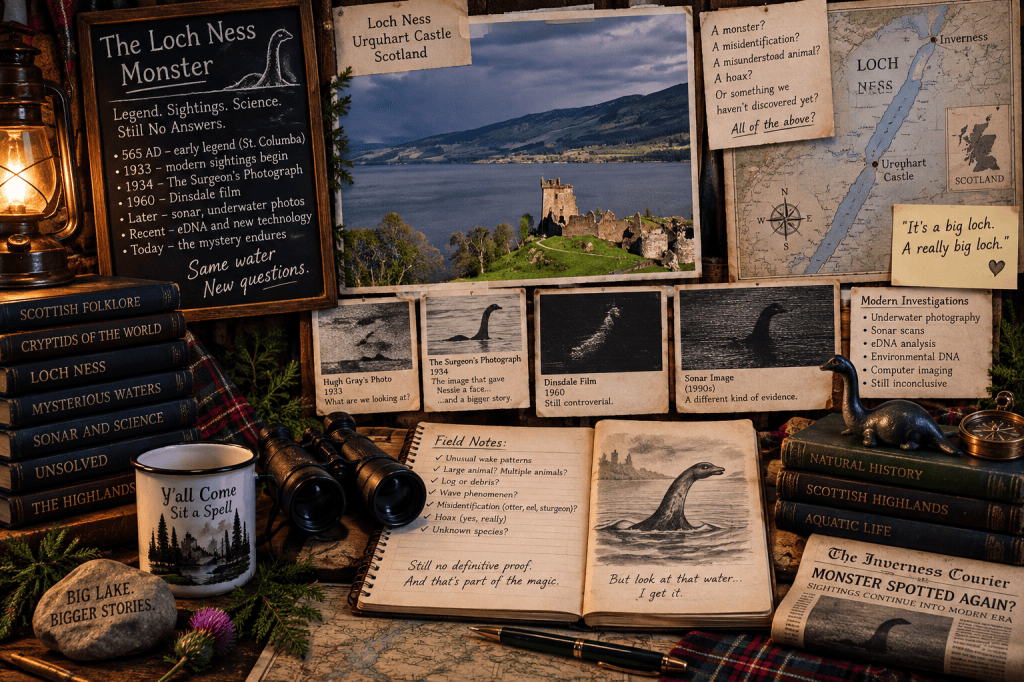
    The Loch Ness Monster

    We’ve made it nine days.

    We’ve examined evidence.

    We’ve questioned witnesses.

    We’ve separated folklore from zoology, identified hoaxes, considered camera artifacts, contemplated the possibility of bug legs, and denied Porch access to exactly one creature on actuarial grounds.

    I believe we’ve demonstrated that we take our responsibilities seriously.

    Good.

    Because today I’m going to need some accumulated credibility.

    It’s Nessie Day.

    And I love her.

    Let’s get that out of the way now.

    The Creature

    The Loch Ness Monster, affectionately known as Nessie, is said to inhabit Loch Ness in the Scottish Highlands.

    Descriptions vary, because of course they do.

    A long neck.

    A small head.

    A large body.

    One or more humps rising from the water.

    Dark or gray skin.

    Sometimes flippers.

    Sometimes a tail.

    The version most of us picture looks vaguely like a plesiosaur, one of the long-necked marine reptiles that disappeared in the same mass extinction that took the non-avian dinosaurs about 66 million years ago.

    This is biologically problematic for several reasons we’ll get to.

    But first we need the loch.

    Because if you’re going to hide a monster somewhere, Loch Ness is an excellent piece of real estate.

    Loch Ness Is Enormous

    Loch Ness stretches for roughly 23 miles through the Scottish Highlands.

    It is deep, reaching around 750 feet at its deepest points, and contains more fresh water than all the lakes in England and Wales combined.

    Its water is dark.

    Peat washed down from the surrounding land stains it brown, dramatically reducing underwater visibility.

    Stand beside Loch Ness and look across it and you immediately understand why stories live there.

    It’s big.

    It’s dark.

    It’s deep.

    And you cannot see what is underneath you.

    Humans have historically handled that particular combination extremely well.

    Has Nessie Been There for 1,500 Years?

    This is where we need to clean up one of the most repeated pieces of Nessie lore.

    You’ll often read that the first recorded sighting of the Loch Ness Monster occurred in 565 CE, when the Irish monk St. Columba encountered a monster in the River Ness.

    According to a biography written about a century after Columba’s death, a creature attacked a swimmer in the river. Columba commanded the beast to go no farther, and it fled.

    Great story.

    It is not a 565 eyewitness report.

    It was written later by Adomnán as part of a saint’s life, a literary form filled with miracles intended to demonstrate the holy person’s power.

    The story also takes place in the River Ness, not Loch Ness itself.

    Could it reflect older local traditions involving dangerous water creatures?

    Possibly.

    Does it establish that people were documenting Nessie in the sixth century?

    No.

    Our modern monster arrives much later.

    1933: Nessie Gets Famous

    In 1933, a new road along the north side of Loch Ness made the water considerably more visible to motorists and visitors.

    That year, hotel manager Aldie Mackay and her husband reportedly saw something large disturbing the surface of the loch.

    The Inverness Courier published an account in May.

    The word monster was attached to Loch Ness.

    And things escalated rapidly.

    Sightings followed.

    Newspapers arrived.

    Tourists arrived.

    Monster hunters arrived.

    And then George Spicer and his wife reported something especially strange.

    They didn’t see it in the water.

    They saw it crossing the road.

    Excuse Me, She Did What?

    In July 1933, the Spicers were driving near Loch Ness when they claimed a large creature crossed the road in front of their car.

    They described a long-necked animal with a bulky body.

    It reportedly moved across the road and disappeared toward the loch.

    This is one of those reports I adore because it creates considerably more problems than it solves.

    A mysterious shape in dark water?

    Fine.

    Waves happen.

    Logs happen.

    Animals surface.

    Light behaves strangely.

    But once Nessie has left the lake and entered traffic, we’ve increased our evidentiary burden considerably.

    No photograph was taken.

    No physical evidence confirmed the encounter.

    But the story helped transform Nessie from something unusual in the water into an animal with a recognizable body.

    And then came the photograph.

    You know the one.

    The Surgeon’s Photograph

    In 1934, the Daily Mail published a photograph showing what appeared to be a small head and long neck rising from Loch Ness.

    It became the image of Nessie.

    The photograph was associated with London physician Robert Kenneth Wilson, which gave it the respectable nickname the Surgeon’s Photograph.

    For decades, it was treated as some of the strongest visual evidence for the monster.

    It wasn’t.

    The photograph was a hoax.

    And the story behind the hoax is magnificent.

    Enter Marmaduke Wetherell

    The Daily Mail had previously hired big-game hunter Marmaduke Wetherell to search for Nessie.

    Wetherell found enormous footprints along the shore.

    Evidence!

    Except experts at the Natural History Museum examined them.

    The tracks had been made using a dried hippopotamus foot.

    One likely source was the sort of hippopotamus-foot object that existed at the time as an umbrella stand or novelty item.

    The Daily Mail publicly humiliated Wetherell.

    Apparently he did not take this well.

    Years later, the Surgeon’s Photograph was revealed as part of a hoax involving Wetherell, his son Ian, Wilson, and others.

    The monster was reportedly a small model mounted on a toy submarine.

    Which means one of the most iconic monster photographs in history was essentially:

    an extremely successful bathtub toy.

    Nessie survived it.

    Of course she did.

    But People Kept Seeing Something

    And this is where Nessie becomes more interesting than one famous fake photograph.

    Sightings continued.

    Photographs continued.

    Film appeared.

    Sonar contacts were reported.

    In 1960, aeronautical engineer Tim Dinsdale filmed a moving object crossing the loch, footage that generated years of debate.

    During the 1970s, Robert Rines led sonar and underwater-photography expeditions that produced images some interpreted as a large flipper and even a creature’s body.

    Later analysis made those interpretations considerably less convincing.

    Then in 1987 came Operation Deepscan.

    A line of boats equipped with sonar swept down Loch Ness attempting to detect large animals.

    They recorded several unexplained sonar contacts.

    Interesting?

    Absolutely.

    Evidence of Nessie?

    No.

    Sonar tells us that something reflected sound.

    Identifying what produced that reflection is the harder part.

    What Evidence Do We Actually Have?

    A tremendous amount of testimony.

    Photographs.

    Film.

    Sonar contacts.

    Stories.

    And more than ninety years of people staring very hard at a large, dark lake.

    What we do not have is a verified large unknown animal.

    No body.

    No bones.

    No tissue.

    No confirmed tooth.

    No carcass.

    No unambiguous photograph.

    No DNA identifying a giant unknown vertebrate.

    And that last one is particularly interesting because scientists went looking for it.

    Scientists Tested the Loch

    In 2018, an international research team collected hundreds of water samples from locations around Loch Ness.

    They were looking at environmental DNA, or eDNA.

    Animals constantly leave genetic material behind in their environment through skin cells, mucus, feces, scales, and other biological material.

    If a large population of unusual animals lived in the loch, researchers hoped its DNA might show up in the water.

    The results were announced in 2019.

    No evidence of plesiosaurs.

    No evidence of sharks.

    No evidence of catfish large enough to explain the legend.

    No DNA pointing toward a giant unknown reptile.

    But there was rather a lot of one animal.

    Eel.

    Oh, For Fuck’s Sake. Eels.

    European eels live in Loch Ness.

    The eDNA survey found their genetic material throughout the loch.

    Professor Neil Gemmell, who led the project, noted that the results could not rule out the possibility of an unusually large eel.

    Now let’s be clear.

    The study did not discover a giant eel.

    It established that eels are abundant in Loch Ness.

    Which we already knew.

    But a large eel at the surface could potentially account for some long, serpentine sightings.

    Other explanations proposed over the years include swimming deer.

    Seals.

    Otters.

    Large fish.

    Floating logs.

    Boat wakes.

    Standing waves.

    Birds.

    And one phenomenon particularly relevant to Loch Ness called a seiche, in which water inside the loch oscillates and produces unusual surface effects.

    There are many ways to make something strange happen on a very large body of dark water.

    None requires a surviving plesiosaur.

    And About That Plesiosaur

    I know.

    She’s prettier this way.

    But we need to talk about it.

    Plesiosaurs were marine reptiles.

    Loch Ness is freshwater.

    The modern loch was shaped by glaciers and reached its current form long after plesiosaurs went extinct.

    So we don’t have a little Scottish Jurassic refuge that simply remained untouched for 66 million years.

    We would also need more than one Nessie.

    A population surviving for generations requires enough animals to reproduce without collapsing genetically.

    Large animals need food.

    They die.

    They leave bones.

    They shed biological material.

    And despite decades of searching, we’ve found no convincing physical evidence of a breeding population of enormous reptiles in Loch Ness.

    Scientifically?

    The plesiosaur is having a very bad day.

    The Grove Take

    I don’t care.

    There.

    I said it.

    I have spent eight days behaving myself.

    I have examined evidence.

    I have rejected unsupported claims.

    I have told you when stories were folklore, when footage was inconclusive, when photographs were hoaxed, and when something was probably an owl.

    Today I am exercising my right as a human being to understand all of the evidence and still say:

    But I want Nessie.

    No offense to the eel.

    I’m sure he’s lovely.

    I want the long neck.

    I want the humps.

    I want one enormous ancient lady quietly living beneath that dark water, surfacing just often enough to make somebody drop their camera and swear.

    I know the biology doesn’t work.

    I know the DNA isn’t there.

    I know the famous photograph was a toy.

    I know people mistake wakes and logs and birds and perfectly ordinary animals for extraordinary things.

    I know.

    I still want her.

    Because humans can hold two things at once.

    We can understand what the evidence says.

    And we can leave a tiny bit of room for wonder anyway.

    Nessie has lived in that room for nearly a century.

    I’m not evicting her today.

    Porch Ruling

    Oh, sweetheart.

    Of course you’re welcome.

    There is, however, a logistical issue.

    We do not have a loch.

    We have a Porch.

    And I’m fairly certain putting a 23-mile freshwater lake in the backyard violates at least one county ordinance.

    So Nessie gets special accommodations.

    She can remain exactly where she is.

    We’ll come to her.

    We’ll sit beside the water with a cup, stare out across the loch, and wait.

    Maybe we’ll see a wake.

    Maybe a bird.

    Maybe an eel.

    Maybe absolutely nothing.

    And if, just once, a little head rises above that dark water followed by one long, impossible neck?

    I promise not to ask for DNA.

  • Tell us about your morning routine.

    Good morning from the Grove, where the coffee is hot and the day is just beginning to stir. A morning routine?
    I have one, though it isn’t a complicated list of tasks to conquer before the day gets going. On an ordinary morning, I begin with a gratitude prayer. Then I stretch, make my coffee, and settle in with the prompt. It’s a gentle way to ease myself into the day, with a little space to notice what I’m grateful for, wake up my body, and see what my thoughts have to say.
    Coffee is the constant. The rest of the routine can shift when life has other plans, but that cup of coffee is part of how I meet the morning. And gratitude comes right along with it. Some days, the prayer is simple. Some days, I have more to say. Either way, taking a moment to acknowledge the good in my life helps me start from a steadier place.
    An early appointment can rearrange everything. Those mornings don’t follow the usual rhythm, and that’s all right. A routine should make a day feel a little more grounded, not turn into one more thing to feel behind on. When there’s time, I return to the familiar pattern: gratitude, stretching, coffee, and a prompt.
    I like that my morning routine leaves room for both intention and curiosity. I don’t have to know exactly what the day will bring before I begin. I can start with gratitude, give myself a moment to stretch, and let the coffee do its important work. Then I can see where the prompt takes me

  • We’ve spent the last week investigating giant hairy bipeds, upright dogs, haunted pants, forest guardians, flying devils, propeller-powered swamp hazards, and one possibly very successful barn owl.

    Today we have a cat.

    Possibly.

    A very large cat.

    Possibly.

    And unlike several of our previous residents, this one has a rather inconvenient advantage when it comes to the question of whether it could exist.

    We already know large black cats are real.

    The question is what one might be doing wandering around southwest England.

    Meet the Beast of Exmoor.

    The Creature

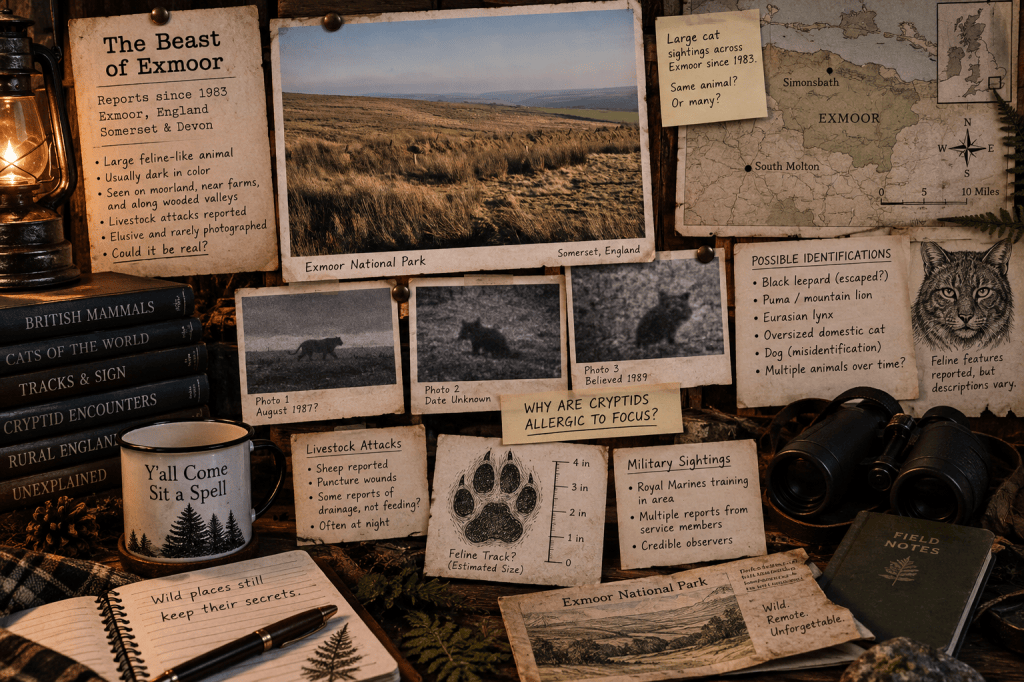
    The Beast of Exmoor is generally described as a large, dark-colored cat roaming Exmoor and the surrounding countryside of Devon and Somerset in southwest England.

    Most witnesses describe something black or very dark brown.

    Low to the ground.

    Muscular.

    Long-bodied.

    With a long tail.

    Estimates of its size vary considerably, which should surprise absolutely no one after eight days of this.

    Some witnesses describe an animal comparable to a large dog.

    Others describe something much bigger.

    The usual suspect is a melanistic leopard, commonly called a black panther.

    Quick zoological housekeeping:

    A black panther is not its own species.

    The term is generally used for a melanistic leopard or jaguar, meaning an animal whose genetics produce unusually dark pigmentation.

    Under the right light, a black leopard’s familiar spots can still be visible beneath the dark coat.

    So the animal people are describing is not biologically impossible.

    Leopards exist.

    Black leopards exist.

    What Britain does not have is a recognized native population of them.

    Which leaves us with a rather more interesting question than usual.

    Something Was Killing Sheep

    Stories of unusual large cats in southwest England existed before the 1980s, but the Beast of Exmoor became nationally famous after a series of livestock deaths in 1983.

    Sheep were being killed around Exmoor.

    A lot of sheep.

    Reports described carcasses with injuries that some people believed were inconsistent with attacks by ordinary dogs or native wildlife.

    Farmers were understandably unhappy.

    The story grew.

    Newspapers got involved.

    And eventually the British government took the reports seriously enough that Royal Marines were reportedly sent into the area to look for the animal.

    They didn’t find one.

    Which, to be fair, is an extremely cat outcome.

    Where Would a Leopard Come From?

    This part is surprisingly plausible.

    Britain has a history of people privately keeping exotic animals.

    Lions.

    Pumas.

    Leopards.

    Other animals that most of us would regard as a rather ambitious household commitment.

    Then came the Dangerous Wild Animals Act of 1976, which introduced licensing requirements for people keeping certain exotic species.

    One long-standing theory suggests that some owners, faced with the cost and regulation involved in legally keeping their animals, simply released them.

    That would be spectacularly irresponsible.

    It would also provide a straightforward explanation for at least some reports of large non-native cats appearing in the British countryside during the following decades.

    Escapes are another possibility.

    So unlike our usual cryptid problem, we aren’t asking whether an unknown species somehow evolved unnoticed in England.

    We’re asking whether known animals might have ended up somewhere they aren’t supposed to be.

    That requires considerably less biological gymnastics.

    And Britain Has Produced Actual Big Cats

    This is where things get awkward for anyone who wants to dismiss every British big-cat report as nonsense.

    Individual exotic cats have unquestionably turned up loose in Britain.

    There have been captures and carcasses involving non-native cats over the years.

    That does not establish that every reported black panther exists.

    It does establish something much narrower and much more useful:

    Large non-native cats have been loose in Britain before.

    And recently, the evidence became considerably more interesting.

    We Have DNA

    In 2022, black hairs were collected from barbed wire near the site of a sheep kill in Gloucestershire.

    Laboratory analysis reportedly produced a 99.9 percent mitochondrial DNA match to leopard.

    Then another sample appeared.

    In 2023, material was collected from a sheep carcass in Cumbria.

    Professor Robin Allaby at the University of Warwick later analyzed a swab from the carcass and identified DNA from the genus Panthera, most likely leopard.

    That result was reported publicly in 2024.

    Allaby had previously remained open-minded about Britain’s alleged big cats.

    The result was strong enough that he said it changed his mind about whether non-native big cats were present in the British countryside.

    Now.

    Everybody remain seated.

    This does not prove the Beast of Exmoor.

    Gloucestershire is not Exmoor.

    Cumbria is definitely not Exmoor.

    It doesn’t tell us how many animals there are.

    It doesn’t establish a breeding population.

    It doesn’t prove that every farmer, hiker, driver, dog walker, or mildly startled pub patron who has reported a giant black cat actually saw a leopard.

    But it does make one sentence considerably harder to say with confidence:

    “There are no big cats roaming wild in Britain.”

    Apparently there may very well be.

    What Evidence Do We Actually Have for the Beast?

    This is where we need to separate British big cats from the Beast of Exmoor.

    For the Beast itself, we have decades of eyewitness reports.

    Livestock deaths.

    Tracks and prints of disputed origin.

    Photographs and videos of varying quality.

    And descriptions from people who insist that what they saw was far too large to be a domestic cat.

    What we do not have is a verified Exmoor leopard.

    No captured animal.

    No carcass.

    No clear photograph universally accepted as showing a large exotic cat on Exmoor.

    No DNA sample that establishes a leopard specifically living there.

    And scale is an enormous problem with photographs.

    Put a black domestic cat in a field with no useful reference point and congratulations:

    You have invented a panther.

    Our brains are not particularly good at estimating the size of unfamiliar objects at a distance without something nearby for comparison.

    Some alleged big-cat photographs undoubtedly show ordinary cats.

    Others are harder to dismiss.

    But “harder to dismiss” and “identified as a leopard” remain two different things.

    Could a Leopard Live There?

    Yes.

    That’s another problem for the skeptics.

    Leopards are extraordinarily adaptable animals.

    Across their natural range they occupy forests, mountains, grasslands, scrub, and landscapes surprisingly close to human settlement.

    They are secretive.

    Mostly solitary.

    Often active at night.

    They can travel significant distances.

    They hunt deer-sized prey.

    Britain has plenty of deer.

    And a large cat attempting to avoid humans is much easier to hide than, say, an eight-foot ape wandering around Washington State with an entire extended family.

    But one leopard surviving quietly in the countryside is one thing.

    A self-sustaining population is another.

    Breeding animals require multiple individuals.

    Multiple large predators require prey and territory.

    Over generations, animals die.

    Bodies remain.

    Animals cross roads.

    They leave scat.

    Hair.

    Tracks.

    DNA.

    At some point, a population should become considerably harder to hide.

    That’s why the evidence for individual escaped or released cats is much easier to accept than the claim that Britain contains an established hidden population of black leopards.

    The Grove Take

    This may be the first creature this month where my answer is:

    Yeah. Maybe.

    Not necessarily the Beast of Exmoor.

    I don’t think one immortal black panther has been wandering around Devon since 1983, periodically stopping to scare farmers before disappearing dramatically into the mist.

    Because, among other things:

    Cat.

    He has other shit to do.

    But do I think it’s possible that people in Britain have genuinely seen large exotic cats roaming free?

    Absolutely.

    At this point, we have evidence that makes dismissing every sighting out of hand seem unreasonable.

    And I love that.

    Because sometimes the monster in the field doesn’t require an unknown species.

    Sometimes the strange thing really is exactly what the witness thought it was.

    A cat.

    Just a considerably larger cat than anybody expected to find there.

    And naturally, being a cat, it has declined to participate further in the investigation.

    No press conference.

    No scheduled appearances.

    No cooperation with photographers.

    No respect whatsoever for our need for conclusive evidence.

    Just:

    You saw me.

    Prove it.

    Honestly, that’s the most convincing evidence of feline involvement we’ve encountered yet.

    Porch Ruling

    Should the Cat Distribution System deem us worthy, the Beast of Exmoor is welcome.

    We’ll provide fresh water, a comfortable chair, and a perfectly lovely bed, all of which will be ignored.

    There is currently a puddle of sunshine warming three boards at the far end of the Porch.

    That belongs to him now.

    We didn’t give it to him.

    That’s not how cats work.

    And should a mysterious enormous black cat appear one afternoon, stretch luxuriously in that sunshine, refuse to explain where he came from, and behave as though he has always lived here?

    Well.

    The system has spoken.