
Yesterday we investigated what may be an unidentified long-legged humanoid, an elaborate hoax, a camera artifact, or bug legs.
We ruled Haunted Pants.
Today we’re going considerably deeper into the forest.
Deep into the Amazon, in fact, where stories have circulated for generations about something large, hairy, extraordinarily difficult to kill, and possessed of one characteristic nearly everyone seems to agree upon:
It smells terrible.
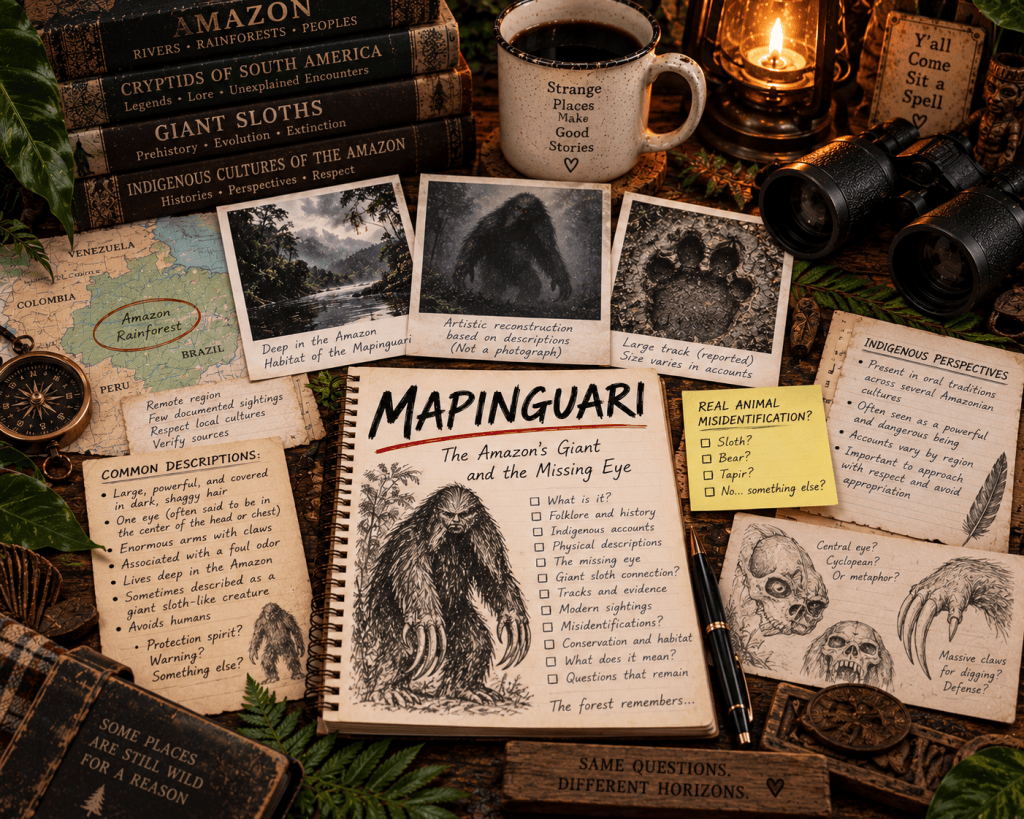
Meet the Mapinguari.
The Creature
There is no single description of the Mapinguari.
That is important.
Stories come from different communities across a very large region, have been told and retold over generations, and don’t necessarily describe exactly the same being.
But certain characteristics appear repeatedly.
Something large.
Hairy.
Powerful.
Often capable of standing or walking upright.
Long claws.
An extraordinarily foul smell.
Some accounts describe a hide so tough that bullets or arrows cannot penetrate it.
Then things get considerably stranger.
In some traditions the Mapinguari has one eye.
In others, backward-facing feet.
And perhaps most memorably, some versions give it an enormous second mouth in its abdomen.
Which is admittedly difficult to reconcile with any known mammal.
But before we decide we’ve wandered completely out of zoology and into mythology, there’s another version of the Mapinguari we need to meet.
Because some people who say they’ve encountered one describe something considerably more animal-like.
And one scientist thought those descriptions sounded familiar.
The Scientist Who Went Looking
David Oren was an ornithologist and zoologist associated with Brazil’s Museu Paraense Emílio Goeldi.
When he first heard stories of the Mapinguari during his work in the Amazon, he regarded them as folklore.
Then he began hearing firsthand accounts.
Hunters, rubber tappers, miners, and Indigenous people described encounters with large animals that Oren thought sounded remarkably similar to something science knew very well.
Just not something science believed was still alive.
A ground sloth.
In 1993, Oren published a scientific paper proposing that at least some Mapinguari reports might represent either relatively recent encounters with ground sloths or, much more controversially, encounters with a surviving population.
And yes.
Giant ground sloths were absolutely real.
There Really Were Giants in These Woods
South America was once home to multiple species of ground sloth.
Some were enormous.
These weren’t the small, slow-moving tree sloths we know today. Ground sloths lived on the ground, possessed formidable claws, and some species could rise onto their hind limbs.
Some also had small bony structures called osteoderms embedded in their skin.
Which suddenly makes a few pieces of Mapinguari lore interesting.
Large and hairy?
Check.
Long claws?
Check.
Capable of standing upright?
Check.
Hide unusually difficult to penetrate?
Well.
Now we at least have something worth talking about.
Oren thought the similarities were strong enough to investigate.
So he did.
People Said They Had Seen It
Oren traveled through areas where Mapinguari encounters were reported and interviewed people who claimed to have seen the creature.
Some said they had seen one at close range.
Several told him they had killed one.
Accounts described an animal around six feet tall when upright, heavily built, covered in coarse hair, armed with powerful claws, and producing an overwhelming odor.
There were reports of tracks.
Damaged vegetation.
Hair.
Feces.
And stories from people accustomed to spending their lives in the forest who insisted that whatever they encountered was not an animal they recognized.
That’s considerably more interesting than somebody’s cousin seeing something cross the interstate at two in the morning.
But eyewitness testimony still isn’t a specimen.
And eventually, science needs the animal.
What Evidence Do We Actually Have?
This is where our surviving-ground-sloth story runs into trouble.
No verified Mapinguari body has been recovered.
No skeleton.
No bone from a recently living unknown ground sloth.
No photograph clearly establishing such an animal.
No verified tissue.
No DNA.
Oren and others collected material thought potentially to have come from the creature.
At least one fecal sample was eventually identified through DNA analysis.
It belonged to a known animal.
An anteater.
Other physical samples associated with alleged Mapinguari encounters have likewise failed to establish the existence of an unknown species.
And the fossil record presents an enormous problem for the living-ground-sloth hypothesis.
Ground sloths disappeared from mainland South America thousands of years ago.
Keeping a breeding population of very large mammals hidden for all that time without leaving behind a recent bone, carcass, tooth, or verified biological sample would be quite an achievement.
The Amazon is enormous.
It is difficult to explore.
It unquestionably still contains species science hasn’t described.
But an undiscovered frog and an undiscovered six-foot terrestrial mammal present rather different logistical problems.
But What About the Stories?
This is where I want to be particularly careful.
The Mapinguari does not need to turn out to be a surviving prehistoric animal for the stories to matter.
And the different Indigenous traditions involving Mapinguari-like beings should not be treated as nothing more than primitive eyewitness reports waiting for Western science to identify the animal correctly.
Among the Karitiana people of Rondônia, for example, beings associated with what Portuguese speakers call the Mapinguari have their own names, stories, and place within the way people understand and move through the forest.
In many tellings across the Amazon, the Mapinguari also functions as a protector of the forest.
It punishes people who hunt excessively.
It keeps humans from taking more than they should.
It inhabits places where people are supposed to remember that the forest does not belong entirely to them.
Whether there is an animal behind some of the encounters is a different question.
And keeping those questions separate matters.
Could the Stories Remember a Real Animal?
Now this is where I get interested.
We know human beings and giant ground sloths overlapped in South America.
That isn’t cryptozoology.
That’s paleontology.
Could memories of encounters with those animals have survived through oral traditions long after the animals themselves disappeared?
Possibly.
Could characteristics of real animals have become mixed over generations with spiritual beliefs, other forest creatures, warnings, storytelling, and cultural meaning?
Absolutely.
Can we demonstrate that this is what happened with the Mapinguari?
No.
And that’s an important no.
A compelling hypothesis is still a hypothesis.
There is a substantial difference between:
“This story contains characteristics reminiscent of an extinct animal.”
and
“This story proves people preserved an accurate zoological description for thousands of years.”
The first is fascinating.
The second requires evidence we don’t currently have.
The Grove Take
I don’t think there’s a giant ground sloth wandering around the Amazon today.
I’d love to be wrong.
Because unlike Haunted Pants, we don’t have to imagine what a ground sloth would have looked like.
They were here.
Actual enormous mammals with ridiculous claws once walked through South America while humans were walking through South America too.
That alone is extraordinary.
Maybe the Mapinguari carries a little memory of them.
Maybe it doesn’t.
Maybe people encountered known animals under unusual circumstances and stories grew around those encounters.
Maybe several completely different traditions eventually got gathered under one convenient name.
Or maybe something very large is still standing behind a tree somewhere in several million square miles of rainforest thinking:
These people have been looking for me for HOW long?
I don’t think so.
But this is only Day Four.
I’m still allowed to hope occasionally.
Porch Ruling
The Mapinguari is welcome at the Grove.
But we’re going to need some ground rules.
First, no abdominal mouths at the dinner table.
Second, we’re going to respect the forest, so there should be no need for the whole avenging-guardian situation.
And finally, if the smell is even half as bad as reported:
You can absolutely have a seat, sweetheart.
It’s just going to be the one downwind.


Leave a comment